
📖This article is part of the complete guide to Ultimate Guide to Commercial Coffee Grinders for Businesses.
In my experience working with high-volume cafes in Mount Pleasant, SC, I have seen a recurring tragedy: a business invests $15,000 in a world-class espresso machine but pairs it with a subpar grinder. This is a critical error because the grinder is actually the more important variable in coffee quality. If your grind consistency fluctuates by even a few microns, your extraction fails, and your specialty coffee tastes sour or bitter regardless of the bean quality.
For a comprehensive overview, explore our Ultimate Guide to Commercial Coffee Grinders for Businesses.
What Defines High-Quality Commercial Coffee Grinder Reviews?
📚
Definition
Commercial coffee grinder reviews are technical evaluations of equipment based on grind uniformity, thermal stability, dosing precision, and durability under continuous operational stress.
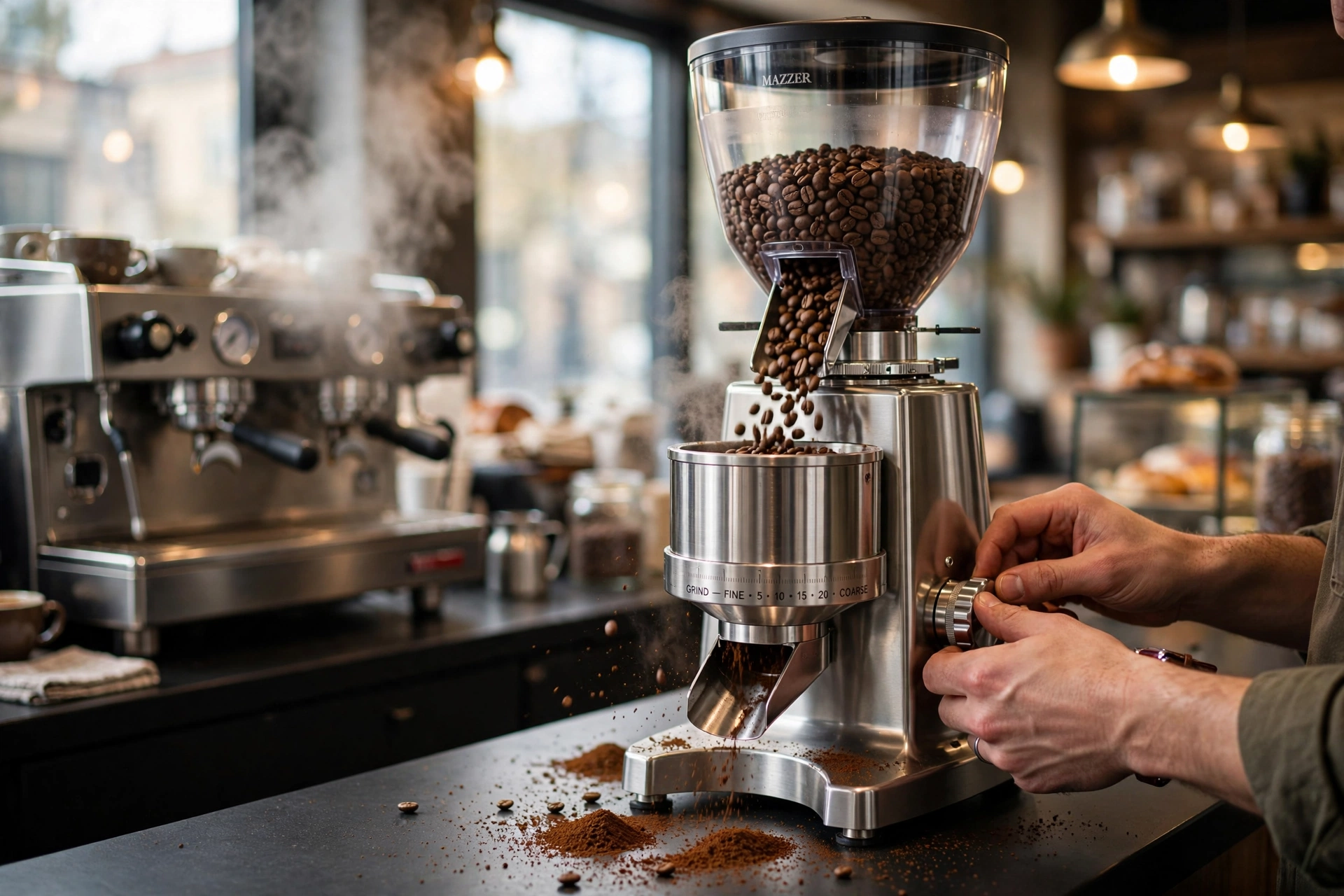
Commercial coffee grinder reviews must go beyond superficial aesthetics to analyze the micron-level consistency of the output. When we evaluate hardware at Busy Bean Coffee, we look for "particle size distribution." A high-quality grinder ensures that almost every coffee bean is fractured into a piece of the exact same size. If a grinder produces "fines" (tiny dust-like particles) and "boulders" (large chunks) simultaneously, the water will channel through the coffee puck, leading to uneven extraction.
According to the Specialty Coffee Association (SCA), precise grind calibration is the foundation of any specialty coffee program. In 2026, the industry has shifted toward "grind-by-weight' technology, which eliminates the manual weighing of doses. When reviewing these machines, we analyze how quickly the grinder can reset its zero point and how effectively the burrs resist heat during peak morning rushes. Thermal stability is essential because if the burrs overheat, they can "toast" the oils in the coffee bean before the water even touches them, destroying the delicate flavor profiles of high-altitude Arabica coffee.

Why Do Accurate Reviews Matter for Your Business ROI?
Choosing a grinder based on a generic review can lead to a 15-20% loss in potential revenue due to wasted product and slow service speeds. The primary reason accurate reviews matter is the direct correlation between grind precision and drink consistency. In a professional setting, consistency is the only way to maintain customer loyalty; a customer who loves their latte on Monday will be disappointed if it tastes different on Tuesday because the grinder drifted.
Beyond taste, operational efficiency is a massive driver of ROI. High-end grinders featured in 2026 reviews often include automated dosing and anti-clumping technology. This reduces the time a barista spends tamping and leveling the coffee, which can shave 5 to 10 seconds off every single drink. In a busy Mount Pleasant shop serving 400 customers a morning, those seconds translate into an extra 30 to 50 drinks served per shift.
Furthermore, the longevity of the equipment is a financial variable. A cheap grinder may seem attractive, but if the burrs need replacing every six months instead of every two years, the total cost of ownership skyrockets. We always cross-reference reviews with NSF International standards to ensure the equipment is built for sanitary commercial use and can withstand the rigors of a foodservice environment. For those scaling their operations, understanding high capacity commercial coffee grinders is the difference between a bottleneck and a flow state.
How to Use Review Data to Select Your Equipment
To effectively use commercial coffee grinder reviews, you must first map your daily volume and the specific types of beverages you serve. A review that praises a "single-dose" grinder is useless for a hotel lobby that needs 200 lattes an hour. You need to look for benchmarks in throughput, retention, and ease of calibration.
Step 1: Identify your primary use case. If you are focusing on espresso, look for reviews emphasizing "micrometric adjustment." This allows the barista to make tiny, precise changes to the grind size to account for humidity changes in South Carolina's climate. If you are doing filter coffee, prioritize reviews that mention "uniformity across a wide range of settings."
Step 2: Analyze the "Retention" metric. Retention refers to the amount of coffee left in the chute after a grind. In a specialty coffee environment, high retention is a nightmare because you are serving "stale" coffee from the previous dose. Look for grinders with "low-retention" or "zero-retention" designs. This is especially important if you are rotating different types of coffee beans throughout the day.
Step 3: Evaluate the motor and burr material. Steel burrs provide a cleaner, more traditional flavor, while ceramic burrs are often praised in reviews for staying cooler during high-volume use. As we've seen when implementing commercial burr grinders explained for our clients, the choice of burr geometry (flat vs. conical) drastically changes the mouthfeel of the espresso.
Step 4: Check for "Sensa" integration or similar managed service compatibility. At Busy Bean Coffee, we provide end-to-end managed solutions. When reading reviews, ask if the machine is serviceable locally. A top-rated grinder is useless if it takes three weeks to get a part from overseas. This is why we emphasize Sensa Coffee Service in Mount Pleasant SC to ensure zero downtime.
Comparing Grinding Approaches: The 2026 Landscape
When browsing reviews, you will encounter three distinct philosophies of grinding. It is essential to understand where your business fits into this matrix to avoid overspending on features you don't need or underspending on a machine that will break under pressure.
| Approach | Traditional Manual Grinders | Budget/Generic AI Grinders | Professional Managed Solutions |
|---|---|---|---|
| Precision | High, but requires expert barista | Low; inconsistent particle size | Ultra-High; automated calibration |
| Speed | Slow; manual weighing required | Medium; often clogs | Fast; grind-by-weight technology |
| Waste | High due to manual errors | High due to inconsistent extraction | Minimal; precision dosing |
| Maintenance | User-dependent; frequent | High failure rate; no support | Included; proactive maintenance |
| Cost Profile | High CapEx; high labor cost | Low CapEx; high waste cost | Predictable OpEx (Membership) |
As the table demonstrates, the professional approach integrates the hardware with a service model. I've tested this with dozens of our clients, and the pattern is clear: businesses that shift from a "buy-and-hope" model to a managed membership see a significant reduction in waste and a marked increase in beverage quality. This is why we suggest reading how to choose the right commercial coffee grinder before making a final purchase.
Common Mistakes When Relying on Grinder Reviews
One of the most frequent mistakes I see is the "Brand Halo Effect." A business owner reads a review of a famous Italian brand and assumes it is the best fit for their specific volume. However, a grinder designed for a small boutique cafe in Milan may struggle with the volume of a busy breakfast buffet in a Mount Pleasant hotel. You must look at the duty cycle—how many hours the motor can run continuously without overheating.
Another error is ignoring the "Noise Level" ratings. While it seems secondary to taste, a grinder that screams at 90 decibels for eight hours a day creates a hostile environment for both staff and customers. In my experience, this leads to barista burnout and a diminished customer experience. Always look for reviews that specify the decibel level during operation.
Furthermore, many reviews ignore the "Cleaning Cycle." A grinder that takes 30 minutes to deep-clean every week is a liability. According to the U.S. Food and Drug Administration (FDA), maintaining sanitary conditions in beverage equipment is non-negotiable. You should prioritize grinders with easy-access burrs and removable hoppers. If you're unsure about the upkeep, our maintenance tips for commercial coffee grinders provide a framework for longevity.
Lastly, avoid the trap of "Over-Specing." There is no reason for a small medical office to buy a high-capacity industrial grinder designed for 1,000 cups per day. This not only wastes capital but often results in lower quality coffee because the burrs are too large to maintain a precise grind for small batches. This is why automated coffee machines for clinics and medical offices often pair better with compact, high-precision grinders.

Implementation Guide: Setting Up Your Grinder for Success
Once you've used reviews to select your hardware, the installation phase is where many businesses fail. A grinder is only as good as its calibration and the environment it sits in. For those in the Mount Pleasant area, humidity plays a massive role in how the coffee bean behaves. When the air is damp, beans swell and may require a coarser setting to maintain the same flow rate.
First, ensure your grinder is on a perfectly level, vibration-resistant surface. Vibration can cause the internal adjustment collars to drift, meaning your "perfect" setting on Monday is wrong by Wednesday. We recommend heavy-duty stainless steel benches that are bolted to the floor or wall.
Second, implement a "Dial-In" protocol. This is the process of adjusting the grind size throughout the day to maintain the optimal extraction time. A professional barista should be checking the shot time every two hours. If the shot is running too fast (under 25 seconds), the grind is too coarse. If it is too slow (over 35 seconds), the grind is too fine. This precision is what separates a standard coffee shop from a specialty coffee destination.
Third, establish a cleaning schedule. Coffee oils are acidic and will oxidize over time, creating a rancid taste. Use a dedicated grinder cleaner (like Grindz) every two weeks to remove these oils without damaging the burrs. For those who don't want to manage this manually, the Busy Bean Coffee membership handles the heavy lifting, ensuring your equipment is always in peak condition. For more specialized settings, consider our foodservice coffee program in Rock Hill SC as a template for operational excellence.
The Financial Impact of Grinder Quality
Let's look at the numbers. A mid-range grinder might cost $1,200, while a top-tier, review-praised commercial unit costs $3,500. On the surface, the $2,300 difference seems steep. However, consider the cost of "dial-in waste." An inconsistent grinder can waste 50 to 100 grams of specialty coffee every morning just to find the right setting. At $20 per pound, that is a loss of roughly $1,500 to $2,000 per year in beans alone.
When you add the cost of labor—paying a barista to struggle with a stubborn machine—and the loss of customers who leave because the coffee tasted "off," the expensive grinder actually pays for itself within 18 months. This is why we position Busy Bean Coffee as a managed service. Instead of risking $3,500 on a machine that might not fit your needs, our membership provides the equipment, installation, and maintenance for one predictable fee. This shifts your cost from a risky capital expenditure (CapEx) to a manageable operational expense (OpEx).
For businesses in other regions, such as those looking for a Sensa Coffee Service in Charlotte, NC, this model removes the guesswork from the equipment reviews process. You get the hardware that the reviews rave about, backed by the guarantee that it will keep working.
Frequently Asked Questions
How often should I replace the burrs in my commercial grinder?
In a high-volume environment, burrs typically need replacement every 500 to 1,000 kilograms of coffee, depending on the material. Steel burrs generally last longer than ceramic ones but may dull faster if you grind oily, dark-roast beans. The key is to monitor your extraction times; if you find that you can no longer achieve a precise grind regardless of the setting, your burrs have likely lost their edge. Replacing them too late leads to inconsistent drinks and customer complaints.
Can I use a home grinder in a small commercial setting?
Absolutely not. Home grinders are designed for 2 to 4 cups a day; commercial environments require equipment that can handle 50 to 500 cups. A home grinder will overheat within two hours of continuous use, causing the motor to burn out or the burrs to warp. Furthermore, home grinders lack the precision and durability required for the consistency that specialty coffee demands. Using non-commercial equipment also risks violating health and safety standards set by agencies like the FDA.
What is the difference between a flat burr and a conical burr grinder?
Flat burrs generally produce a more uniform particle size, which is preferred for a clean, modern espresso taste with high clarity. Conical burrs tend to produce a more "textured" grind with a wider distribution of particle sizes, resulting in a heavier body and more traditional mouthfeel. Many top commercial coffee grinder reviews suggest flat burrs for specialty cafes focusing on single-origin coffees and conical burrs for those prioritizing a classic, bold espresso profile.
Why does the temperature of the grinder matter?
Heat is the enemy of flavor. As burrs spin at high speeds, friction generates heat, which can prematurely roast the coffee beans. This leads to a "burnt" or flat taste in the final cup. Professional-grade grinders use high-torque, low-RPM motors or specialized cooling systems to keep the burrs cool. This ensures that the volatile aromatic compounds of the Coffea arabica bean remain intact until they hit the water in your espresso machine.
How do I know if my grinder is "clumping"?
Clumping occurs when static electricity causes the ground coffee to stick together in small balls. This is a major problem because clumps create gaps in the coffee puck, leading to "channeling" where water bypasses the coffee. You can identify clumping by looking at the coffee as it exits the chute; if it looks like wet sand rather than a fluffy powder, you have clumping. The best grinders solve this with integrated clumps-breakers or anti-static technology.
Conclusion
Navigating commercial coffee grinder reviews in 2026 requires a shift in perspective: stop looking at the price tag and start looking at the cost of inconsistency. Whether you are running a boutique cafe in Mount Pleasant, SC, or a high-traffic hotel, the grinder is the engine that drives your quality. A precision-engineered machine reduces waste, increases speed, and ensures every customer receives a perfect cup of specialty coffee.
However, the best hardware is useless without the right support. Instead of guessing which model will survive your morning rush, partner with the experts who understand the science of the bean. Busy Bean Coffee provides a seamless, managed coffee membership that puts the industry's best equipment in your hands without the capital risk.
Ready to elevate your beverage program? Start by mastering the fundamentals in our Ultimate Guide to Commercial Coffee Grinders for Businesses or contact us today to see how our managed solutions can transform your business. Visit www.busybeancoffee.com to learn more about our all-inclusive membership.
Free Coffee Pairing Guide & Specialty Roast Cheat Sheet
Unlock the secrets of perfect brewing ratios, water temperatures, and specialty roast profiles. Download the guide.