
📖This article is part of the complete guide to Ultimate Guide to Commercial Coffee Grinders for Businesses.
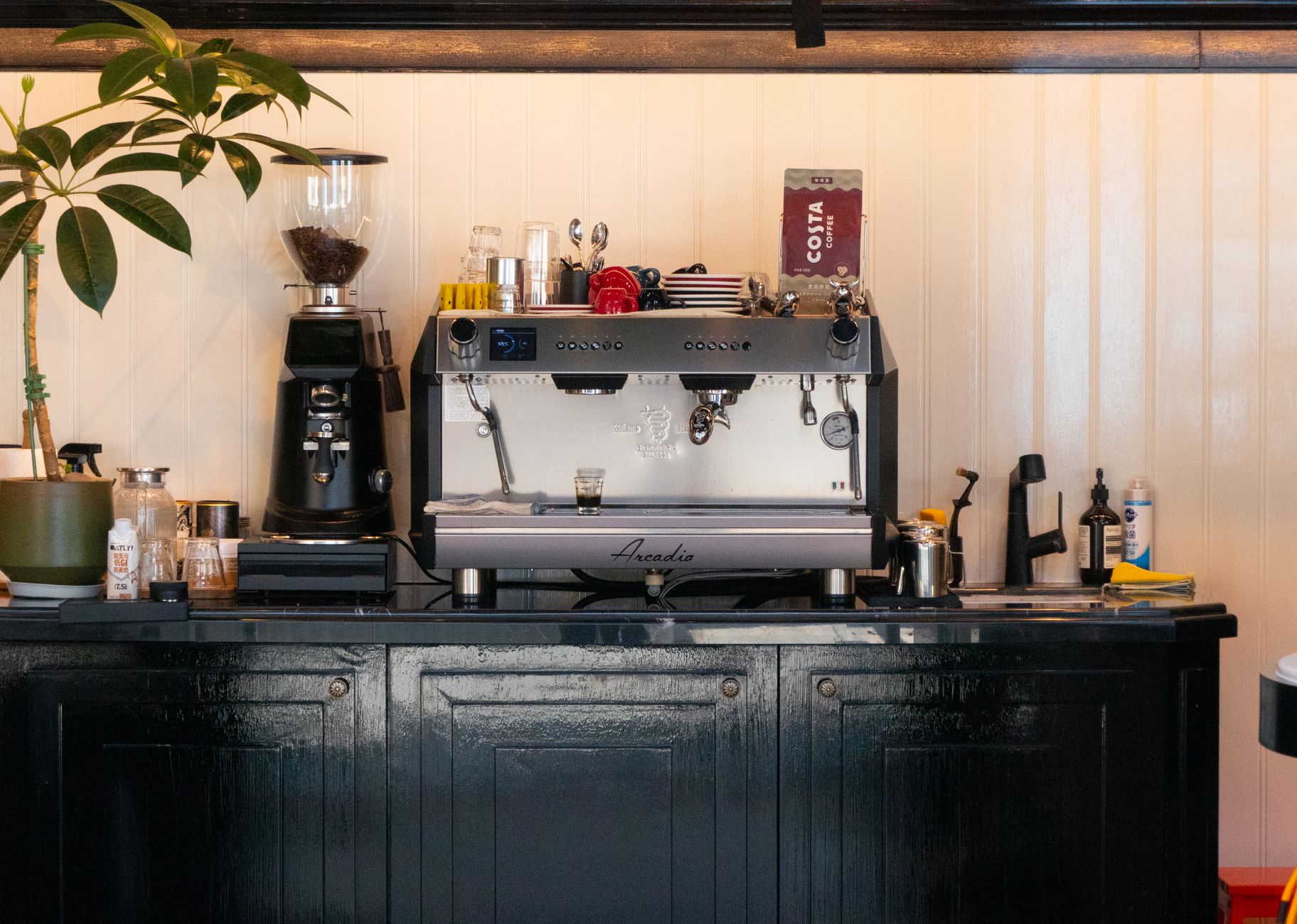
In my experience working with high-volume cafes in Mount Pleasant, SC, the most expensive espresso machine in the world is useless if paired with a subpar grinder. I have seen business owners spend $20,000 on a multi-boiler machine only to struggle with shot channeling and inconsistent tasting coffee because they chose a grinder based on price rather than particle size distribution. When the morning rush hits and your baristas are pushing 60 shots per hour, a grinder that drifts or overheats doesn't just affect the flavor; it destroys your operational efficiency.
For a comprehensive overview of the broader landscape, explore our Ultimate Guide to Commercial Coffee Grinders for Businesses.
What are Commercial Espresso Grinders?
📚
Definition
Commercial espresso grinders are heavy-duty milling machines specifically engineered to produce a fine, uniform powder that creates the necessary resistance (pressure) for water to extract flavor from espresso grounds.
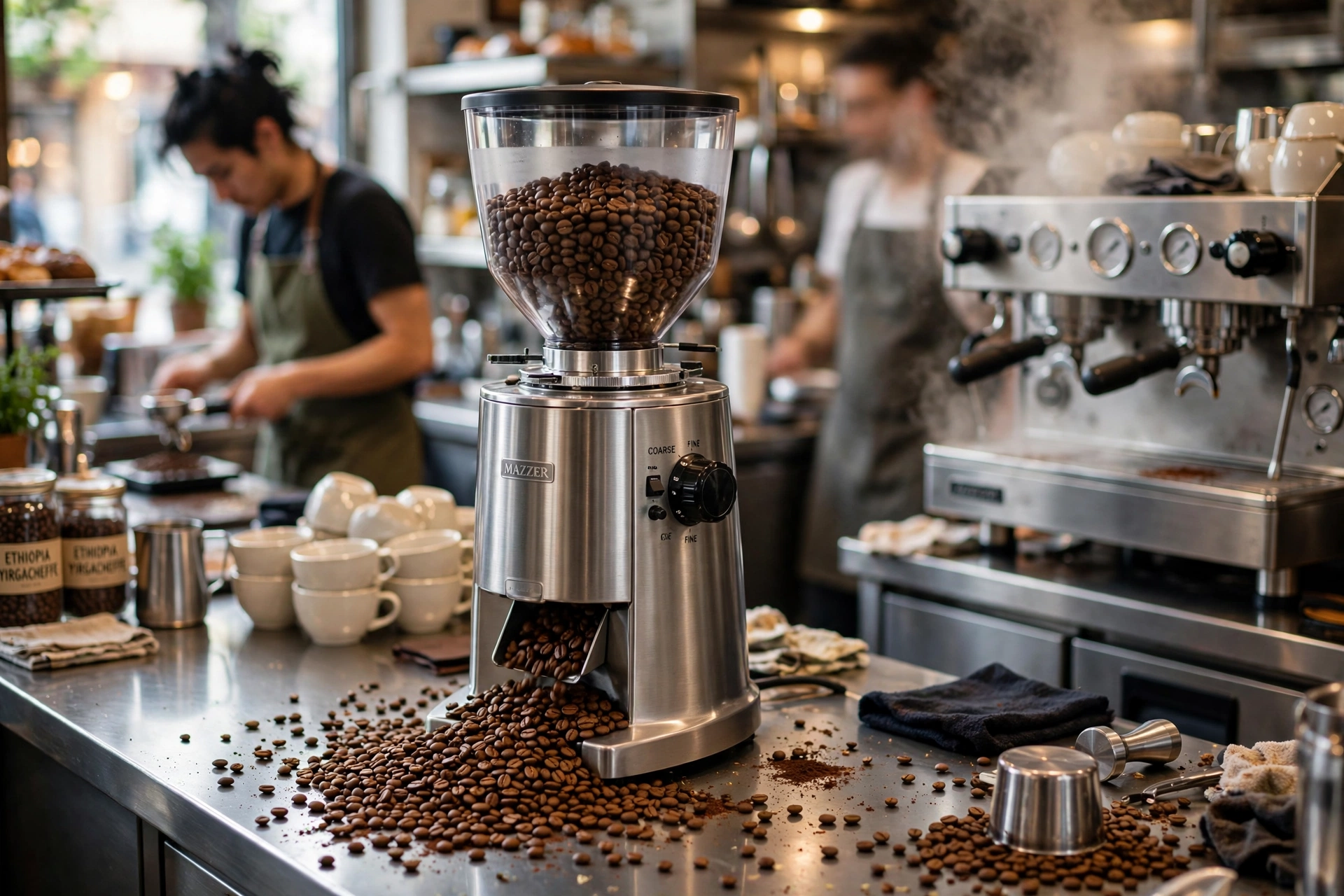
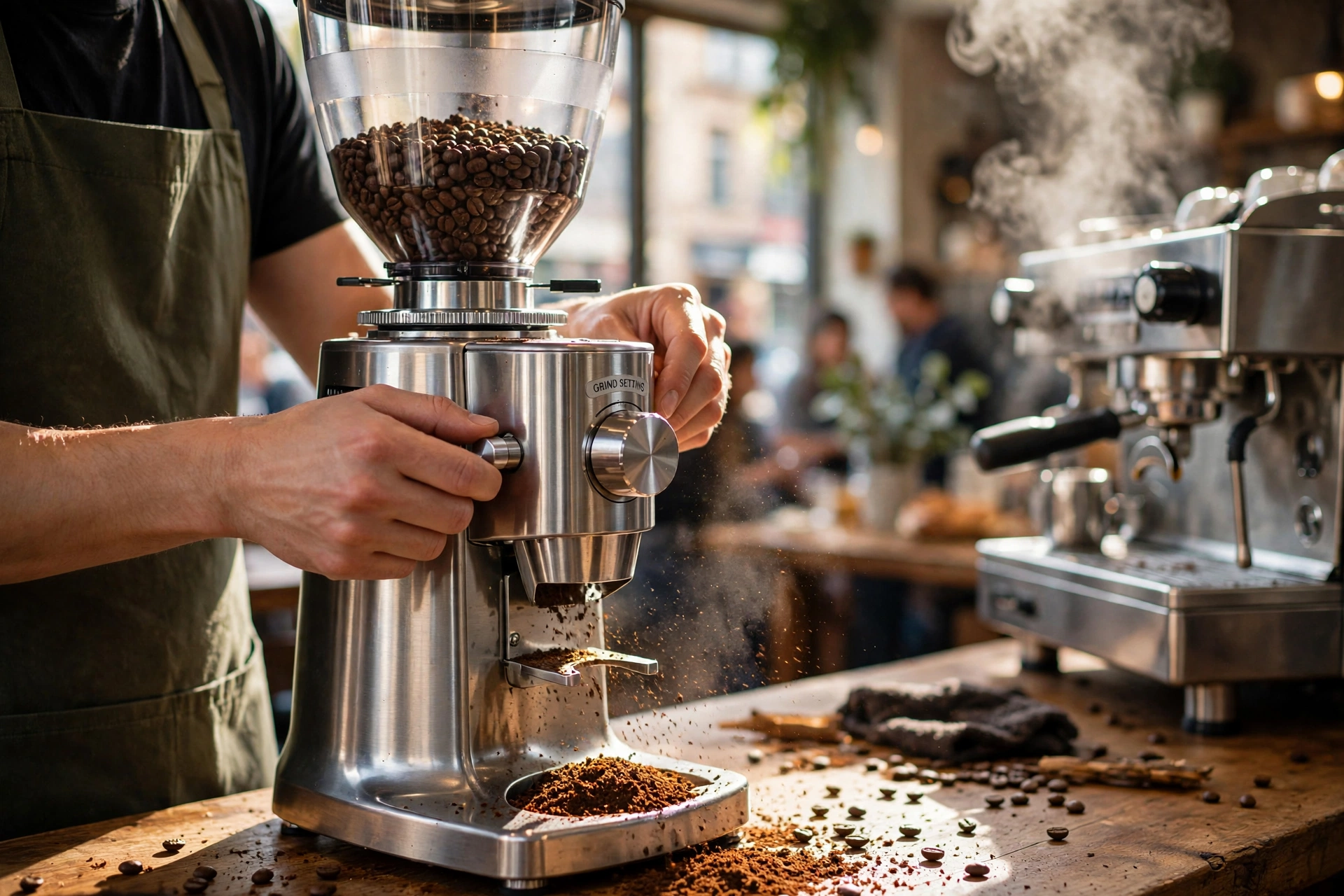
Commercial espresso grinders differ from standard coffee grinders in three primary ways: thermal stability, dosing precision, and burr durability. While a home grinder might overheat after five consecutive double shots, a commercial unit is built with high-torque motors and heat-dissipating materials to ensure that the 100th shot of the day tastes exactly like the first. To maintain this quality, these machines utilize precision-engineered burrs made of hardened steel or titanium, which are designed to withstand the friction of grinding hundreds of pounds of Coffea arabica annually without losing their edge.
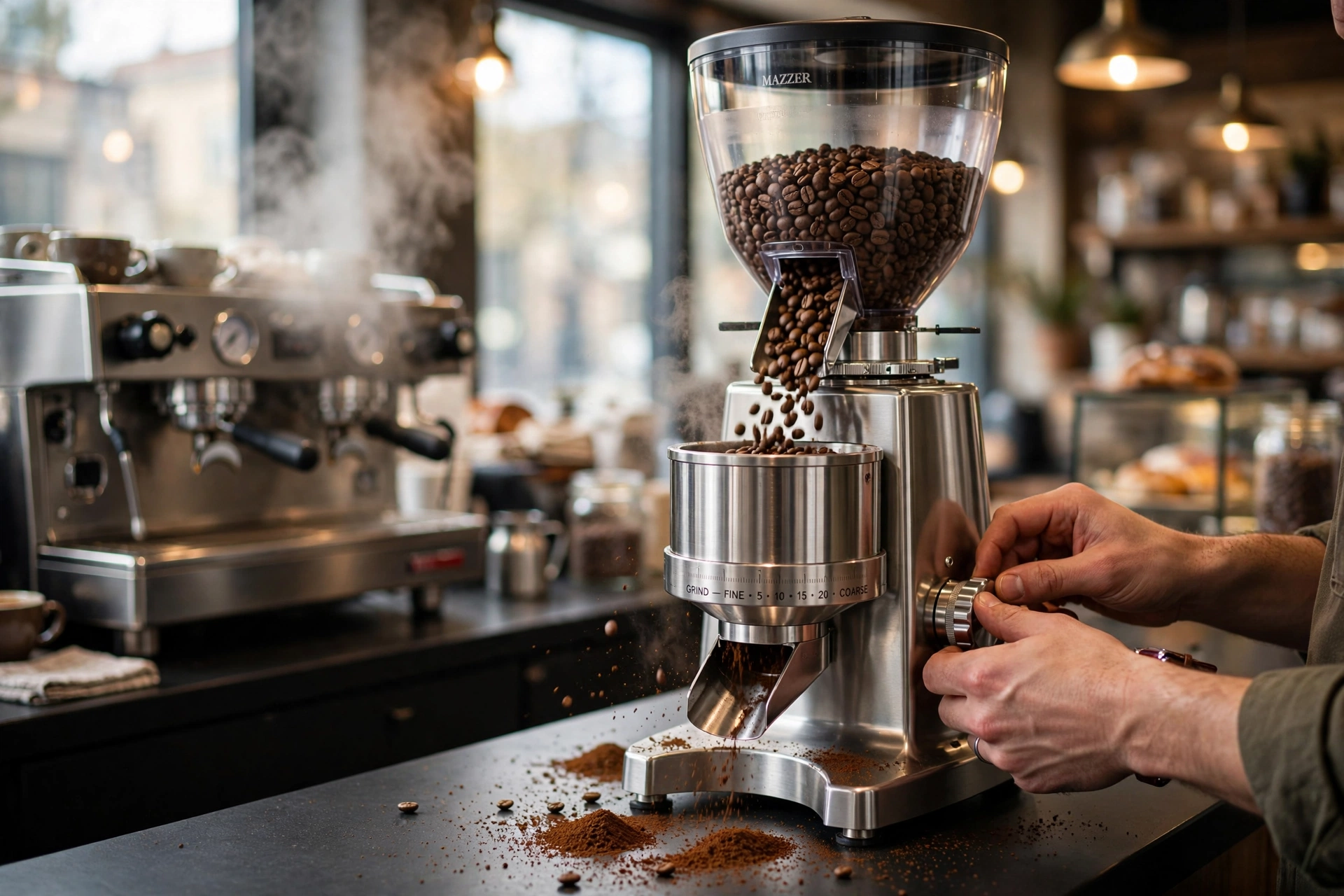
In the modern 2026 landscape, we see a shift toward "grind-by-weight" technology. Rather than relying on a timer—which can be affected by the humidity of the room or the roast level of the coffee bean—modern commercial espresso grinders use internal scales to dose to the exact tenth of a gram. This eliminates waste and ensures that every barista is delivering a consistent product. This level of precision is what separates a specialty coffee shop from a generic beverage station.

Why Does Grinder Choice Matter for Your Business ROI?
Choosing the wrong equipment leads to a phenomenon called "dialing-in drift," where the grind size shifts throughout the day. According to the Specialty Coffee Association (SCA), precise grind distribution is the single most important variable in achieving a balanced extraction. If your grinder produces too many "fines" (dust-like particles) or too many "boulders" (large chunks), you will experience either over-extraction (bitterness) or under-extraction (sourness), regardless of your bean quality.
From a financial perspective, inconsistency is a profit killer. In a high-volume environment, a barista might waste 20 to 50 grams of specialty coffee every time they attempt to "re-dial" a drifting grinder. Over a year, this wastage can cost a medium-sized cafe thousands of dollars. Furthermore, slow grinders create bottlenecks. If your grinder takes 15 seconds to dose a portafilter, and you have a line of 20 people, you are losing revenue every second. This is why we often recommend integrating these solutions into a broader Sensa Coffee Service in Mount Pleasant SC: Complete Guide to ensure maintenance is handled proactively.
Beyond waste, there is the issue of sanitation and compliance. Commercial units must meet strict safety standards. For instance, the NSF International provides certifications (such as NSF/ANSI 4) ensuring that equipment is constructed from non-toxic, easy-to-clean materials. Using a non-certified or residential grinder in a commercial kitchen in 2026 can lead to health code violations and potential liability if the machine fails under industrial load.
How to Implement a High-Performance Grinding Station
Setting up a commercial grinding station requires more than just plugging in a machine. It requires a workflow analysis of your coffee service. To maximize efficiency, follow these professional steps:
-
Determine Your Peak Volume: Calculate your "shots per hour" during the morning rush. A grinder that handles 20 shots per hour is sufficient for a boutique hotel, but a busy breakfast spot needs a machine capable of 100+ without thermal drift. If you are scaling rapidly, you might look into High Capacity Commercial Coffee Grinders for Busy Kitchens.
-
Select the Burr Geometry: Choose between flat burrs for maximum flavor clarity and conical burrs for a more traditional, body-heavy espresso. Flat burrs are generally preferred in specialty coffee settings because they produce a more uniform particle size, which is essential for light-roast coffees.
-
Optimize the Workflow: Place the grinder directly adjacent to the espresso machine to minimize the distance the barista has to move. This "zero-step" movement increases speed and reduces the chance of spilling grounds.
-
Implement a Calibration Schedule: I have found that the most successful cafes calibrate their grinders three times a day: once before opening, once at 11:00 AM, and once at 3:00 PM. This accounts for the changing humidity and temperature in the shop, which affects how the coffee bean expands and contracts.
-
Integrate Managed Services: To avoid the downtime associated with burr replacement, many businesses are moving toward all-inclusive memberships. For example, Sensa Coffee Service in Charleston SC: Complete Guide | Busy Bean Coffee provides the equipment and the maintenance, so you never have to worry about a broken motor during a Saturday rush.
The Traditional vs. Modern Grinding Approach
To understand where the industry is headed in 2026, we must compare the legacy methods with the professional standards we implement at Busy Bean Coffee.
| Feature | Traditional Manual Approach | Generic/Cheap AI Approach | Modern Professional Approach |
|---|---|---|---|
| Dosing | Manual timer / Visual guestimate | Basic timer with poor sensors | Grind-by-weight precision |
| Consistency | High drift; requires constant adjustment | Unstable; prone to clumps | Zero-retention; locked-in precision |
| Heat Mgmt | Rapidly overheats in rushes | Inconsistent heat dissipation | Industrial cooling & thermal stability |
| Waste | High waste during calibration | Medium waste due to inaccuracies | Minimal waste via micro-dosing |
As the table demonstrates, the "Generic AI" approach—which often involves cheap digital timers and basic automation—fails because it doesn't account for the physical properties of the bean. The Modern Professional Approach, which we champion at Busy Bean Coffee, focuses on the physics of the grind and the ergonomics of the barista.

Common Mistakes When Choosing Commercial Espresso Grinders
One of the most frequent errors I see is the "Over-Spec Error." Business owners often buy the largest, most expensive grinder available, even if they only serve coffee as a side item. If your volume is low, a massive high-capacity grinder will actually lead to more waste because the coffee sits in the hopper for too long, losing freshness and aroma. In these cases, a smaller, on-demand grinder is far superior.
Another critical mistake is ignoring the "Retention" factor. Retention refers to the amount of coffee that stays inside the grinder after a dose is dispensed. A grinder with high retention means you are always drinking "old" coffee from the previous shot. For those pursuing a specialty coffee certification, low-retention or "zero-retention" grinders are essential. If you are unsure how to navigate these technical specifications, our guide on how to choose the right commercial coffee grinder provides a deeper dive into these metrics.
Finally, many owners neglect the importance of burr material. While stainless steel is standard, some high-volume sites opt for ceramic. However, in a commercial environment, hardened steel is typically the winner due to its longevity and consistency. I've seen shops try to save money by using replacement burrs from non-certified vendors, only to find that the lack of precision leads to uneven extractions and wasted product. This is why regular maintenance is non-negotiable; for a detailed breakdown, see our maintenance tips for commercial coffee grinders.
Frequently Asked Questions
How often should I replace the burrs in a commercial espresso grinder?
Burr replacement depends entirely on your volume and the type of beans you use. In a high-volume environment, burrs typically need replacing every 500 to 1,000 kilograms of coffee. However, the real indicator is "grind drift." If you find that you are constantly adjusting the settings to achieve the same shot, or if the coffee starts tasting "flat" despite using fresh beans, your burrs are likely dull. We recommend a professional inspection every six months to ensure you aren't sacrificing quality for cost.
What is the difference between a dosing and an on-demand grinder?
A dosing grinder grinds a large amount of coffee into a chamber, and the barista manually scoops the desired amount into the portafilter. This is faster for extremely high volumes but leads to more oxidation and waste. An on-demand grinder grinds the exact amount needed for a single shot directly into the portafilter. This is the gold standard for specialty coffee in 2026 because it preserves the volatile aromatic compounds of the coffee bean and ensures maximum freshness for every customer.
Do I need separate grinders for espresso and drip coffee?
Yes, absolutely. Espresso requires a very fine, precise grind, while drip or pour-over requires a coarser setting. While some "all-in-one" grinders exist, they often struggle with "purge" issues—where old espresso grounds remain in the chute when you switch to a coarser setting, contaminating your drip coffee. For a professional coffee service, having dedicated equipment is the only way to ensure flavor purity. For those operating in different cities, we offer tailored solutions like the Sensa Coffee Service in Raleigh NC (2026 Overview).
Why is my espresso grinder making a high-pitched screaming sound?
This is usually a sign of "stone-out" or a foreign object (like a small pebble often found in coffee shipments) getting caught in the burrs. It can also indicate that the burrs have shifted out of alignment. Immediately turn off the machine to prevent the motor from burning out. In my experience, attempting to "power through" this sound usually results in a total motor failure. Contact a professional technician or use your Sensa Coffee Service in Charlotte, NC membership for a rapid repair visit.
Which is better: Flat burrs or Conical burrs for a cafe?
Flat burrs are generally superior for cafes focusing on specialty coffee because they produce a more uniform particle size, which allows for a more complex and clear flavor profile. Conical burrs are often more forgiving and produce a more "traditional" espresso with more body and texture. If your clientele prefers bold, classic espresso, conical is fine. If you are targeting the connoisseur market and using high-end Coffea arabica, flat burrs are the industry standard.
Conclusion
Investing in a professional-grade commercial espresso grinder is not an expense; it is a strategic decision to protect your product quality and your labor efficiency. In 2026, the difference between a profitable cafe and a struggling one often comes down to the consistency of the extraction. By focusing on low retention, thermal stability, and grind-by-weight precision, you ensure that every customer receives a premium experience, regardless of how busy your shop is.
If you are overwhelmed by the technical specifications of burrs, RPMs, and dosing mechanisms, remember that you don't have to do it alone. Busy Bean Coffee specializes in removing the friction from your beverage program by providing the equipment, installation, and ongoing maintenance in one predictable package. Instead of managing five different vendors for your machines, beans, and repairs, you can streamline everything through a managed membership.
For a deeper understanding of how these machines fit into your overall business strategy, return to our Ultimate Guide to Commercial Coffee Grinders for Businesses and start building a world-class coffee program today.
Visit us at www.busybeancoffee.com to explore our managed coffee solutions.
Free Coffee Pairing Guide & Specialty Roast Cheat Sheet
Unlock the secrets of perfect brewing ratios, water temperatures, and specialty roast profiles. Download the guide.