📖This article is part of the complete guide to Ultimate Guide to Commercial Coffee Grinders for Businesses.
A single gram of coffee shifting in a dose or a microscopic change in particle size can turn a high-margin signature latte into a waste-bucket disaster. In my experience working with high-volume cafes in Mount Pleasant, SC, the most common reason for inconsistent drink quality isn't the barista's skill, but a failure to implement a rigorous commercial grinder calibration routine. When the grind is slightly too coarse, the water rushes through the puck, resulting in sour, under-extracted coffee; too fine, and the shot chokes, producing a bitter, burnt taste that alienates customers.
For a comprehensive overview of the hardware involved, explore our Ultimate Guide to Commercial Coffee Grinders for Businesses.
What is Commercial Grinder Calibration?
📚
Definition
Commercial grinder calibration, often referred to as "dialing in," is the process of adjusting the distance between the grinding burrs to achieve a specific particle size that ensures the optimal extraction of flavors from a specific coffee bean.
Commercial grinder calibration is the precise synchronization of the grinder's output with the espresso machine's flow rate. It is not a one-time setup but a continuous operational requirement. Because coffee beans are organic matter, they react to environmental changes—humidity, temperature, and the age of the roast—meaning the "perfect" setting on Monday morning will likely be incorrect by Tuesday afternoon. The goal is to reach the "sweet spot" where the acidity, sweetness, and bitterness of the Coffea arabica are perfectly balanced.
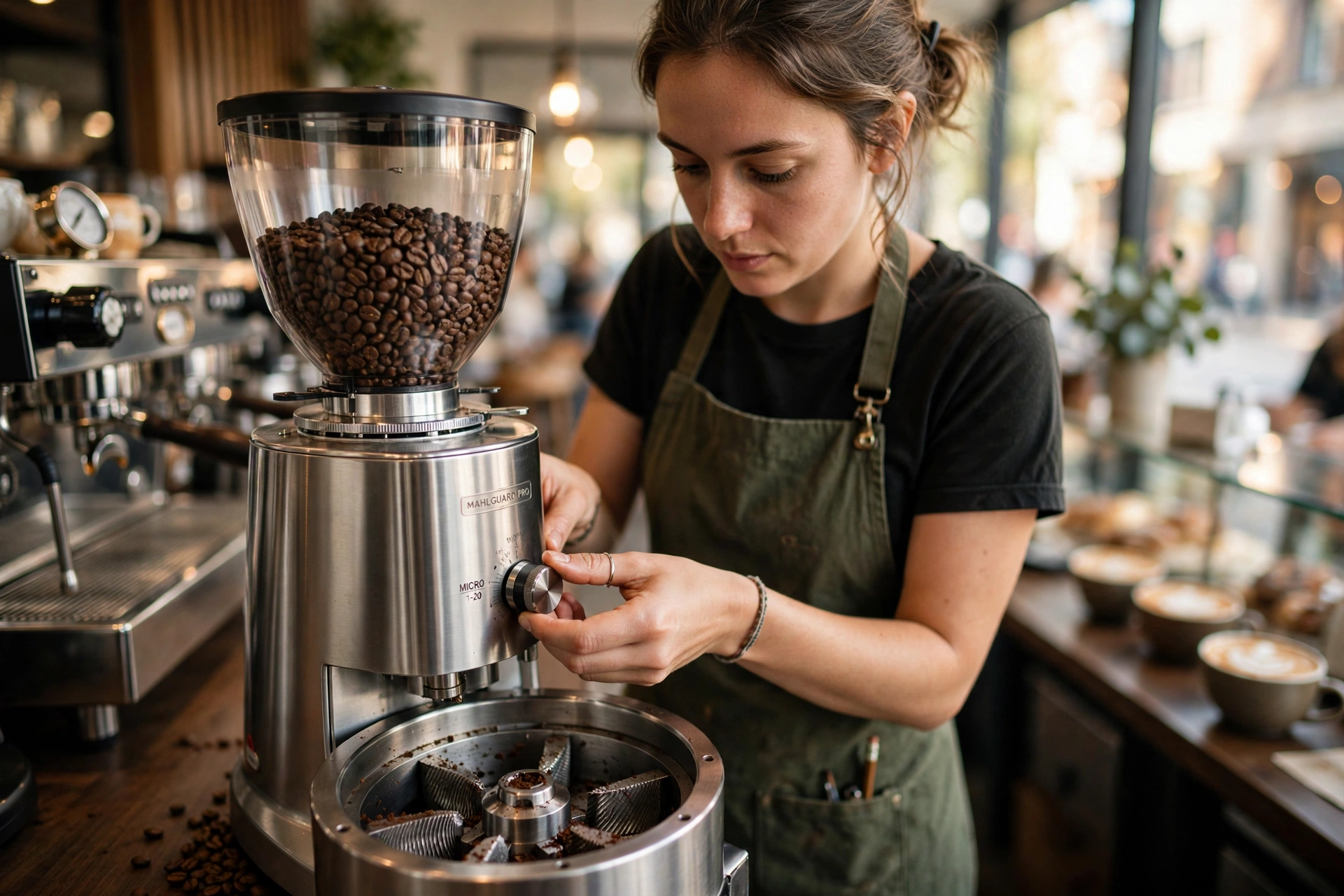
When we calibrate a grinder at Busy Bean Coffee, we aren't just looking for a specific time on a timer; we are looking for a specific tactile and visual result in the coffee puck and a specific flavor profile in the cup. This involves manipulating the collar of the burrs to change the gap. A smaller gap produces finer particles, increasing the surface area and slowing the water flow, while a larger gap produces coarser particles that allow water to pass through more quickly.

Why Does Commercial Grinder Calibration Matter for Your Business?
Calibration is the direct link between your cost of goods sold (COGS) and your customer retention rate. According to the Specialty Coffee Association (SCA), precision in grind size is the most critical variable in espresso extraction after the quality of the bean itself. If your staff isn't calibrating daily, you are likely wasting a significant percentage of your inventory through "bad shots" and inconsistent dosing.
First, calibration ensures flavor consistency. Customers return to a cafe because they expect the same taste every time. If the espresso tastes like lemon one day and charcoal the next, you lose the trust of your regulars. Consistent calibration eliminates this variance. Second, it maximizes efficiency. A properly calibrated grinder allows for a steady workflow, preventing the "bottleneck" effect where baristas spend five minutes fighting a choked machine during a morning rush.
Third, it protects your equipment. Running a grinder that is calibrated too fine—to the point where the burrs are nearly touching—puts immense strain on the motor and can lead to premature wear or total mechanical failure. By following a standardized calibration protocol, you ensure the longevity of your investment. Furthermore, proper calibration reduces the amount of coffee wasted during the "dial-in" process. A trained barista using a calibrated system can find the sweet spot in three shots, whereas an untrained one might waste half a pound of specialty coffee trying to guess the setting.
💡
Key Takeaway
Calibration is not about finding a "perfect number' on a dial, but about adjusting the grind to match the current state of the bean and the environment to ensure consistent extraction.
How to Perform Commercial Grinder Calibration Step-by-Step
Performing a professional calibration requires a digital scale, a timer, and a palate tuned to the nuances of the roast. In my years as a Q-Grader, I've seen businesses try to calibrate by "eye," which is a recipe for inconsistency. You must use data.
Step 1: Establish Your Base Dose
Start by weighing your dry coffee. If your basket is designed for 18 grams of coffee, weigh exactly 18.0g. This removes the "dose variable' from the equation. If the dose fluctuates, you cannot tell if a change in taste is due to the grind size or the amount of coffee in the basket.
Step 2: Set the Target Yield and Time
Determine your target output. A standard ratio is 1:2 (e.g., 18g in, 36g out) within 25 to 30 seconds. Start your timer the moment you engage the pump. If the shot runs in 15 seconds, your grind is too coarse. If it takes 45 seconds or doesn't flow at all, it is too fine.
Step 3: Adjust the Collar
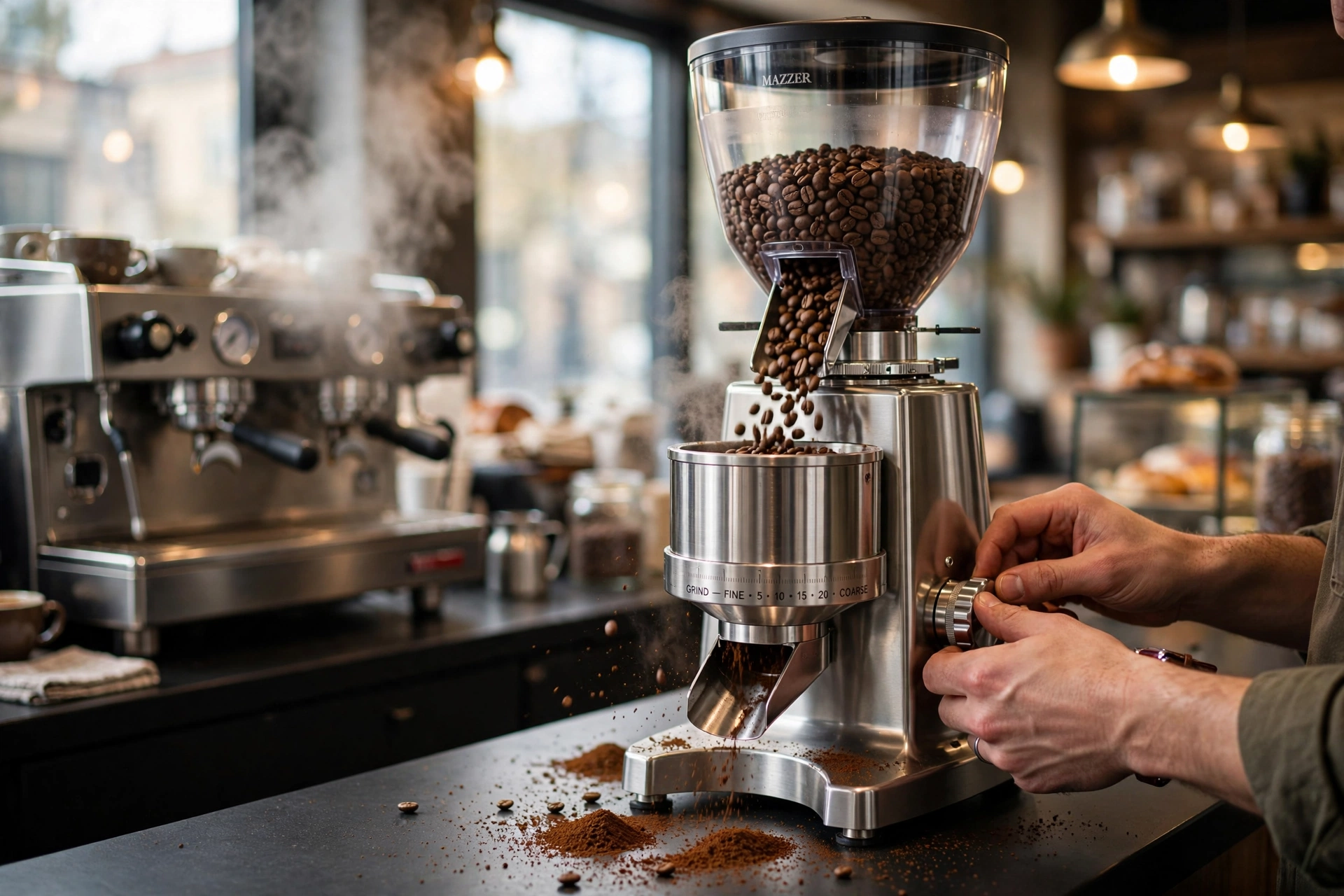
Make small, incremental adjustments. On most commercial grinders, a tiny turn of the dial represents a significant change in micron size. Move the dial toward "Fine' to slow the shot down or toward "Coarse' to speed it up. After every adjustment, you must purge a small amount of coffee (about 5-10 grams) to ensure the old grind size is cleared from the chamber before pulling a test shot.
Step 4: Taste and Evaluate
This is where the science meets the art. If the coffee tastes sour or salty (under-extracted), go finer. If it tastes bitter, astringent, or burnt (over-extracted), go coarser. Use the National Coffee Association USA (NCA) guidelines for taste profiles to help your staff identify these markers.
Step 5: Lock and Document
Once the taste is balanced and the time is within the 25-30 second window, note the setting. This provides a baseline for the next day's calibration.
For those struggling with the hardware side of this process, checking out our guide on Commercial Burr Grinders Explained can help you understand how different burr geometries affect the calibration process.
Commercial Grinder Calibration vs. Casual Dialing
Many small business owners confuse "dialing in" with professional calibration. Casual dialing is reactive; it happens when a shot tastes bad. Professional calibration is proactive; it happens before the first customer walks through the door.
| Feature | Casual Dialing | Generic/Cheap AI Approach | Professional Calibration |
|---|---|---|---|
| Timing | Reactive (after a bad shot) | Based on generic presets | Proactive (daily morning routine) |
| Measurement | Visual estimation/Timing | Automated but unverified | Digital scales (0.1g precision) |
| Consistency | High variance between baristas | Robotic but often incorrect | Standardized across the team |
| Waste | High (trial and error) | Medium (wrong presets) | Low (systematic approach) |
| Equipment Life | Unpredictable wear | Risk of motor strain | Optimized for burr longevity |

Common Calibration Mistakes and How to Avoid Them
One of the most frequent mistakes I see in Mount Pleasant cafes is the "Adjustment Overload." This happens when a barista moves the grinder dial too far in one direction, then over-corrects in the other. This creates a massive amount of waste and leaves the grinder in an unstable state. Always make the smallest possible change and purge the chute.
Another critical error is ignoring the environment. Coffee beans are hygroscopic, meaning they absorb moisture from the air. On a humid morning in South Carolina, the beans will swell, effectively making the grind feel "finer" than it was the day before. If you don't calibrate for the weather, your morning rush will be plagued by choked machines. I always tell my clients: the weather is a variable in your recipe.
Finally, avoid using the same calibration settings for different roast levels. A dark roast is more porous and brittle than a light roast. A light roast typically requires a finer grind to achieve the same extraction level. If you switch beans without recalibrating, you will serve an unbalanced product. To avoid this, maintain a calibration log for each bean variety you use in your coffee service.
If you find that your grinder is frequently drifting or requires constant adjustment, it may be time to look into Maintenance Tips for Commercial Coffee Grinders to ensure your burrs aren't worn down or clogged with oils.
Frequently Asked Questions
Why does my grinder need calibration every day?
Coffee beans are organic and highly sensitive to their environment. Factors such as humidity and temperature cause the beans to expand or contract, which changes how they interact with the burrs. Furthermore, as beans age (degas), their density changes, requiring a finer grind to maintain the same extraction time. Without daily calibration, your espresso flavor will fluctuate, leading to inconsistent quality for your customers.
How do I know if my grind is too coarse?
If the espresso flows too quickly (e.g., 36g of output in 15 seconds) and looks watery or pale, the grind is too coarse. In the cup, this manifests as a sour, salty, or acidic taste because the water passed through the coffee too quickly to extract the sweetness. To fix this, move your grinder dial toward the "Fine" setting and purge the chamber before testing again.
What is the "sweet spot" in calibration?
The sweet spot is the point of optimal extraction where the balance between acidity, sweetness, and bitterness is perfectly aligned. It is usually characterized by a syrupy body, a lingering sweet finish, and a balanced taste that isn't overly sour or unpleasantly bitter. While timing (e.g., 27 seconds) is a great indicator, the flavor is the ultimate truth in calibration.
Does the type of bean affect calibration?
Yes, significantly. Lighter roasts are denser and harder, often requiring a finer grind to allow the water to extract the flavors. Darker roasts are more porous and extract more easily, meaning they generally require a coarser grind to avoid bitterness. If you are using different varieties of Coffea arabica, you will need to recalibrate for each specific bean to maintain quality.
How often should I replace the burrs in my commercial grinder?
Burr replacement depends on your volume, but generally, they should be replaced every 500 to 1,000 kilograms of coffee. When burrs wear down, they lose their sharpness, leading to a more uneven particle size. This makes calibration nearly impossible because you can no longer achieve a precise "sweet spot," and you'll notice an increase in "fines" (dusty coffee) that can clog your machine.
Recommended Readings
To deepen your understanding of these topics, we recommend reading the following articles:
- Best Commercial Coffee Grinders for Restaurants
- Where to Buy Reliable Commercial Coffee Grinders
- Top Commercial Coffee Grinder Reviews for
- Commercial Coffee Grinders for Bakeries and C-Stores
Conclusion
Mastering commercial grinder calibration is the difference between a cafe that simply serves coffee and one that delivers a world-class experience. By treating calibration as a scientific process—using scales, timers, and a structured routine—you protect your margins, your equipment, and your brand reputation. Remember that the environment of Mount Pleasant, SC, and the nature of specialty coffee require constant vigilance. Don't leave your flavor profile to chance; implement a daily calibration log and train your team to trust the data over their gut feeling.
If you are still searching for the perfect hardware to fit your business model, we invite you to read our Ultimate Guide to Commercial Coffee Grinders for Businesses to find the equipment that matches your volume and quality goals. For a fully managed, hassle-free coffee solution, visit Busy Bean Coffee today.
Free Coffee Pairing Guide & Specialty Roast Cheat Sheet
Unlock the secrets of perfect brewing ratios, water temperatures, and specialty roast profiles. Download the guide.