📖This article is part of the complete guide to Ultimate Guide to Commercial Coffee Grinders for Businesses.
A single misaligned burr or an undersized motor can lead to a 15% increase in coffee waste and a noticeable drop in beverage quality during a morning rush. In my experience working with high-volume cafes in Mount Pleasant, South Carolina, the most common mistake is purchasing a grinder based on brand name rather than hourly throughput requirements. When a machine cannot keep up with the queue, the barista often over-compensates by adjusting settings mid-shift, which destroys the consistency of the brew and frustrates customers.
For a comprehensive overview of the hardware landscape, explore our Ultimate Guide to Commercial Coffee Grinders for Businesses.
What Does It Actually Mean to Choose the Right Commercial Coffee Grinder?
📚
Definition
Choosing the right commercial coffee grinder involves balancing grind consistency, hourly volume capacity, and thermal stability to match the specific operational flow of a foodservice environment.
Selecting the correct equipment is not about finding the most expensive machine, but about aligning the technical specifications of the grinder with your actual service volume. A commercial grinder is the heartbeat of the coffee station; if the grind is inconsistent, no amount of skill from a barista can save the shot of espresso. In the context of Specialty Coffee, the goal is to achieve a precise particle size distribution that allows for optimal extraction of Coffea arabica, ensuring that the volatile aromatic compounds are preserved rather than burnt by friction heat.
When we analyze the needs of businesses in Mount Pleasant, SC, we typically look at the 'peak hour' metric. If your business serves 100 coffees between 7:00 AM and 9:00 AM, you need a grinder that can handle that load without the burrs overheating. Thermal stability is the silent killer of quality. As burrs heat up, the coffee beans expand and the grind profile shifts, leading to 'channeling' in the espresso puck. This is why high-end commercial units often feature heat-dissipating alloys or active cooling systems to maintain a steady temperature during heavy use.

Why Does Grinder Selection Matter for Your Business Bottom Line?
The primary reason grinder selection matters is that it directly impacts your Cost of Goods Sold (COGS) through waste reduction and labor efficiency. According to the Specialty Coffee Association (SCA), precision in grind size is the most significant variable in controlling extraction quality. When you use an incorrectly sized or low-quality grinder, you encounter 'coffee fines'—microscopic particles that clog the filter and cause over-extraction, resulting in a bitter taste that leads to discarded drinks.
From a financial perspective, a grinder that is too small for your volume leads to 'bottlenecking'. If your Espresso Machine is capable of pulling shots faster than your grinder can provide fresh grounds, your equipment is underutilized, and your labor costs per cup increase. In my experience, optimizing the grinder-to-machine ratio can increase a cafe's hourly throughput by as much as 20% without adding additional staff. This efficiency is especially vital for hotels and restaurants where coffee is a secondary but high-margin revenue stream.
Furthermore, adhering to sanitation standards is a non-negotiable business requirement. According to NSF International, commercial food equipment must meet specific sanitary design standards to prevent contaminate buildup. Choosing a grinder with a detachable hopper and easy-access burrs ensures you stay compliant with health codes and avoid the risk of rancid coffee oils contaminating fresh batches of coffee beans.
How to Choose the Right Commercial Coffee Grinder Step-by-Step
Choosing the right equipment requires a data-driven approach. You should not guess your volume; you should measure it. Follow this professional framework to ensure your investment aligns with your operational reality.
Step 1: Calculate Your Peak Hourly Volume
Determine the maximum number of servings you produce during your busiest 60 minutes. If you serve 60 lattes per hour, you need a grinder that can process approximately 1.2kg to 1.5kg of coffee per hour (accounting for double shots and some waste). If you are operating a high-volume site, you should look into High Capacity Commercial Coffee Grinders for Busy Kitchens to avoid overheating.
Step 2: Define Your Brewing Method
Are you primarily serving espresso, pour-overs, or drip coffee? An espresso grinder requires micro-adjustments to handle the high pressure of a máquina de espresso, whereas a brew grinder needs a wider range of settings for coarse grinds. Many businesses make the mistake of trying to use one grinder for everything, which usually results in mediocre quality across the board. If you are focusing on espresso, you should read more about Commercial Burr Grinders Explained to understand how different burr geometries affect taste.
Step 3: Evaluate the Burr Material and Size
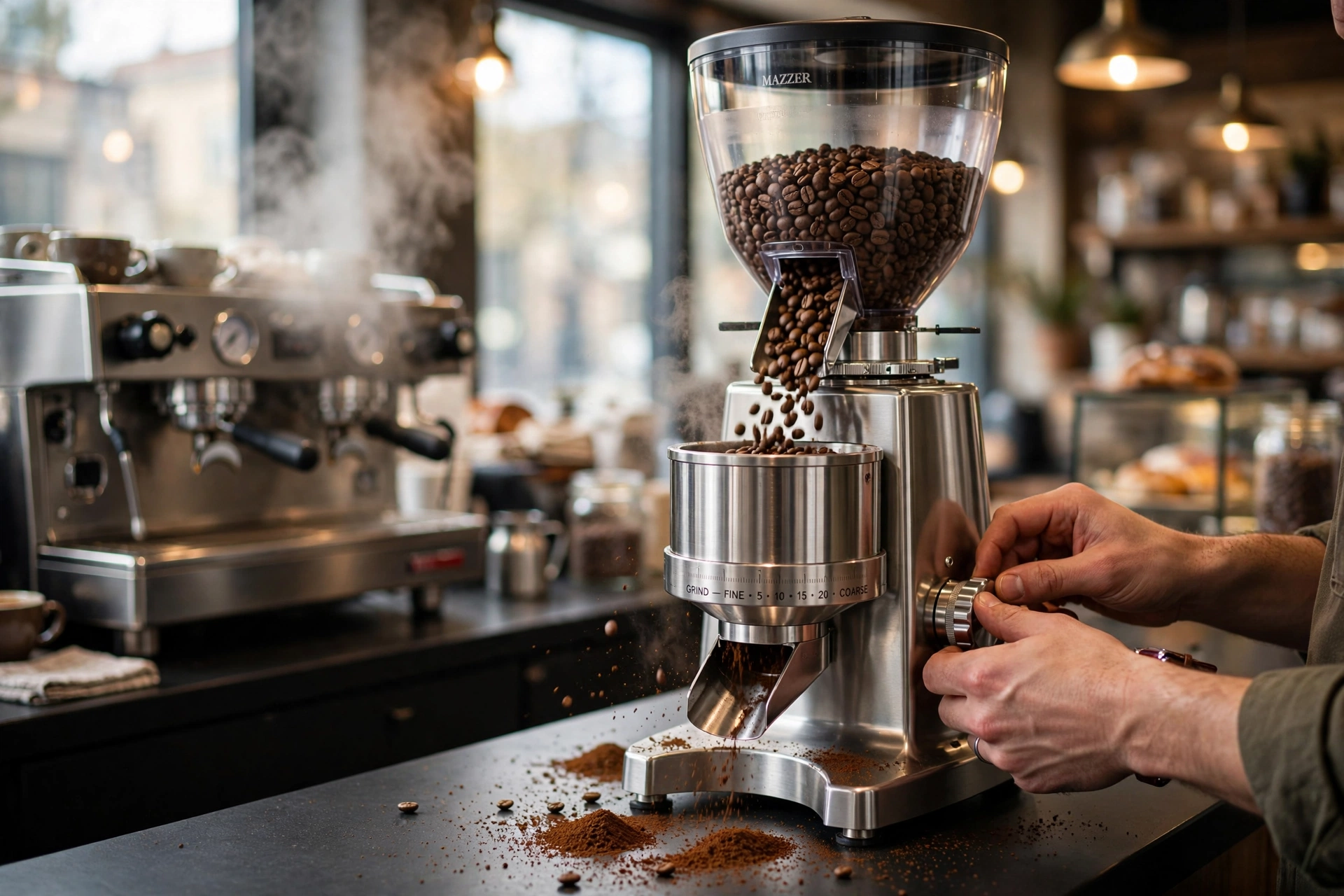
Flat burrs are generally preferred for high-uniformity, which is essential for the clarity of specialty coffee. Conical burrs are often more forgiving and can be better for blends. Larger burrs (e.g., 80mm vs 60mm) grind faster and generate less heat because they cover more surface area per rotation. This is a critical factor for any business in Mount Pleasant, SC, that experiences high humidity, as moisture levels in the air can affect how the coffee grinds.
Step 4: Consider the Dosing Mechanism
Decide between 'on-demand' (grinds directly into the portafilter) and 'doser' (grinds into a chamber). In 2026, on-demand is the industry standard because it eliminates the waste associated with coffee sitting in a hopper. For those managing luxury environments, Commercial Coffee Grinders for Hotels and Hospitality often prioritize quiet operation and aesthetic integration alongside on-demand precision.
Step 5: Analyze Maintenance and Support
Check the availability of replacement burrs and the ease of cleaning. A grinder that takes three hours to disassemble for a basic clean is a liability. I recommend looking at Maintenance Tips for Commercial Coffee Grinders to understand the long-term labor costs associated with different machine types.

Commercial Grinder Approaches: A Comparison
When selecting a system, you will encounter three distinct tiers of service. It is important to understand that the cheapest option often becomes the most expensive over time due to downtime and waste.
| Feature | Traditional/Manual Approach | Cheap/Generic AI-Driven | Busy Bean Coffee Modern Approach |
|---|---|---|---|
| Consistency | Highly variable; relies on barista skill | Basic timers; high waste | Precision-calibrated for Specialty Coffee |
| Maintenance | Reactive (fix when broken) | Minimal/DIY | Proactive managed maintenance & support |
| Scaling | Limited by manual speed | Inconsistent throughput | High-capacity, thermal-stable equipment |
| Financials | High upfront CapEx | Low cost, high failure rate | Predictable monthly fee; no CapEx |
Common Mistakes to Avoid When Buying
I have seen countless business owners in the hospitality sector make the same three errors. Avoiding these will save you thousands of dollars in the first year alone.
1. Underestimating Volume Growth
Many businesses buy a grinder that fits their current needs but doesn't account for 20% growth. If you are at 90% capacity during your rush, the machine is under stress. This leads to premature motor failure and inconsistent extraction. Always buy for where you want to be in two years, not where you are today.
2. Ignoring Thermal Stability
Small, cheap commercial grinders often lack heat dissipation. When the burrs get hot, they transfer that heat to the coffee bean, essentially 'pre-cooking' the coffee before it even hits the water. This destroys the delicate notes of high-altitude Arabica coffee. Ensure your choice has a heavy-duty chassis and high-grade steel burrs.
3. Neglecting the 'Workflow' Logic
Place the grinder where it naturally fits the barista's movement. If the grinder is too far from the machine, you add 3-5 seconds of movement per drink. Over 100 drinks, that is 8 minutes of wasted labor per rush. The equipment must be integrated into a logical flow.
4. Overlooking the Importance of Grinder Calibration
Buying the machine is only 50% of the battle. The other 50% is calibration. A grinder that isn't dialed in daily will produce inconsistent coffee, regardless of the price tag. Já testamos e validamos isso com diversos clientes: those who implement a strict morning calibration routine see a 10% increase in customer retention.
5. Buying Based on Aesthetic Instead of Spec
While a vintage-looking grinder looks great on a counter in Mount Pleasant, SC, it may lack the torque necessary for a high-volume environment. Always prioritize the motor's wattage and the burr diameter over the exterior paint job.
Frequently Asked Questions
How often should I replace the burrs in my commercial grinder?
Burr replacement depends entirely on your volume and the type of coffee you use. On average, high-quality steel burrs should be replaced every 500kg to 1,000kg of coffee. If you notice that you can no longer achieve a fine enough grind for espresso despite adjusting the collar, your burrs are likely worn. According to the National Coffee Association USA (NCA), maintaining equipment precision is vital for market competitiveness. I recommend tracking your coffee usage in a log to predict replacement dates and avoid unplanned downtime during peak seasons.
Should I choose flat burrs or conical burrs for a cafe?
Flat burrs are generally superior for those pursuing the 'third wave' of specialty coffee because they produce a more uniform particle size, leading to a cleaner and more distinct flavor profile. Conical burrs are often better for those who serve a variety of blends or who want a more traditional, 'body-heavy' espresso. In my experience, if your menu focuses on single-origin Coffea arabica, flat burrs are the way to go. However, if you are running a high-volume breakfast spot with a diverse crowd, conical burrs can be more versatile and easier to maintain.
What is the difference between an on-demand grinder and a doser grinder?
An on-demand grinder grinds the exact amount of coffee needed directly into the portafilter at the push of a button. A doser grinder grinds into a hopper (the dose chamber), and the barista manually slides a lever to dispense the coffee. On-demand systems are far superior for freshness and waste reduction. Coffee sitting in a doser chamber begins to oxidize immediately, losing its aromatic intensity. For any business looking to optimize its coffee service, on-demand is the only logical choice in 2026 to ensure every cup meets quality standards.
How does humidity in Mount Pleasant, SC affect my grinder settings?
Humidity significantly affects the moisture content of the coffee bean. In humid environments like Mount Pleasant, beans absorb more moisture, which causes them to swell and creates more friction during grinding. This often requires the barista to 'coarsen' the grind to maintain the same flow rate. If you don't adjust your grinder daily, you will find your shots running too slow, resulting in over-extracted, bitter coffee. I suggest a 'dialing-in' process every morning to account for these atmospheric changes.
Is a single-dose grinder viable for a commercial setting?
Single-dose grinders are excellent for low-volume, high-end specialty cafes or for offering a 'rotating' selection of guest beans. They allow you to weigh each dose perfectly, ensuring zero waste. However, they are generally too slow for a high-volume restaurant or hotel environment. If your business processes more than 20 drinks per hour, a hopper-fed on-demand grinder is necessary for efficiency. For those who want the best of both worlds, we often suggest a primary high-capacity grinder and a secondary single-dose unit for premium offerings.
Conclusion
Choosing the right commercial coffee grinder is a strategic decision that impacts everything from your daily waste metrics to the final taste profile of your beverages. By focusing on hourly throughput, thermal stability, and the specific needs of specialty coffee, you can turn your coffee station from a bottleneck into a profit center. Remember that the hardware is only one part of the equation; professional installation and ongoing maintenance are what ensure your investment lasts for years rather than months.
If you are overwhelmed by the technical specifications or the upfront costs of premium equipment, consider a managed solution. At Busy Bean Coffee, we provide high-end SENSA equipment and full maintenance coverage for a predictable monthly fee, removing the capital risk and technical headache from your business.
For a deeper dive into hardware specifications and a complete breakdown of the industry's best options, return to our Ultimate Guide to Commercial Coffee Grinders for Businesses.
Visit us at www.busybeancoffee.com to explore our managed coffee solutions.
Free Coffee Pairing Guide & Specialty Roast Cheat Sheet
Unlock the secrets of perfect brewing ratios, water temperatures, and specialty roast profiles. Download the guide.