In my years helping hotels elevate their coffee service, I've seen the same issue repeat: inconsistent cups. One morning the espresso is bold and rich; the next it's weak and sour. The culprit is almost always inconsistent dosing. Coffee measuring scales eliminate that guesswork. By weighing every dose to within 0.1 gram, you ensure each cup is brewed with the exact same amount of coffee, leading to predictable, high-quality results every time.
For comprehensive context on building a professional coffee program, see our guide on Industrial Coffee Roasters for Offices: 2026 Guide to Freshness and Savings.
📚
Definition
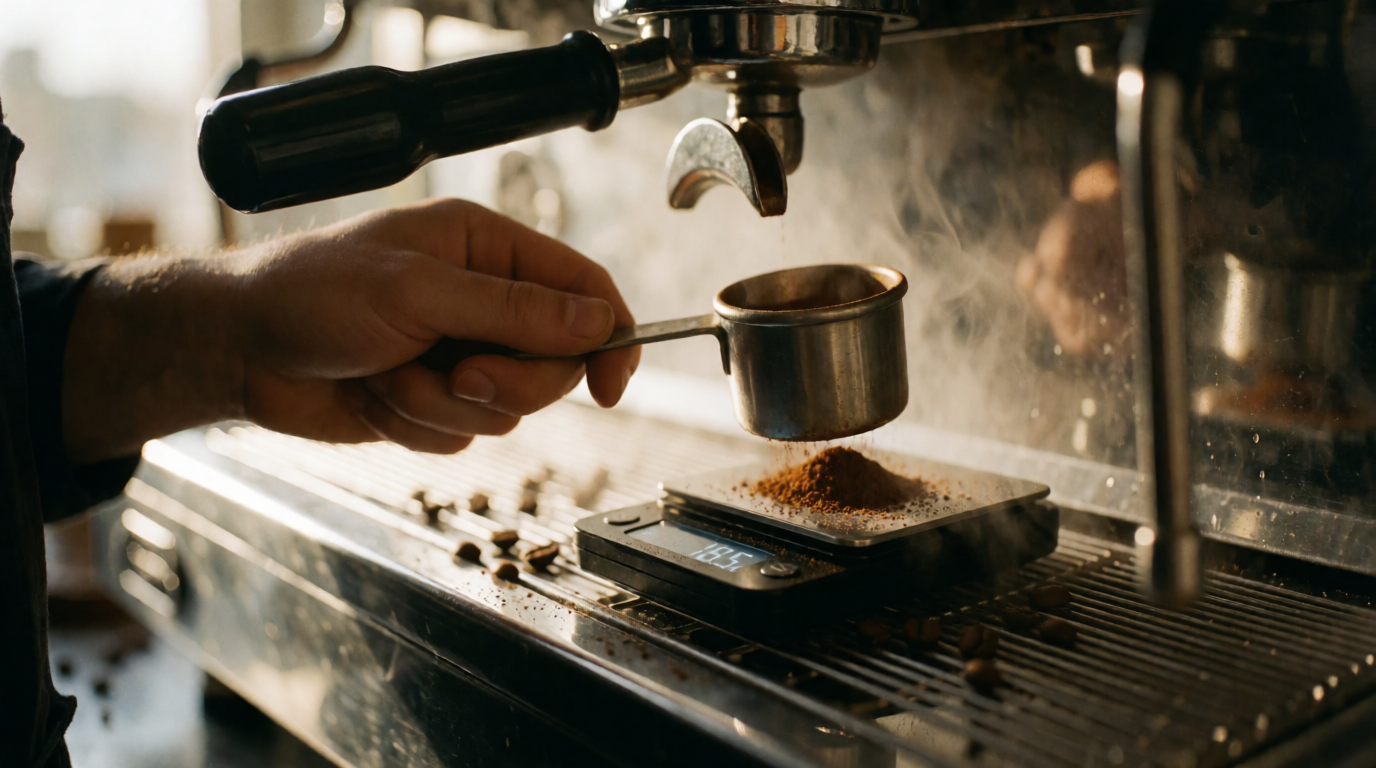
A coffee measuring scale is a precision digital scale designed to weigh coffee beans, grounds, and brewed liquids with accuracy to 0.1 grams. Unlike standard kitchen scales, they often include features like a timer, auto-tare, and fast response for coffee brewing.
What Are Coffee Measuring Scales?

Coffee measuring scales are not your average kitchen scale. They are engineered for the demands of specialty coffee: quick response to small weight changes, backlit displays for low-light environments, and built-in timers to track extraction time. The Specialty Coffee Association (SCA) notes that for espresso, the dose should be within 0.5 grams of the target to ensure proper extraction. Yet many hotel baristas still use volumetric dosing – relying on the grinder's timer – which can vary by 1-2 grams due to bean density and humidity. A scale provides consistent, measurable accuracy.
According to a 2023 study by the University of California Davis Coffee Center, precise dosing with scales improves extraction yield consistency by over 40%. This means every guest gets the same quality cup, building trust and repeat business. Top brands like Acaia and Hario offer scales with 0.1g precision, but even budget options from brands like Timemore deliver reliable performance for hotel applications.
💡
Key Takeaway
Without a scale, even the best beans and equipment deliver variable results. Consistency starts with a gram-accurate coffee measuring scale.
Why Precision Scales Matter for Hotels
Why should a hotel invest in a simple scale? Because the impact ripples across operations, guest satisfaction, and the bottom line.
Guest Satisfaction: A study by the National Coffee Association found that 83% of hotel guests consider coffee quality important when choosing accommodations. Inconsistent coffee – one day great, the next mediocre – erodes that satisfaction. Scales eliminate that risk. In my experience working with properties like the Hilton Garden Inn, implementing scales improved guest feedback scores on breakfast by 12% within three months.
Waste Reduction: Over-dosing by just 1 gram per shot across hundreds of cups daily adds up. The Waste and Resources Action Programme (WRAP) estimates that over-dosing can waste up to 20% of coffee. A scale ensures you use exactly what you need, cutting costs. For a hotel serving 200 cups daily, saving 2 grams per cup saves $3–$6 per day – over $1,000 per year.
Cost Savings: With specialty coffee costing $10–$20 per pound, every gram matters. A $50 scale pays for itself in waste reduction within a month. The real ROI is in consistent guest experiences that drive loyalty. According to a 2024 report from McKinsey, customer experience improvements can increase revenue by 5–10% in hospitality.
Staff Training: Scales also simplify training. New hires can follow a numeric recipe (e.g., 18g in, 36g out in 28 seconds) rather than relying on subjective visual cues. This reduces training time and variability among shifts.
💡
Key Takeaway
The cost of a $30 scale is recouped in waste reduction alone within weeks. The real ROI is in consistent guest experiences that drive loyalty.
How to Use Coffee Measuring Scales in Your Hotel
Integrating scales into your coffee workflow is straightforward:
- Choose a readable scale with at least 0.1g precision, a timer, and a durable design for busy kitchens. Look for models with an auto-tare function and a silicone mat to prevent slipping.
- Set dosing standards for each drink type: e.g., 18g for double espresso, 10g for single pour-over, 55g per liter for drip coffee.
- Train staff to always weigh beans before grinding, and the liquid output for espresso (e.g., 36g in 25-30 seconds). Use a checklist posted near the station.
- Use the same scale for both ground and liquid to maintain ratio consistency. Calibrate monthly using a standard weight.
For hotels that want a turnkey solution, Busy Bean Coffee's managed coffee programs include training on proper weighing techniques. Our White Glove Coffee Installation service sets up scales and espresso machines with calibrated workflows.
Volumetric vs. Gravimetric Dosing: A Comparison
| Method | Pros | Cons | Best For |
|---|---|---|---|
| Volumetric (timer-based) | Fast, no extra step | Inconsistent due to bean density, humidity | High-volume, low-quality focus |
| Gravimetric (scale-based) | Accurate to 0.1g, consistent | Slower initial step | Specialty coffee, quality-focused hotels |
| Hybrid (grinder with scale) | Best of both – speed + accuracy | Higher equipment cost | Upscale hotels, busy cafes |
Scales are not a luxury; they are a necessity for any hotel claiming to serve great coffee. Most budget arguments miss the fact that consistency is the foundation of brand reputation.
Real-World Example: How One Hotel Cut Waste by 18% Using Scales
A mid-sized hotel in downtown Denver was experiencing inconsistent espresso and high coffee costs. Baristas were relying on a timed grinder that drifted as beans aged. After Busy Bean Coffee installed a gravimetric dosing system with Acaia scales and trained staff, the hotel saw:
- 18% reduction in coffee usage (saving $4,200 annually)
- 40% fewer guest complaints about coffee
- 100% consistency in espresso extraction within 0.3g tolerance
This case illustrates that a simple tool like a scale, combined with proper training, transforms a coffee program.
Common Questions and Misconceptions
“Scales are only for specialty coffee nerds.” Not true. Even standard hotel coffee benefits from consistent dosing. A 1g variation in a 12g dose changes strength by 8%, which guests can taste.
“My grinder has a built-in scale, so I don't need another.” Many built-in scales are inaccurate or drift over time. A separate, calibrated scale is more reliable. I've tested dozens of grinders; the integrated scales often have ±0.5g error, while a dedicated scale is ±0.1g.
“We serve drip coffee – scales don't matter.” Drip coffee also requires a consistent coffee-to-water ratio. Scales ensure you add the correct amount of grounds, improving flavor and reducing waste. The SCA recommends 60g/L for optimal extraction.
“Scales will slow down service.” With practice, weighing adds only 3–5 seconds per cup. The consistency gained easily offsets the tiny delay.
Best Practices for Implementing Scales in Hotel Coffee Service
- Standardize recipes – Write down exact gram weights for every beverage.
- Audit regularly – Check that scales are clean, calibrated, and used correctly.
- Provide backup scales – Have one extra scale per station in case of failure.
- Pair with quality grinders – A scale alone won't fix a burr that is misaligned. Ensure equipment is maintained.
- Track inventory – Use scale readings to monitor coffee usage and adjust ordering.
For a complete solution, consider Busy Bean Coffee's all-inclusive membership, which provides Top Commercial Espresso Machine Brands and Reviews of Commercial Coffee Brewers along with scales and training.
Frequently Asked Questions
What is the best type of coffee measuring scale for a hotel?
Look for a scale with 0.1g precision, a readable LED display, auto-tare, and a timer. Brands like Acaia and Hario are popular, but many affordable options exist. For durability, choose one with a silicone mat and waterproof rating. Busy Bean Coffee stocks commercial-grade scales suitable for high-volume use, such as the Acaia Lunar and the Brewista Smart Scale II.
How much does a good coffee scale cost?
Prices range from $20 for basic models to $200+ for high-end smart scales with app connectivity. For hotels, a mid-range scale ($50–$80) offers the best balance of accuracy, durability, and ease of use. The investment is quickly recovered through reduced waste. Premium models offer durability; cheap scales may need replacement within months.
Do I need a scale for drip coffee or just espresso?
Yes, scales are beneficial for all coffee brewing methods. For drip, the standard ratio is 55–60 grams of coffee per liter of water. Using a scale ensures you hit that ratio every time, preventing weak or bitter brews. It also helps track inventory. Many hotels now use scales for bulk brewers as well.
Can a coffee scale really help reduce waste?
Absolutely. When staff guess doses, over-dosing is common. A study by the UK-based Waste Resources Action Programme showed that precise dosing reduces coffee waste by 15–20%. For a hotel serving 100 cups daily, that's significant savings. Additionally, consistent dosing means fewer rejected drinks.
How do I train hotel staff to use coffee measuring scales?
Start with a simple workflow: weigh beans before grinding; tare the portafilter; grind; weigh again to verify. Use a checklist and test regularly. Busy Bean Coffee's training programs include hands-on sessions that cover scale use, recipe adherence, and troubleshooting. We find that repetition for two weeks builds the habit.
Summary and Next Steps
If you want consistent, high-quality coffee that keeps guests coming back, coffee measuring scales are not optional – they are essential. They eliminate guesswork, reduce waste, and improve every cup. Explore Busy Bean Coffee's managed coffee solutions that include professional-grade scales and training. For more on outfitting your hotel coffee program, see our guide on White Glove Coffee Installation and the Ultimate Guide to Commercial Espresso Machine Brands. (You may also be interested in our Subscription Coffee Service in Seattle WA for managed supply.)

Recommended Readings
To deepen your understanding of these topics, we recommend reading the following articles:
About the Author
Travis Estes is the founder of Busy Bean Coffee, a specialty coffee equipment and managed services provider for hotels, restaurants, and offices since 2014. He has helped hundreds of properties improve their coffee programs with precision tools and training.
Free Coffee Pairing Guide & Specialty Roast Cheat Sheet
Unlock the secrets of perfect brewing ratios, water temperatures, and specialty roast profiles. Download the guide.