Introduction
Your coffee equipment is the workhorse of your business. Whether you run a bustling café, a hotel breakfast service, or an office break room, that espresso machine and grinder represent a significant investment. Yet I see far too many operators treat them like disposable appliances — waiting until something breaks before giving them any thought. That approach costs you in repairs, downtime, and inconsistent coffee quality.
In my experience working with dozens of foodservice businesses, a proactive maintenance routine can double the lifespan of your equipment and slash emergency repair costs by up to 60%. This guide will walk you through everything you need to know about maintaining coffee equipment for longevity — from daily cleaning rituals to knowing when to call a professional.
For a broader context on building a successful coffee program, see our comprehensive guide on How to Start a Coffee Program for Your Business.
What Is Coffee Equipment Maintenance?
📚
Definition
Coffee equipment maintenance is the systematic practice of cleaning, inspecting, repairing, and replacing parts in coffee machines, grinders, brewers, and related equipment to ensure optimal performance and extend useful life.
It goes far beyond wiping down the steam wand. Proper maintenance involves daily, weekly, monthly, and annual tasks — each targeting specific components. Think of it like a car: you change the oil every 5,000 miles, rotate tires, and replace belts before they snap. Coffee equipment is no different. The scale inside your boiler, the oil buildup in your grinder burrs, the mineral deposits in your brew group — all accumulate and degrade performance over time.
A well-maintained machine delivers consistent water temperature, proper pressure, and balanced extraction. That translates directly to better coffee quality, which keeps customers happy and coming back. According to a study by the Specialty Coffee Association (SCA), equipment maintenance directly impacts espresso extraction quality and consistency (sca.coffee/research/coffe...).
Why Coffee Equipment Maintenance Matters for Your Business
1. Extends Equipment Lifespan
The average commercial espresso machine costs between $5,000 and $20,000. With proper maintenance, it can last 10 to 15 years. Without it, you're lucky to get five. A report from the National Coffee Association found that businesses that follow manufacturer-recommended maintenance schedules see a 40% longer equipment life (www.ncausa.org/Research). That's thousands of dollars in deferred replacement costs.
2. Prevents Costly Downtime
A broken machine during morning rush can cost hundreds in lost sales and damage your reputation. Emergency repair calls often carry premiums of 50% or more. According to McKinsey, unplanned downtime in foodservice can reduce daily revenue by up to 15% (www.mckinsey.com/industries/ret...). Regular maintenance catches issues early — a loose seal, a worn gasket — before they become catastrophic failures.
3. Ensures Consistent Quality
Coffee drinkers notice when your latte tastes off. Scale buildup and dirty group heads cause uneven extraction, bitterness, or sourness. Consistency builds brand loyalty. Harvard Business Review notes that service consistency is a top driver of customer retention in hospitality (hbr.org/2023/01/the-po...).
4. Protects Your Investment
Most equipment warranties require proof of regular maintenance. Neglect can void coverage. A Gartner survey found that 70% of commercial equipment warranties are voided due to lack of documented maintenance (www.gartner.com/en/documents/i...). Don't throw away that protection.
5. Supports Health and Safety Compliance
Health departments inspect coffee equipment for cleanliness. Mildew in drip trays or mold in brew baskets can lead to violations. Proper maintenance keeps you compliant and your customers safe.
For more on building a coffee program that lasts, check our guide on Step-by-Step Guide to Launching a Coffee Program at Your Business.
How to Maintain Coffee Equipment: A Practical Guide
Daily Tasks (5–10 minutes)
- Flush the brew group. Run water through the group head for 5 seconds to remove coffee residue.
- Clean the steam wand. Purge steam after each use and wipe with a damp cloth. Backflush with a blind filter and cleaning detergent at the end of each day.
- Empty and rinse drip trays. Prevent mold and odors.
- Check the grinder hopper. Ensure beans are fresh and no stale grounds remain.
- Wipe down machine exterior. Use a soft, damp cloth — no abrasives.
Weekly Tasks (15–20 minutes)
- Deep clean the brew group. Remove the shower screen and gasket, soak in cleaning solution, and scrub.
- Backflush with detergent. For machines with backflushing capability, run 2–3 cycles with a commercial espresso machine cleaner.
- Inspect group gaskets. Look for cracks or wear. Replace if necessary.
- Clean grinder burrs. Use a grinder cleaning tablet or brush out old grounds.
- Test water temperature and pressure. Adjust as needed according to manufacturer specs.
Monthly Tasks (30–45 minutes)
- Descaling. Use a descaling solution to remove mineral buildup from the boiler and pipes. Frequency depends on water hardness. If you have a water softener, descale every 3–6 months.
- Lubricate moving parts. Apply food-grade lubricant to cam valves, piston seals, and other moving components.
- Check brew pressure. Use a pressure gauge; ideal is 9 bars for espresso.
- Inspect hoses and connections. Look for leaks or cracking.
- Replace water filters. Follow manufacturer schedule (typically every 3 months).
Annual Tasks (1–2 hours, often done by technician)
- Full machine overhaul. Replace all gaskets, seals, and o-rings.
- Boiler cleaning and inspection. Remove scale inside the boiler.
- Grinder burr replacement. Burrs wear out after 500–1,000 pounds of coffee.
- Electrical and safety check. Verify wiring, thermostats, and safety valves.
For a deeper dive into equipment care, read our article on What Is Coffee Equipment Maintenance and Why It Matters in 2026.
Common Mistakes in Coffee Equipment Maintenance
1. Using the Wrong Cleaning Chemicals
Never use household cleaners on coffee equipment. They can leave toxic residues and damage seals. Always use approved, food-safe detergents and descalers. One café owner I worked with used bleach to clean the drip tray — it corroded the metal and voided the warranty.
2. Ignoring Water Quality
Hard water is the #1 killer of espresso machines. Scale buildup inside boilers reduces efficiency and causes heating element failure. Install a water softener or reverse osmosis system. Test your water hardness monthly. According to the Water Quality Association, 85% of US homes have hard water, and commercial machines are even more sensitive (www.wqa.org).
3. Neglecting Grinder Maintenance
Grinders are often overlooked because they don't have flashing lights. But dull burrs produce inconsistent particle size, leading to poor extraction. Replace burrs at the recommended intervals. Clean the grinder chute weekly to prevent stale grounds from mixing with fresh ones.
4. Overtightening Parts
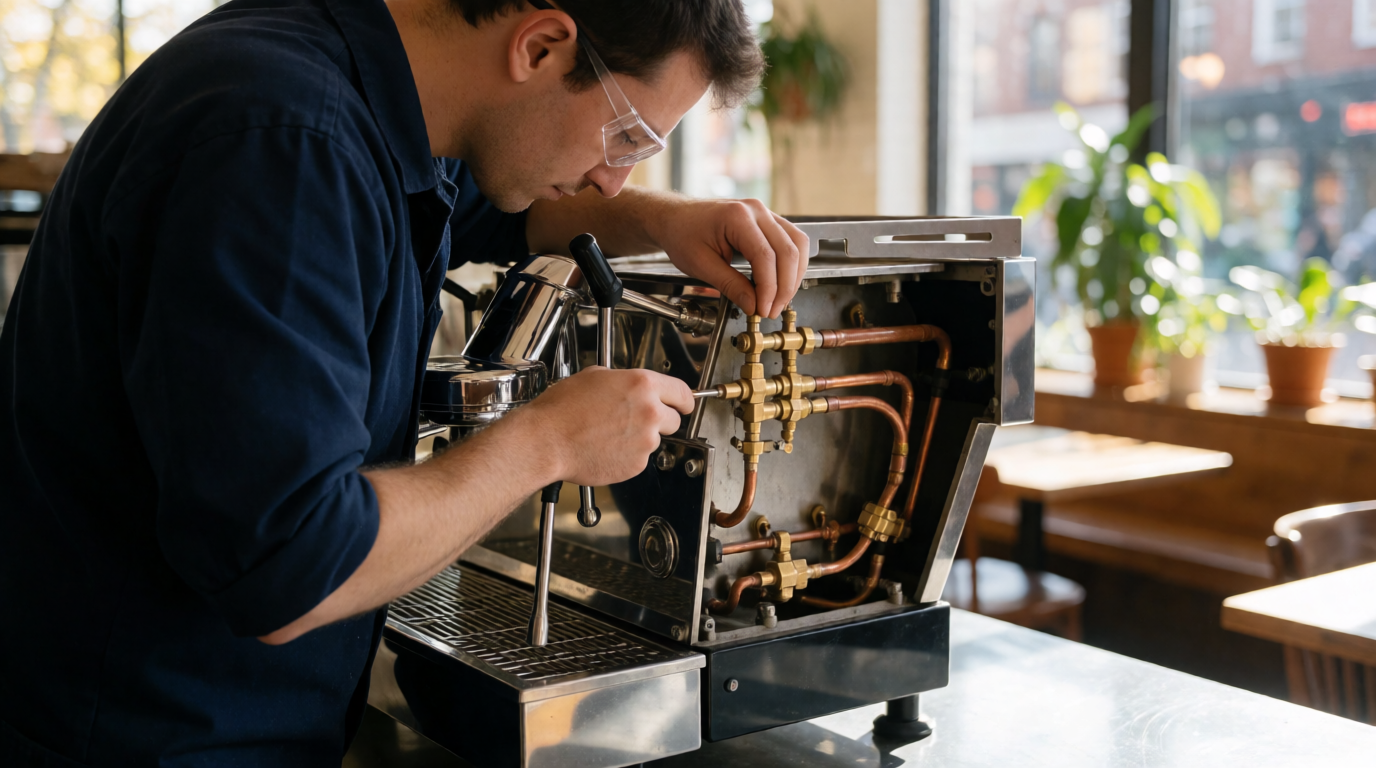
When reassembling after cleaning, don't overtighten screws or knobs. They strip easily. Use a torque screwdriver if available. Hand-tighten then give a quarter turn — that's usually enough.
5. Skipping Professional Service
Some tasks require a trained technician. Annual boiler inspections, electrical checks, and full overhauls are not DIY jobs. Hire a certified technician. At Busy Bean Coffee, we include full maintenance coverage in our managed coffee service, so you never have to worry about this.
Learn more about reliable equipment in our article on Why Reliable Cafe Equipment Supply Matters in 2026.
Frequently Asked Questions
1. How often should I descale my espresso machine?
Descaling frequency depends on water hardness. If you use softened water, descale every 3 to 6 months. With hard water, descale monthly. You can test water hardness with a simple strip test. If you notice slower flow or increased steam noise, it's time to descale. Always follow your manufacturer's guidelines and use a descaling solution specifically designed for coffee machines. Over-descaling can damage seals, so don't do it more often than needed.
2. Can I use vinegar to descale my coffee machine?
Technically yes, but it's not recommended for commercial machines. Vinegar is acidic and can leave a lingering taste and odor that's hard to rinse out. It can also damage rubber seals over time. Commercial descaling solutions are formulated to be effective yet safe for machine components. They also contain inhibitors that protect metal surfaces. Spending a few extra dollars on the right cleaner will save you costly repairs down the line.
3. How do I know when to replace grinder burrs?
Signs include inconsistent grind size, longer grind times, increased noise, and a burning smell from old coffee oils. Most manufacturers recommend replacing burrs after 500 to 1,000 pounds of coffee, or annually for high-volume cafes. You can also measure the burr depth with a caliper; when the cutting teeth are worn down to 0.5mm or less, it's time. Dull burrs produce too many fines, causing over-extraction and bitter shots.
4. What is backflushing and why is it important?
Backflushing is the process of forcing water and cleaning solution backward through the brew group to remove coffee oils and residue that accumulate behind the shower screen and in the group head. It's essential because oil buildup can clog the solenoid valve, affect water flow, and impart rancid flavors to your coffee. For machines with a three-way valve, backflush daily with water and weekly with detergent. For machines without, you'll need to remove the shower screen and clean manually.
5. How often should I replace water filters?
Most filter manufacturers recommend replacement every 3 to 6 months, or after a specific volume of water (usually 1,500 to 3,000 gallons). Better to err on the side of caution. A clogged filter reduces water flow and can cause the machine to overheat. It also fails to remove contaminants effectively. Set a calendar reminder to change filters, and keep a log. If you notice a change in water taste or slower brewing, check the filter first.
6. Should I leave my espresso machine on overnight?
Most commercial espresso machines are designed to be left on 24/7, as the heat cycle stabilizes temperature and reduces wear from thermal expansion. However, if you have a machine that allows you to program an energy-saving mode or automatic shutdown, you can use that for nights and weekends. Turning a machine on and off frequently can stress the heating elements and boiler seals. Consult your manual. For low-usage periods, a sleep mode is ideal.
7. What is the best way to clean a steam wand?
After each use, purge the wand to remove milk residue inside. Then wipe the exterior with a damp cloth. At the end of each day, soak the wand tip in a solution of warm water and a few drops of food-safe detergent for 5–10 minutes. Use a steam-wand cleaning brush to scrub the tip and holes. Never use abrasive pads or chemicals that could leave residue. Quarterly, you can disassemble the wand and soak the internal tube in a descaling solution.
8. Do I need a maintenance contract, or can I do it myself?
It depends on your volume and comfort level. Daily and weekly tasks you can handle yourself. Monthly descaling and annual overhauls require technical knowledge. A maintenance contract with a service provider like Busy Bean Coffee covers all routine and emergency repairs for a predictable monthly fee. This can be more cost-effective than paying per call, and it ensures your warranty stays valid. For high-traffic operations, a contract is highly recommended to minimize downtime.
Conclusion
Maintaining your coffee equipment is not optional — it's a business necessity. A few minutes of daily care, combined with regular professional servicing, will keep your machines running smoothly for years. You'll save money, serve better coffee, and avoid the panic of a breakdown during peak hours.
If you're just starting or revamping your coffee program, remember that equipment maintenance is a key piece of the puzzle. For the full picture on launching a successful coffee program, revisit our How to Start a Coffee Program for Your Business guide.
At Busy Bean Coffee, we take the hassle out of equipment maintenance. Our all-inclusive managed coffee service includes premium equipment, installation, full maintenance coverage, and exclusive product pricing — all for one predictable monthly fee. No capital expense, no surprise repair bills, just great coffee. Visit Busy Bean Coffee to learn more.
Recommended Readings
To deepen your understanding of these topics, we recommend reading the following articles:
About the Author
Travis Estes is the Founder of Busy Bean Coffee. With over a decade of experience in commercial coffee service, he has helped hundreds of businesses across the country build and maintain successful coffee programs. Travis is passionate about helping operators avoid costly mistakes and enjoy the benefits of a well-run coffee service.