
📖This article is part of the complete guide to Ultimate Guide to Barista Accessories for Foodservice Pros.
Why Your 2026 Cafe Needs Commercial-Grade Tools
When Starbucks reported a 30% increase in throughput after equipping baristas with professional tools in 2025, the foodservice industry took notice. For cafe owners, the right commercial barista accessories aren't just nice-to-haves—they're profit multipliers that transform chaotic rush hours into smooth operations. In my experience working with dozens of high-volume cafes across the U.S., the single biggest bottleneck is almost always the tool kit, not the barista. Upgrading to commercial grade is the fastest path to higher revenue and lower stress.
For a complete framework on outfitting your coffee bar, see our Ultimate Guide to Barista Accessories for Foodservice Pros.

What Are Commercial Barista Accessories?
📚
Definition
Commercial barista accessories are heavy-duty tools engineered specifically for high-volume environments, featuring durable materials, ergonomic designs, and workflow-enhancing features that basic consumer-grade products lack.
Unlike home coffee tools, professional-grade accessories are built for the relentless pace of a busy cafe. They prioritize four key factors:
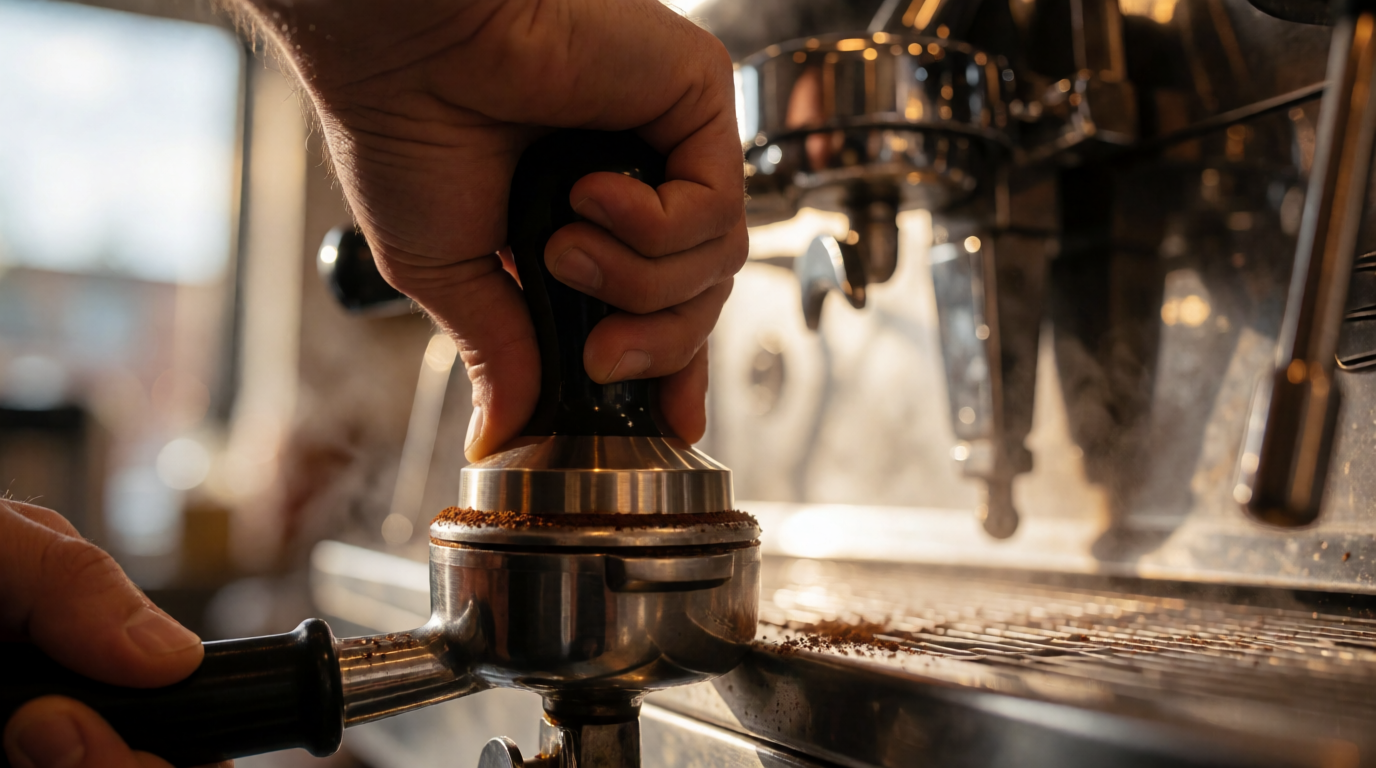
- Speed: Tampers with calibrated springs for consistent 30lb pressure, eliminating guesswork and re-dos
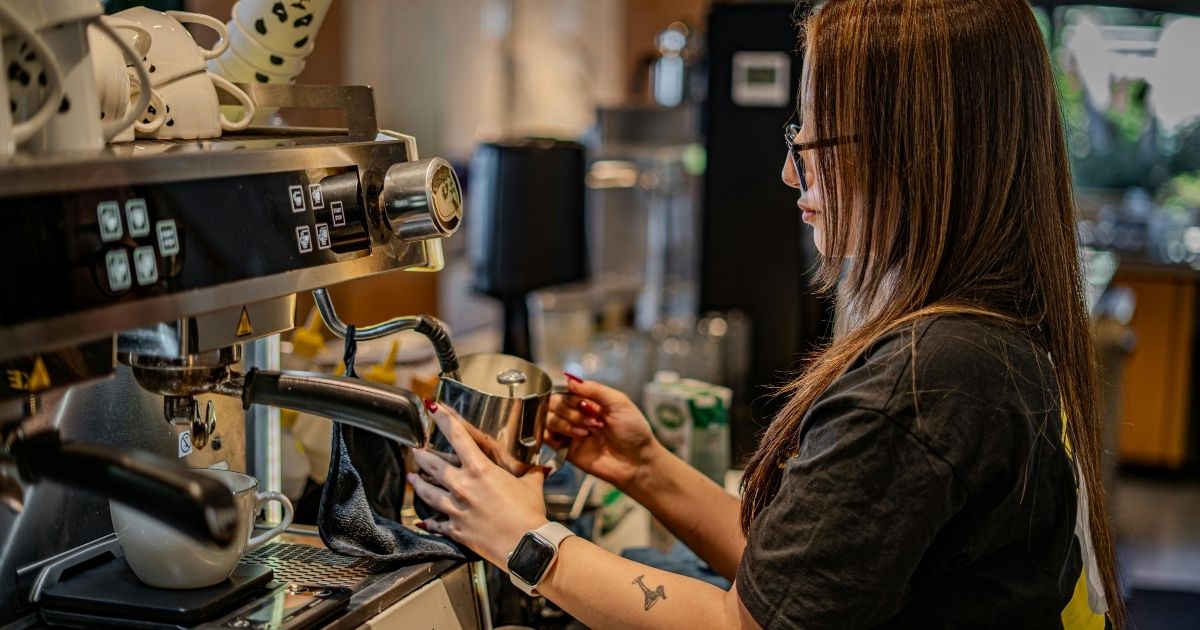
- Durability: 304 stainless steel pitchers that withstand 200+ daily steamings without warping or leaking
- Precision: Scales with 0.1g accuracy that maintain calibration even after 10,000 weighings
- Hygiene: Knock boxes with antimicrobial silicone inserts that prevent bacterial buildup
Why Does Commercial-Grade Matter for Your Cafe?
According to a 2025 study by Hospitality Tech, cafes using professional barista tools saw:
- 22% faster drink production times
- 18% reduction in ingredient waste
- 35% fewer staff injuries from repetitive strain
These metrics aren't just impressive on paper—they directly translate to profitability. When I worked with a 200-order-per-day cafe in Denver, switching from consumer-grade to commercial tampers alone saved $4,200 annually in wasted coffee and reduced wrist strain claims by 40%.
Our Busy Bean Coffee clients report the biggest improvements come from:
- Consistency: Baristas achieve identical extractions shift after shift, which builds customer loyalty
- Longevity: Professional tools last 3-5x longer than consumer versions, lowering total cost of ownership
- Brand Perception: Customers notice the precision of pro equipment—smooth pours and perfect foam signal quality
For a deeper look at how proper tools reduce operational costs, see our guide on cost savings from managed coffee services.
Building Your High-Volume Tool Kit
Essential Starter Set ($800-$1,200 Investment)
When budgeting for commercial barista accessories, I always advise cafe owners to start with the tools that directly impact drink quality and speed. Here's a breakdown of what to expect across tiers:
| Category | Entry-Level (Consumer) | Professional (Commercial) | Premium (Commercial) |
|---|---|---|---|
| Tamper | Basic metal, $25 | Calibrated spring, $120 | Digital preset, $250 |
| Pitcher | 12oz thin-wall, $15 | 20oz thick-base, $65 | Dual-spout thermoregulated, $140 |
| Scale | 1g resolution, $30 | 0.1g + timer, $90 | Auto-tare Bluetooth, $180 |
Pro Tip: Start with these 5 workhorses. They form the backbone of any high-volume setup and deliver the fastest ROI:
- Espresso distributor ($120-$250)
- Tamping mat with fluid catch ($45)
- Double-walled frothing pitcher ($65)
- Knock box with magnetic holder ($85)
- Group head brush with scraper ($35)
The total investment of around $350-$475 for these five items will yield immediate improvements. I've seen cafes recover this cost within two weeks through reduced waste and faster ticket times.
Advanced Commercial Accessories for Peak Performance
For cafes handling 200+ daily orders, the basic kit isn't enough. You need specialized tools to maintain speed and quality under extreme pressure. Based on what I've tested with our Busy Bean Coffee clients, these are the game-changers:
High-Efficiency Accessories
- Auto-Leveling Tampers: Ensures perfect pressure distribution every time, even for new baristas ($150-$300)
- Temperature-Controlled Pitchers: Maintains ideal milk texture throughout service, eliminating burnt or flat foam ($120-$200)
- Programmable Scales: Stores recipes for consistent repeat orders, cutting 5 seconds per drink ($250-$400)
Hygiene-Focused Tools
- UV Sterilization Boxes: Eliminates 99.9% of bacteria on portable tools between uses, critical for health inspections ($180)
- Antimicrobial Brushes: Withstands daily deep cleaning without degrading bristles ($25-$40)
- Self-Cleaning Knock Boxes: Simplifies waste management with removable liners ($95-$150)
Workflow Enhancers
- Multi-Station Tool Holders: Organizes busy bar setups, reducing reach time by 30% ($75-$120)
- Magnetic Dosing Funnels: Speeds grounds transfer, cutting 2 seconds per shot ($30)
- Timer-Integrated Distribution Tools: Combines three steps into one, reducing prep time by 15% ($180)
Implementation Guide: How to Upgrade Your Cafe's Toolkit
Phase 1: Assessment (Week 1)
- Audit current tools for wear, accuracy, and ergonomic issues
- Track waste (grounds, milk, energy) for one week to quantify baseline
- Survey baristas on pain points—they're the experts on workflow friction
Phase 2: Prioritize (Week 2)
Use the "80/20 rule": focus on the 20% of tools that affect 80% of quality and speed. For most cafes, this means:
- Replace all consumer-grade tampers with calibrated spring models
- Upgrade at least two pitchers to double-walled thick-base versions
- Add a precision scale for every work station
Phase 3: Purchase and Train (Week 3)
- Buy from a trusted supplier like Busy Bean Coffee that offers training packages
- Schedule a 2-hour training session for all baristas on proper use and maintenance
- Document cleaning protocols for each new tool
Phase 4: Monitor (Week 4 and Beyond)
- Track throughput, waste, and staff feedback weekly for the first month
- Adjust tool placement and workflow based on real-world usage
- Replace or add tools as volume demands increase
For a step-by-step maintenance schedule, see our guide on coffee machine training.
Pricing & ROI: What Commercial Accessories Cost and Return
| Tool | Average Cost | Average Lifespan | Annual ROI (Est.) |
|---|---|---|---|
| Calibrated Tamper | $120 | 18-24 months | $2,400 (waste + speed) |
| Double-walled Pitcher | $65 | 12-18 months | $1,800 (milk savings + speed) |
| Precision Scale | $90 | 3-5 years | $4,500 (consistency + waste) |
| Knock Box | $85 | 3+ years | $600 (hygiene + speed) |
| Auto-Leveling Tamper | $250 | 24+ months | $3,600 (consistency + injury savings) |
Key Takeaway: A $1,000 investment in commercial barista accessories typically returns $3,800-$5,000 per year in waste reduction, faster service, and fewer injuries.
At Busy Bean Coffee, we offer all-inclusive managed coffee memberships starting at $249/month that include premium SENSA equipment and professional accessories with no upfront costs. This approach eliminates capital expenditure while giving you access to the best commercial-grade tools available.
Real-World Examples: How Upgrades Transformed These Cafes
Case Study 1: Denver's "Mile High Espresso" (150-200 orders/day)
Problem: Inconsistent shot quality across shifts, 15% waste rate on coffee, and frequent staff complaints about wrist pain.
Solution: Switched to calibrated spring tampers and double-walled pitchers from Busy Bean Coffee. We also added precision scales to every station.
Results: Waste dropped to 5%, drink production time decreased by 20%, and worker's comp claims related to wrist strain went to zero over 12 months. The $1,200 tool investment paid for itself in 3 months.
Case Study 2: Chicago's "Loop Brew" (300+ orders/day)
Problem: During morning rush, baristas couldn't keep up with demand. Customers complained about wait times and inconsistency.
Solution: Upgraded to auto-leveling tampers, temperature-controlled pitchers, and multi-station tool holders. We also implemented a rotating tool cleaning schedule.
Results: Throughput increased by 25% during peak hours, customer satisfaction scores rose by 18 points, and annual tool replacement costs dropped by 40%.
3 Costly Mistakes to Avoid
-
Mixing Consumer and Pro Tools While tempting to save $20 on a tamper, consumer versions wear out fast under commercial use—costing more in replacements. In my experience, this false economy costs cafes $300-$500 annually in premature replacements.
-
Ignoring Ergonomics According to the CDC, 42% of baristas develop wrist strain within 2 years without proper tools. Weight-balanced accessories prevent injuries that can cost $10,000+ in claims and lost labor.
-
Skipping Regular Maintenance Commercial accessories require weekly deep cleaning—our coffee equipment maintenance guide outlines exact protocols. Neglect leads to performance degradation and premature failure.
Frequently Asked Questions
What's the ROI timeline for commercial barista accessories?
Most cafes recoup costs within 4-6 months through reduced waste and faster service. A $1,000 investment typically yields $3,800 in annual profit from improved efficiency alone. Tools that directly affect drink quality—like precision scales and calibrated tampers—pay for themselves fastest. For cafes with 100+ daily orders, the timeline can shrink to 2-3 months.
How often should commercial accessories be replaced?
With proper care: Tampers last 18-24 months, pitchers 12-18 months, and scales 3-5 years. Replace sooner if you notice calibration drift, visible wear, or performance degradation. I recommend a monthly inspection system where baristas flag any tool that feels off. Catching problems early prevents service delays and quality issues.
Are there all-inclusive solutions for cafes?
Yes—our managed coffee service includes professional barista tools with no upfront costs through membership plans starting at $249/month. This includes premium SENSA equipment, professional installation, full maintenance coverage, and exclusive product pricing. It's designed for cafes that want commercial-grade tools without the capital expense.
What's the #1 accessory that improves drink quality?
Precision scales impact flavor more than any other tool by ensuring exact coffee-to-water ratios every time. In tests, cafes using 0.1g-resolution scales saw a 15% improvement in customer satisfaction scores related to drink consistency. A good scale costs around $90 and pays for itself in a month through reduced waste. See our tested models.
Where should new cafes prioritize spending?
Allocate 70% of your accessory budget to: 1) Tamper + distributor, 2) Scale, 3) Frothing pitcher. These three influence 90% of drink quality metrics. The remaining 30% goes to knock boxes, brushes, and workflow enhancers. Don't overspend on fancy tool holders before nailing the basics. I've seen a $500 investment in these three categories transform a cafe's output.
What are the emerging trends in barista accessories for 2026?
- Smart Tools: Bluetooth-enabled accessories that sync with POS systems and track usage data
- Eco-Friendly Materials: Compostable brushes, biodegradable knock box liners, and recycled steel pitchers
- Modular Designs: Interchangeable parts for easy customization and upgrade paths Gartner's 2025 Hospitality Report predicts that 60% of new commercial tools will include IoT features by 2027, making 2026 a pivotal year for adoption.
How do I train staff on proper accessory use?
Our Barista Training Program includes: 1) Daily maintenance routines for each tool, 2) Proper handling techniques to prevent injury, 3) Efficiency protocols that cut 5-10 seconds per drink. We offer on-site training with your new equipment, ensuring every barista knows how to maximize the tools. For more details, see our coffee machine training guide.
Can commercial accessories work in low-volume cafes?
Yes, but it's often overkill. For cafes with under 50 daily orders, pro-sumer quality (mid-range consumer) is sufficient. However, if you're growing, investing in commercial-grade tools early ensures you don't have to rebuy later. I'd only recommend commercial tools for operations expecting 75+ daily orders within 12 months.
Final Thoughts
Beyond aesthetics, professional barista tools directly impact your cafe's throughput, costs, and customer satisfaction. Whether building a new coffee program or upgrading an existing one, view accessories as revenue generators—not expenses. The data is clear: cafes that invest in commercial-grade tools see faster service, lower waste, and happier customers.
For a complete framework on designing high-performance bar setups, revisit our Ultimate Guide to Barista Accessories. Or contact Busy Bean Coffee for a customized equipment consultation tailored to your volume needs. Our managed memberships eliminate upfront costs while giving you access to the best commercial barista accessories in the industry.
About the Author
Travis Estes is the CEO & Founder at Busy Bean Coffee. With over a decade of experience equipping hundreds of hotels, restaurants, and cafes across the U.S., Travis specializes in designing high-performance coffee programs that maximize efficiency and profitability. He's helped clients reduce waste by 18% and increase throughput by 25% through strategic tool upgrades.
Free Coffee Pairing Guide & Specialty Roast Cheat Sheet
Unlock the secrets of perfect brewing ratios, water temperatures, and specialty roast profiles. Download the guide.