📖This article is part of the complete guide to Ultimate Guide to Outfitting a Coffee Shop with Equipment.
In my experience working with high-volume cafes in Mount Pleasant, South Carolina, I have seen a recurring tragedy: a business spends $20,000 on a top-tier espresso machine and barely $200 on water filtration. Within six months, the boiler is choked with calcium deposits, and the coffee tastes flat or metallic. Water makes up approximately 98% of every cup of coffee you serve; if your water is poor, your specialty coffee will be poor, regardless of how expensive your beans are.
For a comprehensive overview of all the hardware you need to launch, explore our Ultimate Guide to Outfitting a Coffee Shop with Equipment.
What is a Water Filtration Coffee Shop System?
📚
Definition
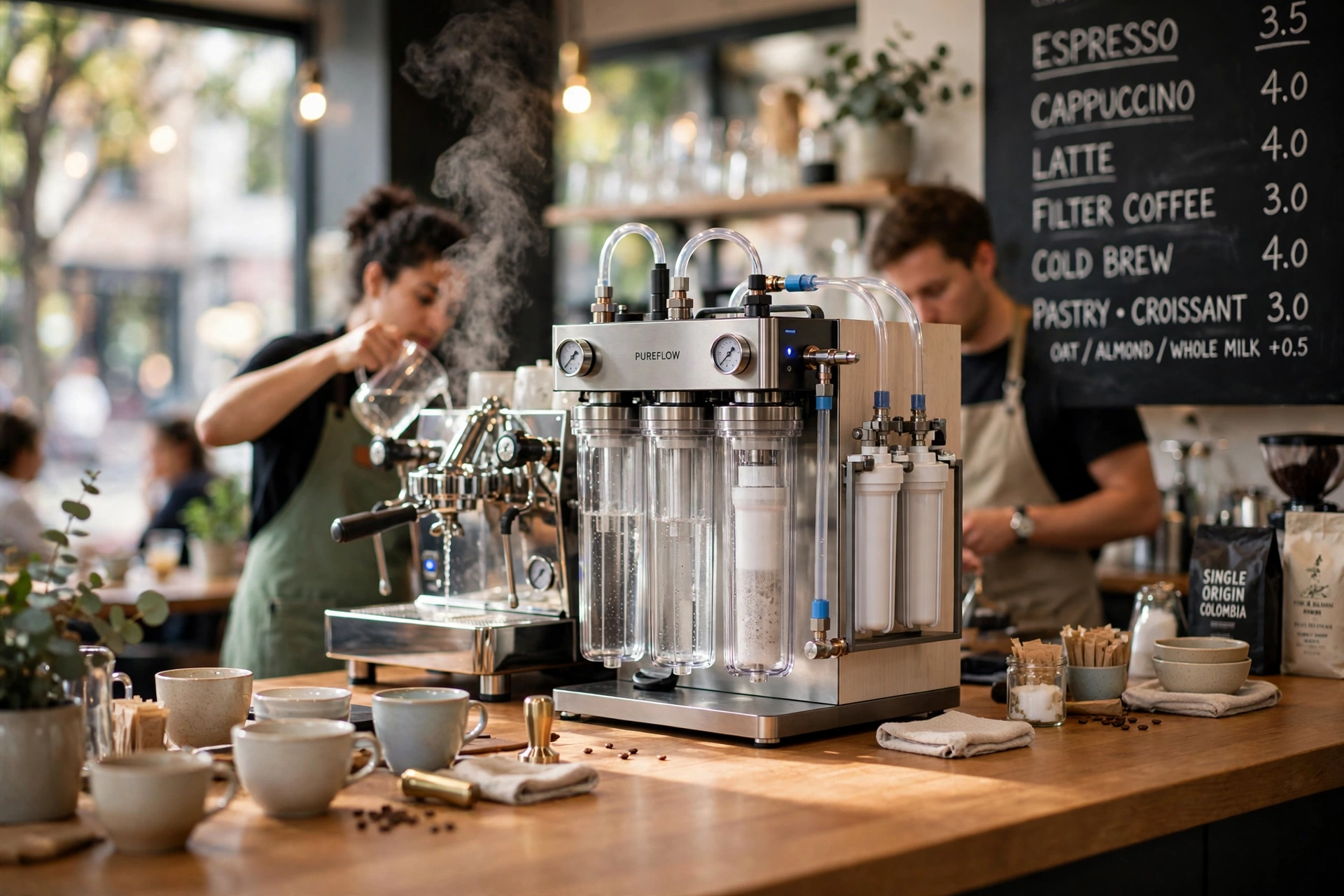
A water filtration coffee shop system is a professional-grade series of filters designed to remove impurities, adjust mineral content, and eliminate contaminants from the municipal water supply before it reaches the brewing equipment.
To answer simply, a water filtration system for a coffee shop is the critical infrastructure that ensures the water used for brewing is chemically balanced and biologically safe. Unlike home filters, these systems are built for high-flow rates and high-pressure environments, specifically targeting scale-forming minerals like calcium and magnesium that destroy commercial heating elements.
In a professional setting, filtration isn't just about removing the taste of chlorine. It is about "water chemistry." Coffee extraction is a chemical process where the water acts as a solvent. If the water is too "soft" (lacking minerals), the coffee will taste thin and sour. If it is too "hard" (excessive minerals), the coffee will taste chalky, and your equipment will suffer from scale buildup.
When we implement these systems at Busy Bean Coffee, we look for a balance between filtration and mineralization. Many high-end systems now use Reverse Osmosis (RO) combined with a mineralization cartridge to put back exactly the amount of magnesium and calcium required for optimal Coffea arabica extraction. This precision ensures that every shot of espresso tastes consistent from the first cup of the morning to the last cup of the shift.

Why Does Water Filtration Matter for Your Business?
Water filtration is the single most important factor in protecting your capital investment and ensuring a consistent product. The primary reason it matters is the prevention of "scale," which is the mineral buildup that occurs when water is heated. According to the NSF International standards for food equipment, maintaining water quality is essential for the longevity of heating elements and the safety of the beverage.
First, consider the impact on flavor. Pure, filtered water allows the nuanced notes of specialty coffee to shine. Chlorine, often found in city water, creates a chemical clash with the volatile oils in the coffee bean, resulting in a harsh, "swimming pool" aftertaste. By removing these odors, you allow the natural sweetness and acidity of the bean to be the star of the show. This is why businesses using high-quality commercial espresso machines must prioritize filtration; otherwise, the machine is simply brewing chlorine-flavored coffee at a high price point.
Second, there is the financial cost of downtime. Scale buildup acts as an insulator on your heating elements, meaning the machine has to work harder and run longer to reach the target temperature. This not only increases electricity costs but leads to premature burnout of the boilers. I've seen cafes lose thousands of dollars in revenue during a holiday weekend because a boiler failed due to scale. A properly filtered system prevents this, turning a potential catastrophe into a simple filter change.
Third, filtration impacts the consistency of your milk texturing and beverage presentation. Impurities in the water can affect the stability of the espresso crema, which in turn affects how the milk integrates into a latte. For those utilizing automatic milk frothers, clean water is just as important for the internal cleaning cycles of the machine to prevent biofilm buildup.
According to research by the Specialty Coffee Association (SCA), the ideal water for brewing should have a total dissolved solids (TDS) count between 150 and 250 mg/L. If your water falls outside this range, you aren't just risking your machine; you are actively degrading the quality of your product. This is why professional-grade filtration is not an optional accessory, but a core component of your coffee service infrastructure.
How to Implement Water Filtration in Your Coffee Shop
Implementing a filtration system requires a strategic approach based on your specific local water chemistry. You cannot simply buy a filter and hope for the best; you must first know what you are filtering.
Step 1: Perform a Water Analysis. Before buying any equipment, get a detailed report of your local water. In Mount Pleasant, SC, for example, the water profile differs significantly from what you'd find in a city like Chicago. You need to know your hardness (calcium/magnesium levels), alkalinity, and the presence of chlorine or chloramines. Without this data, you are guessing.
Step 2: Choose the Right Filtration Method. Depending on your analysis, you will choose between different technologies:
- Activated Carbon: Essential for removing chlorine and organic compounds that affect taste.
- Ion Exchange: Used for softening water by replacing calcium and magnesium ions with sodium ions.
- Reverse Osmosis (RO): The gold standard for purity, stripping almost everything out of the water. This is often paired with a remineralization stage to ensure the water isn't "too dead" for coffee extraction.
Step 3: Integration with Equipment. Your filtration system must be installed before the water reaches your coffee grinders for shops (if they have water connections) and your brewers. It should be placed in a location that allows for easy access during filter changes. At Busy Bean Coffee, we recommend a manifold system that can split one main filtration line into multiple machines, ensuring every piece of equipment receives the same quality of water.
Step 4: Establish a Maintenance Schedule. A filter is only effective until it is saturated. You must track your water usage in gallons and change cartridges according to the manufacturer's specifications. I have seen business owners ignore their filter light for six months, only to find their espresso machine's flow rate has dropped by 40% due to a clogged filter.
Step 5: Continuous Monitoring. Periodically test the output water using a TDS meter. This allows you to verify that the filter is still performing as expected and that your water chemistry hasn't shifted due to municipal changes.
💡
Key Takeaway
Water filtration is not a "set it and forget it" installation. It is a managed process that requires regular testing and scheduled maintenance to protect your equipment and flavor profile.
Water Filtration vs. Standard Softening
Many business owners mistake a standard water softener for a coffee filtration system. While they both deal with "hard water," their goals and outcomes are fundamentally different. A standard softener focuses on removing scale to protect pipes; a coffee filtration system focuses on optimizing flavor and machine health.
| Feature | Standard Water Softener | Generic Cheap Filter | Professional Coffee Filtration |
|---|---|---|---|
| Goal | Prevent pipe scale | Remove basic taste/odor | Optimize brew chemistry & machine life |
| Mineral Balance | Replaces Ca/Mg with Sodium | Random removal | Precision TDS management |
| Taste Impact | Can taste "salty" | Variable | Clean, neutral, flavor-enhancing |
| Equipment Protection | Moderate | Low (quick saturation) | High (specialized for boilers) |
| Maintenance | Salt refills | Simple swap | Scheduled professional service |
Generic filters often fail because they are designed for residential use and cannot handle the pressure and volume of a commercial environment. They saturate quickly and can even restrict water flow, causing your bean to cup machines to trigger "low water' warnings even when the tank is full. A professional system, such as those we provide at Busy Bean Coffee, is engineered for the specific thermal demands of commercial espresso brewing.

Common Mistakes to Avoid When Filtering Water
One of the most frequent errors I encounter is the "One Size Fits All" mentality. Many owners buy the same filter their friend used in a different city. However, water chemistry is local. A filter designed for the soft water of the Pacific Northwest will perform poorly in the hard water regions of the Southeast. Always base your purchase on a local water report.
Another mistake is neglecting the "bypass" or "fail-safe" mechanisms. If a filter becomes completely clogged, some systems will simply stop the flow of water, shutting down your entire operation. Other, lower-quality systems might allow unfiltered water to leak through to protect the flow, which means you are suddenly brewing with raw, hard water without even knowing it. Ensure your system has a reliable pressure gauge so you can see exactly when the filter is beginning to fail.
Furthermore, many shops forget to filter the water used for the ice machine or the dishwasher. While these aren't brewing coffee, scale buildup in an ice machine can lead to bacterial growth and equipment failure, and hard water in a dishwasher leaves spots on your glassware, which ruins the customer's visual experience. A holistic approach to water management is the only way to run a professional operation.
Finally, avoid the temptation to use bottled water in a commercial setting. While it seems like a quick fix for bad tap water, the logistics are a nightmare and the chemistry is inconsistent. Between the plastic waste and the labor cost of hauling jugs, it is an inefficient solution. A permanent, professional filtration system integrated into your commercial drip brewers is the only scalable solution for a growing business.
Frequently Asked Questions
Does water filtration really affect the taste of the coffee?
Yes, profoundly. Water is the solvent that extracts flavors from the coffee bean. If the water contains too much chlorine, it creates a chemical taste that masks the natural acidity and sweetness of specialty coffee. Conversely, if the water is too pure (distilled), it lacks the minerals needed to "grab" the flavors from the bean, resulting in a flat, tea-like brew. Professional filtration balances these minerals to ensure the best possible extraction.
How often should I change my water filters?
This depends entirely on your water volume and the quality of your source water. However, as a general rule, most commercial cartridges should be replaced every 3 to 6 months. The best way to track this is by monitoring the gallon count on your meter or using a calendar. Waiting until you notice a change in taste or a drop in water pressure usually means you've already waited too long, and scale may have already started forming in your machine.
Can I use a home water pitcher for my coffee shop?
Absolutely not. Home pitchers are designed for a family of four, not a business serving hundreds of customers. They cannot handle the flow rate required by commercial machines, and the filtration media is too weak to remove the levels of minerals found in high-volume commercial usage. Using a home filter in a business environment is a recipe for equipment failure and inconsistent coffee quality.
What is TDS and why does it matter for coffee?
TDS stands for Total Dissolved Solids. It is a measure of all the inorganic and organic substances dissolved in your water, expressed in milligrams per liter (mg/L). For coffee, TDS is the primary indicator of how the water will interact with the coffee grounds. Too high, and you get bitterness and scale; too low, and you get under-extraction. The Specialty Coffee Association suggests a target range that ensures a balanced, vibrant cup.
Is Reverse Osmosis (RO) better than carbon filtration?
RO is more powerful because it removes almost all dissolved solids, providing a "blank slate." However, for coffee, RO can be too effective, removing the minerals that help extract flavor. Therefore, the best systems use RO to clean the water and then a remineralization cartridge to add back specific amounts of calcium and magnesium. Carbon filtration alone is great for taste (removing chlorine), but it does not stop scale buildup as effectively as an RO/remineralization system.
Conclusion
Water filtration is the invisible foundation of every great cup of coffee. Without it, your expensive equipment is at risk, and your beans are not reaching their full potential. By investing in a professional water filtration coffee shop system, you are not just buying a filter; you are buying insurance for your machinery and a guarantee for your customers that every sip is perfect.
Whether you are just starting out or upgrading an existing space, remember that the chemistry of your water is just as important as the roast of your beans. For those looking to build a complete, high-performance beverage program from the ground up, we recommend reviewing our Ultimate Guide to Outfitting a Coffee Shop with Equipment to ensure no detail is overlooked.
If you are tired of worrying about scale and inconsistent flavor, Busy Bean Coffee provides all-inclusive managed solutions that take the guesswork out of your equipment and water needs. Visit us at www.busybeancoffee.com to see how we can streamline your coffee operations.
Free Coffee Pairing Guide & Specialty Roast Cheat Sheet
Unlock the secrets of perfect brewing ratios, water temperatures, and specialty roast profiles. Download the guide.