📖This article is part of the complete guide to Ultimate Guide to Commercial Coffee Brewers for Business.
Unexpected equipment downtime during a morning rush can cost a hospitality business upwards of $400 in lost revenue and customer goodwill in a single hour. In my experience working with mid-sized hotels and high-traffic cafes, the most expensive part of owning a coffee system isn't the initial purchase price, but the 'invisible' costs: scale buildup, gasket failures, and the labor hours spent troubleshooting a machine that refuses to prime. For a comprehensive overview of the hardware involved, explore our Ultimate Guide to Commercial Coffee Brewers for Business.
What is a Managed Coffee Service Commercial Model?
📚
Definition
A managed coffee service commercial model is an all-inclusive membership where a provider supplies high-end equipment, professional installation, ongoing maintenance, and premium coffee beans for a fixed monthly fee, eliminating the need for upfront capital expenditure.
When you opt for a managed coffee service commercial approach, you are essentially moving your coffee operation from a CapEx (Capital Expenditure) model to an OpEx (Operational Expenditure) model. Instead of spending $10,000 to $25,000 on a top-tier espresso machine or a fleet of high-volume brewers, you pay a predictable monthly subscription. This ensures that your technology remains current and your beverage quality stays consistent without the risk of owning an obsolete piece of hardware.
At Busy Bean Coffee, we've seen that the primary value of this model lies in the transfer of risk. In a traditional ownership model, if a boiler fails on a Tuesday morning, the business owner is responsible for finding a technician, paying a premium for emergency service, and managing the lost productivity. In a managed service, that risk is absorbed by the provider. The focus shifts from 'maintaining a machine' to 'delivering a beverage experience.'

This model is particularly effective for businesses that lack a dedicated on-site technician. For example, a medical clinic using Automated Coffee Machines for Clinics and Medical Offices cannot afford to have staff spending two hours a week cleaning group heads or descaling boilers. The managed service ensures that a certified technician handles the technical load, allowing the staff to focus on patient care while the coffee remains at a specialty grade.
Why Does the Choice Between Managed and Owned Matter for Your Bottom Line?
Choosing between a managed coffee service commercial model and ownership directly impacts your cash flow and the long-term scalability of your beverage program. The most critical factor is the Total Cost of Ownership (TCO). While owning a machine seems cheaper over a five-year horizon on paper, the reality of 'technical debt'—the accumulating cost of repairs and inefficiency—often makes ownership more expensive in real-world applications.
According to the Specialty Coffee Association (SCA), maintaining precise temperature stability and water chemistry is essential for specialty coffee quality. For an owner, this means investing in expensive reverse osmosis systems and spending hours on calibration. For a managed service client, these standards are baked into the monthly fee. If the water quality slips or the temperature drifts, the service provider corrects it as part of the agreement, ensuring that the Coffea arabica beans are never wasted through poor extraction.
From a financial perspective, the benefits of managed services include:
- Zero Initial Capital Outlay: You preserve your cash reserves for marketing or staffing rather than tying up thousands of dollars in depreciating hardware.
- Predictable Budgeting: A fixed monthly fee removes the 'surprise' $1,200 repair bill that often disrupts quarterly budgets.
- Guaranteed Uptime: Service Level Agreements (SLAs) in managed models typically guarantee repair times that are significantly faster than calling a third-party technician.
- Automatic Upgrades: As coffee technology evolves—such as the move toward more energy efficient commercial coffee brewers—managed services allow you to upgrade without selling old gear at a loss.
In my experience, businesses in fast-growing hubs like those utilizing Sensa Coffee Service in Charlotte, NC find that the ability to scale their equipment capacity without a massive new loan is a significant competitive advantage. They can add more brewers as their guest count grows without impacting their immediate liquidity.
How to Transition from Ownership to a Managed Coffee Service?
Moving from a traditional ownership model to a managed service requires a shift in how you view your assets. You are no longer buying a tool; you are buying a result. The process involves auditing your current volume, identifying your quality gaps, and aligning your monthly budget with your growth projections.
Step 1: Conduct a Volume and Quality Audit
Track exactly how many gallons of coffee or shots of espresso you produce daily. Analyze the downtime you've experienced over the last twelve months. If you are spending more than four hours a month on basic maintenance, your current ownership model is draining your labor productivity.
Step 2: Define Your Beverage Standard
Determine if you need a simple drip system or a full-scale espresso program. If you are targeting a high-end demographic, you'll need equipment capable of handling specialty coffee with precision. For those in high-traffic areas, you might consider high volume commercial coffee brewers that can keep up with demand without sacrificing flavor.
Step 3: Evaluate the Service Agreement
Look for 'all-inclusive' terminology. A true managed coffee service commercial model should cover installation, preventative maintenance, emergency repairs, and the coffee supply. If the contract excludes 'wear and tear' parts like gaskets and screens, it is not a fully managed service; it is a lease.
Step 4: Integrate with Existing Workflow
Ensure the equipment fits your counter space and power requirements. At Busy Bean Coffee, we handle the site survey to ensure that your electrical load can handle the new machinery without tripping breakers—a common mistake when businesses try to DIY their equipment upgrades.
Step 5: Staff Training
Even the best machine fails if the barista is untrained. A managed service should include ongoing training. Whether you are using single serve commercial brewers for a lobby or a complex espresso setup, the human element is where the quality is actually delivered.
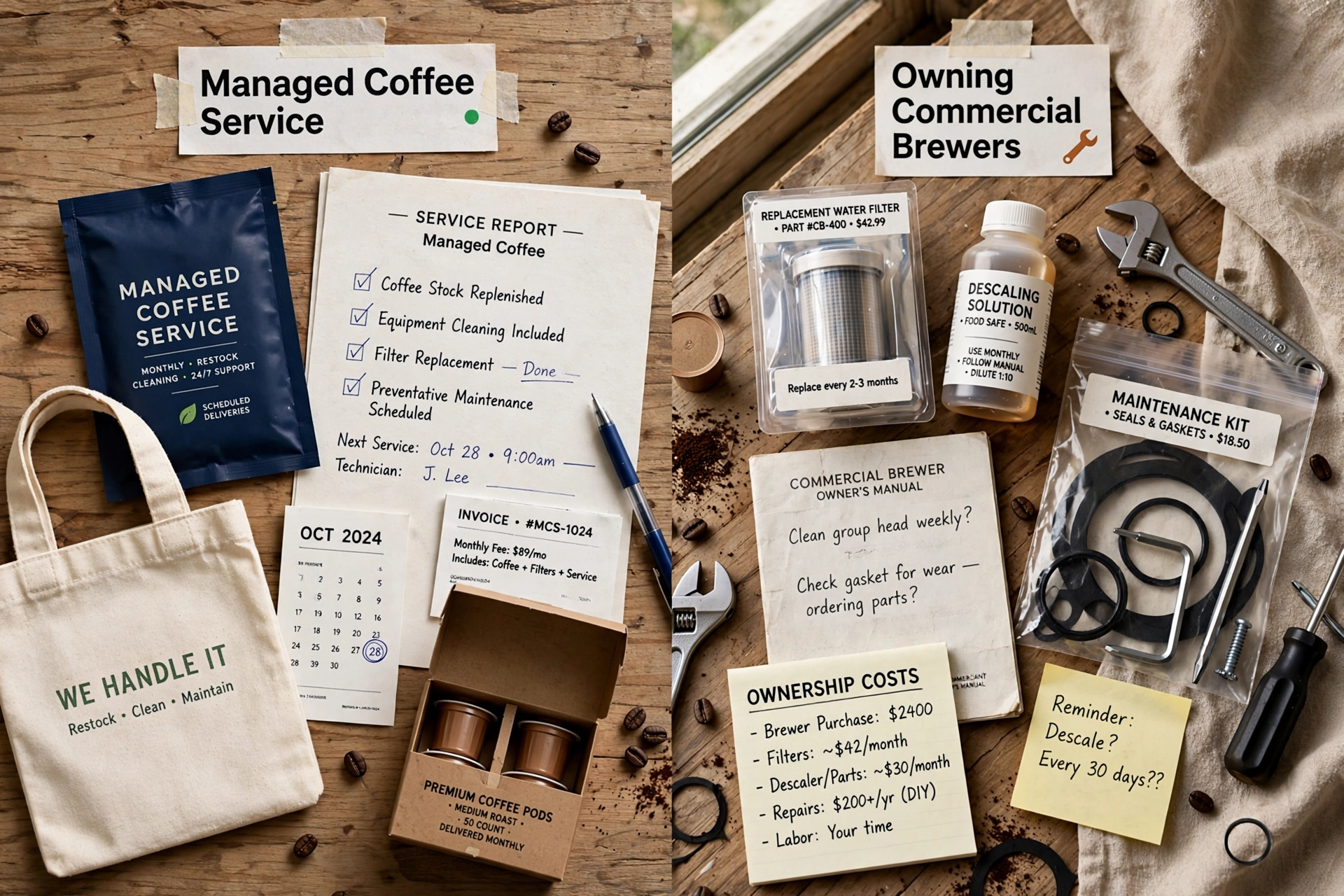
Managed Coffee Service vs. Owning Commercial Brewers
To help you visualize the trade-offs, I have compiled a comparison of the three most common ways businesses handle their coffee infrastructure in 2026.
| Feature | Traditional Ownership | Generic/Cheap Lease | Busy Bean Managed Service |
|---|---|---|---|
| Upfront Cost | Very High (CapEx) | Moderate | Zero (OpEx) |
| Maintenance | Owner's Responsibility | Reactive (Break/Fix) | Proactive & Preventative |
| Equipment Quality | Varies by Budget | Entry-Level/Generic | Premium SENSA Equipment |
| Coffee Quality | Inconsistent | Commodity Grade | Specialty Grade (SCA Standard) |
| Risk Management | High (Downtime = Loss) | Moderate (Slower Repair) | Low (Guaranteed Uptime) |
| Upgradability | Difficult/Expensive | Occasional | Seamless & Integrated |

As the table demonstrates, the Traditional approach puts all the risk on the business owner. The Generic lease provides a middle ground but often lacks the professional oversight needed to maintain specialty coffee standards. The Managed approach provided by Busy Bean Coffee removes the friction entirely, treating coffee as a utility rather than a liability.
Common Mistakes When Choosing a Coffee Model
One of the most frequent errors I see is the 'Cheap Machine Trap.' A business owner buys a mid-range brewer, thinking they've saved money. However, because that machine lacks the thermal stability of a professional unit, they end up wasting 15% of their coffee beans due to poor extraction and inconsistent taste. This is a hidden cost that often exceeds the monthly fee of a managed service.
Another mistake is ignoring the water quality. According to NSF International, improper water filtration is the leading cause of equipment failure in commercial food service. Owners often forget to change filters every six months, leading to scale buildup that destroys the heating element. In a managed model, this is handled automatically, preventing the catastrophic failure of the machine.
Finally, many businesses underestimate the cost of labor. When you own the machine, your most expensive employee—perhaps a manager or a lead barista—is the one scrubbing the machine or calling the repair company. When you use a managed service, like those deployed via Sensa Coffee Service in Jacksonville, FL, that labor is shifted back to revenue-generating activities.
💡
Key Takeaway
The true cost of owning a coffee brewer is not the price tag on the box, but the cost of the labor and lost revenue associated with its maintenance and failure.
Frequently Asked Questions
Is a managed coffee service more expensive in the long run than owning?
While the cumulative monthly payments over five years may exceed the initial purchase price of a machine, the TCO (Total Cost of Ownership) is usually lower. Ownership costs include unplanned repairs, technician call-out fees, filter replacements, and the inevitable loss of value as the machine depreciates. Managed services bundle these costs into a predictable fee, effectively hedging against inflation and equipment failure. For most businesses, the tax advantages of an OpEx model (deducting the service as a monthly operating expense) outweigh the depreciation benefits of ownership.
How does coffee quality differ between managed and owned services?
Quality depends on the beans and the calibration, not the ownership model. However, managed services typically provide a higher baseline of quality because they include professional calibration and specialty-grade coffee. When you own a machine, quality often dips as the equipment ages and isn't serviced. With a managed service, the provider is incentivized to keep the machine in peak condition to avoid service calls, ensuring that every cup of specialty coffee meets the rigorous standards of the National Coffee Association USA (NCA).
What happens if the equipment breaks down in a managed service?
In a professional managed coffee service commercial agreement, downtime is minimized through a Service Level Agreement (SLA). Typically, the provider offers a guaranteed response time, often within 24-48 hours, and may provide a loaner machine if the primary unit cannot be fixed on-site. This eliminates the 'panic phase' where an owner must search for a qualified technician who is available and knows the specific brand of machine, which can often take several days during peak seasons.
Can I choose my own coffee beans with a managed service?
Most premium managed services, including Busy Bean Coffee, provide exclusive access to high-quality roasts that are specifically calibrated for the equipment provided. While some providers allow outside beans, doing so can sometimes void the warranty or affect the calibration of the machines. We believe that the synergy between the roast profile and the machine's pressure and temperature settings is what creates the 'perfect cup,' which is why we integrate the supply chain into the service.
Are managed services only for large corporations?
Absolutely not. Managed services are actually more beneficial for small to mid-sized businesses that cannot afford a full-time maintenance staff. Whether you are a boutique hotel using Sensa Coffee Service in Savannah GA or a small medical office, the ability to have professional-grade equipment without a $20,000 upfront investment levels the playing field, allowing small businesses to offer the same coffee quality as a global chain.
Conclusion
Deciding between a managed coffee service commercial model and ownership comes down to how you value your time and your risk. Ownership offers total control but demands total responsibility for every leak, clog, and calibration error. A managed service transforms your coffee program into a reliable utility, ensuring that your guests and employees always have access to premium beverages without the operational headache.
If you are currently struggling with unpredictable repair bills or inconsistent brew quality, it may be time to shift your strategy. By moving to a membership model, you eliminate capital risk and ensure your business always has the latest in brewing technology. For a deeper dive into the hardware options available for your specific business needs, we recommend visiting our Ultimate Guide to Commercial Coffee Brewers for Business.
Stop managing machines and start managing your guest experience. Discover how Busy Bean Coffee can streamline your beverage program at www.busybeancoffee.com.
Free Coffee Pairing Guide & Specialty Roast Cheat Sheet
Unlock the secrets of perfect brewing ratios, water temperatures, and specialty roast profiles. Download the guide.