📖This article is part of the complete guide to Ultimate Guide to Commercial Coffee Brewers for Business.
In my experience working with high-traffic hotels and bustling breakfast diners, the most expensive mistake a manager can make is underestimating peak-hour volume. I once saw a 200-room hotel lose an estimated 15% of its morning revenue simply because their equipment couldn't keep up with the 8:00 AM rush, resulting in lines that stretched out the door and guests who gave up and left. When you are dealing with hundreds of guests per hour, a standard brewer isn't just slow; it's a bottleneck that actively drains your profit margins.
For a comprehensive overview of all equipment options, explore our Ultimate Guide to Commercial Coffee Brewers for Business.
What are High Volume Commercial Coffee Brewers?
📚
Definition
High volume commercial coffee brewers are industrial-grade brewing systems specifically engineered to produce large quantities of coffee rapidly, maintaining temperature and flavor consistency across dozens of gallons per hour.
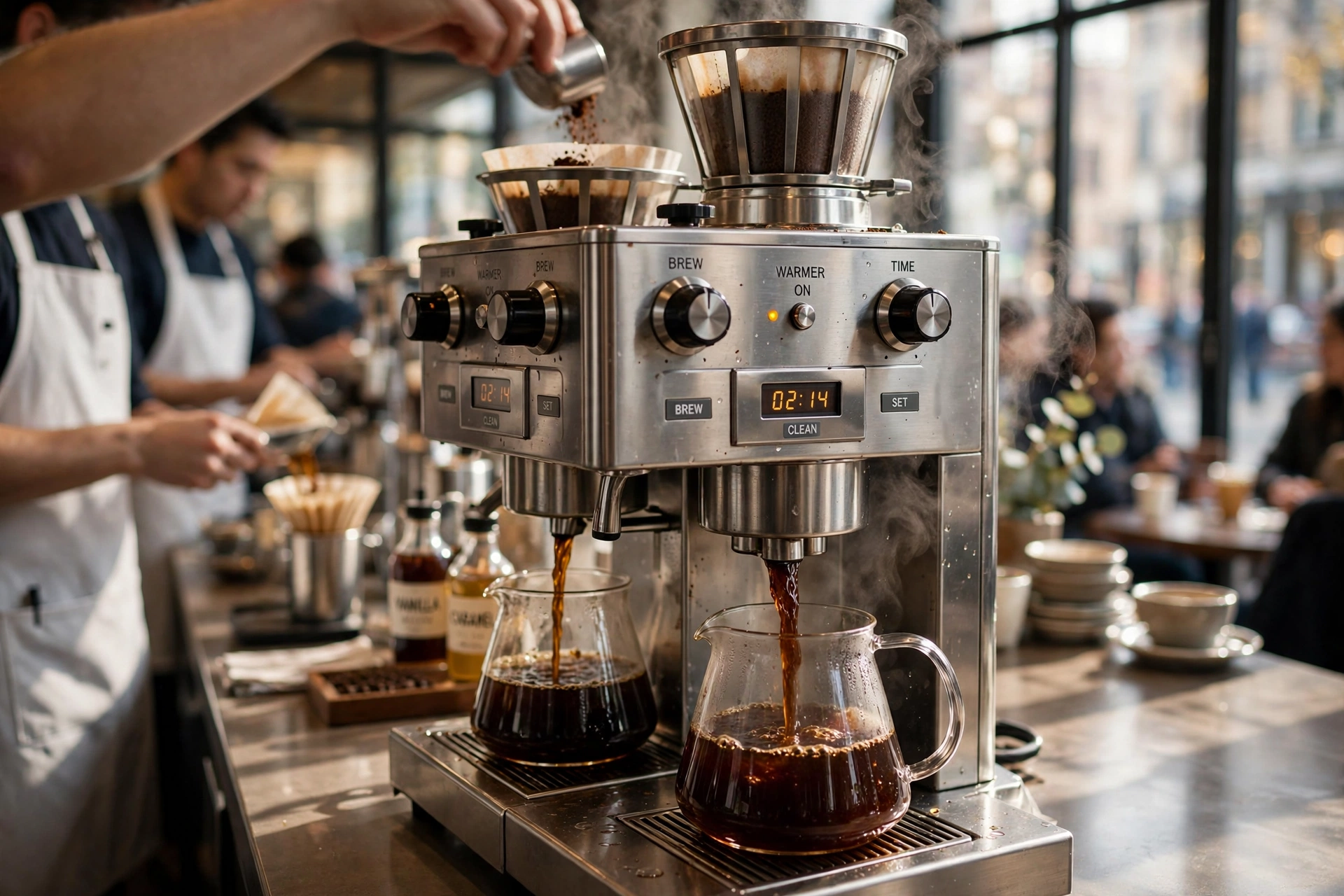
High volume commercial coffee brewers differ from standard commercial machines primarily in their thermal stability and reservoir capacity. While a small business brewer might handle 2 to 4 gallons a day, high-volume systems are built to output 20 to 100+ gallons daily without experiencing 'thermal drift,' where the water temperature drops during consecutive brew cycles. These systems often utilize high-capacity boilers and precision-controlled heating elements to ensure that the 50th cup of the morning tastes exactly like the first.
When we analyze the hardware at Busy Bean Coffee, we look for specific markers of high-volume capability: heavy-duty stainless steel construction, rapid-recovery boilers, and the ability to interface with automated water filtration systems. These machines are designed to handle the rigors of a 2026 foodservice environment where speed is non-negotiable. To understand how these fit into the broader landscape, you might want to check our Types of Commercial Coffee Brewers Explained.

Why Does High Volume Brewing Matter for Your Business?
High volume commercial coffee brewers are essential because they decouple your revenue potential from your equipment's physical limitations. In a high-traffic venue, your throughput is your ceiling. If your machine takes 10 minutes to brew a pot and you only have two burners, your maximum capacity is fixed regardless of how many staff members you hire. By implementing high-capacity systems, you effectively raise that ceiling, allowing you to serve more customers in less time.
According to the National Coffee Association USA (NCA), coffee consumption patterns have shifted toward high-quality, specialty-grade brews even in fast-paced environments. This means you cannot simply switch to 'industrial' coffee that tastes like charcoal just to move volume; you must maintain the integrity of the specialty coffee while scaling the output. High-volume brewers allow for this balance by utilizing precision brewing ratios that ensure a consistent extraction of Coffea arabica beans, even when brewing 5 gallons at a time.
Furthermore, the operational efficiency gained from these machines reduces labor stress. When a barista is fighting with a slow machine during a rush, errors increase and morale drops. A high-capacity system allows the staff to focus on customer service rather than equipment troubleshooting. If you are operating in a high-growth area, such as implementing a Sensa Coffee Service in Charlotte, NC, the ability to scale your beverage program without replacing hardware every year is a significant financial advantage.
Moreover, the ROI of high-volume equipment is found in the reduction of waste. Lower-end machines often produce 'burnt' coffee when held in thermal carafes for too long because the initial brew temperature was inconsistent. High-volume professional brewers utilize precise temperature controls to ensure the coffee stays fresh longer, reducing the amount of liquid poured down the drain. For those concerned about the overhead of these larger systems, comparing them to Energy Efficient Commercial Coffee Brewers Guide can help balance the power draw with the production needs.
How to Implement High Volume Brewing in Busy Venues
Implementing a high-volume system requires more than just plugging in a machine; it requires a strategic layout designed for 'flow.' The core approach is to separate the brewing zone from the serving zone to prevent staff collisions. In my experience, a 'linear flow' layout—where the coffee moves from the brewer to a staging area and then to the guest—reduces service time by up to 20%.
- Capacity Calculation: Start by calculating your 'Peak Hour Volume.' Multiply your average guest count during your busiest 60 minutes by 1.2 (to account for growth). If you need 100 cups per hour, you need a system capable of producing at least 6.25 gallons per hour without downtime.
- Water Filtration Integration: High-volume machines move massive amounts of water. According to NSF International, water quality is the primary factor in equipment longevity. You must install a commercial-grade filtration system to prevent scale buildup, which is the number one killer of high-volume boilers.
- Thermal Management: Use insulated thermal servers instead of hot plates. Hot plates continue to cook the coffee, destroying the delicate notes of the coffee bean. Thermal carafes keep the brew hot for hours without changing the flavor profile.
- Staff Training: Ensure your team understands the 'brew-to-serve' cycle. A high-volume system is only effective if the next pot is started before the current one is empty.
For venues that need this level of scale but lack the internal expertise to manage it, a Sensa Coffee Service in Raleigh NC (2026 Overview) provides the equipment and the maintenance necessary to keep these heavy-duty machines running. If your volume is slightly lower but still requires professional output, you might consider looking at Best Drip Coffee Makers for Commercial Use.
High Volume Approach vs. Traditional Methods
When scaling a coffee program, business owners typically choose between three paths. The traditional way is often a recipe for failure in a 2026 market, while the generic AI-driven 'cheap' approach often leads to hardware failure.
| Feature | Traditional Approach | Generic/Cheap AI Approach | Modern High-Volume Approach |
|---|---|---|---|
| Throughput | Low (Slow brew cycles) | Moderate (Fast but inconsistent) | High (Rapid, consistent output) |
| Quality | Variable (Burnt/Under-extracted) | Low (Generic taste, high waste) | Premium (Specialty Coffee grade) |
| Maintenance | Reactive (Fix when broken) | Neglected (Cheap parts fail) | Proactive (Managed service/NSF standards) |
| Labor | High (Constant monitoring) | Moderate (Frequent errors) | Low (Automated/Efficient flow) |
As the table demonstrates, the Modern Approach—which we champion at Busy Bean Coffee—focuses on the intersection of speed and quality. Many businesses try to use 'Generic' machines that claim high output but lack the thermal mass to actually deliver it. This results in 'temperature crashing,' where the water temperature drops mid-brew, leading to sour, under-extracted coffee that guests will complain about.

Common Mistakes to Avoid When Scaling Volume
One of the most frequent mistakes I see is the 'Single-Point Failure' trap. Businesses buy one massive brewer and assume they are covered. However, if that one machine goes down during a Monday morning rush, the entire revenue stream for that category stops. I always recommend a redundant system: two medium-high volume brewers instead of one giant one. This ensures that you can still operate at 50% capacity during a maintenance window.
Another critical error is neglecting the coffee roasting profile. High-volume brewing can amplify certain taste defects in lower-grade beans. When brewing in bulk, the surface area for oxidation increases. If you are using low-quality beans, the bulk-brewed coffee will taste flat and bitter. We recommend using a medium-light roast of Arabica coffee to maintain brightness and acidity even in large thermal dispensers.
Avoid the temptation to skip the water filtration system to save on initial capital expenses. Scale buildup in a high-volume boiler is exponentially more destructive than in a small home machine. A single layer of calcium scale can reduce heating efficiency by 10%, leading to higher electricity bills and inconsistent brew temperatures. Following the guidelines provided by the U.S. Food and Drug Administration (FDA) regarding equipment sanitation is also non-negotiable; high-volume machines have more crevices where coffee oils can build up and turn rancid.
Finally, do not ignore the 'last mile' of the coffee experience. There is no point in having a high-volume brewer if your pouring station is a mess. Invest in high-quality dispensers and organized stir-and-sugar stations. If the guest has to wait 3 minutes to find a lid after the coffee was brewed in 30 seconds, you have simply moved the bottleneck from the machine to the counter. For those operating in smaller capacities, our guide on Commercial Coffee Brewers for Small Businesses offers a different perspective on balancing efficiency with lower volumes.
Frequently Asked Questions
How do I determine if my venue needs a high-volume brewer?
If your current equipment takes more than 5 minutes to replenish a pot during peak hours, or if you have a queue of more than 5 guests waiting specifically for coffee, you have exceeded your current capacity. High-volume brewers are necessary when your 'demand rate' exceeds your 'brew rate.' Calculate your peak hourly volume; if you are serving more than 40 guests per hour, a dedicated high-volume system is the only way to maintain quality and speed without increasing labor costs.
Does high volume brewing affect the taste of specialty coffee?
It can, but not if the equipment is professional. The main risk is 'thermal degradation' and over-extraction. Professional high-volume brewers solve this by using precision temperature control and optimized showerheads that distribute water evenly across the coffee bed. When using high-quality specialty coffee, these machines ensure that the flavor profile is preserved across the entire batch, avoiding the bitter taste associated with cheap, large-batch machines.
How often should high-volume machines be serviced?
Due to the sheer volume of water and coffee passing through the system, high-volume machines should undergo a professional deep-clean and calibration every quarter. This includes descaling the boiler, replacing seals, and verifying that the brew temperature matches the SCA standards. Neglecting this leads to a gradual decline in taste and an eventual catastrophic failure of the heating element, which is far more expensive than preventative maintenance.
Can I use an espresso machine for high-volume drip coffee?
No, these are entirely different technologies. An espresso machine is designed for high-pressure, low-volume extraction, whereas a high-volume brewer is designed for gravity-fed, large-batch extraction. Using an espresso machine to try and meet the demand for 'black coffee' will result in extremely slow service and likely burn out the pump. For a mix of both, we suggest a tiered approach: a high-volume brewer for batch coffee and a professional espresso machine for specialty drinks.
What is the typical ROI for upgrading to a high-volume system?
Most venues see a return on investment within 6 to 12 months. This comes from three sources: increased throughput (more guests served per hour), reduced waste (less coffee thrown away due to quality issues), and lower labor costs (staff spend less time managing the machine). In some cases, upgrading can increase morning coffee revenue by 15-20% simply by eliminating the 'wait-time' friction that causes guests to skip the coffee station.
Conclusion
Scaling your beverage program in 2026 requires a shift from a 'consumer' mindset to an 'industrial' mindset. High volume commercial coffee brewers are not just a luxury; they are the engine that allows a busy venue to maximize its revenue potential without sacrificing the quality of the guest experience. By focusing on thermal stability, water filtration, and linear flow, you can transform your coffee station from a bottleneck into a profit center.
Whether you are managing a hotel in Mount Pleasant, SC, or a corporate office in a major city, the goal remains the same: delivering a perfect cup of coffee at scale. If you want to explore how these systems integrate with a wider business strategy, return to our Ultimate Guide to Commercial Coffee Brewers for Business.
For those who want a truly seamless experience, Busy Bean Coffee offers all-inclusive managed memberships that remove the stress of equipment ownership. Stop worrying about boiler failures and start focusing on your guests. Visit www.busybeancoffee.com to see how we can scale your coffee program today.
Free Coffee Pairing Guide & Specialty Roast Cheat Sheet
Unlock the secrets of perfect brewing ratios, water temperatures, and specialty roast profiles. Download the guide.