📖This article is part of the complete guide to Ultimate Guide to Commercial Coffee Brewers for Business.
Reducing overhead in a high-volume foodservice environment often starts with the equipment that never stops running. In my experience working with hotels and cafes, the coffee station is frequently the largest hidden energy drain, with old boilers consuming power even during the slowest hours of the mid-afternoon slump. Switching to energy efficient commercial coffee brewers isn't just an environmental choice; it is a direct strategy to reclaim your profit margins.
For a comprehensive overview of the equipment landscape, explore our Ultimate Guide to Commercial Coffee Brewers for Business.
What are Energy Efficient Commercial Coffee Brewers?
📚
Definition
Energy efficient commercial coffee brewers are professional-grade machines engineered with advanced thermal management, precision heating elements, and intelligent standby modes to minimize kilowatt-hour (kWh) consumption without compromising brew quality.
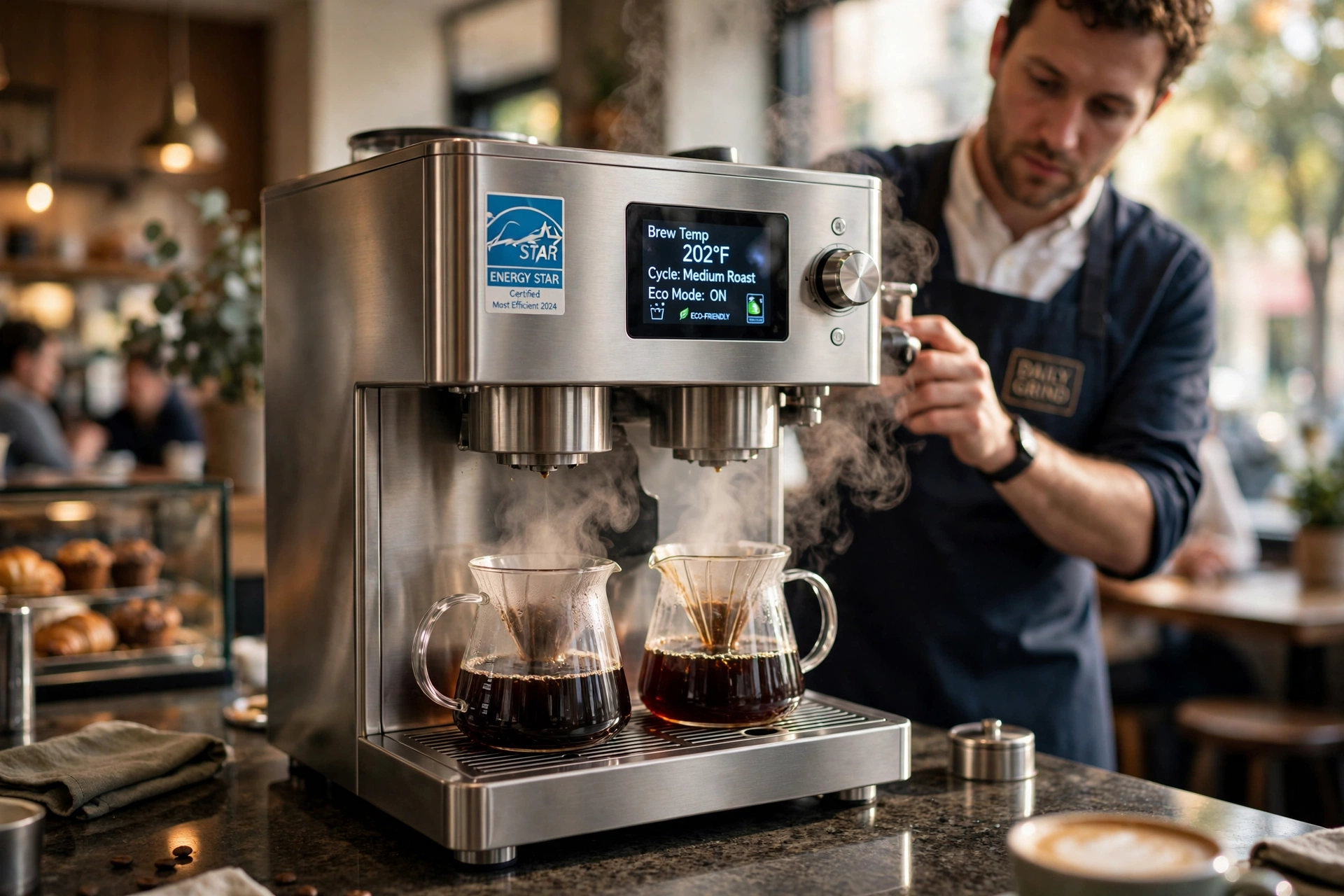
Energy efficient commercial coffee brewers utilize a combination of hardware and software to ensure that heat is only applied when and where it is needed. Traditional machines often rely on large, constantly heated boilers that waste immense amounts of energy maintaining a specific temperature 24/7. In contrast, modern efficient systems employ "on-demand" heating or highly insulated thermoblocks. This means the machine only heats the exact volume of water required for the current cycle, drastically reducing the standby energy load.
When we built the equipment standards for Busy Bean Coffee, we discovered that the most significant energy waste occurs during the "idle phase." By integrating sensors and programmable timers, energy efficient models can enter a deep-sleep mode during non-peak hours, which can reduce energy consumption by up to 40% in low-traffic environments. This technology is especially critical for businesses in areas like Mount Pleasant, SC, where seasonal traffic fluctuations make constant high-power draw unnecessary.

Why Does Energy Efficiency Matter for Your Business?
Energy efficiency in coffee brewing matters because utility costs are a volatile variable that can erode a thin profit margin. In a typical 2026 commercial kitchen, a standard inefficient brewer can account for a disproportionate percentage of the electricity bill due to the high wattage required for boiling water. By prioritizing energy efficient commercial coffee brewers, businesses can see an immediate reduction in operational expenses, which can then be reinvested into higher quality specialty coffee beans or staff training.
According to the Specialty Coffee Association (SCA), maintaining precise water temperature is fundamental to extracting the complex flavors of Coffea arabica. Efficiency allows for this precision without the brute-force energy waste of older systems. When a machine can hit 200°F and hold it with minimal wattage, the consistency of the cup improves while the cost per brew drops. This is a key consideration for those implementing a Sensa Coffee Service in Charleston SC or other high-traffic coastal hubs.
Beyond the balance sheet, energy-efficient equipment reduces the heat load in the kitchen. In many small cafes, the heat generated by an inefficient boiler forces the air conditioning system to work harder, creating a double-cost penalty. Transitioning to a more efficient setup mitigates this thermal load, improving the working environment for your barista and reducing overall HVAC costs. For businesses scaling their operations, exploring high volume commercial coffee brewers that prioritize energy recovery is the most sustainable path to growth.
How to Implement Energy Saving Strategies in Your Coffee Program
Implementing energy efficiency requires a shift from "always-on" thinking to "precision-on" management. The first step is conducting an energy audit of your current brewing station. Use a simple plug-in power meter to determine how many kWh your current machine consumes during a 24-hour cycle, including the overnight period. You will likely find that the standby power is the primary culprit.
- Transition to On-Demand Heating: Replace old-style large tank boilers with thermoblock or instant-heat systems. These systems heat water as it flows through the pipe, eliminating the need to keep gallons of water hot for hours.
- Program Intelligent Scheduling: Use the programmable timers found in modern energy efficient commercial coffee brewers to align the machine's peak power with your peak foot traffic. If your cafe doesn't open until 7 AM, the machine should not be at full temperature at 4 AM.
- Optimize Water Filtration: Scale buildup in heating elements acts as an insulator, forcing the machine to use more energy to heat the water. Regular maintenance and high-quality filtration ensure that the heating elements operate at maximum efficiency. This is a core part of our managed coffee service approach.
- Pair with Energy-Saving Accessories: If you use thermal carafes, ensure they are high-grade vacuum insulated. This reduces the need for hot plates, which are notorious energy hogs that also degrade the flavor of the coffee over time. If you are running a small business coffee setup, avoiding hot plates is the fastest way to cut costs.
In my experience, the most overlooked part of this process is the "human element." Training your staff to turn off non-essential equipment during the mid-day lull can save an additional 5-10% in energy costs. When we analyze businesses using our SENSA equipment, the data shows that those who utilize the automated power-down features see a significantly higher ROI than those who leave machines on manual settings.
Comparing Brewing Approaches
To understand the value of moving toward energy-efficient systems, we must compare the traditional industry standards against modern alternatives. The transition is not just about the machine, but the entire philosophy of water and heat management.
| Feature | Traditional Boiler Approach | Cheap Generic AI/Automation | Modern Energy-Efficient (Sensa/Busy Bean) |
|---|---|---|---|
| Power Draw | High constant load; wastes energy during idle | Variable; often lacks precision thermal control | Optimized on-demand heating; intelligent standby |
| Temperature Stability | Fluctuates as boiler empties | Inconsistent; relies on basic timers | Precision PID control; stable to the degree |
| Operational Cost | High monthly utility bills | Low upfront cost, high long-term waste | Predictable monthly cost via managed membership |
| Impact on Flavor | Potential for burnt coffee on hot plates | Inconsistent extraction due to temp drops | Preserves specialty coffee profiles |
As seen in the table, the generic approach often mimics efficiency through basic timers, but it lacks the professional thermal management required for high-quality coffee roasting profiles. The professional modern approach, such as that provided by Busy Bean Coffee, integrates hardware that minimizes waste while maximizing the extraction of Arabica coffee.

Common Mistakes When Selecting Efficient Brewers
One of the most frequent mistakes I see is the "Efficiency Paradox," where a business buys a machine with a low energy rating but fails to implement a proper water filtration system. According to NSF International, mineral buildup can drastically reduce the efficiency of heating elements. If you have hard water and no filter, an "energy efficient" machine will eventually become an energy hog as the heater struggles to push through calcium deposits.
Another mistake is ignoring the "Total Cost of Ownership" (TCO). Some businesses choose the cheapest possible energy-efficient model, which often uses lower-grade components that fail after 18 months of heavy commercial use. In a high-volume setting, a machine that breaks down requires a replacement that consumes more energy during manufacturing and transport than the original machine saved in electricity. This is why we emphasize the importance of commercial-grade drip coffee makers built for longevity.
Finally, avoid relying solely on "Eco-Modes" without testing them. Some low-end machines have a sleep mode that takes so long to wake up that baristas simply disable it to keep up with the morning rush. True energy efficiency must be seamless. If the transition from standby to brew takes more than 30 seconds, it will be ignored by your staff, and your energy savings will vanish. This is why the precision engineering in our Sensa Coffee Service in Charlotte, NC is designed for speed and efficiency simultaneously.
Deep Dive: The Physics of Thermal Extraction
To truly understand why energy efficient commercial coffee brewers are superior, we need to look at the thermodynamics of the brewing process. Coffee extraction is a chemical reaction that is highly dependent on temperature. If the water is too cool, the coffee is under-extracted and sour; too hot, and it becomes bitter and burnt.
Traditional boilers use a "reservoir" method. They heat a large volume of water and keep it there. This creates a constant state of evaporation and heat loss through the metal walls of the boiler. Energy efficient systems use a process called "flash heating" or "precision thermoblocks." Instead of a tank, water passes through a coiled heating element. The surface area contact is maximized, meaning the water reaches the target temperature (typically 195°F to 205°F) in a fraction of a second.
This transition reduces the "thermal mass" of the machine. A smaller thermal mass means the machine requires less energy to reach its operating temperature and can be powered down more aggressively without affecting the quality of the first cup of the day. For those exploring single serve commercial brewers, this is the primary reason why pod-based systems often feel more energy-efficient than large-batch brewers.
Frequently Asked Questions
How much can a business actually save by switching to energy efficient commercial coffee brewers?
While savings vary by volume, most businesses report a 15% to 25% reduction in the specific electricity costs associated with their coffee program. For a high-volume venue, this can equate to hundreds of dollars per month. The savings come not just from the active brewing cycle, but from the massive reduction in "phantom load"—the energy the machine consumes while sitting idle. When combined with a managed membership, these costs become a predictable monthly fee, removing the volatility of utility spikes.
Do energy efficient brewers affect the taste of the coffee?
On the contrary, they often improve it. Traditional boilers can suffer from "temperature drift," where the water temperature fluctuates as the tank empties. Energy efficient systems using PID (Proportional-Integral-Derivative) controllers maintain a rock-steady temperature. This precision ensures that the specialty coffee is extracted perfectly every time, avoiding the bitterness associated with overheating. High-end baristas prefer these systems because they offer a level of control that old-school boilers simply cannot match.
How does water filtration impact the energy efficiency of my brewer?
Water filtration is the unsung hero of energy efficiency. In regions with hard water, minerals like calcium and magnesium precipitate out of the water and coat the heating elements. This creates a layer of "scale" that acts as an insulator. The heating element must then work much harder and run longer to heat the water through that crust. By using a professional filtration system, you ensure the heating element is in direct contact with the water, maintaining the machine's factory-rated energy efficiency and extending its lifespan.
Are these machines more expensive to purchase upfront?
Generally, yes. The precision components—such as thermoblocks and electronic controllers—cost more than a simple heating element and a metal tank. However, this is where the Busy Bean Coffee model changes the game. Instead of a massive capital expenditure (CapEx), our managed membership converts the cost into a predictable monthly operating expense (OpEx). You get the most energy-efficient, top-tier SENSA equipment without the upfront price tag, allowing the energy savings to contribute to your ROI from day one.
Which is more efficient: a large batch brewer or a single-serve system?
From a per-cup perspective, a high-efficiency large batch brewer is generally more energy-efficient if you are serving 50+ cups per hour, because it heats a large volume of water in one cycle. However, for low-volume offices or boutique hotels, a single-serve system is far more efficient because it only heats the exact amount of water needed for one cup, eliminating the waste of brewing a full pot that may end up being thrown away. The choice depends entirely on your specific volume and traffic patterns.
Conclusion
Investing in energy efficient commercial coffee brewers is no longer just a "green" initiative; it is a financial necessity in 2026. By reducing phantom loads, utilizing on-demand heating, and maintaining equipment through proper filtration, foodservice businesses can significantly lower their overhead while increasing the quality of their beverage service. Whether you are operating a small cafe in Mount Pleasant, SC or a large hotel in a major city, the move toward precision thermal management is the only way to scale sustainably.
If you are ready to stop wasting energy and start maximizing your margins, the most efficient path is a managed solution. We handle the installation, the maintenance, and the equipment, ensuring you always have the most energy-efficient technology in your kitchen. To learn more about how these machines fit into a broader strategy, visit our Ultimate Guide to Commercial Coffee Brewers for Business or contact us today.
Visit www.busybeancoffee.com to upgrade your coffee program.
Free Coffee Pairing Guide & Specialty Roast Cheat Sheet
Unlock the secrets of perfect brewing ratios, water temperatures, and specialty roast profiles. Download the guide.