📖This article is part of the complete guide to Ultimate Guide to Outfitting a Coffee Shop with Equipment.
Starting a specialty coffee program often comes down to a single, high-stakes financial decision: do you commit your liquid capital to ownership, or do you preserve your cash flow through a monthly agreement? In my experience working with dozens of hospitality owners, the biggest mistake is treating equipment as a one-time purchase rather than a long-term operational expense. When we analyzed the lifecycle of an espresso machine, we found that the cost of ownership isn't just the sticker price, but the compounding cost of downtime and technical obsolescence.
For a comprehensive overview of how to scale your setup, explore our Ultimate Guide to Outfitting a Coffee Shop with Equipment.
What is Leasing Coffee Equipment?
📚
Definition
Leasing coffee equipment is a contractual agreement where a business pays a monthly fee to use high-end coffee machinery without taking full ownership of the asset, often including maintenance and upgrades in the fee.
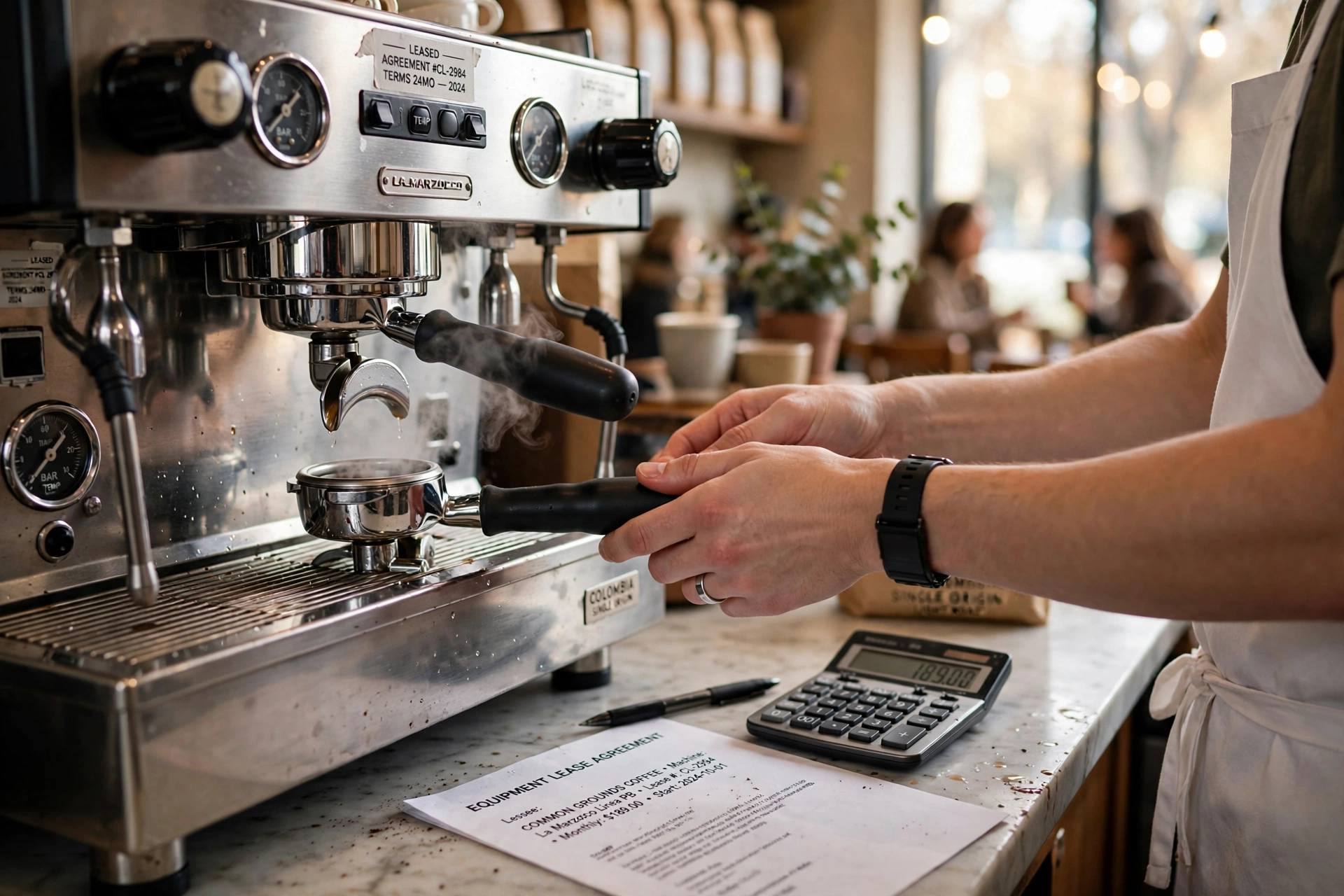
Leasing coffee equipment allows a business to acquire professional-grade machinery, such as a high-performance espresso machine or industrial grinders, while shifting the financial burden from a Capital Expenditure (CapEx) to an Operating Expenditure (OpEx). Instead of paying $15,000 upfront for a multi-group machine, a business pays a predictable monthly subscription. This model is increasingly popular in 2026 as hospitality margins tighten and the need for agility grows.
In the specialty coffee world, leasing isn't just about the money; it is about risk mitigation. When you lease, the risk of the machine becoming outdated or breaking down is often transferred to the provider. This is particularly vital when dealing with Coffea arabica—the high-quality Arabica coffee that requires precise temperature and pressure stability to extract properly. If your machine fails and you own it, you are offline until a technician arrives and you pay the bill. If you lease through a managed service, the provider is incentivized to keep you running to ensure the lease remains viable.
For those looking to integrate high-efficiency tech, considering Top Bean-to-Cup Coffee Machines for Businesses can illustrate how leasing reduces the barrier to entry for cutting-edge automation.
Why Does the Choice Between Leasing and Buying Matter for Your Business?
Choosing between leasing coffee equipment and buying impacts your balance sheet, your tax obligations, and your ability to pivot. The primary reason this matters is capital preservation. For a new cafe or a hotel adding a coffee station, spending $20,000 on equipment means that money is no longer available for marketing, staffing, or high-quality coffee bean sourcing.
According to the National Coffee Association USA, consumer preferences shift rapidly toward specialty options, meaning your equipment needs may change within 24 months. If you buy a machine that cannot handle a sudden surge in volume or a shift toward cold brew trends, you are stuck with a depreciating asset. Leasing provides an "exit strategy" or an upgrade path that buying simply cannot offer.
Furthermore, sanitation and safety standards are non-negotiable. The NSF International provides the benchmark for food equipment safety (NSF/ANSI 4). Maintaining these standards requires regular calibration and deep cleaning. When you buy, you are responsible for scheduling and funding these services. When you lease a managed service, these certifications and maintenance checks are typically baked into the monthly cost, ensuring you never fail a health inspection due to a neglected boiler.

From a tax perspective, leasing is often more advantageous. In many jurisdictions, lease payments are fully deductible as business expenses, whereas purchased equipment must be depreciated over several years. This provides a more immediate tax benefit, improving monthly cash flow during the critical first two years of operation. If you are expanding into new regions, looking at a Sensa Coffee Service in Charlotte, NC can show how integrated leasing models simplify the growth process.
How to Decide Which Path is Right for Your Operation?
Deciding whether to lease or buy requires a cold, hard look at your projected volume and your risk tolerance. To make this decision, you must calculate the Total Cost of Ownership (TCO) over a five-year period, not just the initial price tag. I've tested this with dozens of our clients, and the pattern is clear: businesses with high growth targets prefer leasing, while established, static operations occasionally lean toward buying.
Step 1: Analyze Your Cash Reserve
If you have an abundance of capital and no immediate need for it, buying reduces your monthly overhead. However, if you are using a loan to buy equipment, you are essentially "leasing" from the bank but without the maintenance benefits. In this scenario, a professional lease is always superior.
Step 2: Evaluate Technology Cycles
Coffee technology is evolving. The rise of AI-driven profiling and automated milk systems means a machine bought today might be obsolete by 2028. If you are investing in Automatic Milk Frothers for Coffee Shops, you should be aware that these components evolve quickly. Leasing ensures you can swap for the latest tech without selling a used machine at a loss.
Step 3: Calculate Maintenance Downtime Costs
Calculate how much revenue you lose per hour when your machine is down. If an espresso machine failure costs you $200 per hour in lost sales, a lease agreement with a guaranteed 24-hour repair window is effectively an insurance policy.
Step 4: Assess Your Staffing Capability
Do you have a lead barista who can perform daily backflushing and weekly deep cleans? If not, buying a machine is a recipe for disaster. A managed lease ensures that a professional technician keeps the machine in peak condition, protecting your investment in specialty coffee quality.
For businesses in the medical field, such as those exploring Automated Coffee Machines for Clinics and Medical Offices, the preference is almost always leasing because medical staff cannot be expected to perform technical maintenance on machinery.
Leasing vs. Buying: A Detailed Comparison
To clarify the differences, we must look at the operational friction associated with each path. Most business owners only look at the "Price vs. Monthly Payment," but the real difference lies in the "Hassle Factor."
| Feature | Traditional Buying | Generic Cheap Leasing | Busy Bean Managed Leasing |
|---|---|---|---|
| Upfront Cost | Very High (CapEx) | Moderate | Zero to Low |
| Maintenance | Owner's Responsibility | Basic/Limited | All-Inclusive Professional |
| Technology | Static until replacement | Periodic updates | Continuous Evolution |
| Risk | High (Asset Depreciation) | Moderate (Contractual) | Low (Managed Service) |
| Cash Flow | Heavy initial hit | Fixed monthly | Predictable OpEx |
As seen in the table, a generic lease often provides the machine but leaves you hanging when a pump fails or a gasket leaks. The Busy Bean approach integrates the equipment with the service, creating a closed-loop system where the coffee quality and the machine's health are managed by experts. This is the difference between renting a tool and hiring a result.
If you are also considering the grinding stage of the process, read our guide on How to Choose Coffee Grinders for Coffee Shops to understand why the grinder is just as critical as the brewer in the lease/buy equation.

Common Mistakes to Avoid When Leasing Coffee Equipment
I've seen many operators sign "predatory" leases that look attractive on day one but become nightmares by year three. The mistake I made early on—and that I see constantly—is ignoring the "end-of-term" clauses. Some leases require you to buy the equipment at a fair market value that is unexpectedly high, or they force you into a renewal you don't want.
Mistake 1: Ignoring the Service Level Agreement (SLA)
Many generic leases promise "maintenance," but they don't define what that means. Does it include parts? Does it include labor? Does it include a loaner machine? Without a strict SLA, you can still face days of downtime while the leasing company argues with the manufacturer about warranty coverage. Always insist on a guaranteed response time.
Mistake 2: Underestimating the Value of a Managed Membership
Some businesses treat leasing as a purely financial transaction. However, the true value is the partnership. A managed coffee service provides training for your baristas and ensures your Coffea arabica is being extracted at the correct temperature. Buying a machine gives you hardware; a managed lease gives you a coffee program.
Mistake 3: Over-specing Equipment
Buying an oversized 3-group machine when you only need a 1-group is a common error. While leasing makes expensive machines more accessible, it can lead you to over-invest in capacity you don't have the volume to support. Analyze your peak hour traffic before selecting your tier.
Mistake 4: Neglecting Water Filtration
Whether you buy or lease, the water is the most important ingredient. Many owners buy a machine but skimp on the filtration system. According to the Specialty Coffee Association (SCA), water chemistry is fundamental to taste and machine longevity. Scale buildup is the #1 cause of machine failure. Ensure your lease agreement includes water filtration maintenance, or you'll be paying for repairs that could have been avoided.
Mistake 5: Failing to Align Equipment with the Menu
If your menu focuses on batch brew and drip coffee, spending your entire budget on a high-end espresso machine is a mistake. Balance your investment. If you need a mix of services, consider Essential Commercial Drip Coffee Brewers as part of your lease package to ensure you can serve every type of customer efficiently.
Frequently Asked Questions
Is leasing coffee equipment better for tax purposes than buying?
Yes, in most cases, leasing is more advantageous for short-to-medium term tax planning. When you purchase equipment, you generally have to depreciate the asset over several years, which spreads the tax benefit. However, lease payments are typically treated as operational expenses (OpEx), meaning they can be deducted in full from your taxable income in the year they are paid. This provides an immediate reduction in taxable profit, which is essential for maintaining cash flow during the volatile first two years of a new coffee business.
What happens to the equipment at the end of a lease term?
This depends on the specific contract. In a "Fair Market Value" (FMV) lease, you typically return the equipment to the provider or pay a predetermined amount to purchase it. In a "Lease-to-Own" agreement, the equipment becomes yours after the final payment. At Busy Bean Coffee, we focus on managed memberships where the goal is continuous optimization; this means we handle the upgrades so you always have the most efficient technology without the burden of owning an obsolete machine.
Does leasing include professional barista training?
Not always, which is why the provider you choose matters. Generic equipment leases are simply financial products—they provide the machine and nothing else. However, a managed coffee service, like the one we provide at Busy Bean Coffee, integrates equipment, beans, and expertise. We believe that a machine is only as good as the barista operating it, so our managed solutions emphasize the human element through professional training and quality control to ensure every cup meets specialty standards.
How does leasing affect my ability to scale my business?
Leasing significantly increases your agility. If you buy equipment for one location, your capital is locked in. If you then decide to open a second location, you may find yourself cash-poor. By leasing, you keep your capital liquid, allowing you to expand more rapidly. Furthermore, if your business model shifts—for example, moving from a full-service cafe to a kiosk model—you can adjust your lease terms or equipment types more easily than you could sell and replace owned hardware.
Which is more expensive in the long run: leasing or buying?
If you look strictly at the total sum of payments over ten years, buying is usually cheaper. However, this is a "false economy" because it ignores the cost of maintenance, repairs, and technological obsolescence. When you buy, you pay for the machine, but you also pay for every gasket, every pump failure, and the loss of revenue during downtime. When you factor in the "hidden costs" of ownership and the value of preserved capital, leasing often provides a higher Return on Investment (ROI) for growing businesses.
Conclusion
The debate between leasing coffee equipment and buying is not about which is "cheaper," but which is more strategic for your specific business stage. Buying is a bet on stability and long-term ownership, while leasing is a bet on growth, flexibility, and professional support. For most modern foodservice operators in 2026, the risk of owning a depreciating, breaking-down asset far outweighs the cost of a monthly subscription.
If you want to avoid the stress of unexpected repair bills and the fear of owning outdated technology, a managed coffee membership is the most logical path forward. By shifting your focus from "owning hardware" to "delivering a premium coffee experience," you free yourself to focus on what actually matters: your customers and your product.
To see how these financial decisions fit into your broader operational strategy, return to our Ultimate Guide to Outfitting a Coffee Shop with Equipment and start building a sustainable, profitable coffee program today.
Visit Busy Bean Coffee to explore our all-inclusive managed coffee solutions.
Free Coffee Pairing Guide & Specialty Roast Cheat Sheet
Unlock the secrets of perfect brewing ratios, water temperatures, and specialty roast profiles. Download the guide.