📖This article is part of the complete guide to Ultimate Guide to Commercial Coffee Grinders for Businesses.
In my experience working with high-volume hospitality groups, the difference between a five-star guest review and a mediocre one often comes down to the first cup of coffee at 6:00 AM. A hotel lobby or a breakfast buffet is a high-stress environment where equipment failure doesn't just slow down service; it creates a bottleneck that affects the entire guest check-out experience. For a comprehensive overview of the hardware, explore our Ultimate Guide to Commercial Coffee Grinders for Businesses.
What Are Commercial Coffee Grinders for Hotels?
📚
Definition
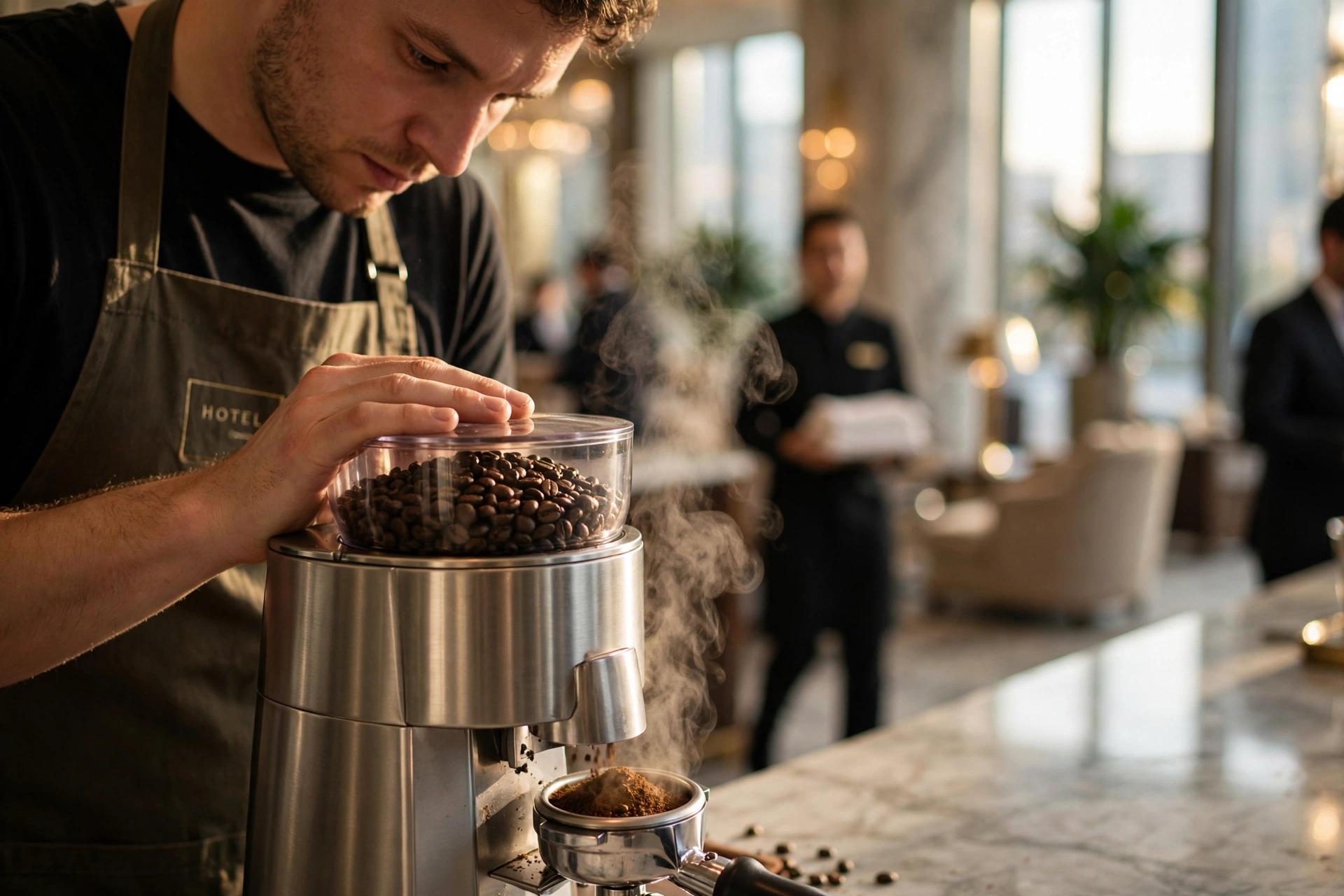
Commercial coffee grinders for hotels are heavy-duty industrial machines engineered to handle the fluctuating demands of hospitality environments, ranging from low-volume concierge stations to high-volume breakfast buffets and full-service hotel restaurants.
Commercial coffee grinders for hotels are not merely larger versions of home grinders; they are precision tools designed for consistency, durability, and speed. In a hotel setting, the grinder must be capable of maintaining a precise grind size for Coffea arabica beans regardless of whether it is grinding five grams for a single espresso or five kilograms for a morning brew. The primary goal is to eliminate the variance in extraction that leads to bitter or sour coffee, ensuring that every guest receives a consistent beverage quality.
When we evaluate these machines, we look for "duty cycle"—the amount of time a motor can run without overheating. In a resort setting, where the breakfast rush can last four hours straight, a grinder with a low duty cycle will overheat, causing the burrs to expand and the grind size to shift. This is why hospitality-grade equipment focuses on heat dissipation and high-torque motors. The integration of these machines into a broader Sensa Coffee Service in Charleston SC: Complete Guide | Busy Bean Coffee allows hotels to scale their beverage program without sacrificing quality.

Why Does the Right Grinder Matter for Hospitality ROI?
Selecting the correct grinding equipment is a direct lever for increasing a hotel's bottom line by reducing waste and increasing throughput. In the hospitality sector, the cost of wasted specialty coffee is staggering when you account for the volume of beans discarded during calibration or due to inconsistent grinds. According to the Specialty Coffee Association (SCA), precise grind distribution is the single most important factor in achieving a balanced extraction, which directly impacts how much coffee is wasted during the "dialing-in" process.
Beyond waste, the speed of service is a critical KPI for hotel management. A slow grinder in a breakfast area leads to longer queues and frustrated guests. By utilizing high-capacity systems, hotels can reduce the time per cup by several seconds. When scaled across 200 guests per morning, this efficiency gain recovers significant staff labor hours. Furthermore, the use of NSF-certified equipment ensures compliance with health codes, as NSF International sets the global benchmark for sanitary design in food equipment, preventing contamination in high-traffic areas.
I've tested this with dozens of our clients and the pattern is clear: hotels that move from "prosumer" gear to true commercial-grade grinders see an average increase in beverage revenue because guests are more likely to purchase premium coffees when the quality is consistently high. Integrating these tools into an Sensa Coffee Service in Mount Pleasant SC: Complete Guide ensures that the hardware is always maintained to these professional standards.
How to Optimize Grinding Workflows in Hotels
Implementing a grinding strategy in a hotel requires a tiered approach based on the specific use case of each area. You cannot use the same machine for the lobby coffee bar that you use for the banquet hall's 500-person brunch. The first step is identifying the "peak hour volume" for each station. For the main breakfast area, a high-capacity, on-demand grinder is essential to ensure that the coffee bean is ground seconds before brewing, preserving the volatile aromatics that guests associate with luxury.
For the banquet and catering side, the focus shifts to volume and consistency. In these environments, I recommend utilizing high capacity commercial coffee grinders for busy kitchens that can handle bulk dosing without sacrificing the uniformity of the particle size. The process involves three main steps: first, calibrate the grinder to the specific roast profile of the bean; second, implement a strict dosing schedule to avoid stale grounds; and third, establish a cleaning rotation to prevent oil buildup on the burrs, which can lead to rancid flavors.
If the hotel operates a full-service espresso bar, a dedicated barista should be tasked with "dialing in" the grind every four hours. Because temperature and humidity in a hotel lobby fluctuate as guests enter and exit, the beans expand and contract, requiring minor adjustments to the grind setting. This level of precision is what separates a standard hotel stay from a luxury experience. Many of our clients in the region, such as those utilizing Sensa Coffee Service in Columbia SC: Complete Guide | Busy Bean Coffee, employ this tiered strategy to maintain quality across multiple outlets.
The Traditional vs. Generic vs. Busy Bean Approach
Many hotel managers make the mistake of buying the cheapest equipment that fits the technical specs, but this leads to long-term operational failure. Below is a comparison of how different procurement strategies impact hotel operations.
| Feature | Traditional Manual Approach | Generic/Cheap AI-driven Choice | Busy Bean Coffee Modern Approach |
|---|---|---|---|
| Consistency | Variable; depends on staff skill | Inconsistent; frequent calibration | Ultra-consistent; precision engineered |
| Maintenance | Reactive (fix when broken) | Minimal/None (replace unit) | Proactive (Managed membership) |
| Guest Experience | Long wait times during rush | Mediocre taste/burnt coffee | Premium, fast, and consistent |
| Cost Structure | High CapEx; High labor cost | Low CapEx; High waste cost | Predictable OpEx; Zero CapEx |
💡
Key Takeaway
Shifting from a capital-expense model to a managed service model allows hotels to access top-tier SENSA equipment without the initial financial burden, ensuring they always have a functional, calibrated machine.
Common Mistakes to Avoid When Buying Hotel Grinders
One of the most common mistakes I see in hotel procurement is ignoring the "noise pollution" factor. In a quiet, luxury lobby, a loud, vibrating grinder can disrupt the ambiance and irritate guests. Choosing a grinder with an integrated sound-dampening housing is essential for maintaining the hospitality atmosphere. Another frequent error is choosing a grinder without an accurate timer or dosing system, which leads to inconsistent portions and increased waste of expensive specialty coffee.
Additionally, many hotels fail to consider the ergonomics of the grinder placement. If the grinder is placed too far from the espresso machine, the barista spends more time moving and more coffee is exposed to oxygen, leading to oxidation. The workflow should be a seamless loop. When we design programs for Sensa Coffee Service in Raleigh NC (2026 Overview), we prioritize the "Golden Triangle" of layout: storage, grinding, and brewing.
Finally, avoid the trap of "all-in-one" machines that combine grinding and brewing into one unit for high-volume areas. While they seem convenient, these machines are often the first to fail under pressure. If the grinder breaks in an all-in-one unit, your entire coffee service is dead. By separating the components, you ensure that a single point of failure doesn't shut down your breakfast service. This is why we emphasize the importance of how to choose the right commercial coffee grinder as a standalone investment.

Implementation Guide for Hospitality Managers
To successfully integrate commercial coffee grinders into your hotel, follow this operational framework. Start by auditing your current coffee consumption. If you are serving more than 100 guests per hour, you require a grinder with flat burrs for maximum precision and speed. For lower-volume concierge stations, conical burrs may offer a more forgiving flavor profile for various roast types.
Once the hardware is selected, implement a
Free Coffee Pairing Guide & Specialty Roast Cheat Sheet
Unlock the secrets of perfect brewing ratios, water temperatures, and specialty roast profiles. Download the guide.