📖This article is part of the complete guide to Ultimate Guide to Commercial Coffee Grinders for Businesses.
In my experience working with high-volume hospitality clients, I have seen a recurring struggle: the battle between speed and precision. One operator in Mount Pleasant, SC, was losing nearly 10% of their daily profit simply because their dosing system was inconsistent, leading to massive waste in the drip tray. When the rush hits, every second counts, but if those seconds result in a shot that tastes like battery acid because the grind shifted, the speed was meaningless. For a comprehensive overview, explore our Ultimate Guide to Commercial Coffee Grinders for Businesses.
What is the Difference Between Dosing and Single Dose Grinders?
📚
Definition
Dosing grinders (also known as hopper-fed grinders) use a large container to hold coffee beans, dispensing a pre-measured amount of ground coffee into a portafilter or dosing chamber. Single dose grinders require the user to weigh and add the exact amount of coffee beans needed for one specific brew cycle into the chamber before grinding.
When comparing dosing vs single dose grinders, the fundamental difference lies in the workflow of the bean-to-cup process. A dosing grinder is designed for throughput; it keeps a reservoir of beans ready at all times, allowing a barista to simply engage the motor and receive a consistent mass of coffee. This is the standard for most fast-paced environments where the goal is to serve 50 customers per hour without stopping to weigh every single gram of coffee.
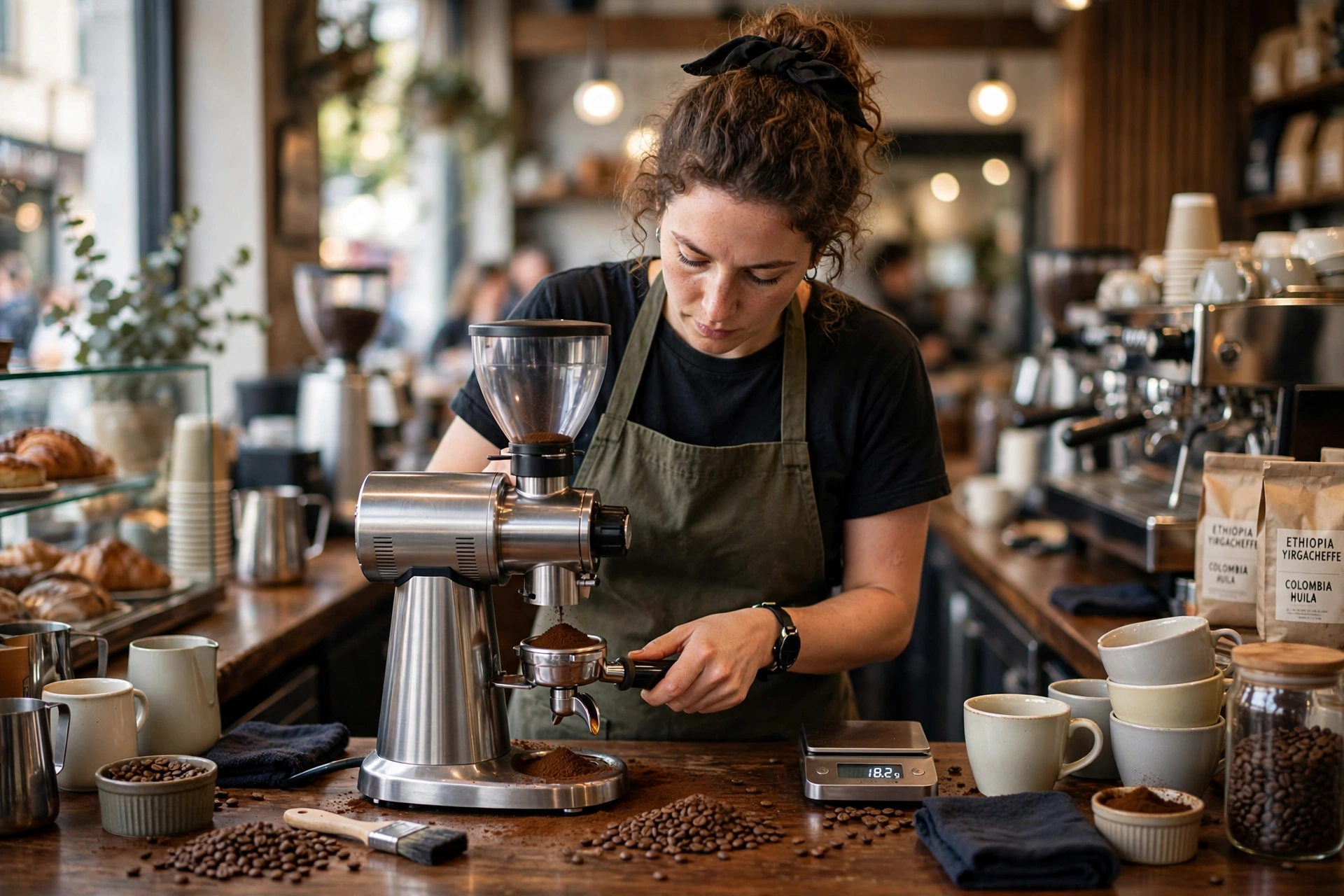
Conversely, a single dose grinder is built for precision and freshness. By eliminating the hopper, these machines prevent coffee beans from oxidizing as they sit in a large plastic container. In a single dose setup, the barista weighs the beans to the tenth of a gram, pours them into the chamber, and grinds. This ensures that no coffee is left stale in the machine and that every single shot is an exact replica of the previous one. For those prioritizing the highest standards of specialty coffee, this is often the preferred method, though it introduces a significant bottleneck in a high-traffic cafe.

Why Does the Choice Between Dosing and Single Dose Matter for Your Business?
Choosing the right system is not just about taste; it is about the financial health and operational efficiency of your beverage program. In a commercial setting, the wrong choice can lead to either a catastrophic loss of speed or an unacceptable increase in ingredient waste. If you are running a hotel lobby in Mount Pleasant, SC, where guests expect a quick caffeine fix before a meeting, a single dose grinder will create a line out the door that kills your customer satisfaction scores.
From a quality perspective, the Specialty Coffee Association (SCA) emphasizes the importance of freshness and precise extraction. Dosing grinders can suffer from "popcorning" or retention, where old grounds get stuck in the chute and mix with fresh coffee. This can lead to inconsistent flavors, especially if the machine is not purged regularly. Single dose grinders virtually eliminate this issue, ensuring that every cup of Coffea arabica served meets the rigorous standards of a Q-Grader.
Furthermore, the impact on labor costs is substantial. A dosing system allows a less experienced staff member to produce a consistent product. A single dose system requires a highly skilled barista who understands how to dial in the grind and manage a scale. According to the National Coffee Association USA (NCA), consumer demand for premium, specialty-grade coffee continues to rise, which puts pressure on businesses to provide high-quality brews without sacrificing the speed of service. If your business model relies on high-volume turnover, the dosing grinder is an essential tool for survival. If your model is a "slow bar" or a luxury tasting room, single dosing is the only way to justify a premium price point.
How to Implement the Right Grinding Strategy in Your Workflow
Implementing a grinding strategy requires an analysis of your peak hours and your target customer persona. The approach differs based on whether you are optimizing for throughput or for a curated experience. If you are managing a large-scale operation, you might consider a hybrid approach: a high-capacity dosing grinder for your house blends and a single dose grinder for your rotating single-origin offerings.
To successfully integrate these tools, follow these steps:
- Audit Your Peak Volume: Track how many drinks you serve during your busiest 60-minute window. If you exceed 30 drinks per hour, a single dose grinder will likely fail you unless you have multiple stations.
- Calculate Waste Thresholds: Measure how much coffee is wasted during the "dialing in" process. Dosing grinders often require purging 5-10 grams of coffee after a setting change. Single dose grinders waste almost nothing after the initial calibration.
- Train Your Staff on Retention: If using a dosing grinder, teach your baristas to perform a "purge shot" every few hours. This removes the stale grounds residing in the chamber and ensures the flavor profile remains crisp.
- Integrate Precision Tools: For those using single dose, invest in high-accuracy scales. The difference between 18.0g and 18.5g can change the extraction time by several seconds, affecting the final taste of the espresso machine output.
For those still undecided on the hardware, reading our guide on Commercial Burr Grinders Explained can help you understand how the actual cutting mechanism affects the result, regardless of the dosing method. If you find your volume is increasing, you may need to look into High Capacity Commercial Coffee Grinders for Busy Kitchens to keep up with demand.
Dosing vs Single Dose: The Professional Comparison
When deciding between these two systems, it is helpful to look at them through the lens of traditional vs. modern commercial standards. Many businesses start with a cheap hopper-fed system and quickly realize that the lack of precision is costing them money in the form of wasted beans and inconsistent quality.
| Feature | Traditional Dosing (Hopper) | Generic Single Dose | Professional Managed Solution |
|---|---|---|---|
| Workflow Speed | Extremely Fast | Slow / Manual | Optimized & Managed |
| Waste Level | High (Retention issues) | Very Low | Minimized via Calibration |
| Consistency | Variable (Depends on purge) | Extremely High | Guaranteed Standard |
| Skill Requirement | Low to Medium | High (Precision focus) | Supported by Expert Setup |
As shown in the table, the professional approach isn't just about picking one tool, but about managing the entire ecosystem. When we build a coffee program at Busy Bean Coffee, we discover that the most successful businesses don't just buy a machine; they implement a system. For example, using a professional dosing grinder paired with a strict calibration schedule provides 95% of the quality of single dosing with 500% of the speed.

Common Mistakes to Avoid When Choosing a Grinder
One of the most frequent mistakes I see in the industry is the "Prestige Trap." This happens when a business owner buys a high-end single dose grinder because they saw it in a viral video, only to realize that their staff cannot keep up with the morning rush. I once consulted for a boutique hotel in Mount Pleasant, SC, that installed three single dose grinders. The result was a beautiful-looking bar, but guests were waiting 12 minutes for a single latte. We eventually replaced two of them with high-efficiency dosing grinders, and their revenue increased because they could serve more people in the same window of time.
Another critical error is neglecting the impact of environmental factors on the grind. In humid coastal areas like Mount Pleasant, SC, coffee beans absorb moisture from the air. In a dosing grinder, the beans in the hopper are exposed to this humidity, which can cause the grind to "drift" throughout the day. The solution is not necessarily to switch to single dosing, but to implement a more frequent calibration schedule. According to NSF International, maintaining equipment to sanitary and technical standards is essential for food safety and consistent performance. A grinder that is not cleaned and calibrated according to NSF guidelines will produce inconsistent results regardless of whether it is a dosing or single dose model.
Lastly, avoid ignoring the "retention" factor. Many business owners assume that a dosing grinder always has old coffee in it. While true, modern professional grinders have minimized this significantly. If you are choosing a dosing grinder, look for "low retention" models. This bridges the gap between the speed of a hopper and the freshness of a single dose. If you are unsure how to balance these needs, our guide on How to Choose the Right Commercial Coffee Grinder provides a framework for matching your equipment to your specific volume.
Deep Dive: The Economics of Grinding Waste
Let's look at the numbers. In a typical dosing setup, a barista might purge 5 grams of coffee every time they adjust the grind or start a new shift. Over a year, in a busy cafe, this can add up to several kilograms of wasted specialty coffee. For a high-end Arabica coffee, this is a direct hit to the bottom line. However, the labor cost of single dosing is often higher. If a barista spends an extra 30 seconds per drink weighing beans, and you serve 200 drinks a day, you are adding nearly 17 hours of labor per month just to the weighing process.
In my experience, the ROI of a dosing grinder is found in the labor savings and the volume of sales.
Free Coffee Pairing Guide & Specialty Roast Cheat Sheet
Unlock the secrets of perfect brewing ratios, water temperatures, and specialty roast profiles. Download the guide.