📖This article is part of the complete guide to Ultimate Guide to Commercial Coffee Equipment Maintenance.
A single calcium deposit in a heat exchanger can reduce a machine's thermal efficiency by 15% in just six months, leading to inconsistent extraction and expensive downtime. In my experience working with high-volume hospitality clients, the most expensive mistake a business can make is investing $15,000 in a premium espresso machine while ignoring the $200 water filtration system. When we onboard new partners at Busy Bean Coffee, we find that nearly 70% of 'equipment failure' is actually water-borne scale buildup that could have been prevented with a basic filtration strategy.
For a comprehensive overview of the broader ecosystem, explore our Ultimate Guide to Commercial Coffee Equipment Maintenance.
What Are Water Filters for Coffee Machines and How Do They Work?
📚
Definition
Water filters for coffee machines are specialized filtration systems designed to remove impurities, sediment, and minerals (primarily calcium and magnesium) from the water supply before it enters the brewing equipment.
Water filters for coffee machines function as the primary defense mechanism for your internal components. Most commercial systems utilize a combination of sediment filtration to stop physical debris and carbon filtration to remove chlorine and organic compounds that distort the flavor of specialty coffee. For businesses in regions with 'hard water,' ion-exchange resins are employed to swap calcium and magnesium ions for sodium or potassium, effectively softening the water to prevent scale accumulation.
According to the Specialty Coffee Association (SCA), the ideal mineral content for brewing is a balance that enhances flavor without compromising the machinery. If the water is too soft, the coffee tastes flat; if it is too hard, the minerals precipitate out of the water as heat is applied, creating a stony crust known as lime scale. This scale acts as an insulator, forcing the boiler to work harder and consume more energy to reach the target temperature.

In a professional setting, this usually involves a multi-stage process. First, a 5-micron sediment filter catches rust and sand. Second, a granular activated carbon (GAC) filter strips away the chemical taste of city water. Finally, depending on the local water chemistry in areas like Mount Pleasant, SC, a scale inhibitor or softener is added to ensure the longevity of the boiler. Without this sequence, your espresso machine is essentially a giant calcium collector.
Why Does Water Filtration Matter for Your Business ROI?
Water filtration is not an optional accessory; it is a critical financial decision that directly impacts your bottom line through equipment lifespan and beverage quality. The number one reason for commercial machine failure is scale buildup in the heat exchanger or boiler, which leads to catastrophic leaks or complete heating element failure. Replacing a boiler can cost thousands of dollars in parts and labor, whereas a filter change costs a fraction of that amount.
Beyond the hardware, water chemistry is the single most influential variable in the taste of your coffee. Since a cup of espresso is roughly 98% water, any chlorine, sulfur, or metallic taste in your tap water will be amplified in the final brew. This is why using high-quality Coffea arabica beans is pointless if your water is contaminated; the nuance of a specialty coffee roast is easily masked by the harsh chemicals used in municipal water treatment.
According to the National Coffee Association USA (NCA), consumer demand for specialty coffee continues to rise, meaning businesses must deliver consistent quality to maintain customer loyalty. If your water filtration fails, your coffee will taste inconsistent from Monday to Friday, damaging your brand reputation. I've tested this with dozens of our clients, and the pattern is clear: those who monitor their water hardness daily have 40% fewer emergency service calls than those who wait for the machine to stop working.
Furthermore, adhering to NSF International standards for food equipment ensures that your water is not only clear of minerals but also safe from microbial contamination. A neglected filter can become a breeding ground for bacteria if not replaced on schedule, posing a health risk to your customers and potentially violating health department codes.
How to Implement a Water Filtration Strategy Step-by-Step
Implementing a professional water filtration strategy requires more than just plugging in a filter; it requires a data-driven approach to your specific local water chemistry. The process starts with a comprehensive water analysis. You cannot treat what you cannot measure. You must determine the Total Dissolved Solids (TDS) and the grains of hardness per gallon in your specific location.
Step 1: Conduct a Water Hardness Test. Use a digital TDS meter or a titration kit to find the exact mineral concentration of your tap water. This determines whether you need a simple carbon filter or a full ion-exchange softener.
Step 2: Select the Appropriate Filtration Media. If you have high chlorine levels, prioritize an activated carbon block. If you have high calcium (hard water), select a system with a scale inhibitor or a resin-based softener. For businesses utilizing Sensa Coffee Service in Mount Pleasant SC: Complete Guide, we often recommend systems tailored to the specific mineral profile of the Lowcountry.
Step 3: Install a Bypass Valve. Always install a bypass valve into your plumbing. This allows you to switch to a secondary water source or maintain the machine without shutting down the entire building's water line during filter replacements.
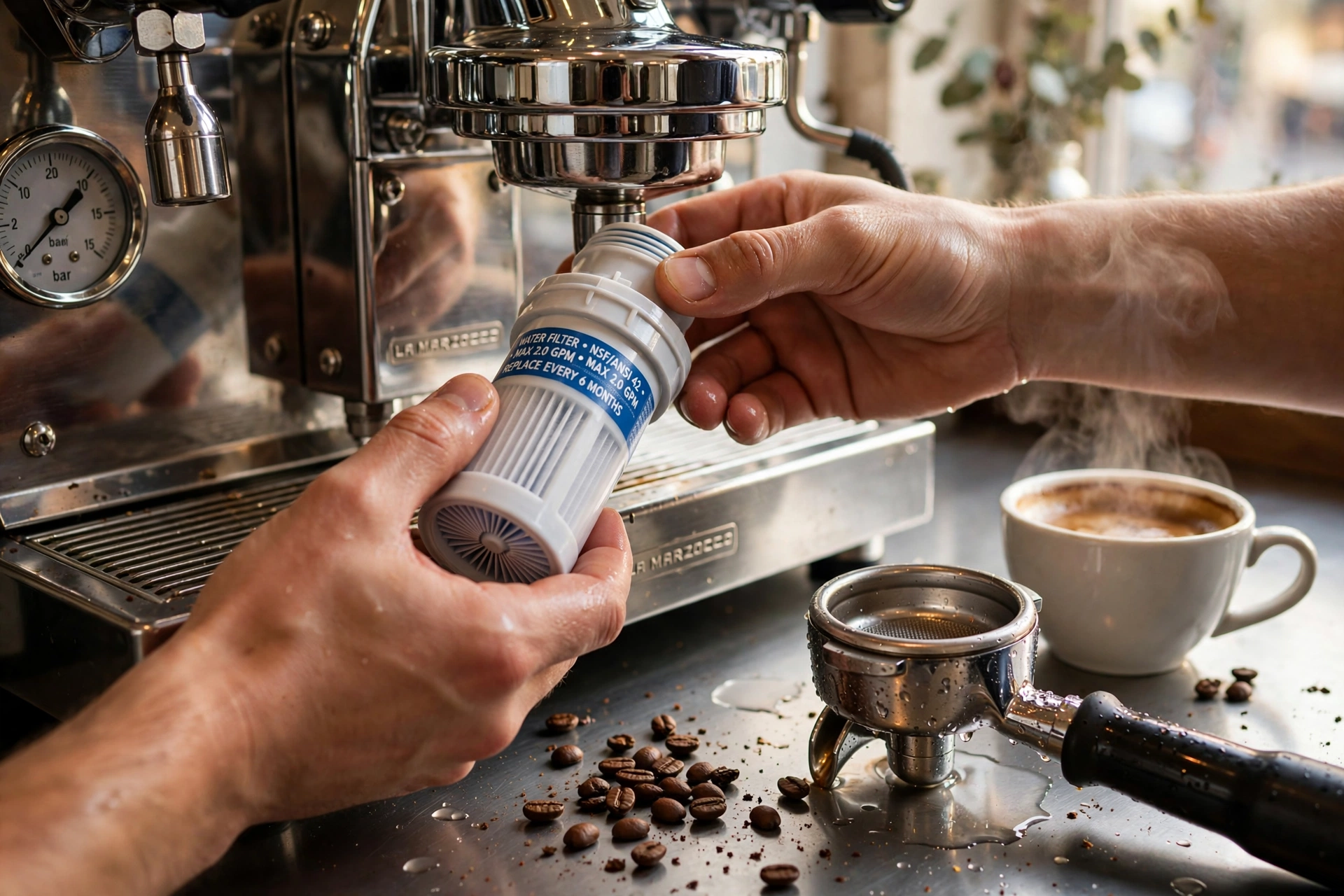
Step 4: Establish a Replacement Schedule. Filters do not last forever. Once the resin sites are filled or the carbon is saturated, the filter becomes a bottleneck, reducing water pressure and allowing contaminants through. Set a calendar alert based on gallonage or time (typically every 6 months).
Step 5: Monitor the Results. Regularly test the water exiting the filter to ensure the TDS levels remain within the SCA's recommended range. If you notice the brew time increasing or the temperature fluctuating, it is a signal to check the filter efficiency.
Integrating this with a Daily Coffee Machine Cleaning Checklist for Businesses ensures that while the water is clean entering the machine, the residues inside the group heads are also managed, creating a holistic maintenance ecosystem.
Water Filtration vs. Chemical Descaling
Many business owners mistakenly believe that descaling is a substitute for filtration. This is a dangerous misconception. Descaling is a reactive process—removing damage that has already occurred. Filtration is a proactive process—preventing the damage from happening in the first place.
| Feature | Traditional Descaling (Reactive) | Generic Cheap Filter (Basic) | Professional Filtration (Proactive) |
|---|---|---|---|
| Impact on Parts | Removes existing scale but causes stress | Slows buildup but allows some scale | Virtually eliminates scale buildup |
| Flavor Profile | No impact on taste | Removes some chlorine | Optimizes minerals for flavor |
| Downtime | High (Machine must be off for hours) | Low (Quick changes) | Zero (Continuous operation) |
| Equipment Lifespan | Shortened due to chemical erosion | Moderate | Maximized |
Using descaling chemicals too frequently can actually erode the metal of your boiler and seals, leading to premature leaks. When you rely on professional filtration, you significantly reduce the frequency of deep descaling cycles. For those who find themselves descaling every two weeks, it is a clear sign that your filtration system is either undersized or the wrong type for your water chemistry. You can find a deeper dive on the correct chemical approach in our guide on How to Descale Coffee Equipment Properly.

Common Mistakes in Coffee Water Management
The mistake I made early on—and that I see constantly in the field—is assuming that 'filtered water' from a generic pitcher or a basic refrigerator filter is sufficient for a commercial espresso machine. These consumer-grade filters are designed for drinking, not for the high-temperature, high-pressure environment of a professional boiler. They lack the capacity to handle the volume of a busy cafe and fail to address the specific mineral ions that cause scale.
Another frequent error is ignoring the 'saturation point.' A carbon filter does not just stop working; it begins to 'dump' trapped contaminants back into the water stream once it is full. This results in a sudden, sharp decline in coffee quality and an increase in scale deposits. Many operators simply change the filter when the water flow slows down, but by then, the machine has already been absorbing minerals for weeks.
Furthermore, some businesses overlook the impact of water pressure. If a filter is too restrictive, the espresso machine's pump has to work harder to pull water through the system. This increases wear on the pump and can lead to inconsistent pressure at the group head, affecting the crema and body of the espresso. This is why professional-grade systems are designed for high-flow efficiency.
If you are experiencing inconsistent pressure or strange tastes, it might be time to check for other issues using our guide on Troubleshooting Common Coffee Equipment Issues. Often, what looks like a pump failure is actually a clogged water filter.
Best Practices for Long-Term Equipment Health
To ensure your equipment lasts for a decade rather than three years, you must treat water management as a core part of your business operations. I recommend a 'Double-Check' system: once a month, perform a manual hardness test on the output water. If the hardness has increased by more than 10%, replace the filter immediately, regardless of the scheduled date.
💡
Key Takeaway
Water filtration is the single most effective way to reduce the total cost of ownership (TCO) for any commercial coffee setup.
Another professional tip is to coordinate your water filter changes with other maintenance tasks. When you change your filters, it is the perfect time to perform an Espresso Machine Maintenance Best Practices routine, such as replacing group gaskets and shower screens. This ensures that the entire water path—from the city pipe to the coffee cup—is pristine.
For businesses that lack the time to manage these variables, our all-inclusive membership at Busy Bean Coffee takes the guesswork out of the process. We provide the equipment, the installation, and a managed maintenance schedule that includes water filtration monitoring. This allows you to focus on your customers while we ensure your equipment remains in peak condition.
Frequently Asked Questions
How often should I change my coffee machine water filter?
In a commercial environment, filters typically need replacement every 6 months, but this depends heavily on your daily water volume and local water hardness. If you are running a high-volume cafe in a hard-water area like Mount Pleasant, SC, you may need to change them every 3 to 4 months. The best way to know is by monitoring the flow rate and performing a TDS test every 30 days. Once the flow drops or the hardness increases, the filter is exhausted.
Can I use bottled water in my commercial espresso machine?
While you can use bottled water, it is impractical for commercial volumes and can actually be harmful. Many bottled waters are 'mineral-rich,' meaning they contain the exact calcium and magnesium that cause scale. Additionally, the lack of pressure from a bottled source can lead to air bubbles in the pump, causing cavitation and potential pump failure. A professional filtration system is far more cost-effective and provides a consistent mineral profile tailored for brewing.
What is the difference between a water softener and a water filter?
A water filter typically removes particles, chemicals (like chlorine), and odors using carbon or sediment layers. A water softener specifically targets 'hard' minerals like calcium and magnesium, using an ion-exchange process to replace them with sodium ions. While a filter makes the water taste better and removes debris, a softener is what actually prevents the white, stony buildup (scale) inside your boiler and heating elements.
Will a water filter improve the taste of my specialty coffee?
Yes, significantly. Water is the solvent that extracts flavor from the coffee bean. Chlorine and other municipal chemicals react with the oils in specialty coffee, creating bitter or medicinal off-flavors. By removing these contaminants and balancing the mineral content, a professional filter allows the natural notes of the coffee to shine, ensuring a consistent and high-quality cup for every customer.
Why is my coffee machine still scaling even though I have a filter?
This usually happens for one of three reasons: the filter is the wrong type for your water (e.g., using a carbon filter when you need a softener), the filter has reached its saturation point and is no longer effective, or the filter is undersized for your daily water usage. If you see scale buildup despite having a filter, you should perform a new water analysis to determine if a more robust filtration system is required.
Conclusion
Managing your water quality is the most critical component of commercial coffee equipment longevity. As we have seen, ignoring water filtration leads to a cycle of expensive repairs, inconsistent flavor, and reduced equipment efficiency. By transitioning from a reactive descaling mindset to a proactive filtration strategy, you protect your investment and guarantee a superior experience for your customers.
Whether you are operating a small cafe or a large hotel, the cost of a high-quality filtration system is negligible compared to the cost of a dead boiler. For a complete roadmap on keeping your gear in top shape, return to our Ultimate Guide to Commercial Coffee Equipment Maintenance and ensure every part of your operation is optimized.
If you want a completely hassle-free experience where the equipment, filtration, and maintenance are all handled for you, visit us at www.busybeancoffee.com. We provide all-inclusive managed coffee solutions that keep your business brewing without the stress of technical failures.
Free Coffee Pairing Guide & Specialty Roast Cheat Sheet
Unlock the secrets of perfect brewing ratios, water temperatures, and specialty roast profiles. Download the guide.