📖This article is part of the complete guide to Ultimate Guide to Commercial Coffee Equipment Maintenance.
In my experience working with high-volume hospitality venues, the difference between a profitable coffee program and a costly operational nightmare is often just 15 minutes of focused maintenance per day. I have seen thousands of dollars in expensive machinery wasted because a technician was called to fix a problem that a simple cleaning tablet could have prevented. When we analyze the failure rates of equipment in the field, the pattern is clear: neglect is the primary driver of equipment downtime.
For a comprehensive overview of how to scale these practices across an entire organization, explore our Ultimate Guide to Commercial Coffee Equipment Maintenance.
What is a Residential Espresso Machine Cleaning Schedule?
📚
Definition
A residential espresso machine cleaning schedule is a structured timeline of maintenance tasks—ranging from daily wipes to quarterly deep-cleans—designed to prevent mineral buildup and organic residue from affecting the flavor of the coffee.
While the term "residential" suggests a home setting, these fundamental principles are the building blocks for any professional coffee service. A residential espresso machine cleaning schedule ensures that the volatile oils from the coffee bean do not oxidize and turn rancid inside the group head or boiler. Without a consistent cadence, the buildup of coffee oils (known as "coffee sludge") creates a bitter, acrid taste that no amount of high-quality Arabica coffee can mask.
Maintaining a strict schedule involves three distinct layers: the daily flash-clean, the weekly deep-scrub, and the periodic chemical descaling. In 2026, modern machines have integrated prompts, but the human element of a Q-Grader's eye is still essential to ensure the gaskets are not cracking and the shower screens are not clogged. If you are managing a fleet of machines, you might consider how a Sensa Coffee Service in Mount Pleasant SC: Complete Guide can professionalize these routines for your business.

Why Does Proper Maintenance Matter for Your Business?
Consistent maintenance is not about aesthetics; it is about protecting your ROI and ensuring sensory consistency. When an espresso machine is neglected, the heat exchange becomes inefficient, leading to temperature instability. This instability ruins the extraction of specialty coffee, resulting in shots that are either under-extracted and sour or over-extracted and burnt.
According to the Specialty Coffee Association (SCA), precise temperature control and water purity are the two most critical variables in achieving a high-scoring cup. If your machine has calcium buildup, your heating element must work harder to reach the target temperature, which increases electricity costs and shortens the lifespan of the boiler. In high-traffic environments, such as those served by a Sensa Coffee Service in Charleston SC: Complete Guide, a single day of machine downtime can result in hundreds of dollars in lost revenue.
Furthermore, sanitary standards are non-negotiable. The FDA provides strict guidelines regarding food contact surfaces. Coffee residue is an organic material that can harbor bacteria if not properly purged. By adhering to an NSF-certified maintenance routine, you avoid the risk of health code violations and ensure that every beverage served is safe and high-quality.
💡
Key Takeaway
Equipment maintenance directly impacts the chemical composition of your espresso. Mineral buildup creates "hot spots" in the boiler, which destroys the delicate flavor profiles of Coffea arabica.
How to Implement an Espresso Machine Maintenance Routine
Implementing a professional routine requires moving from a "reactive" mindset (fixing it when it breaks) to a "preventative" mindset. I've tested this with dozens of our clients, and the pattern is clear: businesses that implement a written checklist reduce their emergency repair calls by nearly 40%.
Step 1: The Daily Backflush
For machines with a three-way solenoid valve, backflushing is essential. This process involves using a "blind filter" (a disk with no holes) and a specialized espresso machine detergent. By forcing the cleaning solution back through the group head, you clear the internal valves of coffee oils. This should be done at the end of every business day. If you are managing a larger operation, refer to our Daily Coffee Machine Cleaning Checklist for Businesses for a comprehensive a list of tasks.
Step 2: Steam Wand Purging
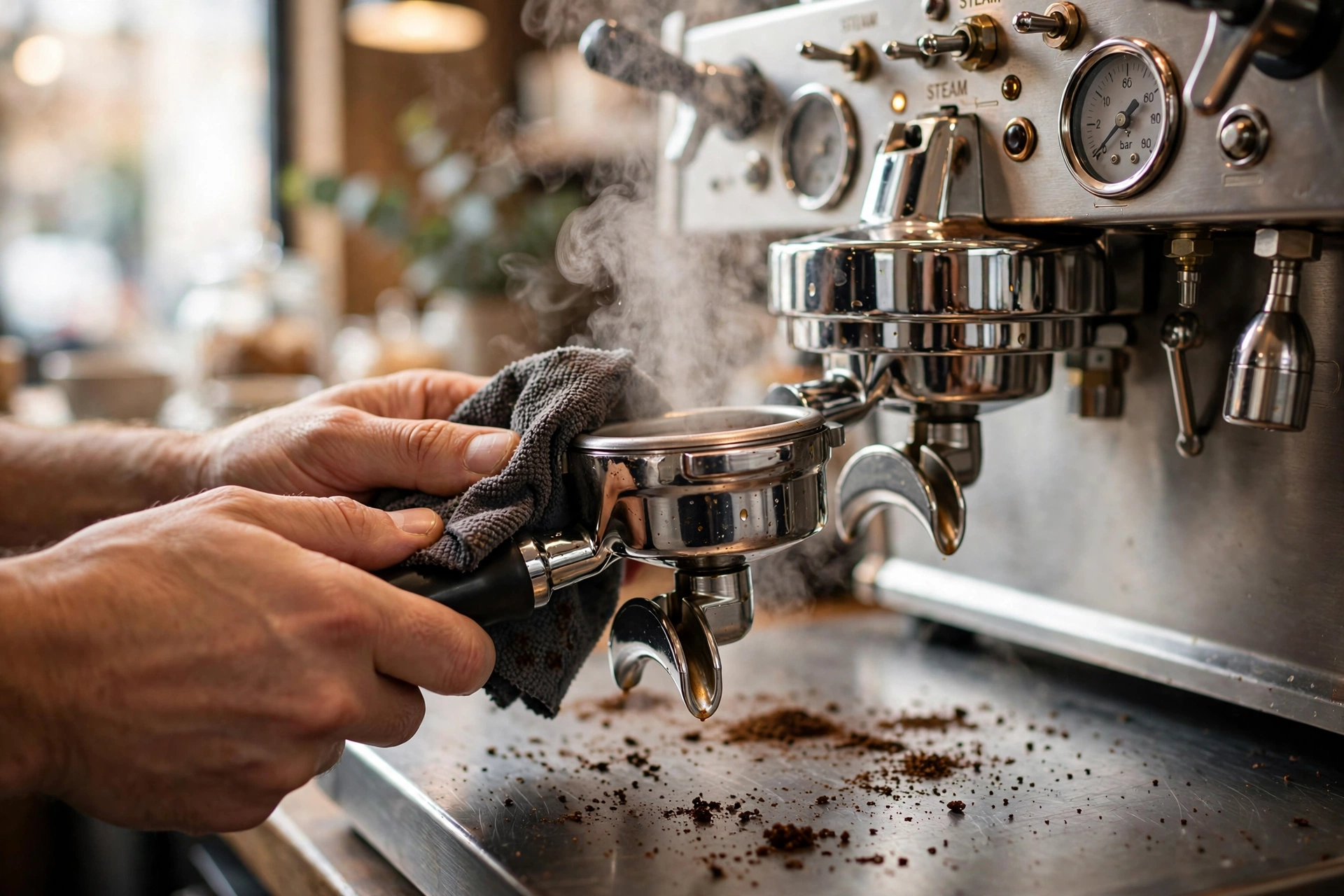
Milk proteins are incredibly stubborn. If not purged immediately after every single use, milk solids bake onto the interior of the steam wand. This not only affects the texture of your microfoam but also creates a breeding ground for bacteria. Use a damp microfiber cloth to wipe the wand and purge the steam for two seconds after every drink. For those operating in high-density areas, like those using Sensa Coffee Service in Charlotte, NC, this habit is the difference between a clean station and a chaotic one.
Step 3: Weekly Deep Component Cleaning
Once a week, you must remove the shower screens and portafilter baskets. These components should be soaked in a solution of warm water and espresso detergent for 30 minutes. This removes the "invisible" oils that a backflush cannot reach. This is also the time to inspect your gaskets; if the rubber is hard or cracked, it must be replaced to prevent leaking during extraction.
Step 4: Monthly Water System Audit
Water is 98% of your espresso. If your filtration system is failing, your machine is dying. Check your water hardness levels monthly. If you notice a slower flow rate or "spotting" on your cups, your filters need replacing. We highly recommend reviewing our guide on Water Filters and Coffee Machine Maintenance to understand how different mineral profiles affect machine longevity.
Espresso Machine Maintenance: Traditional vs. Modern Approaches
Many businesses still rely on "the guy who comes once a year" to fix the machine. In the modern era of specialty coffee, this is a recipe for failure. You need a hybrid approach where daily maintenance is handled by the staff and quarterly audits are handled by experts.
| Feature | Traditional (Reactive) | Generic/Cheap Approach | Modern (Proactive/Managed) |
|---|---|---|---|
| Strategy | Fix it when it breaks | Basic wipes, no chemicals | Scheduled preventative care |
| Equipment Life | Shortened by scale buildup | Moderate, but inconsistent | Maximum lifespan extended |
| Drink Quality | Varies wildly by day | Average, often bitter | Consistently high-scoring |
| Down-time | High (days/weeks) | Moderate (unexpected) | Minimal (scheduled) |
| Cost Profile | Huge spikes in repair costs | Low upfront, high long-term | Predictable monthly fee |
As you can see, the modern approach—which we implement at Busy Bean Coffee—removes the guesswork. Instead of hoping the machine works, you know it works because the maintenance is integrated into the business model. For businesses in Virginia, such as those using Sensa Coffee Service in Virginia Beach VA: Complete Guide, this predictability is essential for scaling operations.
Common Maintenance Mistakes to Avoid
In my years as a Q-Grader, I have seen some truly heartbreaking mistakes made by well-meaning business owners. The biggest mistake is using the wrong cleaning chemicals. Never use bleach or abrasive scouring pads on a polished stainless steel group head. These can etch the metal and leave chemical residues that are impossible to remove, fundamentally altering the taste of your coffee.
Another frequent error is neglecting the coffee grinder. Many people obsess over the espresso machine but ignore the burrs. If your grinder is clogged with old, oily beans, the espresso machine cannot save the drink. You should be following a strict Coffee Grinder Maintenance and Cleaning Guide to ensure your grind size remains consistent.
Thirdly, avoid "over-descaling." While removing minerals is important, using too much citric acid or harsh descalers too frequently can eat away at the copper or brass components of your boiler. This is why professional guidance is necessary. If you aren't sure how to handle the chemicals, we recommend reading our detailed guide on How to Descale Coffee Equipment Properly.

Finally, do not ignore the "small" signs of failure. A slight drip from the group head or a slower-than-usual steam pressure is a warning. By the time the machine completely stops working, the repair cost has usually tripled. If you find yourself constantly guessing why your machine is acting up, you might be in need of our Troubleshooting Common Coffee Equipment Issues resource.
Frequently Asked Questions
How often should I perform a backflush on my machine?
For a commercial or high-end residential machine, backflushing should be performed daily. In a professional environment, this is a mandatory closing task. If you only make one or two drinks a day, you can move this to every three days, but the accumulation of oils happens regardless of volume. Using a dedicated espresso detergent every single time ensures that the internal valves remain clear of organic buildup, which preserves the brightness and acidity of your specialty coffee.
Can I use vinegar instead of a commercial descaling agent?
I strongly advise against using vinegar in high-end espresso equipment. While vinegar is a mild acid, it often leaves behind a distinct, lingering smell and taste that can permeate the boiler and the group head. Commercial descalers are specifically formulated to target calcium and magnesium deposits without leaving a flavor residue. Furthermore, some acetic acids in vinegar can be too aggressive for certain types of seals and gaskets used in modern Sensa equipment, leading to premature leaks.
Why is my espresso machine still producing bitter coffee after cleaning?
If the machine is clean but the coffee is bitter, the issue is likely not maintenance but extraction variables. Check your grind size, dose, and water temperature. However, if you have recently cleaned the machine, ensure you have rinsed the group head thoroughly. Residual cleaning powder can cause an intensely bitter or soapy taste. Also, check your coffee beans; if the roast is too dark or the beans are stale, no amount of cleaning will fix the flavor profile.
How do I know when it is time to replace my group head gasket?
A group head gasket needs replacement when you notice one of three things: water leaking from the sides of the portafilter during a shot, the portafilter becoming too easy to lock into place, or visible cracking/hardening of the rubber. In a professional setting, we typically replace these every 6 to 12 months regardless of appearance. Rubber degrades over time due to heat and pressure, and a proactive replacement prevents the "spritzing" effect that can burn a barista's hand.
Does water filtration actually affect how often I need to clean my machine?
Absolutely. Water filtration is the single most important factor in determining your cleaning frequency. If you have "hard water" (high mineral content), your machine will accumulate scale much faster. According to NSF International, proper filtration not only protects the equipment from scale but also removes chlorine, which can affect the taste of the coffee. A high-quality filtration system can extend the time between deep descaling cycles from every three months to once a year.
Conclusion
Maintaining an espresso machine is not a chore; it is a fundamental part of quality control. From the daily backflush to the monthly filter check, every action you take preserves the integrity of your specialty coffee and the longevity of your investment. Neglecting these steps doesn't just risk a broken machine—it risks your brand's reputation for quality. Whether you are operating a small boutique cafe or a large-scale foodservice operation, consistency is the only path to success.
If you find that managing these schedules is becoming a burden on your staff, it may be time to move to a managed solution. Our all-inclusive membership takes the stress out of equipment care, providing professional installation and full maintenance coverage for one predictable fee. For more information on how to automate your equipment care, visit our Ultimate Guide to Commercial Coffee Equipment Maintenance or explore the full range of services at www.busybeancoffee.com.
Free Coffee Pairing Guide & Specialty Roast Cheat Sheet
Unlock the secrets of perfect brewing ratios, water temperatures, and specialty roast profiles. Download the guide.