📖This article is part of the complete guide to Cost of Commercial Coffee Equipment.
Most business owners make the mistake of calculating their coffee cost based solely on the price per pound of the coffee bean. In my experience working with dozens of cafes and restaurants in Mount Pleasant, SC, this 'sticker price' approach leads to a massive undervaluation of actual expenses, often erasing 15% to 20% of projected net profit. When you ignore the waste, the electricity, and the inevitable wear and tear on your espresso machine, you aren't running a profitable beverage program; you're running a subsidy.
For a comprehensive overview of the hardware side of this equation, explore our guide on commercial coffee equipment cost.
What is the True Cost of Coffee for Business?
📚
Definition
The true cost of coffee for business is the Total Cost of Ownership (TCO) per cup, encompassing the raw material (green or roasted beans), consumable utilities, labor for preparation and cleaning, equipment depreciation, and waste.
Calculating the true cost of coffee for business requires moving beyond simple arithmetic and into operational accounting. While a bag of specialty coffee might cost $15, the actual cost to deliver that coffee to a customer involves a complex web of variables. You must account for the 'dialing-in' process, where a barista may waste 20 to 50 grams of coffee every morning just to calibrate the grind size for the day's humidity and temperature.
In my years as a Q-Grader, I've seen businesses ignore the cost of water filtration. If you are using a high-end espresso machine in a region with hard water, the cost of replacing filters and the labor for descaling are direct costs of every single cup sold. If you don't factor these in, your margins are an illusion. The true cost is not what you pay the supplier; it is what it costs to keep the machine running and the quality consistent throughout a 12-hour shift.

Why Calculating True Cost is Vital for Your Margins
Understanding the true cost of coffee for business is the only way to set prices that ensure long-term sustainability. Many operators set their prices based on what the cafe down the street charges, but they forget that the other cafe might have a different equipment financing structure or a different waste profile. According to the National Coffee Association USA, coffee consumption patterns are shifting toward higher-value specialty drinks, meaning the cost of labor and precision equipment plays a larger role in the final price than ever before.
When you fail to calculate true cost, you encounter 'margin bleed.' This happens when small, unaccounted-for expenses—like a leaking steam wand or excessive milk waste—accumulate. If a barista pours 2 ounces of wasted milk per latte, and you sell 200 lattes a day, that's 400 ounces of wasted product daily. Over a year, this represents thousands of dollars in lost revenue that never appeared on a supply invoice but definitely appeared in your bank balance.
Furthermore, the Specialty Coffee Association (SCA) emphasizes the importance of technical standards in brewing. Achieving these standards requires precision, which in turn requires time. Labor is the most expensive ingredient in any cup of coffee. If it takes a barista three minutes to craft a perfect pour-over, the labor cost for that single drink might exceed the cost of the coffee bean itself. Without a true cost analysis, you are essentially giving away your most expensive resource: time.
How to Calculate the True Cost of Coffee Step-by-Step
To find the true cost of coffee for business, you must aggregate four distinct cost centers. I recommend tracking these for 30 days to get a statistically significant average.
1. The Raw Material Cost (COGS)
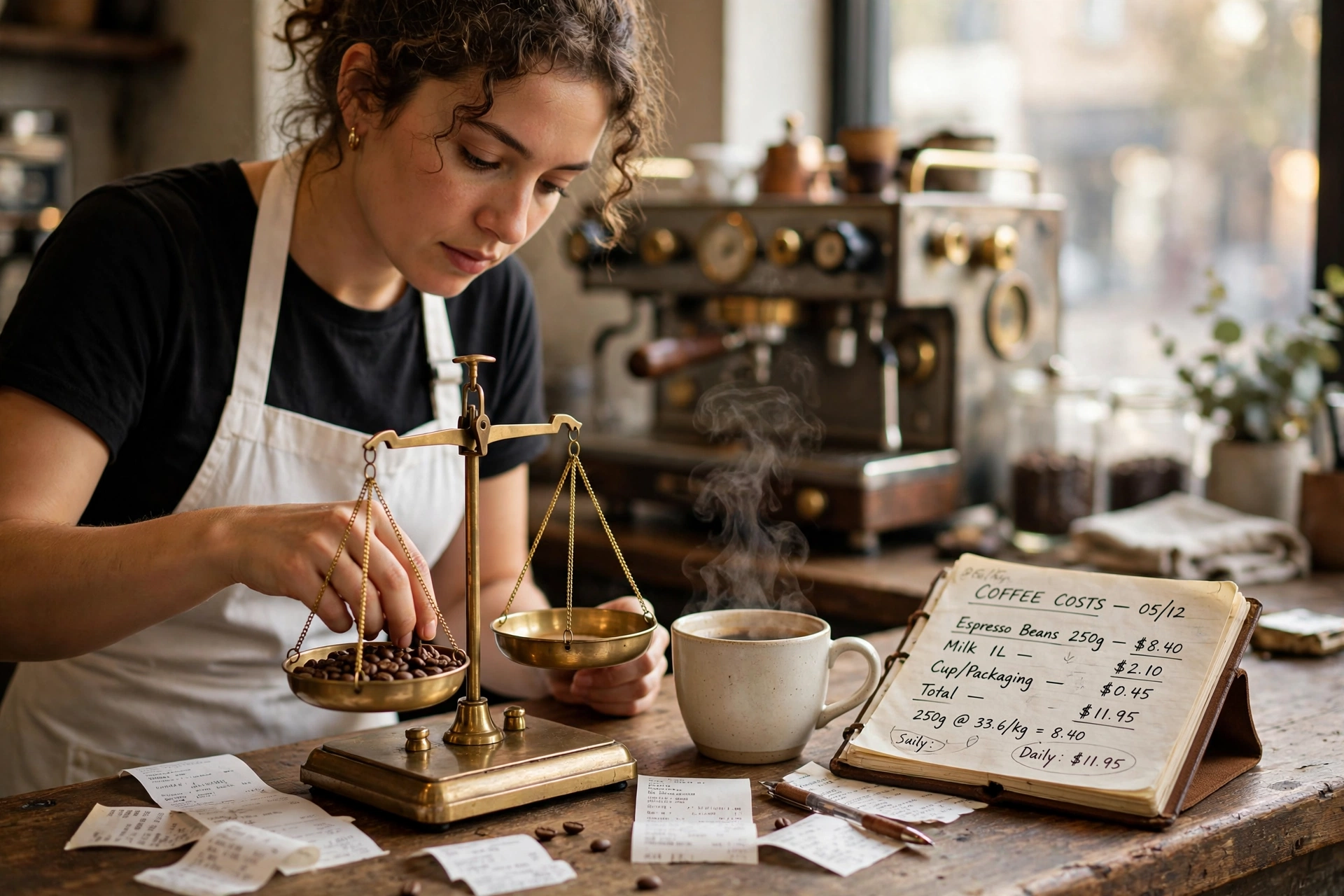
Start with the price per pound of your coffee bean. However, do not use the purchase price; use the yield price.
- Formula: (Price per bag / Total grams per bag) x Grams per dose = Cost per dose.
- The Waste Factor: Add 5-10% to this number to account for spillage and calibration (dialing in). If you use 18g for a double shot, calculate for 20g to be safe.
2. The Variable Operational Cost
This includes the consumables that disappear with every cup. This is where most businesses fail. You must include:
- Water Filtration: Divide the annual cost of filter replacements by the total number of cups sold per year.
- Milk/Sweeteners: Average the cost of milk used per drink, including the 10% waste from steaming.
- Packaging: Cups, lids, sleeves, and napkins. In 2026, sustainable packaging is more expensive, and this must be reflected in the per-cup cost.
3. Labor and Production Time
Calculate the cost of the barista's time per drink. If a barista earns $18/hour and can produce 30 drinks per hour, the labor cost per drink is $0.60. However, you must also include the time spent on cleaning and maintenance (backflushing the machine, cleaning the hopper), which should be amortized across your daily volume.
4. Equipment Depreciation and Maintenance
Your espresso machine is a depreciating asset. If a machine costs $12,000 and has a functional lifespan of 5 years, it costs $2,400 per year just to exist in your shop. Divide this by your annual cup volume. Add the cost of preventative maintenance—such as the annual technician visit to replace gaskets and calibrate pressure—to this figure.
For those who find this manual calculation overwhelming, we often suggest looking into an all-inclusive coffee membership to flatten these variables into one predictable monthly cost.
Comparison: Cost Management Approaches
Depending on how you manage your equipment and supply chain, your cost structure will vary wildly. The following table illustrates the difference between an amateur approach and a professional managed solution.
| Feature | Traditional Manual Tracking | Cheap/Generic Equipment | Managed Coffee Solution (Busy Bean) |
|---|---|---|---|
| Cost Visibility | Fragmented; often missed | Hidden in repair bills | Transparent monthly fee |
| Equipment Risk | High (unplanned downtime) | Very High (frequent failure) | Zero (full maintenance coverage) |
| Quality Control | Variable (human error) | Low (inconsistent temp) | High (SENSA professional gear) |
| Capital Outlay | Heavy upfront investment | Moderate upfront | Zero upfront (Membership) |
Common Mistakes When Calculating Coffee Costs
In my experience, the most common error is the 'Average Cost Fallacy.' Business owners take the average cost of a bag of beans and assume that is their cost per cup. They ignore the fact that specialty coffee varies in price by origin and grade. A Coffea arabica bean from Ethiopia may cost significantly more than a Brazilian blend, yet many shops charge the same for both, effectively lowering their margin on the more premium product.
Another mistake is ignoring the 'Energy Tax.' High-end espresso machines and brewers pull significant power. While it's hard to track per cup, the cost of electricity to keep a boiler at temperature for 14 hours a day is a real expense. According to NSF International, energy-efficient equipment can reduce these overheads, but the initial cost is higher, which again brings us back to the need for a Total Cost of Ownership (TCO) calculation.

Finally, many fail to account for the 'Hidden Costs of Owning Commercial Coffee Equipment.' As discussed in our detailed breakdown of hidden costs, things like water softener salt and specialized cleaning powders add up. If you spend $50 a month on chemicals, that is an expense that must be distributed across your cup count. If you only sell 1,000 cups a month, that's $0.05 per cup. It seems small, but in a high-volume environment, these cents determine whether you are profitable or just breaking even.
Deep Dive: The Impact of Waste on ROI
Let's look at a real-world scenario. Imagine a cafe in Mount Pleasant, SC, selling 150 lattes a day. They use 18g of coffee per shot.
The Ideal Scenario:
- Beans: 2.7kg per day
- Waste: 0%
- Cost: $120/day
The Real-World Scenario:
- Dial-in waste: 100g
- Spilled grounds/incorrect doses: 200g
- Purging steam wands (milk waste): 1.5 liters
- Total cost: $145/day
That $25 difference per day is $9,125 per year. For many small businesses, that is the difference between a bonus and a budget cut. This is why I always advise clients to implement a waste log. By tracking exactly how many shots are tossed and how much milk is poured down the drain, you can identify if the issue is a training problem (barista skill) or an equipment problem (inconsistent grinding).
If you are struggling with these variables, you might want to compare the leasing vs buying options for commercial coffee machines to see which model reduces your financial risk. When you lease or use a membership, the maintenance and depreciation are often baked into the cost, removing the guesswork from your spreadsheets.
Frequently Asked Questions
How much waste is considered "normal" in a commercial coffee setting?
In a professional environment using specialty coffee, a waste factor of 5% to 10% is considered standard. This includes the morning calibration process, where the barista adjusts the grinder to ensure the espresso flows at the correct rate. If your waste exceeds 12%, it usually indicates a need for better barista training or an upgrade to a more precise grinder. High-end equipment from Busy Bean Coffee minimizes this variance, allowing for tighter margins.
Should I include the cost of the barista's salary in the per-cup cost?
Yes, absolutely. Labor is one of the three largest expenses in the coffee industry. To calculate this, divide the total hourly wage of the staff by the number of drinks produced per hour. For example, if a barista earns $20/hour and produces 40 drinks, the labor cost per drink is $0.50. Ignoring this leads to a fundamental misunderstanding of your ROI and can result in underpricing your menu items.
How does water quality affect the true cost of coffee?
Water quality affects both taste and equipment longevity. Using unfiltered water leads to scale buildup in the boiler, which decreases thermal efficiency (increasing electricity costs) and eventually causes machine failure. The cost of high-quality filtration systems and the labor for regular descaling must be amortized across every cup sold. Following FDA guidelines for food-contact surfaces also means using specific cleaning agents, which adds to the operational cost.
Is it better to buy coffee in bulk to lower the true cost?
Bulk buying can lower the unit price per pound, but it often increases the "true cost" due to freshness degradation. Specialty coffee reaches its peak flavor shortly after roasting. If you buy too much and the beans go stale, your waste percentage increases because you'll have to toss out old product or suffer a drop in customer retention. The goal is a lean inventory that balances purchase discounts with product quality.
How often should I recalculate my true cost of coffee?
I recommend a full audit every quarter. Coffee bean prices fluctuate based on the global commodities market and harvest cycles. Additionally, utility costs and labor rates change. A quarterly review allows you to adjust your menu prices dynamically rather than waiting until the end of the year to realize you've been losing money on every cappuccino sold.
Conclusion
Calculating the true cost of coffee for business is not a one-time task; it is a continuous process of operational refinement. By moving beyond the price of the bean and incorporating labor, utilities, depreciation, and waste, you gain a transparent view of your business's health. The difference between a struggling cafe and a thriving one often comes down to these hidden decimals. Whether you are optimizing your current setup or looking for a more predictable model, the goal is always the same: maximize quality while minimizing unaccounted-for leakage.
If the complexity of tracking these variables feels like a second full-time job, it may be time to shift your strategy. Instead of managing a dozen disparate costs, our managed membership provides a single, predictable monthly fee that covers the equipment, the maintenance, and the premium product. This allows you to focus on your customers rather than your spreadsheets.
For a deeper dive into how to budget for your hardware, check out our complete guide on the Cost of Commercial Coffee Equipment and start building a more profitable beverage program today.
Visit us at www.busybeancoffee.com to explore our all-inclusive solutions.
Free Coffee Pairing Guide & Specialty Roast Cheat Sheet
Unlock the secrets of perfect brewing ratios, water temperatures, and specialty roast profiles. Download the guide.