📖This article is part of the complete guide to Cost of Commercial Coffee Equipment.
A high-end espresso machine often looks like a one-time capital expenditure on a balance sheet, but for most foodservice operators, the sticker price is merely the entry fee. In my experience working with dozens of cafes in Mount Pleasant, SC, I have seen owners budget for the hardware while completely ignoring the operational bleed that happens every single day. When you buy a machine, you aren't just buying steel and boilers; you are inheriting a lifelong commitment to technical maintenance and utility consumption that can erode your margins if left unmanaged.
For a comprehensive overview of the initial investments and budget planning, explore our guide on commercial coffee equipment cost.
What Exactly Are the Hidden Costs of Owning Commercial Coffee Equipment?
📚
Definition
Hidden costs in commercial coffee equipment refer to the indirect, recurring, and unforeseen expenses—such as preventative maintenance, energy inefficiency, water filtration replacements, and labor-induced waste—that occur after the initial purchase of the hardware.
When businesses calculate the cost of a coffee program, they typically look at the invoice for the espresso machine and the grinder. However, the true cost of ownership is a trailing metric. The hidden costs owning commercial coffee equipment include everything from the $150 spent on monthly water filter replacements to the thousands of dollars lost in productivity when a group head seal fails during a Saturday morning rush.
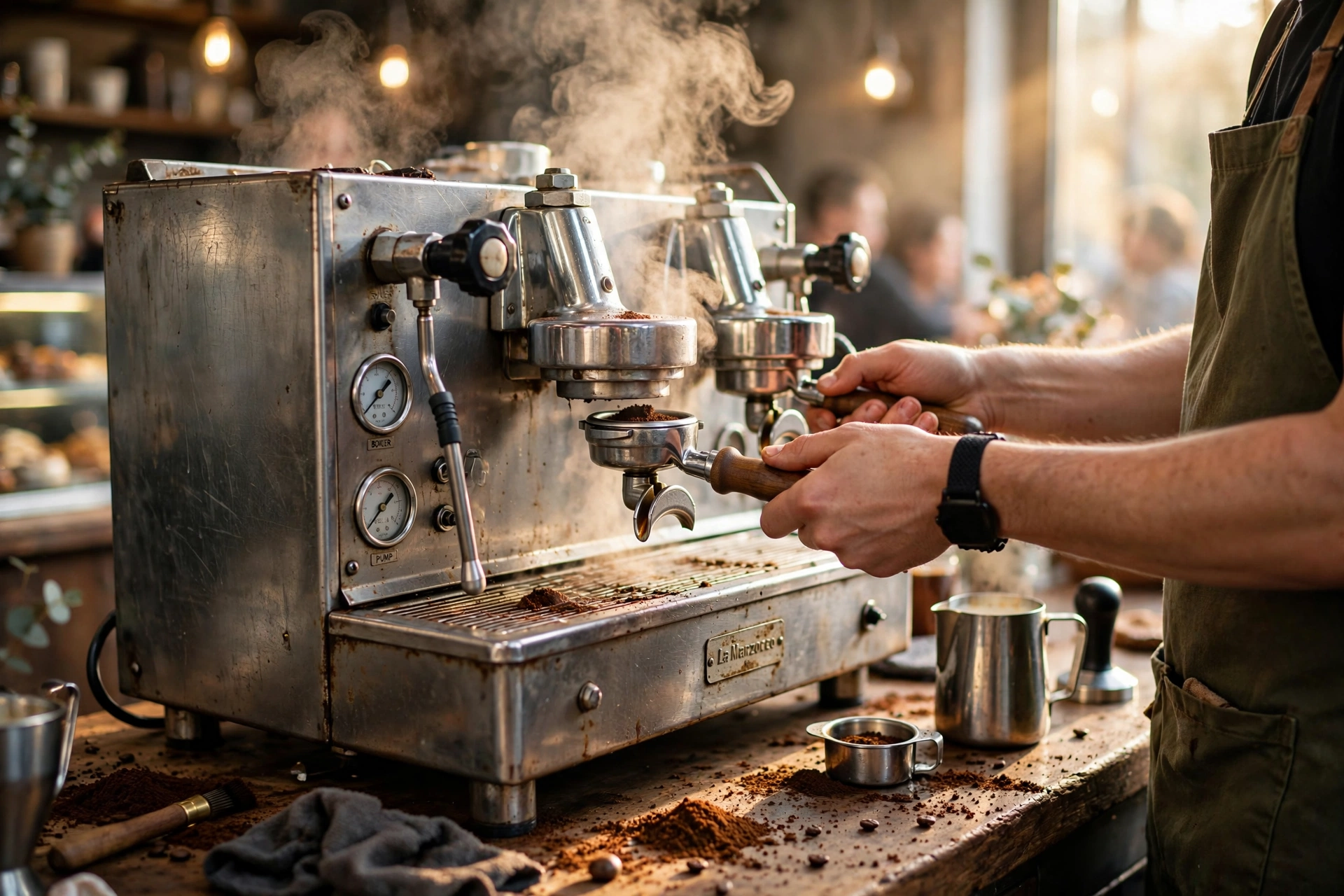
In the industry, we call this 'the iceberg effect.' The hardware cost is the tip visible above the water, while the operational expenses are the massive bulk submerged beneath. For example, a professional-grade espresso machine requires specific chemical detergents for backflushing and descaling. If these are ignored, calcium buildup occurs, which leads to heating element failure. Replacing a boiler in 2026 isn't just a parts cost; it is the cost of three days of zero coffee revenue while the machine is in the shop.
Furthermore, labor is a hidden cost. A barista who isn't properly trained on the specific nuances of your machine will waste more coffee beans through incorrect calibration. According to the Specialty Coffee Association (SCA), precise temperature stability and pressure are essential for quality, but achieving this requires constant technician-level oversight or highly skilled labor, both of which carry a significant price tag.

Why Do These Hidden Costs Matter for Your Business Bottom Line?
Ignoring the trailing expenses of coffee hardware leads to a phenomenon I call 'margin erosion.' You might believe you are making $3.00 profit per latte, but once you factor in the electricity to keep a boiler at 200°F for 14 hours a day and the cost of a quarterly technician visit, that profit margin shrinks. In the current 2026 economy, where ingredient costs for Coffea arabica fluctuate due to climate volatility, your equipment efficiency is the only variable you can truly control.
According to research from the National Coffee Association USA (NCA), consumer demand for specialty coffee continues to rise, but the cost of maintaining the high standards required for this segment is increasing. If your equipment is inefficient, you are paying a 'hidden tax' on every cup served. High energy consumption is a primary culprit; older or poorly maintained machines can consume up to 20% more electricity than optimized units.
Moreover, water quality is the single biggest hidden cost driver. Using unfiltered water in a commercial environment is a recipe for financial disaster. Limescale buildup acts as an insulator on heating elements, forcing the machine to work harder and consume more power to reach the same temperature. This doesn't just increase your utility bill; it shortens the lifespan of the equipment. When a machine that should last 10 years dies in 4 because of poor water management, the depreciation cost per cup skyrockets.
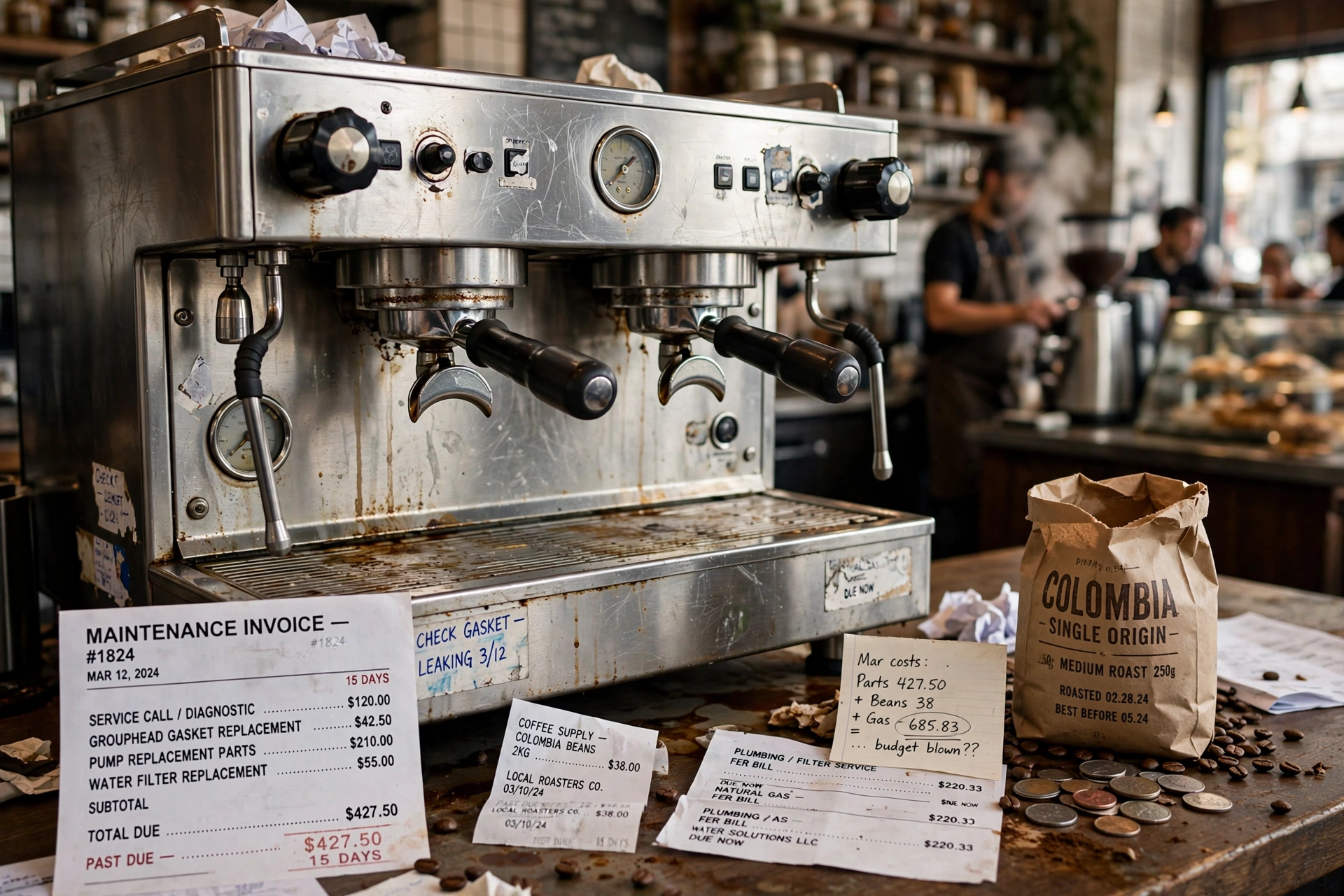
Consider the impact of downtime. For a mid-sized cafe in Mount Pleasant, SC, an espresso machine failure during a peak window can result in an immediate loss of $500 to $1,200 in gross revenue per day. When you add the emergency call-out fee for a technician—which often carries a premium for 'same-day' service—the cost of a single blown gasket can easily exceed $400. This is why understanding the total cost of ownership is more important than finding the cheapest machine on the market.
How to Identify and Manage Invisible Equipment Expenses
Managing the hidden costs owning commercial coffee equipment requires a shift from reactive to proactive management. The mistake I see constantly is owners waiting for the machine to break before calling a professional. By the time a machine stops working, the damage is usually systemic and expensive. Instead, you must implement a rigid preventative maintenance (PM) schedule.
First, track your consumables. Create a monthly ledger for water filters, group head gaskets, shower screens, and cleaning chemicals. These items are inexpensive individually but represent a significant annual spend. If you are replacing a water filter every six months instead of every three, you aren't saving money; you are gambling with a $15,000 piece of equipment.
Second, monitor your energy baseline. In 2026, energy-efficient boilers with PID controllers and insulated tanks are the standard. If your equipment is older, it may be costing you hundreds of dollars extra per month in electricity. I recommend installing a dedicated sub-meter on your coffee equipment to see exactly how many kilowatt-hours your machines are pulling during peak and off-peak hours.
Third, invest in labor training. A barista who understands how to calibrate a grinder to account for humidity changes in Mount Pleasant, SC, will save you pounds of coffee beans per week. Waste is a hidden cost. Every time a barista 'dials in' a grinder and tosses five double-shots of specialty coffee, that is pure profit going into the trash.
For those who find this level of management overwhelming, there are alternatives. You can look into commercial coffee machine leasing vs buying to shift some of the risk, or evaluate if an all-inclusive coffee membership is a better fit for your operational style. The goal is to move the unpredictability of 'hidden costs' into a predictable, fixed monthly expense.
The Traditional Approach vs. Modern Coffee Management
To understand where the financial leakage happens, we must compare how different business models handle equipment ownership. The traditional 'buy and pray' method is where most hidden costs reside.
| Feature | Traditional Ownership (Buy & Pray) | Cheap/Generic Lease | Managed Coffee Solution (Busy Bean) |
|---|---|---|---|
| Initial Capital | Very High (Upfront) | Moderate | Zero to Low |
| Maintenance | Reactive (Fix when broken) | Basic (Limited) | Proactive (All-inclusive) |
| Water Management | Often Ignored/Manual | Basic Filtration | Professional Water Strategy |
| Cost Predictability | Low (Spikes during failures) | Moderate | High (Fixed Monthly Fee) |
| Equipment Quality | Variable | Entry-Level | Premium SENSA Grade |
As shown in the table, the traditional approach creates a volatile financial environment. When you own the equipment outright without a managed service contract, you are essentially self-insuring against equipment failure. While this seems cheaper on paper, the reality is that the spikes in maintenance costs often outweigh the monthly fee of a professional service.

Common Mistakes That Inflate Equipment Costs
One of the most frequent errors I encounter is the 'DIY Maintenance Trap.' In an attempt to save $150 on a technician visit, an owner might attempt to replace a group head gasket or descale a boiler using a non-industry-approved chemical. This often leads to leaks or, worse, chemical contamination of the water lines. According to the U.S. Food and Drug Administration (FDA), maintaining food-contact surfaces requires specific protocols; using the wrong chemicals can not only damage the machine but lead to health code violations.
Another mistake is neglecting the 'small' parts. A worn-out portafilter spring or a slightly chipped basket can cause uneven extraction. This results in a bitter or sour cup of coffee, leading to 'comp' drinks—where the barista gives away a free coffee to replace a bad one. If you comp five lattes a day, that is an invisible cost of nearly $5,000 per year in lost revenue and wasted product.
Lastly, many operators ignore the impact of air quality. In dusty environments or kitchens with high grease concentrations, cooling fans on espresso machines and grinders can clog. When the electronics overheat, the machine may not fail immediately, but the components degrade faster. Regular vacuuming of the internal electronics—something rarely included in basic owner manuals—can extend the life of your motherboard by years.
If you are struggling to track these variables, it is often more efficient to use a system designed for this. We built our managed services at Busy Bean Coffee specifically to eliminate these variables. We discovered that by controlling the water quality, the maintenance schedule, and the equipment grade, we could actually lower the total cost per cup for our clients compared to them owning the gear independently.
Frequently Asked Questions
How much should I budget for annual maintenance on a commercial espresso machine?
For a single-group or two-group machine, you should budget between $600 and $1,500 annually for basic preventative maintenance. This includes professional calibration, gasket replacement, and deep descaling. However, this is the 'best-case' scenario. If you are in a hard-water area like parts of South Carolina, these costs can double. It is far more economical to budget a monthly amount for a service contract than to set aside a lump sum and hope for the best, as unplanned repairs often cost 3x more than scheduled maintenance.
Do water filters really prevent expensive repairs?
Yes, water filtration is the most critical investment in your coffee setup. Unfiltered water contains minerals like calcium and magnesium that precipitate out of the water and form hard scale inside your boilers and heat exchangers. This scale acts as an insulator, forcing your heating elements to run longer and hotter to reach temperature, which eventually burns out the element. According to NSF International, adhering to equipment sanitation and water standards is essential for longevity. A $100 filter can save a $2,000 boiler replacement.
Is it cheaper to buy an espresso machine or lease one?
Buying has a lower long-term cost only if you have the capital upfront and a rigorous maintenance plan. However, leasing or using a managed membership often proves cheaper in terms of cash flow and risk. When you buy, you absorb 100% of the depreciation and repair risk. In a lease or membership, that risk is transferred to the provider. For most businesses, the 'hidden' costs of ownership—like the sudden $800 repair bill—make the predictable monthly fee of a managed service more financially attractive.
How does energy efficiency affect the cost of coffee equipment?
Energy efficiency impacts your monthly overhead directly. Older machines often have uninsulated boilers that lose heat rapidly, requiring the element to cycle on and off constantly. Modern machines with PID controllers and high-efficiency insulation can reduce electricity costs by 15-20%. When scaled over a year of 18-hour daily operation, this can save a business hundreds of dollars. Using energy-efficient equipment also reduces the heat load in your cafe, potentially lowering your air conditioning costs during the humid South Carolina summers.
What are the most common 'small' parts that cause big problems?
Group head gaskets and shower screens are the most common culprits. A hardened gasket leads to leaks, which can cause water to pool on your counters and eventually seep into the machine's electrical components. A clogged shower screen causes uneven water distribution, leading to 'channeling' in the coffee puck. This ruins the taste of the coffee and increases waste. While these parts cost less than $20, neglecting them leads to poor product quality and potential electrical failures that cost thousands to repair.
Recommended Readings
To deepen your understanding of these topics, we recommend reading the following articles:
- How Much Does a Commercial Espresso Machine Cost?
- Financing Options for Commercial Coffee Equipment
- ROI of Coffee Equipment
- How to Calculate the True Cost of Coffee for Your Business
Conclusion
Owning commercial coffee equipment is a commitment that extends far beyond the initial purchase. The hidden costs—from the relentless drip of electricity and water filter replacements to the catastrophic impact of unplanned downtime—can easily consume the profits your coffee program is designed to generate. Whether you are running a boutique cafe in Mount Pleasant or a high-volume restaurant, the key to profitability is moving from reactive spending to a strategic, managed approach.
If you find that the invisible costs of ownership are eroding your margins, it may be time to rethink your model. Instead of gambling on the longevity of your hardware, consider a solution that bundles premium SENSA equipment, full maintenance, and expert support into one predictable fee. This allows you to focus on your customers and your craft, rather than worrying about when your boiler will fail.
To get a full picture of how these expenses fit into your overall budget, return to our comprehensive guide on commercial coffee equipment cost. If you're ready to eliminate the guesswork from your beverage program, visit us at www.busybeancoffee.com to explore our managed coffee solutions.
Free Coffee Pairing Guide & Specialty Roast Cheat Sheet
Unlock the secrets of perfect brewing ratios, water temperatures, and specialty roast profiles. Download the guide.