📖This article is part of the complete guide to Ultimate Guide to Outfitting a Coffee Shop with Equipment.
In my experience working with high-volume hospitality venues, the biggest bottleneck isn't the brewing process; it's the dispensing. I've seen queues stretch out the door of luxury hotel lobbies simply because staff were struggling with manual carafes or slow-pouring urns. When efficiency drops, the guest experience follows. Switching to a precision-engineered system can slash service times and eliminate the waste associated with over-pouring.
For a comprehensive overview of the broader ecosystem, explore our Ultimate Guide to Outfitting a Coffee Shop with Equipment.
What are Pro Coffee Dispensers?
📚
Definition
Pro coffee dispensers are commercial-grade beverage delivery systems designed to provide consistent, measured volumes of coffee or specialty drinks while maintaining thermal stability and hygiene standards.
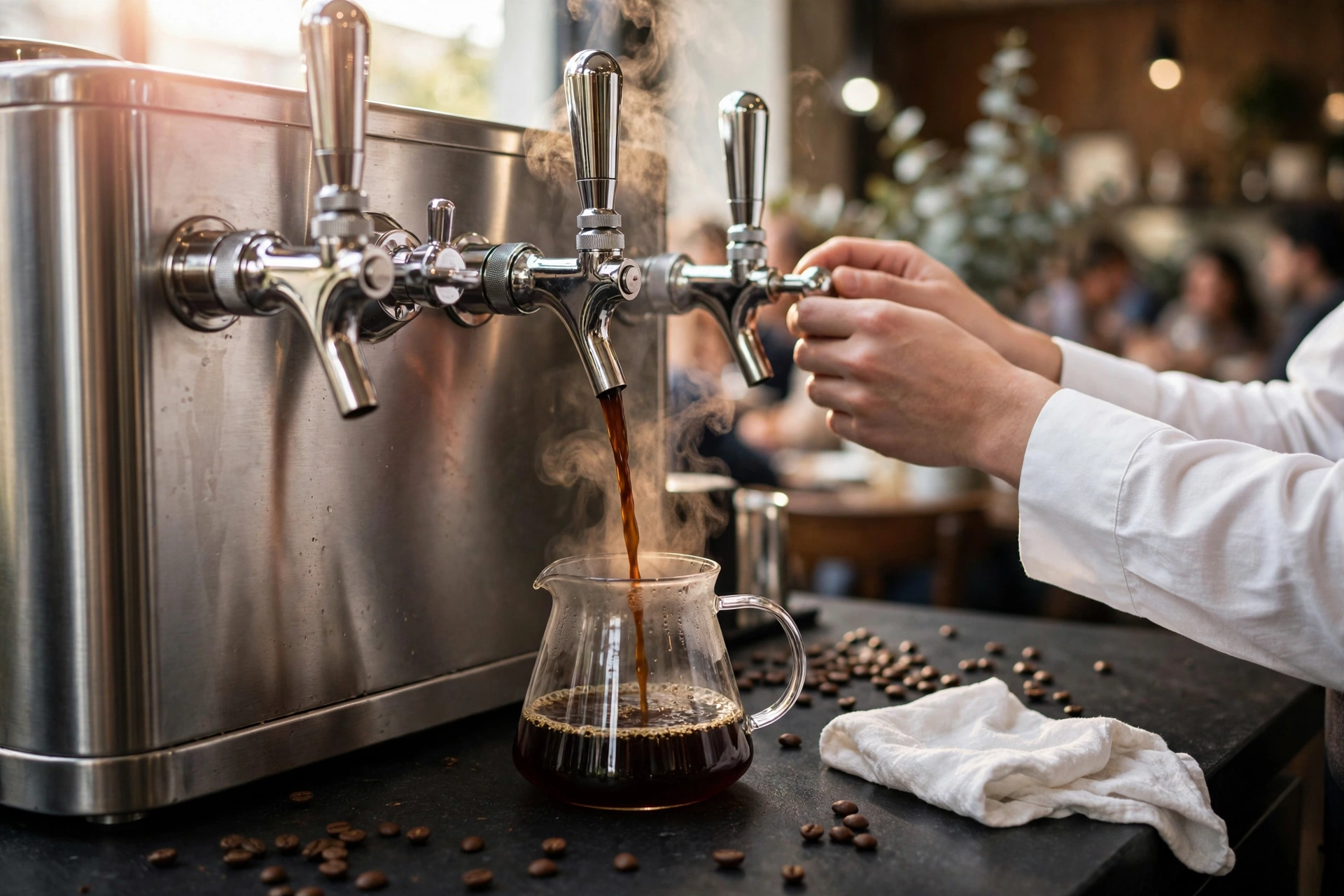
Pro coffee dispensers are not simply large pots of coffee; they are precision tools designed to handle the rigorous demands of a professional environment. These systems range from atmospheric dispensers and vacuum-insulated urns to sophisticated automated beverage stations that integrate with water filtration and heating elements. In a professional setting, the goal is to maintain the integrity of the specialty coffee from the moment it is brewed until the moment it hits the guest's cup, preventing the oxidation and flavor degradation common in home-grade equipment.
When we analyze the hardware, the distinction lies in the materials and the flow control. A pro-grade system uses high-grade stainless steel and BPA-free polymers that meet strict sanitary codes. According to NSF International, commercial food equipment must adhere to specific standards (like NSF/ANSI 4) to ensure that the surfaces are non-absorbent and easy to sanitize, preventing the growth of biofilms that can ruin the taste of a premium roast.

Beyond sanitation, these dispensers focus on thermal retention. A common mistake I see is the use of equipment that allows the coffee to sit and 'cook' on a hot plate. Professional dispensers utilize vacuum insulation or precision heating elements that keep the liquid at the ideal serving temperature without burning the coffee bean oils, which would otherwise result in a bitter, acrid taste.
Why Do Pro Coffee Dispensers Matter for Your Business?
Efficiency in a professional environment is measured in seconds. The primary reason pro coffee dispensers are essential is their ability to standardize output and reduce labor costs. In a fast-paced environment, a manual pour is prone to human error; one staff member fills a cup to the brim, while another leaves an inch of room. This inconsistency leads to significant product waste over a fiscal year. By implementing measured dispensing, businesses can maintain a strict cost-per-cup analysis, which is fundamental for maintaining margins in 2026.
Furthermore, the impact on the customer experience is immediate. Guests in a corporate office or a hotel lobby expect a seamless transition from the counter to their seat. A pro dispenser allows for rapid self-service or rapid staff-led service, reducing the 'friction' of the morning rush. When integrated with high-end hardware, these systems ensure that the Coffea arabica profiles—the fruity notes and acidity—are preserved rather than destroyed by fluctuating temperatures.
As the National Coffee Association USA notes, consumer preferences are shifting toward higher quality and convenience. Businesses that fail to provide a professional dispensing experience risk losing customers to competitors who offer a more polished, efficient beverage program. This is especially true for those integrating top bean-to-cup coffee machines for businesses where the expectation of quality is already set high.
From a technical perspective, professional dispensers protect your investment in coffee. If you are paying a premium for specialty roasts, serving them from a low-quality urn is like putting budget tires on a Ferrari. The thermal mass of a pro dispenser prevents the 'temperature crash' that happens when coffee is moved from a brewer to a plastic carafe, ensuring the beverage remains in the 'goldilocks zone' (typically between 175°F and 185°F) for an extended period.
How to Implement Pro Coffee Dispensers in Your Workflow
Integrating professional dispensing into your operation requires a strategic approach to placement and maintenance. The first step is identifying your peak volume hours. If you have a 30-minute window where 70% of your daily traffic occurs, you need a high-capacity dispenser with a rapid-flow valve. If your traffic is steady throughout the day, a series of smaller, vacuum-insulated dispensers may be better to ensure freshness.
Step 1: Infrastructure Setup
Ensure your dispensing station has a dedicated power circuit and a direct link to a professional water filtration system. Mineral buildup is the silent killer of pro coffee dispensers. Scaling in the heating elements reduces efficiency and alters the taste of the water, which constitutes 98% of your cup. I recommend a reverse osmosis or multi-stage carbon filtration system to protect the internals of your hardware.
Step 2: Calibration and Portioning
Once installed, calibrate your dispensing volume. If your system allows for programmable pours, set them to exactly 1oz below the rim of your standard cup. This prevents spills and ensures that your inventory tracking remains accurate. This level of precision is why many businesses transition from basic brewers to essential commercial drip coffee brewers paired with pro dispensers.
Step 3: Staff Training on Thermal Management
Train your baristas on the concept of 'thermal shock.' Coffee should never be poured into a freezing cold dispenser. Ensure the equipment is pre-heated. In my experience, a pre-heated stainless steel vessel can extend the peak flavor window of a brew by an additional 20 to 30 minutes.
Step 4: The Sanitization Cycle
Establish a strict cleaning schedule. Pro dispensers have 'dead zones'—small crevices in the valves where coffee residue can accumulate. This residue oxidizes and creates a rancid flavor that contamines every subsequent brew. Use a food-safe descaling agent weekly and a full deep-clean daily.

For those in specialized environments, such as medical offices or high-end clinics, the requirements change slightly. The focus shifts toward automation and sterility. You might consider automated coffee machines for clinics and medical offices which combine the dispenser and brewer into one seamless, touchless interface, further reducing the risk of cross-contamination.
Pro Coffee Dispensers vs. Manual Carafes
Many business owners hesitate to invest in pro dispensers because they believe manual carafes provide a 'boutique' feel. However, the data shows that the operational friction of manual carafes outweighs the aesthetic benefit in any volume over 20 cups per hour.
| Feature | Manual Carafes | Cheap Consumer Urns | Pro Coffee Dispensers |
|---|---|---|---|
| Temperature Stability | Rapidly drops | Unstable (Hot plate burn) | High (Vacuum/Precision) |
| Service Speed | Slow (Individual pours) | Moderate | Fast (High-flow valves) |
| Waste Level | High (Over-pouring) | Moderate | Low (Measured output) |
| Sanitation | Moderate | Low (Hard to clean) | High (NSF Certified) |
| Scalability | Very Low | Low | High |
Using a manual approach is essentially a bet that your staff will always be perfect. A professional approach is a system that ensures the result is perfect regardless of who is behind the counter. When we helped a client in Mount Pleasant, SC, transition from carafes to a managed pro-dispensing system, they reported a 15% reduction in coffee waste within the first month alone.
Common Mistakes to Avoid with Beverage Dispensing
One of the most frequent errors I see is the 'Eternal Brew' mistake. This happens when a business leaves a pro dispenser on a low-heat setting for 12+ hours. Even the best professional equipment cannot stop the chemical process of oxidation indefinitely. Coffee begins to lose its volatile aromatic compounds after 30 to 60 minutes. I recommend a 'batch-and-dump' policy: if the coffee has been in the dispenser for more than two hours, it should be composted and replaced. Quality is a choice, not an accident.
Another critical error is ignoring the interface between the dispenser and the cup. If you are using pro coffee dispensers but serving in low-quality, thin paper cups, the heat will dissipate instantly, and the guest will experience a lukewarm beverage. Match your hardware to your consumables. Use double-walled or insulated cups to complement the thermal precision of your equipment.
Finally, avoid the temptation to use 'generic' cleaning chemicals. Some industrial degreasers leave a chemical residue that is nearly impossible to rinse out of a stainless steel valve. Always use chemicals specifically formulated for coffee equipment. This is a detail that often gets overlooked but is essential for maintaining the flavor profile of specialty coffee.
💡
Key Takeaway
The ROI of a pro coffee dispenser is found in the intersection of waste reduction, labor efficiency, and flavor preservation. It is a tool for scaling quality.
If you are building a full-scale operation, don't forget that the dispenser is only one part of the chain. You must also ensure you have the right coffee grinders for coffee shops to provide the consistent grind size necessary for the high-volume brewing that feeds these dispensers. Without a consistent grind, your dispenser is simply delivering inconsistent coffee faster.
Frequently Asked Questions
How long does coffee stay fresh in a pro dispenser?
In a high-quality vacuum-insulated pro dispenser, coffee maintains its peak flavor profile for approximately 60 to 90 minutes. While the temperature may remain high for several hours, the volatile oils and aromatic compounds that define specialty coffee begin to break down. To ensure the best guest experience, we recommend brewing in smaller, more frequent batches rather than one massive brew that sits all morning. This ensures the 'brightness' of the roast is preserved.
Do pro dispensers require professional installation?
While some standalone urns are plug-and-play, most professional-grade dispensing systems—especially those integrated with water lines—require professional installation. Incorrect plumbing can lead to leaks or, more importantly, poor water pressure that affects the heating element. Proper installation ensures that the equipment is leveled and the filtration system is correctly sequenced. For those seeking a zero-stress setup, our managed services at Busy Bean Coffee handle everything from installation to ongoing maintenance.
How do I prevent 'burnt' taste in large-volume dispensers?
The 'burnt' taste is typically caused by 'hot plate' heating, where the coffee at the bottom of the vessel is kept at a temperature far exceeding the boiling point. To avoid this, use dispensers that employ vacuum insulation or indirect heating. Ensure your brewing temperature is set between 195°F and 205°F, and once the coffee is in the dispenser, it should be held at 175°F to 185°F. This prevents the scorching of the sugars in the coffee bean.
What is the difference between an atmospheric dispenser and a vacuum urn?
An atmospheric dispenser relies on gravity and basic seals to hold coffee, often using a heating element to keep it warm. A vacuum urn uses a double-walled construction with a vacuum seal between the walls, similar to a Thermos. Vacuum urns are superior for maintaining temperature without adding extra heat, meaning they don't 'cook' the coffee. For high-end coffee service, vacuum urns are the gold standard for preserving flavor integrity.
How often should pro coffee dispensers be descaled?
Depending on the hardness of your local water, descaling should occur every 2 to 4 weeks. In regions with high mineral content, such as parts of the Southeast, calcium and magnesium deposits can build up quickly, restricting flow and reducing heating efficiency. Regular descaling not only protects the hardware but prevents the 'metallic' taste that occurs when minerals contaminate the brew. Using a high-quality filtration system can extend this interval, but it never eliminates the need for a deep clean.
Conclusion
Moving from basic pouring to a pro coffee dispenser system is a transition from 'making coffee' to 'managing a beverage program.' By focusing on thermal stability, measured output, and rigorous sanitation, you eliminate the variables that lead to waste and customer dissatisfaction. In the 2026 market, where efficiency and quality are non-negotiable, these systems provide a tangible competitive advantage by allowing your staff to focus on hospitality rather than the mechanics of pouring.
Whether you are operating a boutique hotel in Mount Pleasant, SC, or a corporate hub, the goal remains the same: consistent, high-quality coffee delivered with zero friction. This efficiency is only possible when your hardware is synchronized. For those looking to build a complete, high-performance environment, our Ultimate Guide to Outfitting a Coffee Shop with Equipment provides the blueprint for success.
If you're tired of the hassle of equipment maintenance and the unpredictability of manual service, let us handle the heavy lifting. At Busy Bean Coffee, we provide all-inclusive managed coffee memberships that put the best equipment in your hands without the capital expense.
Free Coffee Pairing Guide & Specialty Roast Cheat Sheet
Unlock the secrets of perfect brewing ratios, water temperatures, and specialty roast profiles. Download the guide.