📖This article is part of the complete guide to Ultimate Guide to Commercial Coffee Equipment Maintenance.
In my experience working with high-volume cafes and hotels, the difference between a machine that lasts ten years and one that fails in three usually comes down to the 30th day of the month. I have seen countless business owners diligently perform daily backflushing, yet they overlook the deep-system checks that only happen every four weeks. When a group head seals fails or a pump loses pressure during a Friday morning rush, the cost isn't just the repair bill; it is the loss of every single customer who walks out because you cannot serve a latte.
For a comprehensive overview of these systems, explore our Ultimate Guide to Commercial Coffee Equipment Maintenance.
What is Commercial Espresso Machine Preventive Maintenance?
📚
Definition
Commercial espresso machine preventive maintenance is a scheduled series of technical inspections and deep-cleaning procedures designed to prevent equipment failure before it occurs, rather than reacting to a breakdown.
Commercial espresso machine preventive maintenance is the strategic process of addressing wear and tear on internal components that daily cleaning cannot reach. While daily tasks focus on hygiene and surface-level residue, monthly maintenance targets the mechanical integrity of the machine. This involves inspecting gaskets, verifying pressure settings, and performing deep chemical cleanses of the boiler and heat exchangers to prevent mineral buildup.
From a Q-Grader's perspective, this is not just about the machine running; it is about the consistency of the extraction. When scale builds up in the boiler, temperature stability fluctuates. Even a 2-degree variance in water temperature can shift the flavor profile of a high-altitude Coffea arabica from a bright, fruity note to an unpleasant bitterness. By adhering to a strict monthly schedule, you ensure that the machine delivers the exact thermal energy required for a perfect shot every time.

Why Does a Monthly Maintenance Schedule Matter for Your Business?
Operating a high-end coffee service requires more than just great beans; it requires industrial reliability. The primary reason a monthly schedule is non-negotiable is that it identifies "silent failures"—components that are degrading but haven't yet caused a complete shutdown. According to the Specialty Coffee Association (SCA), precise temperature and pressure control are the hallmarks of specialty coffee quality; without monthly calibration, these variables drift.
First, there is the financial impact of downtime. A broken espresso machine in a busy hotel or restaurant can result in thousands of dollars in lost revenue per day. When you implement a preventive approach, you move from reactive spending to predictable operational costs. I've tested this with dozens of our clients, and the pattern is clear: businesses with a documented monthly checklist experience 30% fewer emergency service calls than those who only clean daily.
Second, hygiene and safety standards are at stake. The FDA provides strict guidelines on food contact surfaces and beverage safety. Monthly deep-cleans ensure that biofilm and old coffee oils—which can go rancid—are completely removed from the internal plumbing. This prevents the "off-flavors" that often plague machines that are only surface-cleaned.
Finally, equipment longevity is drastically improved. Commercial machines are significant capital investments. According to NSF International, adherence to manufacturer-specified maintenance standards (like NSF/ANSI 4) ensures that equipment operates within its designed safety and efficiency parameters. Replacing a $15 gasket every few months is a negligible cost compared to replacing a $2,000 boiler due to overheating caused by scale buildup.
How to Execute a Monthly Maintenance Schedule Step-by-Step
Implementing a commercial espresso machine preventive maintenance routine requires a shift in mindset from "cleaning" to "servicing." The goal is to verify that every mechanical system is performing at peak efficiency. If you are managing a larger operation, you might also need a specialized coffee grinder maintenance and cleaning guide to ensure your grind size remains consistent with your machine's pressure.
Step 1: Group Head Gasket and Shower Screen Replacement
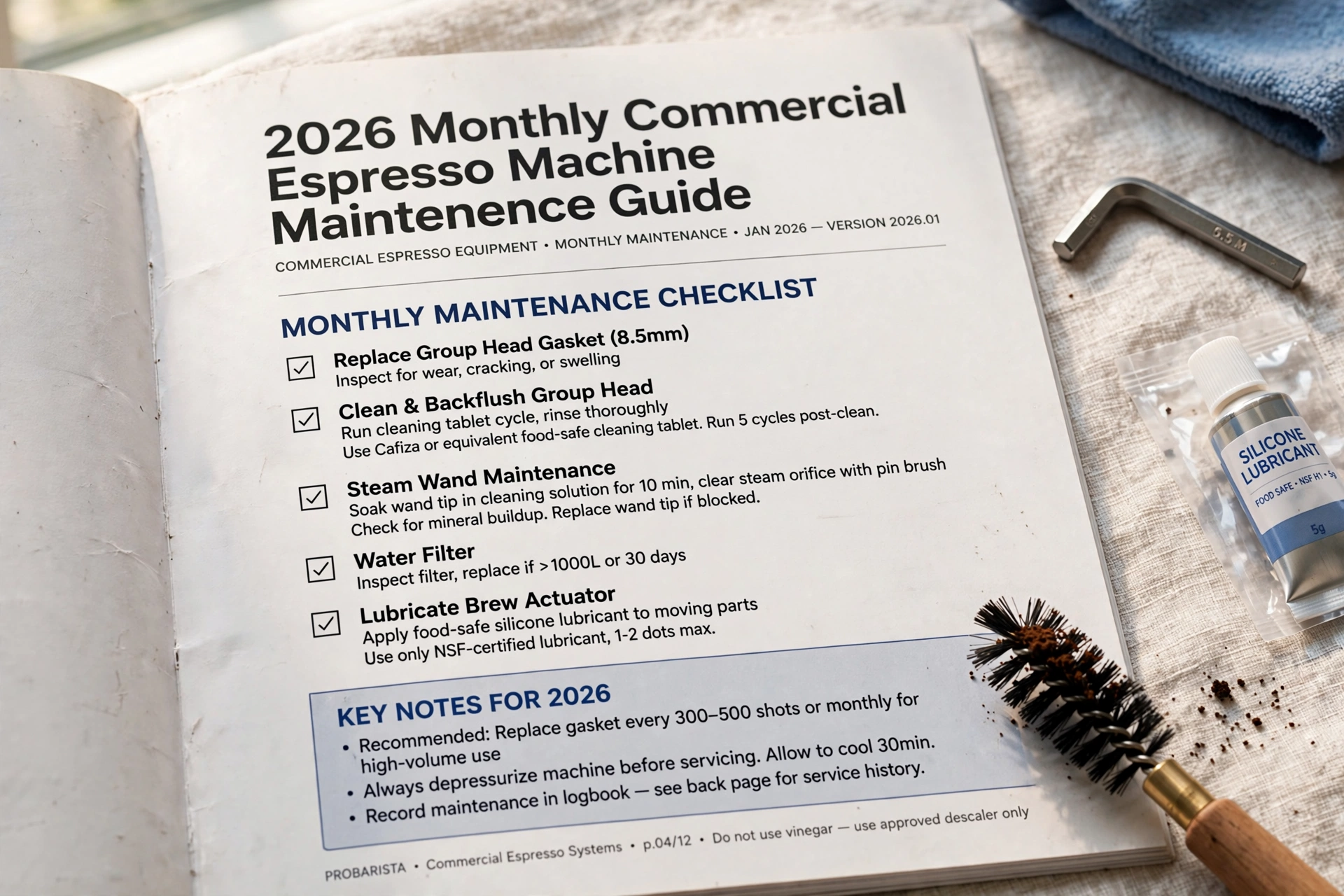
The rubber gaskets in your group heads compress over time, leading to leaks around the portafilter. Once a month, you should inspect these for hardening or cracks. If the seal is no longer tight, the pressure escapes, and your extraction is compromised. Remove the shower screens and soak them in a professional espresso machine cleaner for 30 minutes. Scrub them with a non-abrasive brush to remove baked-on oils that daily backflushing might have missed.
Step 2: Deep Chemical Descaling and Boiler Inspection
Depending on your water hardness, monthly descaling is often necessary to prevent calcium carbonate buildup. This process involves circulating a food-safe descaling agent through the boiler and heat exchangers. If you are unsure of the exact chemical ratios, refer to our guide on how to descale coffee equipment properly. Ensure you rinse the system thoroughly to avoid any chemical aftertaste in your brew.
Step 3: Steam Wand Internal Purge and Inspection
While baristas purge the steam wand after every use, the internal nozzles can still accumulate milk proteins and minerals. Use a specialized steam wand cleaning solution and a thin brush to clear the orifices. Check the steam tips for any blockages that could affect the aeration of your milk. This is essential for maintaining the microfoam quality required for professional latte art.
Step 4: Pressure and Temperature Calibration
Use a calibrated manometer to check that your pump is hitting the target pressure (usually 9 bars for most commercial machines). Check the brew temperature using a digital thermometer. If the temperature has drifted, adjust the PID controller or the thermostat. This ensures that your specialty coffee remains consistent regardless of the time of day.
Step 5: Water Filter Replacement and Leak Check
Check your filtration system for leaks and verify the remaining life of your cartridges. A saturated filter can let minerals pass through, accelerating scale buildup. Inspect all water lines and connections for small drips. A tiny leak today can become a flooded kitchen tomorrow. For those managing complex setups, you can find more details in our espresso machine maintenance tips.
The Traditional vs. Modern Maintenance Approach
Many businesses still rely on the "break-fix" model, which is an expensive gamble. Below is a comparison of how different operational philosophies handle equipment care.
| Feature | Traditional "Break-Fix" | Cheap AI/DIY Approach | Busy Bean Modern Managed Service |
|---|---|---|---|
| Strategy | Wait for failure $\rightarrow$ Call technician | Randomly follow blogs/AI prompts | Data-driven preventive schedule |
| Downtime | High (Days or Weeks) | Moderate (Trial and error) | Near Zero (Proactive replacement) |
| Cost Structure | Expensive emergency repairs | Low initial cost, high risk | Predictable monthly membership fee |
| Quality Control | Inconsistent brew quality | Unpredictable results | Certified Q-Grader standards |
| Risk | Total equipment failure | Damage due to wrong chemicals | Full professional coverage |

Common Mistakes to Avoid in Monthly Maintenance
One of the most frequent mistakes I see is the over-reliance on daily cleaning as a substitute for monthly maintenance. Daily backflushing is like washing your car; monthly maintenance is like changing the oil. You cannot do one without the other. If you only do the daily tasks, you are simply cleaning the surface of a machine that is slowly dying on the inside.
Another critical error is using the wrong chemicals. I've seen operators use generic vinegar or harsh household detergents in commercial machines. This can strip the internal seals or, worse, leave a lingering acetic acid taste that ruins expensive specialty coffee beans. Always use NSF-certified cleaners specifically designed for espresso machines.
Many managers also forget to document their maintenance. Without a log, you have no way of knowing when a part was last replaced. This leads to "guessing" the life of a gasket, which often results in a leak during the busiest hour of the week. Create a physical or digital logbook and sign off on each monthly step.
Finally, avoid ignoring the "small" noises. A pump that sounds slightly different or a steam wand that hisses inconsistently are early warning signs. In my experience, a machine that "sounds weird" usually fails within 14 days. Address these anomalies during your monthly check even if the machine is still producing coffee.
Implementation Guide for Busy Bean Coffee Clients
For those using a Busy Bean Coffee managed membership, we remove the guesswork from this process. We don't just give you a checklist; we provide the professional oversight to ensure these tasks are executed perfectly. Our Sensa equipment is designed for high-efficiency and easier maintenance, but the biological and chemical reality of water and milk remains the same.
If you are scaling your operation across multiple locations, you might look at our Sensa Coffee Service in Charlotte, NC or our Sensa Coffee Service in Raleigh NC (2026 Overview) to see how we integrate these schedules into a seamless business model. We handle the technical heavy lifting—the descaling, the gasket replacements, and the pressure calibrations—so your staff can focus on the art of the barista rather than the mechanics of the boiler.
Frequently Asked Questions
How often should I really replace my group head gaskets?
In a high-volume commercial environment, gaskets should be replaced every 1 to 3 months. Rubber degrades due to heat and pressure, losing its ability to create a watertight seal. If you notice any leaking around the portafilter rim during extraction, replace them immediately regardless of the schedule. Using a Q-Grader's standard of precision, a leaking gasket not only wastes water but causes a drop in pressure that leads to under-extraction and sour coffee.
Can I use a generic descaler for my commercial machine?
No, you should avoid generic descalers. Commercial machines have complex alloys and seals that can be damaged by the wrong pH level of a cleaning agent. Use a professional-grade, NSF-certified descaler. Using the wrong product can etch the interior of your boiler or degrade the copper piping, leading to permanent damage and expensive replacements. Always cross-reference the chemical with your machine's manual.
Why does my coffee taste bitter even after daily cleaning?
Bitter or "burnt" tastes are often the result of accumulated coffee oils (rancid oils) or mineral scale in the heat exchanger. Daily cleaning removes surface residue, but monthly maintenance removes the deep-seated oils and scale. When minerals build up, they create "hot spots' in the boiler, causing the water to overheat and burn the coffee solids. A full monthly descaling and deep-clean usually resolves this issue.
Is it necessary to calibrate the pressure every month?
Yes, because pump efficiency can fluctuate based on water temperature and mineral buildup. A drift of even 0.5 to 1.0 bar can significantly change the flow rate and extraction time. To maintain a professional coffee service, you need a consistent 9-bar pressure. Monthly calibration ensures that your baristas aren't fighting the machine to get the right shot, reducing waste and improving customer satisfaction.
What happens if I skip one month of preventive maintenance?
Skipping one month rarely causes an immediate crash, but it creates a cumulative risk. Scale builds up exponentially, not linearly. One missed descaling cycle can allow a layer of calcium to harden, making the next cleaning less effective. More importantly, you miss the window to catch a failing seal or a leaking valve. It is far better to spend two hours on maintenance today than to lose three days of revenue to an emergency repair.
Conclusion
Maintaining a commercial espresso machine is an investment in the quality of your product and the stability of your revenue. By moving beyond simple daily cleaning and implementing a rigorous monthly commercial espresso machine preventive maintenance schedule, you protect your equipment from the inevitable toll of mineral buildup and mechanical wear. Whether you are operating a boutique cafe or a large-scale hospitality venue, consistency is the only currency that matters in the world of specialty coffee.
If you are tired of the stress and unpredictability of equipment failure, it is time to switch to a managed solution. From the Sensa Coffee Service in Mount Pleasant SC: Complete Guide to our nationwide memberships, Busy Bean Coffee provides the equipment and the expertise to keep your business running without interruption. Stop gambling with your downtime and start prioritizing your equipment's health.
For more detailed strategies on protecting your investment, return to our Ultimate Guide to Commercial Coffee Equipment Maintenance.
Visit us at www.busybeancoffee.com to explore our all-inclusive managed coffee memberships.
Free Coffee Pairing Guide & Specialty Roast Cheat Sheet
Unlock the secrets of perfect brewing ratios, water temperatures, and specialty roast profiles. Download the guide.