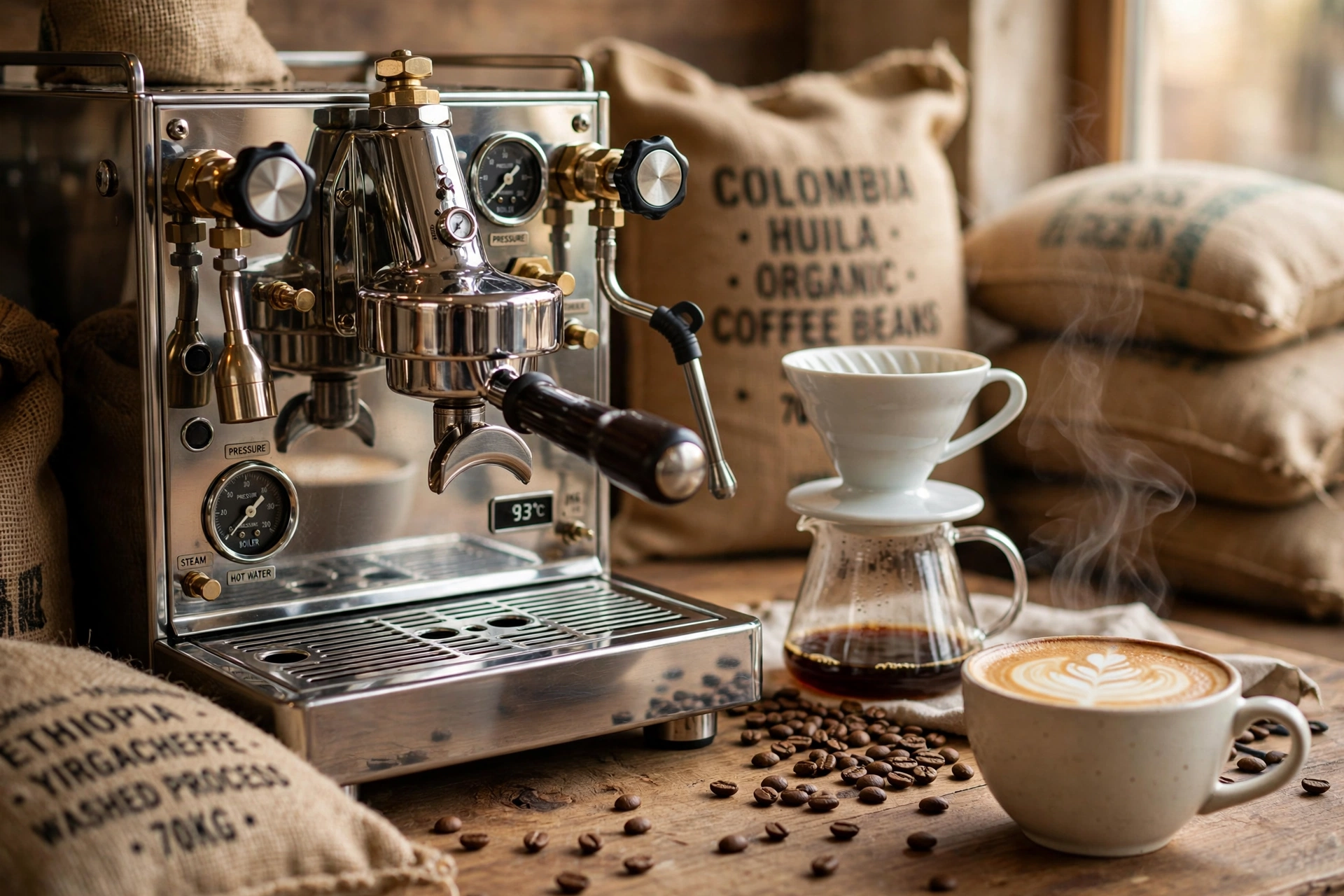
📖This article is part of the complete guide to Ultimate Guide to Specialty Coffee Equipment for Business.
Most restaurant owners treat coffee as an afterthought, a low-margin add-on that just needs to be 'hot and black.' But after years of managing equipment for high-traffic venues, I've seen the opposite: a high-quality coffee program can be a primary driver of table turnover and an incredible booster for the average check. If you are serving mediocre coffee from a home-grade machine in a commercial setting, you are leaving money on the table and risking your brand reputation.
For a comprehensive overview of the industry, explore our Ultimate Guide to Specialty Coffee Equipment for Business.
What are the Best Commercial Coffee Machines for Restaurants?
📚
Definition
Commercial coffee machines for restaurants are heavy-duty beverage systems designed for continuous, high-volume output, featuring reinforced boilers, professional-grade pumps, and NSF-certified materials to withstand the rigors of a professional kitchen environment.
When we talk about the 'best' machines, we aren't talking about the most expensive ones, but the ones that align with your specific service model. In my experience working with diverse foodservice operators, the ideal setup usually falls into three categories: super-automatic machines for speed, semi-automatic espresso machines for quality, and high-capacity drip systems for breakfast rushes. The core goal is to maximize the extraction of the coffee bean while minimizing the labor required from your staff.
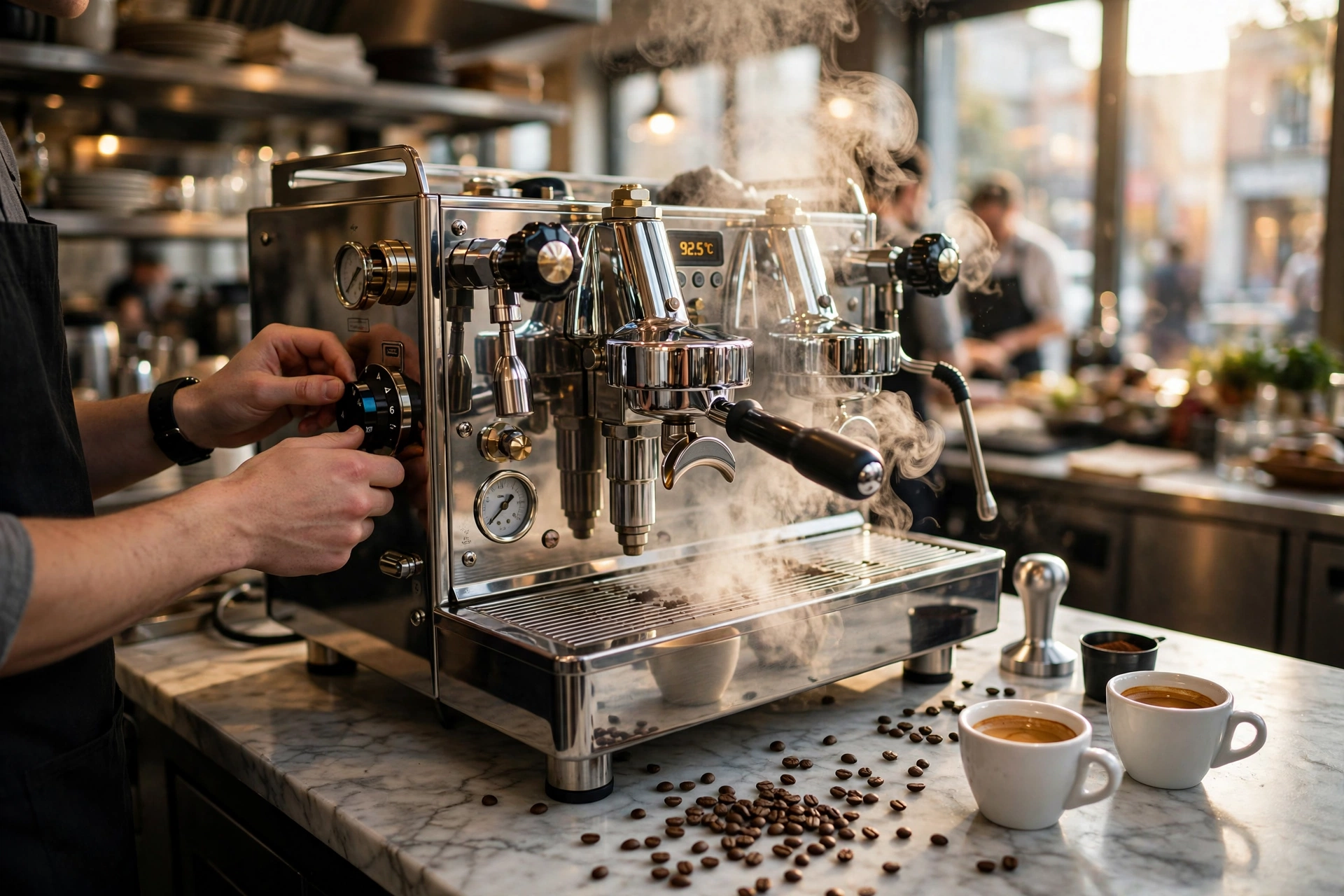
For restaurants that prioritize a curated experience, a semi-automatic machine allows a trained barista to control every variable, from grind size to tamping pressure. However, for a diner or a casual bistro, a super-automatic system—where one button handles everything from grinding to frothing—is often the smarter investment. These machines ensure consistency regardless of who is behind the counter, preventing the 'Monday morning coffee' from tasting different than the 'Friday night brew.'
Why the Right Coffee Equipment Matters for Your Bottom Line
Choosing the wrong equipment doesn't just result in bad coffee; it results in wasted labor and lost revenue. According to the National Coffee Association USA (NCA), coffee consumption patterns have shifted toward specialty brews and espresso-based drinks, meaning customers now expect a higher standard of quality even in non-cafe environments. If your machine cannot keep up with a Saturday brunch rush, you lose customers to the cafe next door.
First, consider the impact on labor. A manual process that takes five minutes per latte is a liability during a rush. By implementing a high-efficiency espresso machine, you reduce the 'ticket-to-table' time, allowing for faster table turnover. Second, there is the matter of waste. Cheap machines often result in inconsistent extraction, meaning you throw away more shots and waste more expensive specialty coffee beans.
Furthermore, sanitation is a legal necessity. Using equipment that doesn't meet NSF International standards for food equipment can lead to health code violations. Professional machines are built with stainless steel and modular components that allow for deep cleaning, which is essential when dealing with milk proteins and coffee oils that can go rancid if not properly purged.
How to Choose the Right Machine Based on Your Service Model
Selecting a machine requires a cold, hard look at your volume and your staff's skill level. I've seen many owners buy a $15,000 manual machine only to have it sit unused because no one knew how to dial it in. To avoid this, you should categorize your needs based on your primary revenue stream.
The High-Volume Breakfast Spot
If your primary goal is pumping out gallons of coffee for a morning crowd, you need a combination of high-capacity thermal carafes and precision brewers. In this scenario, Commercial Drip Coffee Makers for Businesses are your best friend. They provide the stability needed to serve 50 people in 20 minutes without a dip in quality.
The Upscale Bistro or Fine Dining
Here, the coffee is the final note of the dining experience. You need a machine that produces an authentic espresso with a rich crema. I recommend a semi-automatic machine with a dedicated volumetric dosing system. This allows the staff to start a shot and walk away to plate a dessert, knowing the machine will stop at the exact milliliter required. If you're expanding your beverage menu, you might also look into Where to Buy Latte Art Tools for Foodservice Pros | Busy Bean Coffee to add that visual 'wow' factor to your drinks.
The Casual Dining/Family Restaurant
Consistency is king here. A super-automatic machine is the gold standard. These machines handle the coffee roasting nuances by automating the temperature and pressure, ensuring that every cappuccino tastes identical. For those in specific regions, like the Carolinas, we often see high demand for localized services; for instance, those seeking a Coffee delivery service in Charlotte NC - Complete Guide | Busy Bean Coffee often pair their bean delivery with automated hardware to keep operations lean.

Comparing the Three Main Approaches to Restaurant Coffee
When deciding on your hardware, it is helpful to visualize the trade-off between control and convenience. Most owners fluctuate between three distinct paths.
| Feature | Traditional Manual Approach | Generic/Cheap AI/Auto Approach | Busy Bean Coffee Managed Approach |
|---|---|---|---|
| Control | Absolute control over every shot | Very limited; 'black box' settings | Balanced precision and automation |
| Labor | Requires highly trained barista | No skill required, but low quality | Minimal training for high-end results |
| Consistency | Varies by staff member | Consistent, but often mediocre | High consistency with premium roasts |
| Maintenance | Owner handles everything | Frequent breakdowns, no support | Full maintenance and professional setup |
| Risk | High waste during training | High risk of equipment failure | |
| Financials | High upfront CapEx | Low upfront, high long-term cost | Predictable monthly fee (No CapEx) |
Common Mistakes When Buying Commercial Coffee Machines
One of the most frequent errors I see is the 'Over-Spec' trap. An owner buys a 3-group head machine for a restaurant that only sells 10 coffees a day. Not only is this a waste of money, but the machine's boilers will be cycling constantly, wasting electricity and wearing out the heating elements prematurely. Always buy for your actual peak volume, not your imagined future volume.
Another critical mistake is ignoring the water quality. Coffee is 98% water. If you hook a high-end espresso machine directly to city water without a sophisticated filtration system, the calcium and magnesium will build up as scale. Within six months, your heating elements will be choked, and your coffee will taste like metallic brine. I always insist that my clients implement a multi-stage filtration system to protect their investment.
Finally, many restaurants fail to consider the 'hidden' costs of ownership. A machine isn't just a one-time purchase; it's a relationship. Between group head gaskets, steam wand seals, and descaling cycles, the maintenance is relentless. If you don't have a plan for who fixes the machine at 7:00 AM on a Sunday, you don't have a coffee program; you have a liability. This is why we developed our managed service at Busy Bean Coffee, removing the stress of maintenance from the owner's plate.
Deep Dive: The Role of Coffea Arabica in Restaurant Success
To truly elevate a restaurant's coffee program, you must understand the raw material. Most commercial-grade 'coffee' uses a mix of Robusta and Arabica. However, for any establishment aiming for a 'specialty' designation, using 100% Coffea arabica is non-negotiable. Arabica beans grow at higher altitudes and possess a complexity of flavor—ranging from fruity to chocolatey—that Robusta simply cannot match.
When you pair high-altitude Arabica beans with a precision-tuned commercial machine, the result is a beverage that can be priced at a premium. According to the International Coffee Organization (ICO), the global demand for specialty-grade coffee continues to rise as consumers become more discerning. By specifying the origin and roast of your beans on the menu, you transform a commodity into an experience.
Implementation Guide: Setting Up Your Coffee Station
Setting up a coffee station is about more than just plugging in a machine. It is about workflow ergonomics. In my experience, the 'Golden Triangle' of coffee service consists of the grinder, the machine, and the knock-box. If these three are not within a single pivot step of the operator, you are wasting seconds per drink, which adds up to hours of lost productivity over a month.
- Water Line Integration: Ensure your machine is placed near a dedicated water line and a floor drain. Never rely on a manual reservoir for a commercial setting; it is slow and prone to contamination.
- Electrical Requirements: Most high-end machines require 220V power. Do not use extension cords or power strips, as the amperage draw of a commercial boiler can trigger breakers or cause overheating.
- Grinder Calibration: Your grinder is just as important as your machine. Invest in an on-demand burr grinder to ensure that the coffee bean is ground seconds before brewing, preventing oxidation.
- Staff Training: Even with an automated machine, your team needs to know how to purge the steam wand and clean the drip tray. A dirty machine produces bitter coffee, regardless of the bean quality.
If you are overwhelmed by these technical requirements, that is exactly why we offer a managed solution. From professional installation to ongoing maintenance, Busy Bean Coffee ensures your station is optimized for maximum flow and minimum stress.
Frequently Asked Questions
How often should a commercial coffee machine be serviced?
Commercial machines should undergo a basic deep clean daily and a professional calibration/service every three to six months. This includes replacing gaskets, checking pump pressure, and descaling the boiler. Neglecting this schedule leads to inconsistent temperature and potential hardware failure. At Busy Bean Coffee, our managed membership includes all this maintenance, so you never have to track a calendar or worry about an unexpected breakdown during a holiday rush.
Can I use a home espresso machine in a small restaurant?
Absolutely not. Home machines are designed for 2-5 drinks per day and lack the thermal stability and pump power required for commercial use. Using a home machine in a professional setting will lead to rapid burnout of the heating element and inconsistent results. Furthermore, home machines are not NSF-certified, which can put you in disagreement with health department regulations during inspections. Always invest in equipment rated for commercial duty.
What is the difference between a super-automatic and a semi-automatic machine?
A super-automatic machine handles the entire process—grinding, tamping, and brewing—at the touch of a button. It is ideal for restaurants with high volume and minimal staff training. A semi-automatic machine requires a human to grind and tamp the coffee manually, offering far more control over the flavor profile. While semi-automatics produce superior quality in the hands of a pro, super-automatics provide the consistency and speed essential for most fast-paced dining environments.
How do I reduce the waste of coffee beans in my restaurant?
Waste usually happens due to poor calibration or incorrect dosing. Using an on-demand grinder ensures that only the exact amount of coffee needed for a shot is ground, eliminating the 'purging' of old coffee from a hopper. Additionally, training staff on the correct tamping pressure prevents 'channeling,' where water bypasses the coffee, resulting in a shot that must be thrown away. High-precision equipment from Busy Bean Coffee minimizes these errors significantly.
Which is better for a restaurant: drip coffee or espresso?
It depends entirely on your customer demographic and the time of day. Breakfast-heavy venues must prioritize high-capacity drip systems for speed and volume. Evening and brunch venues benefit more from espresso machines, as lattes and cappuccinos command a higher price point and appeal to a broader range of tastes. The most successful restaurants implement a hybrid approach, using a professional drip system for the base and an espresso machine for specialty drinks.
Conclusion
Investing in the right commercial coffee machines for restaurants is not just about the beverage; it is about optimizing your operational efficiency and protecting your brand. From the selection of Coffea arabica beans to the precision of your espresso machine, every detail contributes to the guest's final impression of your establishment. Whether you are running a high-volume diner in Mount Pleasant or a boutique bistro, the goal is always the same: high quality, low friction, and maximum ROI.
If you are tired of the CapEx burden and the headache of constant maintenance, it might be time to shift to a managed model. Our all-inclusive membership provides premium equipment and professional support for one predictable fee. For a comprehensive overview of how to build your beverage program from the ground up, return to our Ultimate Guide to Specialty Coffee Equipment for Business.
Ready to upgrade your coffee experience without the massive upfront cost? Visit us at www.busybeancoffee.com to see how our managed solutions can transform your restaurant's bottom line.
Free Coffee Pairing Guide & Specialty Roast Cheat Sheet
Unlock the secrets of perfect brewing ratios, water temperatures, and specialty roast profiles. Download the guide.