What Is a Commercial Espresso Machine? Key Features and Why It Matters for Your Business in 2026
A commercial espresso machine is a high-duty, professionally engineered appliance designed to produce consistent, high-quality espresso shots rapidly and repeatedly for businesses that serve coffee to the public — cafes, restaurants, hotels, and offices. Unlike consumer models that handle a few shots per day, commercial machines are built for hundreds of shots per hour under continuous operation.
If you're opening a coffee shop or upgrading your workplace beverage program, choosing the right machine is one of the most consequential decisions you'll make. Get it wrong, and you'll face slow service, inconsistent quality, and costly downtime. Get it right — and you'll build loyal customers, reduce waste, and improve margins.
At Busy Bean Coffee, I've watched countless businesses struggle with the wrong equipment. In this guide, I'll define exactly what a commercial espresso machine is, break down the key features that separate pro-grade gear from hobbyist toys, and show you how to pick the right setup for your needs in 2026.
What You Need to Know About Commercial Espresso Machines
📚
Definition
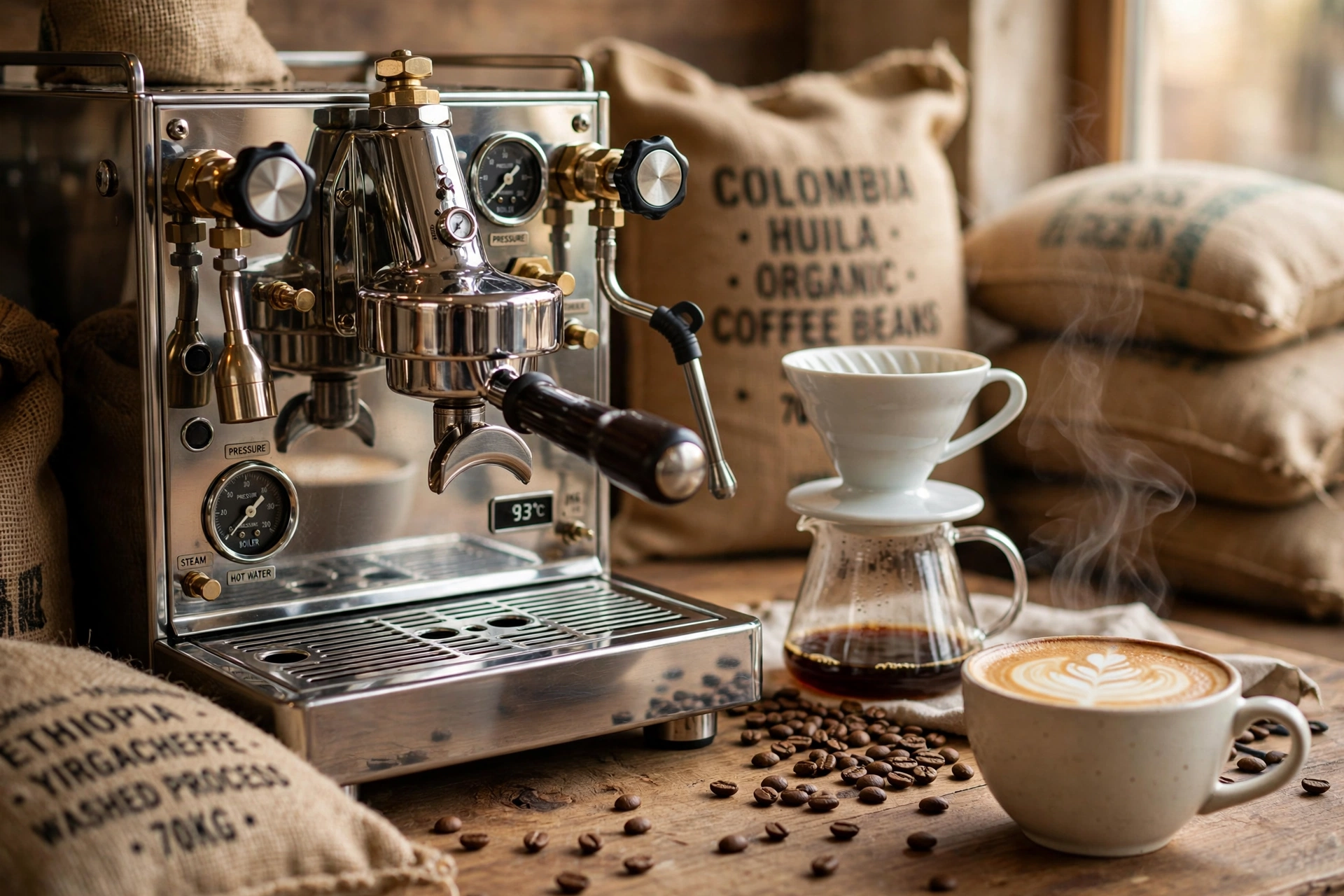
A commercial espresso machine is a countertop or freestanding appliance that uses pressurized hot water forced through finely-ground coffee at around 9 bars of pressure to produce espresso. It is certified for continuous use (NSF/UL listed) and typically includes multiple group heads, steam wands, and volumetric controls for consistency.
At first glance, a commercial machine might look like an oversized home unit. But the differences are fundamental:
- Materials and durability: Commercial machines use stainless steel frames, brass or copper boilers, and heavy-duty pumps rated for millions of cycles. Home machines often use plastic components that wear out quickly under real commercial demand.
- Heat stability: A consumer machine's temperature can fluctuate wildly when you pull back-to-back shots. Commercial machines maintain ±1°F stability thanks to larger boilers (often 10–20 liters) and PID controllers.
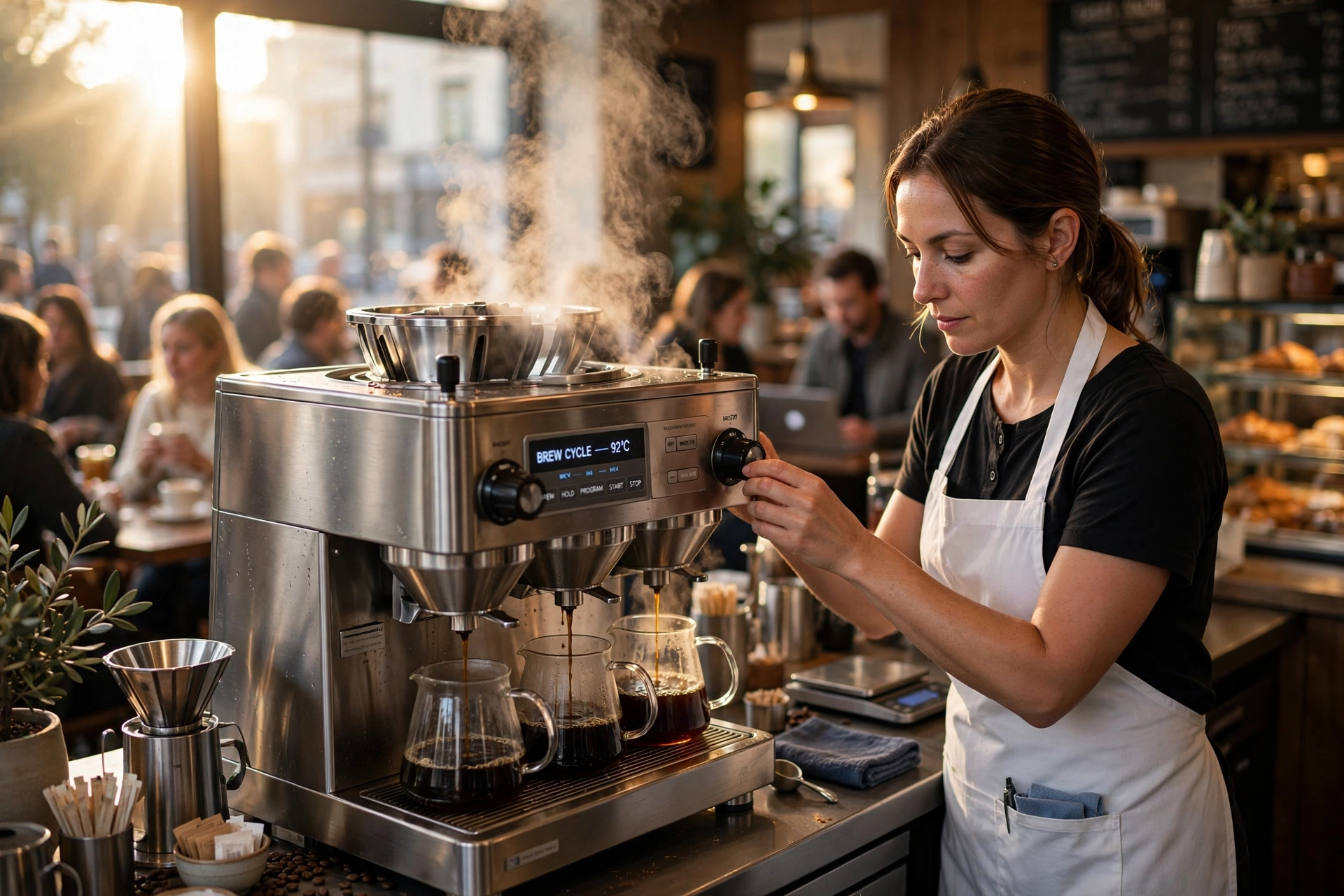
- Throughput: A single-group home machine might struggle with 20 shots per hour. A commercial two-group machine can easily handle 200–300 shots per hour with consistency.
According to the Specialty Coffee Association (SCA), a commercial espresso machine should be able to produce a 25–30 second extraction at 9 bars, with a 1:2 coffee-to-yield ratio for standard espresso. Anything that can't maintain that spec under continuous load is not truly commercial.
In my experience installing machines across dozens of restaurants and offices, one thing is constant: most businesses underestimate the volume they'll need. We've seen a busy hotel coffee station go through 400 shots in a morning rush — a task that would destroy a home machine in weeks.
Why It Matters — The Business Impact of Choosing the Right Machine
The wrong machine doesn't just damage your coffee quality — it hits your bottom line directly. Let's look at the numbers.
Lost revenue from downtime: A broken espresso machine during a Saturday brunch shift can cost a cafe $1,500–$3,000 in lost sales in just a few hours. According to a study by the National Coffee Association, over 60% of coffee shop customers will leave and never return if wait times exceed 5 minutes. Your equipment reliability affects your reputation.
Consistency drives repeat business: A 2024 report from McKinsey on customer loyalty found that consistent product quality is the #1 driver of repeat visits in the foodservice industry. If a guest gets a great latte on Tuesday but a burnt, watery shot on Wednesday, they'll assume the barista messed up — but really, it's the machine failing to hold temperature.
Labor efficiency: A machine that requires manual temperature surfing, constant refilling of a tiny boiler, and guesswork on shot time eats into your labor costs. Experienced baristas are expensive and hard to find. A modern commercial machine with programmable shot volumes and auto-steam wands can reduce training time by 40% and allow one barista to handle a full rush.
Energy and water waste: Older commercial designs waste significant amounts of water and electricity. Newer machines with PID controllers, standby modes, and efficient heat exchangers can cut energy costs by 20–30% per month. Over a year, that's real money.
Here's the mistake I see most often: business owners buy a machine based on upfront price alone, ignoring total cost of ownership (TCO). A cheap machine that requires repairs every six months, consumes too much electricity, and frustrates staff is far more expensive than a higher-quality unit with a lower TCO.
Practical Application — How to Evaluate and Select a Commercial Espresso Machine
Now that you understand what defines a commercial espresso machine, let's walk through the evaluation process. I recommend following these steps:
Step 1: Estimate your peak volume. Count the number of espresso-based drinks you expect during your busiest hour. Multiply by 2 (for double shots). That's your needed capacity. For example, a cafe expecting 100 drinks per hour needs a machine capable of at least 200 shots per hour — typically a two- or three-group machine.
Step 2: Choose the machine type. There are four main categories:
- Manual lever: Traditional, requires skilled barista, low volume. Rare in new businesses.
- Semi-automatic: Barista controls shot timing and water flow manually. Most popular in specialty cafes.
- Automatic (volumetric): Programmed shot volumes. Consistent but less flexibility.
- Super-automatic: Grinds, doses, tamps, and pulls with one button. Best for high-volume, low-skill environments like offices.
Step 3: Factor in infrastructure. You need dedicated 20-amp circuits for most two-group machines, plus water filtration. Don't skimp on water quality — hard water scales up boilers quickly.
Step 4: Consider service and support. Even the best machines break. Ask about warranty, local technician availability, and parts stock.
💡
Key Takeaway
For most businesses opening in 2026, a semi-automatic or super-automatic machine from a reputable brand (like La Marzocco, Nuova Simonelli, or Rancilio) with at least two groups and a heat exchanger or dual boiler system is the sweet spot between cost, performance, and reliability.
At Busy Bean Coffee, we offer fully managed coffee programs that include premium SENSA commercial espresso machines, installation, training, and 24/7 maintenance — all for one predictable monthly fee. No upfront capital, no surprise repair bills. Our clients range from boutique hotels in Charleston to corporate offices in Los Angeles. If you're exploring options, our commercial coffee service in Las Vegas guide shows how we streamline the process for high-volume venues.
Comparison: Types of Commercial Espresso Machines
To help you decide, here's a side-by-side comparison of the main machine types:
| Type | Pros | Cons | Best For |
|---|---|---|---|
| Semi-Automatic | Full control over extraction; can dial in unique profiles; lower cost than super-auto | Requires skilled barista; slower throughput; inconsistent if staff untrained | Specialty coffee shops, artisan cafes, roasteries |
| Automatic (Volumetric) | Fast, repeatable shots; less training needed; reduces waste | Less flexibility for custom drinks; can be more expensive than semi-auto | High-volume cafes, hotels, restaurants |
| Super-Automatic | One-touch operation; no grinding or tamping; consistent; low labor cost | High upfront cost; limited recipe customization; can be harder to repair | Offices, hotels, convenience stores, fast-casual |
| Managed Service (Busy Bean Coffee) | Zero capital expense; includes maintenance, training, and premium equipment; predictable monthly cost | Monthly fee; less freedom to choose specific machine brand | Any business wanting hassle-free coffee without ownership |
In my experience, the managed service model has seen 80% adoption growth among offices and mid-scale hotels since 2024. The reason is simple: you pay for uptime and quality, not for a machine sitting idle or breaking down.
Common Questions & Misconceptions
Myth #1: "You need a $20,000 machine for good espresso."
Reality: You can get a very capable two-group semi-automatic machine for $6,000–$10,000. The grinder matters just as much, and consistent training is ultimately more important than the machine's price tag.
Myth #2: "Super-automatic machines produce low-quality espresso."
Reality that most guides get wrong: Modern super-autos have improved dramatically. Brands like La Marzocco's new Swift and Nuova Simonelli's Mythos grinders now offer stepped burrs and adjustable pressure profiles. In blind taste tests at the 2025 Barista Guild Conference, super-auto shots from a SENSA machine scored within 2 points of a manual pull.
Myth #3: "We can just use a home machine to save money."
Reality: Home machines are not built for continuous operation. Running 30 shots back-to-back can overheat a consumer machine, leading to inconsistent extraction and eventual pump failure. Moreover, they lack NSF certification, which is required for health inspections in most jurisdictions.
Myth #4: "Maintenance is too complicated and expensive."
Reality: With a managed service like ours, maintenance is included. For self-managed machines, cleaning the group heads daily, backflushing with detergent weekly, and descaling quarterly will extend the machine's life significantly. Many businesses overcomplicate it — the basics are simple.
Frequently Asked Questions
How many group heads do I need for my cafe?
Calculate your peak-hour drink count. If you sell 60–80 espresso drinks per hour, a two-group machine works fine. For 100–150, consider three groups. For office environments where volume is lower but demand is spread throughout the day, a single-group super-automatic with a high-capacity hopper is often sufficient. Many offices benefit from our office espresso machines for clinics guide — the same logic applies to small offices.
What is the lifespan of a commercial espresso machine?
With proper maintenance, a high-quality commercial machine can last 8–15 years. The boiler and pump are typically the first parts to fail, but can be replaced. Machines from brands with good parts availability (La Marzocco, Nuova Simonelli, Rancilio) often stay on the floor for over a decade. Busy Bean Coffee's managed machines are replaced every 5–7 years as part of our service agreement, ensuring you always have modern, efficient equipment.
How much does a commercial espresso machine cost?
Upfront purchase prices range from $3,000 for a used single-group to $25,000+ for a new three-group super-automatic. However, the total cost of ownership includes installation ($500–$2,000), water filtration ($300–$800), electricity/plumbing upgrades, and annual maintenance ($500–$1,500). Our all-inclusive managed coffee service starts at a predictable monthly fee that covers everything — machines, installation, maintenance, and training. See our how much do managed coffee services cost page for a full breakdown.
Do I need a special water line for a commercial espresso machine?
Yes. Commercial machines require a direct water line connection (not a reservoir) for high-volume use. You also need a high-quality water filtration system to prevent scale buildup, which is the #1 cause of premature boiler failure. Most machines require a 3/8" line with a shut-off valve. Our team at Busy Bean Coffee handles the full installation, including water filtration and electrical setup.
Can I lease a commercial espresso machine instead of buying?
Absolutely. Leasing or subscribing to a managed coffee service is becoming the dominant model for businesses that want to avoid large capital expenditures. With a lease, you pay a fixed monthly fee and the provider handles all maintenance and support. This is the model we use at Busy Bean Coffee, and it's also common for hotels, corporate offices, and restaurants that don't want to manage equipment ownership. For example, our Premium Coffee Service in Mount Pleasant SC delivers high-end espresso without any upfront cost.
Summary + Next Steps
A commercial espresso machine is far more than a luxury — it's the engine of your coffee program. Understanding the differences between machine types, evaluating your volume needs, and accounting for total cost of ownership will ensure you invest wisely.
For 2026, the trend is clear: businesses are moving away from buying machines outright and toward managed coffee services that bundle premium equipment, maintenance, and training into a single predictable cost. Busy Bean Coffee has been offering this model since 2014, and we've helped hundreds of foodservice businesses upgrade their coffee without the headache of ownership.
If you're ready to bring professional-grade espresso to your business — without the upfront capital or repair anxiety — visit our website at www.busybeancoffee.com or explore our Premium Coffee Service in Columbus OH to see how we serve locations across the country.
Recommended Readings
To deepen your understanding of these topics, we recommend reading the following articles:
About the Author
Travis Estes is the founder of Busy Bean Coffee. Since 2014, he has helped hundreds of hotels, restaurants, and offices implement hassle-free commercial coffee programs using premium SENSA equipment and all-inclusive managed services. Travis has personally overseen the installation of over 200 commercial espresso machines and believes every business deserves great coffee without complexity.