What Are Corporate Cafe Solutions for Businesses
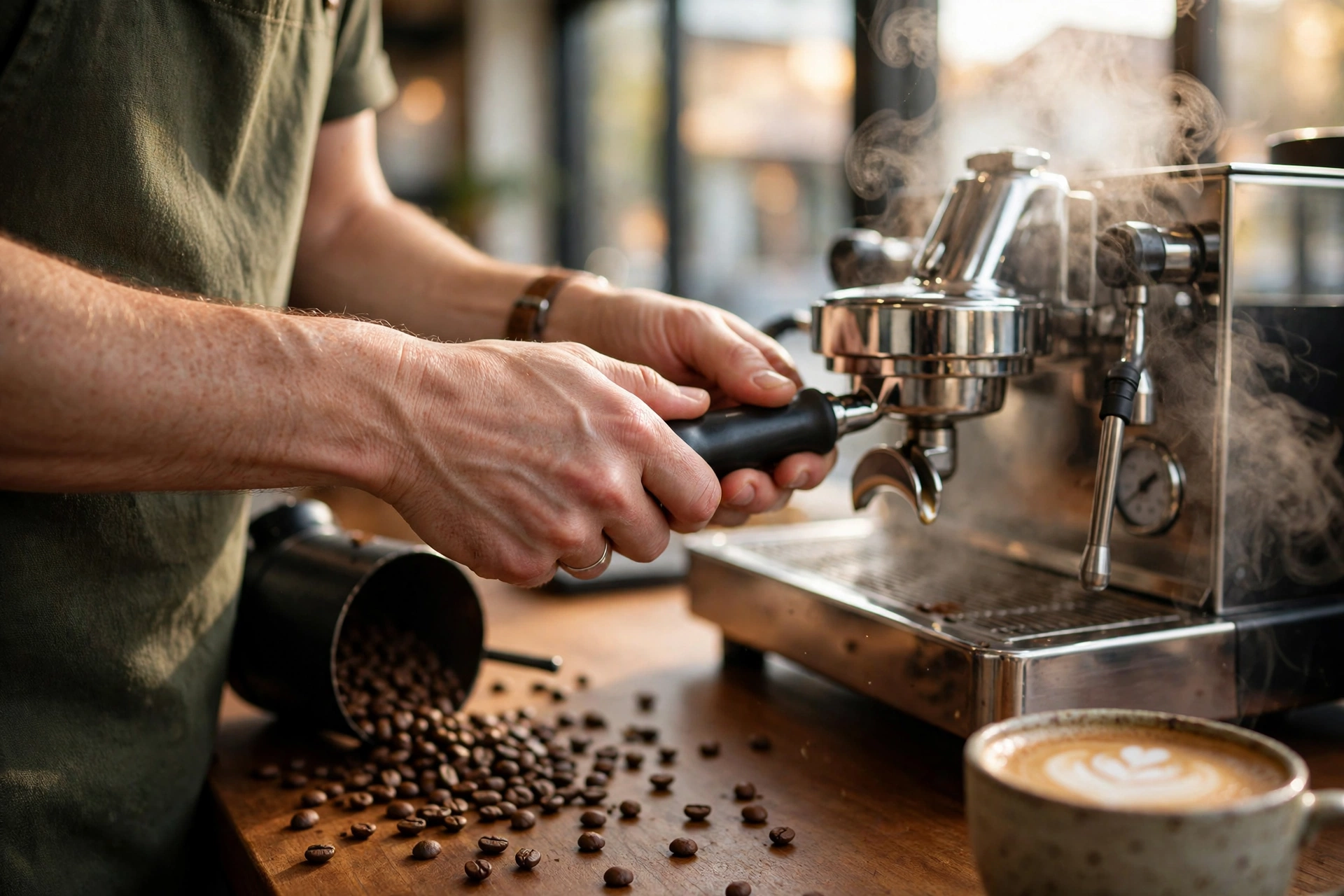
If you've walked into a modern office lobby, co-working space, or corporate headquarters in the past few years and noticed a sleek coffee bar with professional-grade equipment, fresh pastries, and a barista pulling espresso shots — you've encountered a corporate cafe solution. But here's the thing: most business leaders don't realize a corporate cafe solution isn't just a fancy coffee machine in the breakroom. It's a fully managed, turnkey hospitality program designed specifically for workplace environments. These solutions combine commercial-grade equipment, specialty-grade coffee, professional staffing or self-service systems, and ongoing maintenance into a single service — often for a predictable monthly fee.
📚
Definition
A corporate cafe solution is a managed coffee service program for businesses that includes professional espresso equipment, premium bean sourcing, installation, maintenance, and optionally, trained baristas — all bundled under one contract with a single point of accountability.
The confusion happens because many vendors rebrand traditional vending services or basic office coffee providers as "cafe solutions." A true corporate cafe solution is an entirely different category. In my experience working with dozens of companies across the United States — from tech firms in Austin to law offices in Boston — the difference between a real cafe program and a glorified breakroom setup comes down to three things: equipment quality, service accountability, and beverage outcome.
What a Corporate Cafe Solution Actually Includes
A proper corporate cafe solution is not a single product. It's an integrated ecosystem of hardware, consumables, and service. Let's break down the core components.
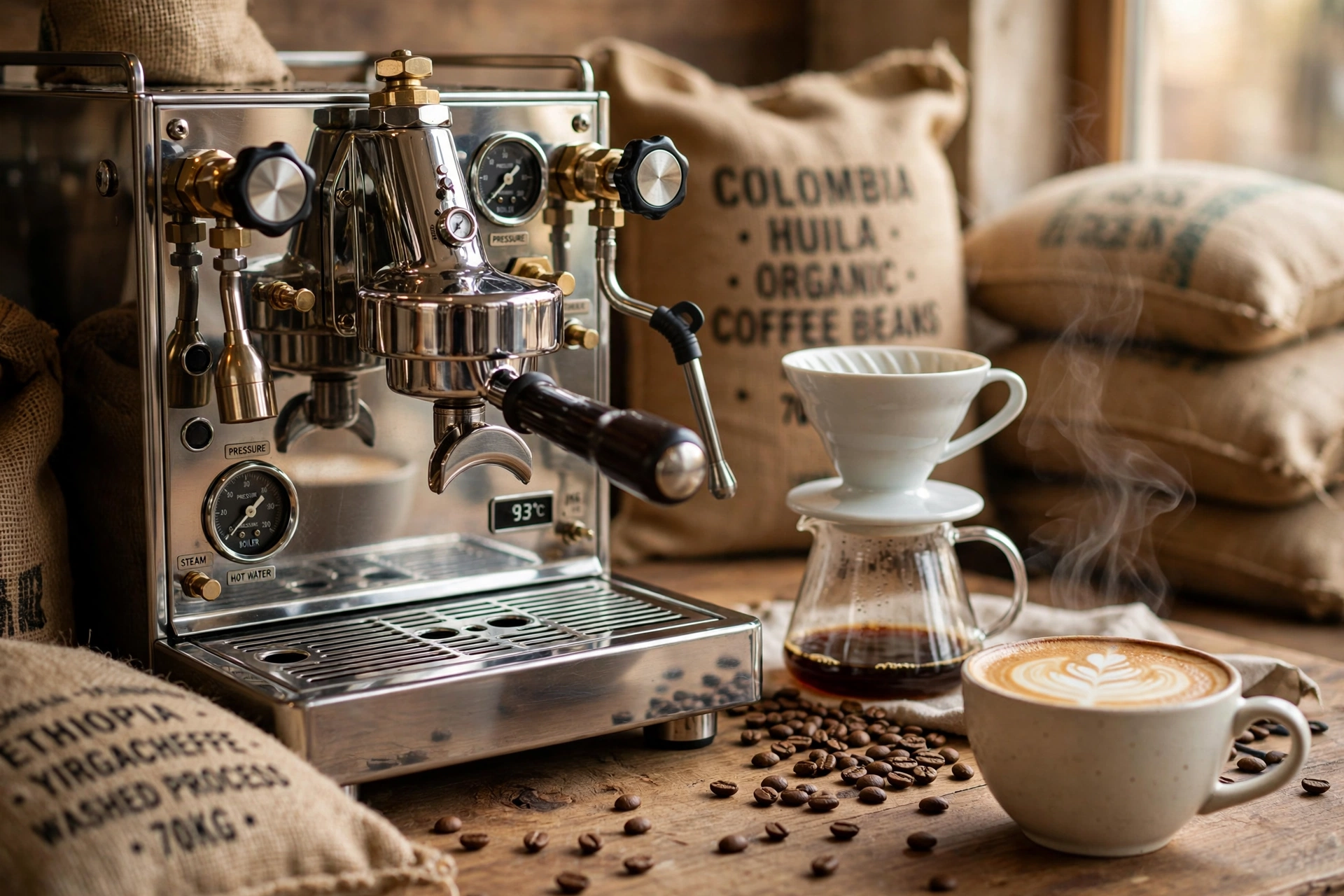
Commercial espresso equipment. This is where most programs stand or fall. A true corporate cafe uses machines rated for 100-300+ shots per day — not residential units that overheat after a dozen drinks. Machines from La Marzocco, Nuova Simonelli, or SENSA (which Busy Bean Coffee deploys) are built with commercial boilers, group heads, and steam wands that deliver consistent pressure and temperature shot after shot.
Specialty-grade coffee sourcing. The beans matter more than most buyers realize. A corporate cafe solution typically sources single-origin or carefully blended arabica beans with a Specialty Coffee Association (SCA) score of 80 or higher. This isn't commodity coffee. De acordo com relatórios recentes do setor de the National Coffee Association's 2025 coffee trends report, 62% of coffee drinkers say they would visit their workplace cafe less if the coffee quality dropped — which makes sourcing a retention lever, not a cost center.
Full installation and infrastructure. This includes water filtration systems (essential for espresso extraction), electrical work if the machine requires dedicated circuits, counter modifications, and proper drainage. Many businesses underestimate the facility-side requirements. A good provider handles all of this as part of the setup.
Ongoing preventive maintenance. Commercial espresso machines require regular descaling, backflushing, gasket replacement, and recalibration. Without scheduled maintenance, shot quality degrades rapidly and machines fail mid-service. In my experience, the single biggest complaint from companies that try to self-manage cafe equipment is the downtime. A managed solution eliminates that by including monthly or quarterly preventive visits with real-time remote monitoring.
Staffing or self-service models. Some businesses want a full-service cafe with a trained barista during peak hours. Others prefer a self-serve model where employees pull their own shots using a touchscreen interface. A flexible corporate cafe solution offers both — and can transition as the company grows. For a deeper look at how these programs work in hybrid environments, see our guide on Corporate Cafe Solutions for Hybrid Work Environments.
McKinsey's 2024 Workplace Experience Survey found that companies investing in premium workplace amenities — including quality food and beverage programs — saw an 18% improvement in employee satisfaction scores compared to companies that cut those budgets. That's not a soft metric. Employee satisfaction directly correlates with retention in a labor market where the cost of replacing a single salaried employee is estimated at six to nine months of their salary.
Why Corporate Cafe Solutions Matter in 2026
Here's where most of the noise lives. Conventional thinking says office coffee is about caffeine delivery. Just get something hot and dark into a cup and move on. That view is outdated and costly.
Corporate cafe solutions are now a talent retention tool. In 2026, the return-to-office mandate is still a contentious topic across American businesses. Companies that force employees back without offering compelling workplace experiences are bleeding talent. Glassdoor's 2025 workplace trends report noted that office amenities — specifically onsite food and beverage programs — were cited as a "very important" factor by 47% of workers aged 25-40 when choosing between similar job offers.
A corporate cafe solution signals something intangible but powerful: the company invests in the small daily experiences of its people. That matters when the alternative is a remote worker's own kitchen setup. I've seen companies go from 60% voluntary office attendance to 85% within three months of installing a proper cafe program. Coffee alone didn't cause that shift, but it became the anchor of a new workplace culture.
The financial math flips too. Traditional office coffee programs look cheap on a line-item basis — $50 for a can of Folgers and $200 for a Mr. Coffee machine. But they waste far more in lost productivity and dissatisfaction. A 2024 study from the Workforce Institute at UKG found that employees who are satisfied with their workplace amenities report 13% higher discretionary effort. If you have 200 employees with an average salary of $75,000, a 13% productivity lift is worth nearly $2 million annually. Suddenly, a $1,500 monthly cafe program looks like a 100:1 ROI play — not an expense.
The hidden cost of bad coffee. Here's a pattern I've observed repeatedly: companies that cheap out on coffee programs end up subsidizing employees who leave the building to buy coffee. A $7 latte from the local shop, times 100 employees, times 220 working days — that's over $150,000 in annual leakage that flows out of the building and into a third-party cafe. A corporate cafe solution captures that spend internally, often at a fraction of the per-cup cost. Additionally, for those still comparing providers, our detailed breakdown on Busy Bean Coffee vs Aramark: Service Comparison for 2026 highlights exactly how independent managed services outperform the legacy players on equipment quality and service responsiveness.
💡
Key Takeaway
Corporate cafe solutions stop being a cost center when you calculate total cost of ownership against the productivity lift, retention improvement, and recaptured external coffee spend. The math almost always favors the managed approach.
How to Implement a Corporate Cafe Solution
Getting from "we want better coffee" to "our cafe is running smoothly" requires a structured process. Here's the step-by-step approach I've used with clients across different industries.
Step 1: Audit your current coffee spend. Most companies don't know what they're actually spending. Include bean cost, equipment lease or depreciation, maintenance contracts, labor (if applicable), and the external coffee employees buy because they don't like what's in the breakroom. This total cost of serving coffee is always higher than the line item suggests.
Step 2: Define the experience level. Is this self-serve espresso for 50 employees at a small law firm, or is it a full-service cafe for 500 people at a corporate headquarters? The equipment scale, staffing model, and physical footprint change dramatically. Many providers, including Busy Bean Coffee, offer tiered solutions that scale from a single super-automatic machine to a multi-station espresso bar with a dedicated barista.
Step 3: Evaluate the infrastructure. Check your water supply, electrical capacity, floor drainage, and counter space. A commercial espresso machine typically requires a 20-amp dedicated circuit and a water line with a filtration system. If you're retrofitting an existing breakroom, expect some construction costs. A good provider surveys the space before quoting — if they don't, run.
Step 4: Negotiate a managed contract — not an equipment lease. This is where most businesses get trapped. Leasing a machine separately from the beans and maintenance creates finger-pointing when something breaks. The machine vendor blames the plumber. The bean supplier says the grinder is faulty. A true managed corporate cafe solution holds one party accountable for everything: equipment, beans, maintenance, and service. Busy Bean Coffee's all-inclusive membership model is built exactly this way — one monthly fee, one point of contact, no surprise bills.
Step 5: Plan the launch and training. Even the best machine produces bad coffee in untrained hands. For self-serve models, the provider should train a small set of "cafe champions" who can calibrate the grinder and troubleshoot common issues. For full-service models, the barista should be trained on the specific machine and bean profile before opening day.
Managed Service vs. Traditional Office Coffee
The market offers several options. Here's how they compare at a practical level.
| Feature | Traditional Office Coffee | Equipment Lease (DIY) | Managed Corporate Cafe Solution |
|---|---|---|---|
| Equipment quality | Residential drip brewer | Commercial espresso machine | Commercial espresso + grinder + water filtration |
| Bean freshness | Pre-ground, shelf-stable | Wholesale grade, 30+ day lag | Specialty grade, roasted within 2 weeks |
| Maintenance | None (replace when broken) | You coordinate repairs | Preventive + emergency, included |
| Service accountability | None | Fragmented (machine vs. bean vendor) | Single point of contact |
| Total monthly cost (typical) | $200–$500 | $800–$1,800 | $1,200–$3,500 |
| Employee satisfaction | Low | Medium | High |
The numbers don't lie. A managed corporate cafe solution costs more upfront but delivers dramatically better outcomes. The key is choosing a provider that focuses on specialty-grade coffee and commercial equipment — not one that simply resells home machines at a markup.
Common Questions & Misconceptions
"Corporate cafe solutions are just expensive breakrooms." Wrong. The difference between a breakroom and a cafe is the same as the difference between a cafeteria and a restaurant — equipment, service, and intent. A cafe is designed to be a destination within the workplace. Layout, lighting, and beverage quality all factor into how people use the space. Companies that invest in cafe-quality setups see significantly higher usage rates and employee satisfaction.
"We don't have the space for a full cafe." Many corporate cafe solutions are designed for limited footprints. A single super-automatic machine on a countertop, paired with a small pastry display and a water station, can deliver a cafe experience in under 40 square feet. The equipment has shrunk dramatically over the last five years while output capacity has increased.
"Our employees prefer going out for coffee." Some do — and they always will. But the data suggests that when a workplace offers comparable or better quality coffee than the local shop, the majority of employees shift their consumption. A 2025 survey by the International Foodservice Manufacturers Association found that 71% of office workers said they would eat or drink more at work if the quality were restaurant-grade.
"Managed services are too expensive for small offices." This depends on the provider and the packaging. Some managed solutions offer tiered pricing. A small team of 25 might pay $500-$800 a month for a single high-end super-automatic machine with specialty beans and maintenance. That's $20-$32 per employee per month — roughly the cost of four Starbucks runs per person. The economics improve as headcount grows.
Frequently Asked Questions
What is the difference between office coffee service and a corporate cafe solution?
Office coffee service (OCS) typically involves a drip brewer or pod machine with commodity-grade coffee delivered in bulk. The provider drops off supplies and occasionally services the machine. A corporate cafe solution is a fundamentally different category. It includes commercial espresso equipment rated for high-volume use, specialty-grade coffee with a known roast date, professional installation including water filtration and counter modifications, scheduled preventive maintenance, and in some cases, a trained barista. The service model is managed — meaning one provider handles everything, and if something breaks, they fix it within a defined service window. OCS solves for "caffeine access." A corporate cafe solution solves for "beverage experience."
How much does a corporate cafe solution cost in 2026?
Pricing varies by location, equipment tier, and service level. For a managed solution from a provider like Busy Bean Coffee, expect $1,200 to $3,500 per month for a mid-size office of 50-150 employees. This includes the commercial espresso machine, professional grinder, water filtration system, installation, all maintenance and repairs, and a steady supply of specialty-grade beans. Some providers offer barista staffing as an add-on, which adds $15 to $30 per hour depending on local labor markets. The all-inclusive membership model eliminates capital expenditure — no equipment purchase, no surprise repair bills, no separate bean contracts. When you factor in the productivity and retention benefits, the effective cost per cup is often lower than a fast-casual coffee shop.
What equipment is included in a corporate cafe setup?
A standard setup includes a commercial espresso machine (typically 1-2 group heads), a commercial burr grinder with timed dosing, a three-stage water filtration system, and often a steam function for milk-based drinks. Higher-end configurations add a second grinder for decaf beans, a hot water tower for tea service, and sometimes a bean-to-cup super-automatic machine for high-volume, lower-complexity service. The equipment must be commercial-rated — health department approved, National Sanitation Foundation (NSF) listed, and built to handle 100+ shots per day without overheating. Residential or "prosumer" machines don't qualify and will fail within months under commercial use.
Can a small office with fewer than 30 employees benefit from a corporate cafe solution?
Yes, though the economics look different. For very small offices, some providers offer scaled-down programs with a single super-automatic machine that handles everything from grinding to extraction to milk frothing with one button. The monthly cost may be $500-$900 for a small team. At 25 employees, that's $20-$36 per person per month. Compare that to two Starbucks visits per employee per week at $6 each — that's $1,200 per month in external spend for the whole office. The corporate cafe solution captures that spend internally, improves convenience, and removes the friction of leaving the office. For small professional services firms, the ROI often arrives within the first quarter.
How long does it take to set up a corporate cafe program?
The typical timeline is two to four weeks from signed agreement to first service. Week one covers site survey and infrastructure assessment. Weeks two and three handle equipment procurement, counter preparation, water line installation, and electrical work if needed. Week four is installation, calibration, and staff training. If the office requires significant construction — like building out a full cafe counter with plumbing — the timeline can stretch to six to eight weeks. The fastest deployments use pre-configured equipment packages and existing counter space, which Busy Bean Coffee routinely completes within 10-14 business days. Remote monitoring and telemetry are activated during installation so the provider can track machine performance and bean inventory from day one.
Summary + Next Steps
Corporate cafe solutions represent a strategic upgrade from legacy office coffee programs. They bundle commercial-grade equipment, specialty bean sourcing, professional installation, and ongoing maintenance into a single managed service that improves employee satisfaction, recaptures external coffee spend, and supports return-to-office initiatives. The cost is higher than a drip brewer, but the return — measured in productivity, retention, and culture — more than justifies the investment.
If you're evaluating whether a corporate cafe solution makes sense for your business, start with a total cost of coffee calculation. Add up what you're currently spending on breakroom supplies, equipment lease, repairs, and the coffee your employees buy outside the building. Then compare that to a managed solution like the one offered by Busy Bean Coffee. For most mid-size and larger offices, the all-inclusive model delivers better coffee, lower stress, and a demonstrable return within months.
For a deeper dive into complementary topics, explore our guide on how to set up office coffee solutions on a budget or learn about commercial coffee service in major cities across the United States.
About the Author
Travis Estes is the Founder of Busy Bean Coffee, a managed coffee service provider that has been deploying corporate cafe solutions for hotels, restaurants, and offices since 2014. He has personally overseen hundreds of commercial installations and believes great coffee should never require a capital expenditure spreadsheet.