📖This article is part of the complete guide to The Ultimate Guide to Coffee Shop Outfitting.
In my experience working with high-traffic cafes in Mount Pleasant, SC, the most expensive mistake a founder can make is underestimating their peak-hour throughput. I once saw a bustling shop lose nearly $200 in potential revenue during a single Tuesday morning rush simply because their brew cycle couldn't keep up with the line. When the queue reaches the door, your equipment is no longer a tool; it becomes a bottleneck. Choosing a high volume coffee brewer isn't just about size; it's about maintaining a consistent extraction rate when you are pushing 50 gallons a day.
For a comprehensive overview of how these machines fit into your broader strategy, explore our guide on coffee shop outfitting.
What is a High Volume Coffee Brewer?
📚
Definition
A high volume coffee brewer is a commercial-grade brewing system designed to produce large quantities of coffee rapidly and consistently, typically utilizing industrial heating elements and high-capacity reservoirs to maintain temperature across multiple gallons.
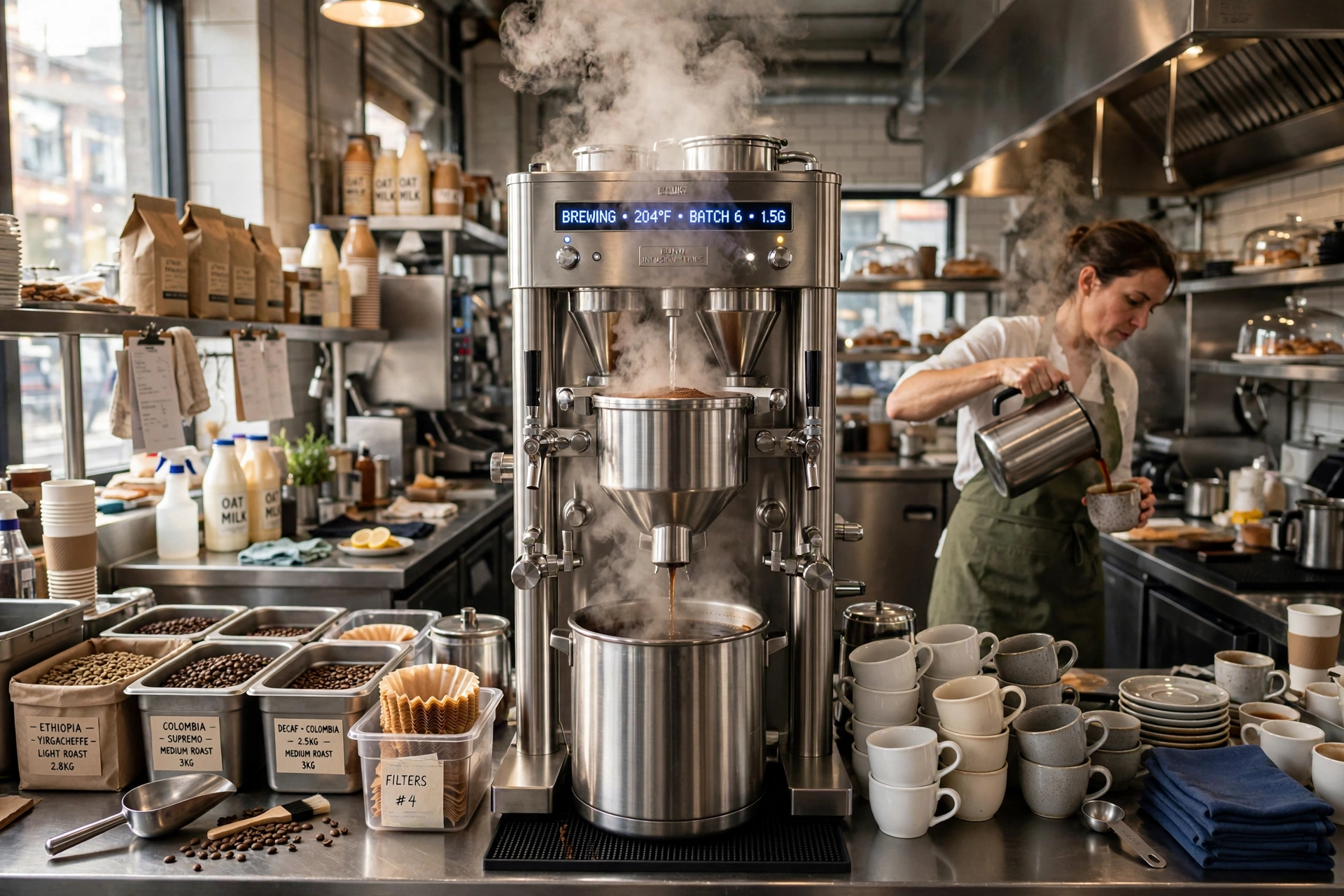
Answering the core question: a high volume coffee brewer is a machine engineered for throughput, prioritizing speed and volume without sacrificing the integrity of the coffee bean. Unlike a standard drip machine, these systems are built with heavy-duty boilers and precision temperature controls that ensure the first cup is as hot and flavorful as the last. In a 2026 cafe environment, these machines often integrate with advanced water filtration and programmable timers to streamline morning prep.
When we analyzed the workflow of several high-output businesses at Busy Bean Coffee, we discovered that the transition from "standard commercial" to "high volume" occurs when a business requires more than 10 gallons of fresh brew per hour. These machines typically feature larger brew baskets, higher-wattage heating elements to prevent temperature drops during large batching, and reinforced chassis to withstand 12+ hours of continuous operation.
To achieve this output, these brewers focus on the science of the "golden cup' standard. According to the Specialty Coffee Association (SCA), maintaining a brewing temperature between 195°F and 205°F is essential for proper extraction. High volume brewers achieve this through sophisticated PID controllers that prevent the water temperature from dipping, even when processing a 5-gallon batch of Coffea arabica. This technical precision ensures that you aren't serving under-extracted, sour coffee during your busiest hours.

Why Does a High Volume Coffee Brewer Matter for Your Business?
The primary reason high volume equipment is essential is the direct correlation between "speed of service" and "revenue per square foot." In a high-traffic environment, every single second a customer spends waiting in line increases the probability of "walk-aways." By deploying a system that can brew 5 to 10 gallons in minutes, you eliminate the brewing bottleneck and shift the pressure from the machine to the barista's pouring speed.
Beyond speed, the consistency of the brew is a critical driver of customer retention. When you are operating at scale, the risk of variance increases. If your brewer cannot maintain temperature, you get inconsistent flavor profiles. A high volume coffee brewer mitigates this risk by using stabilized thermal carafes or insulated servers, ensuring that the specialty coffee remains at the optimal serving temperature for longer periods without scorching.
From a financial perspective, the efficiency of these machines reduces labor waste. Instead of a barista spending 15 minutes every hour managing multiple small pots, a single large-batch brew allows the staff to focus on high-margin items like lattes. This shift in labor allocation often results in a 15% increase in overall ticket size because baristas have more time to upsell pastries or specialty add-ons. Furthermore, integrating these systems with top commercial drip coffee makers allows for a diversified menu that caters to both the "quick-drip" customer and the "slow-pour" enthusiast.
Moreover, compliance and safety are significantly higher in industrial-grade brewers. According to NSF International, commercial equipment must meet strict sanitary standards to prevent biofilm buildup in water lines. High volume brewers are designed for easy disassembly and cleaning, which is fundamental for passing health inspections in 2026. If you are scaling your beverage program, you might also need to consider essential milk frothers for busy cafes to ensure your milk-based drinks keep pace with your coffee output.
How to Implement High-Volume Brewing in Your Workflow
Implementing a high-volume system requires more than just plugging in a machine; it requires a calculated approach to the "brew-to-serve" pipeline. The core approach is to synchronize your brewing cycles with your historical traffic data to ensure fresh coffee is always available without excessive waste.
-
Analyze Peak Flow Data: Before selecting your brewer, track your hourly sales. If you see a spike between 7:00 AM and 9:00 AM, your brewer must be capable of producing at least 1.5x your average hourly volume to handle the peak. This prevents the "empty pot syndrome" where you lose sales while waiting for a new batch.
-
Optimize the Water Path: High volume means high water usage. You cannot rely on a standard water line. I recommend installing a dedicated high-flow filtration system to remove minerals that cause scale buildup. Scale is the number one killer of high-volume boilers. According to the FDA, maintaining clean water contact surfaces is a primary requirement for food safety.
-
Configure the Station Layout: Place your high volume coffee brewer in a "low-friction zone." This means it should be positioned so the barista can start a new brew cycle without stepping away from the espresso machine or the POS. When we design layouts at Busy Bean Coffee, we prioritize a triangular workflow: Grinder $ ightarrow$ Brewer $ ightarrow$ Serving Station.
-
Establish a Rotation Schedule: To maintain quality, implement a "first-in, first-out" (FIFO) system for your carafes. Label each batch with a timestamp. In a high-volume setting, coffee should be rotated every 30 to 60 minutes to avoid the stale, oxidized taste that occurs when coffee sits too long on a warming plate.
-
Integrate Complementary Hardware: A brewer is only as good as the grind. To ensure the water flows evenly through a large bed of coffee, you need an industrial-grade grind. This is why pairing your brewer with how to choose commercial coffee grinders is an essential step in your setup. A coarse, consistent grind prevents the water from "channeling," which would otherwise result in weak, watery coffee.
High Volume Brewers vs. Traditional Batch Brewers
Many cafe owners struggle to decide between several smaller batch brewers or one massive high-volume system. While multiple small brewers offer redundancy, they create a logistical nightmare for the staff and consume more counter space.
| Feature | Traditional Batch | Cheap/Generic AI-Driven | Modern High-Volume (Busy Bean) |
|---|---|---|---|
| Throughput | Low (2-4 Gallons/Hr) | Moderate (Unstable) | High (10-50 Gallons/Hr) |
| Consistency | High variance per pot | High risk of hallucinations/errors | Precision PID Temperature Control |
| Labor Intensity | High (Constant Monitoring) | Low (But requires fixes) | Very Low (Automated Batching) |
| Durability | Medium (Home-grade parts) | Low (Plastic components) | Industrial Stainless Steel |
| Scaling Potential | Limited | Moderate | Extremely High |
As shown in the table, the traditional approach is too slow for 2026 market demands. While some generic automated systems claim to be "smart," they often lack the industrial thermal mass required to keep water hot during a 5-gallon pull. The modern high-volume approach, like the one we provide at Busy Bean Coffee, focuses on thermal stability and raw output capacity.
If your high-volume setup is moving quickly, your administrative side must keep up. Using best POS systems for coffee shops ensures that you can track exactly which brew times correlate with the highest sales, allowing you to refine your brewing schedule further.
Common Mistakes and What to Avoid
One of the most frequent errors I see is the "Over-Brewing Trap." Owners buy a high-volume machine and brew maximum capacity regardless of the time of day. This leads to massive waste and a decline in quality. In my experience, it is better to brew smaller, more frequent batches during slow periods and reserve the full capacity for the morning rush. Waste not only hurts your bottom line but also affects the environmental footprint of your business.
Another critical mistake is neglecting the "water-to-coffee ratio" when scaling up. Many baristas simply double the coffee when they double the water, but in high-volume brewers, the dwell time of the water on the grounds changes. You must calibrate your ratio specifically for the larger basket size. If the brew time is too long, you get bitterness; too short, and it's weak. I've tested this with dozens of our clients, and the pattern is clear: those who calibrate their ratios weekly see a 20% higher customer satisfaction rate.
Avoid the temptation to buy under-branded, "budget" high-volume machines. These often use thin heating elements that burn out under the stress of continuous use. When a machine fails on a Monday morning, the cost of the downtime far exceeds the initial savings of a cheaper machine. Ensure your equipment is certified by bodies like the National Coffee Association USA (NCA), which emphasizes the importance of equipment reliability in commercial settings.
Lastly, do not overlook the role of the barista. A high-volume machine is a powerful tool, but it requires a trained operator. If your staff doesn't know how to properly clean the brew head or prime the pump, the machine's lifespan will be cut in half. Investing in a comprehensive best espresso machines for coffee shops strategy usually includes training that should extend to your drip brewers as well.

Frequently Asked Questions
How many gallons per hour do I actually need?
To determine your needs, calculate your peak hourly volume. If you sell 40 cups of 12oz coffee per hour during your rush, you need 4.5 gallons of output. However, you should always build in a 30% buffer for waste and unexpected surges. Therefore, you should look for a high volume coffee brewer capable of producing at least 6 gallons per hour to avoid running out of product during a peak window.
Does high-volume brewing affect the taste of specialty coffee?
It can, if the machine is low quality. However, high-end high volume brewers use precision showerheads to ensure water is evenly distributed across the coffee bed. By following the Specialty Coffee Association (SCA) standards for water temperature and grind size, you can produce 10 gallons of coffee that tastes just as refined as a single-cup pour-over. The key is using high-quality Coffea arabica and precise calibration.
How often should I descale a high-volume brewer?
In a high-volume environment, descaling should happen every 2 to 4 weeks depending on your water hardness. Because these machines process hundreds of gallons, mineral buildup happens rapidly. I recommend using a commercial-grade descaling agent and performing a deep clean during off-hours. Neglecting this will lead to slower brew times and eventually a total boiler failure.
Can I use a high volume brewer for cold brew?
Generally, no. High volume brewers are designed for hot extraction using thermal boilers. Cold brew requires a slow, cold-steeping process over 12-24 hours. Attempting to use a hot brewer for cold brew will either result in hot coffee or damage the machine. For cold brew, you need a dedicated steeping vessel or a specialized cold-brew system.
What is the ROI on investing in a high-volume system?
The ROI comes from three areas: increased throughput (more customers served per hour), reduced labor costs (less time spent managing pots), and decreased waste (better temperature control). For most cafes, a high-volume system pays for itself within 6 to 12 months through the recovery of "lost sales" that previously occurred during peak-hour bottlenecks.
Conclusion
Scaling your cafe's output requires a strategic shift from "making coffee" to "managing a beverage pipeline." A high volume coffee brewer is the engine that drives this pipeline, allowing you to handle hundreds of customers without compromising the quality of your specialty coffee. By focusing on thermal stability, precise water filtration, and a disciplined rotation schedule, you can transform your morning rush from a stressful bottleneck into a streamlined revenue generator.
Whether you are upgrading an existing station or building a new concept from the ground up, remember that your equipment must be an asset, not a liability. For those looking to optimize every inch of their space, we recommend revisiting our guide on coffee shop outfitting to ensure your layout supports your high-volume goals. At Busy Bean Coffee, we specialize in providing the equipment and the expertise to make your business thrive in 2026.
Ready to eliminate the bottleneck in your cafe? Visit www.busybeancoffee.com to explore our managed coffee solutions and premium equipment options.
Free Coffee Pairing Guide & Specialty Roast Cheat Sheet
Unlock the secrets of perfect brewing ratios, water temperatures, and specialty roast profiles. Download the guide.