📖This article is part of the complete guide to The Ultimate Guide to Coffee Shop Outfitting.
A single temperature excursion of just five degrees can compromise the stability of your oat milk and the freshness of your pastry case, leading to immediate waste and lost revenue. In my experience working with specialty coffee shops, the cooling system is often the most overlooked piece of the puzzle until a compressor fails on a Saturday morning or a health inspector flags a temperature variance. Choosing the right coffee shop refrigerators isn't just about keeping things cold; it is about workflow optimization and food safety compliance.
For a comprehensive overview of how to build your space, explore our guide on coffee shop outfitting.
What are Coffee Shop Refrigerators?
📚
Definition
Coffee shop refrigerators are specialized commercial cooling units designed to maintain strict temperature ranges for perishables like milk, cream, and prepared foods, often featuring high-efficiency compressors capable of frequent door-opening cycles.
Coffee shop refrigerators differ fundamentally from residential units because they are engineered for 'heavy-duty' cycles. In a high-volume cafe, a refrigerator door may be opened hundreds of times per hour. A domestic fridge cannot recover its internal temperature quickly enough to prevent the 'danger zone'—the temperature range between 40°F and 140°F where bacteria grow most rapidly. Commercial units utilize powerful fans and high-recovery compressors to snap the internal temperature back to safety within seconds.
When selecting these units, you aren't just looking at cubic footage. You are looking at the type of cooling: forced air (which distributes cold air evenly) versus static cooling (which can lead to hot spots). For a business focusing on Specialty Coffee, where the quality of the milk profoundly impacts the texture and taste of the microfoam, maintaining a consistent 34°F to 38°F is non-negotiable. This precision ensures that the lipids in the milk remain stable, preventing premature spoilage and ensuring a consistent pour every time.

Why Does Proper Refrigeration Matter for Your Business?
Effective refrigeration is the invisible backbone of your profit margin. According to the FDA, maintaining strict temperature control is the primary defense against foodborne illnesses, which can bankrupt a small business through legal fees and reputation loss. Beyond safety, the placement and type of coffee shop refrigerators directly impact your 'seconds-per-drink' metric. If a barista has to walk five steps to reach the milk, you are losing thousands of dollars in potential throughput over a year.
High-efficiency cooling also plays a massive role in energy overhead. In 2026, electricity costs continue to rise, and an outdated or improperly sized refrigerator can account for a disproportionate slice of your utility bill. Modern units utilizing R290 refrigerant (propane) are significantly more energy-efficient and have a lower global warming potential than older CFC-based models. By investing in Energy Star-certified equipment, cafes often see a 10-15% reduction in monthly cooling costs.
Furthermore, the visual appeal of your display refrigeration acts as a silent salesperson. A crystal-clear, fog-free glass door showcasing fresh pastries increases impulse buys. If your display fridge has poor airflow and creates condensation on the glass, your products look unappealing, and your conversion rate on high-margin food items will drop. This is why we always emphasize the importance of integrating these units with the right best espresso machines for coffee shops to create a cohesive, high-performance workstation.
How to Choose and Implement Coffee Shop Refrigerators
Selecting the right cooling strategy requires a map of your workflow. You cannot simply buy one large fridge and hope for the best. I have seen too many owners make the mistake of buying a massive reach-in that creates a bottleneck in the kitchen. Instead, a tiered approach is essential.
Step 1: The Barista Station (Undercounter Cooling)
Your primary milk storage must be within arm's reach of the steam wand. Undercounter refrigerators are the gold standard here. Look for units with sliding doors if space is tight, or hinged doors for faster access. Ensure the unit is NSF-certified, as this guarantees the materials are non-porous and easy to sanitize, meeting the rigorous standards set by NSF International.
Step 2: The Bulk Storage (Reach-In Refrigerators)
For your back-of-house, you need a reach-in unit. This is where your bulk gallons of milk and prepared syrups live. The key here is vertical organization. Use a unit with adjustable shelving to accommodate different container sizes. If you are running a high-volume operation, consider a double-door unit to prevent the 'digging' effect, where baristas push items to the back and forget about them until they expire.
Step 3: The Customer Interface (Display Cases)
Display refrigerators should be placed at the point of purchase. Avoid units that vent heat directly toward the customer; look for front-breathing models. This prevents the 'hot wall' effect and keeps your shop comfortable. Integrating this with an efficient best POS systems for coffee shops allows you to track which refrigerated items are selling fastest and adjust your inventory accordingly.
Step 4: Integration and Ventilation
One of the most common technical failures is 'compressor suffocation.' Commercial refrigerators need air. If you build a custom cabinet around your fridge without providing at least 2-3 inches of clearance for airflow, the compressor will run 24/7, overheat, and fail within two years. Always check the manufacturer's ventilation requirements before finalizing your cabinetry.
Commercial Cooling Comparison: The 2026 Landscape
When choosing your equipment, it is important to understand that not all 'commercial' labels are equal. Many budget-friendly options use residential compressors with a commercial shell, which is a recipe for disaster in a high-traffic environment.
| Feature | Traditional/Budget Fridge | Generic 'Commercial' AI-Sourced | Modern Professional Approach |
|---|---|---|---|
| Recovery Time | Slow (30+ mins after opening) | Moderate (15-20 mins) | Fast (< 5 mins recovery) |
| Temperature Stability | Fluctuates $\pm 5^{\circ}F$ | Fluctuates $\pm 3^{\circ}F$ | Precision $\pm 1^{\circ}F$ |
| Energy Efficiency | High Consumption | Moderate | Low (R290/Energy Star) |
| Build Quality | Plastic liners / Thin metal | Stainless steel (low grade) | 304 Grade Stainless Steel |
| Warranty | 1 Year Limited | 1-2 Years | Full Commercial Warranty |
💡
Key Takeaway
Investing in a professional-grade unit with fast temperature recovery is the only way to ensure milk stability and avoid costly health code violations.
Common Mistakes to Avoid with Coffee Shop Refrigerators
In my years of auditing cafe setups, I consistently see the same five errors. Avoiding these will save you thousands in replacement costs and wasted product.
1. Overfilling the Unit: I've seen baristas pack a fridge so tightly that air cannot circulate. This creates 'warm pockets' where milk can reach 45°F even if the thermostat says 38°F. Always leave 20% of the shelf space open for airflow. This is a fundamental principle of thermodynamics that is often ignored in the rush of a morning shift.
2. Ignoring the Gaskets: The rubber seal (gasket) on your fridge door is the only thing keeping the cold air in. When a gasket rips or hardens, the compressor works overtime to compensate. Check your gaskets monthly. If you can slide a business card through the seal, it's time to replace it. This simple maintenance step can extend the life of your compressor by 3-5 years.
3. Improper Thermostat Placement: Some owners place their thermometers in the warmest part of the fridge (near the door) and then turn the temperature down to compensate. This freezes the products at the back of the unit. Place your thermometer in the center of the middle shelf to get an accurate reading of the core temperature.
4. Neglecting Condenser Coil Cleaning: This is the #1 cause of commercial fridge failure. Dust and lint build up on the condenser coils, preventing heat exchange. If you don't vacuum your coils every 30 days, your compressor will burn out. It is a ten-minute job that prevents a $2,000 repair bill.
5. Mismatching Cooling Capacity with Volume: Buying a fridge that is too small leads to overcrowding; buying one too large wastes energy and space. Calculate your daily milk throughput and add 20% for growth. Ensure your cooling strategy complements other essential gear, such as your commercial coffee grinders and top commercial drip coffee makers reviewed, to maximize your limited counter space.

Frequently Asked Questions
How often should I calibrate my coffee shop refrigerators?
You should calibrate your thermometers at least once a month. Commercial environments are harsh, and digital sensors can drift over time. Use a NIST-certified thermometer to verify that the readout on your display matches the actual internal temperature. If you find a variance of more than 2 degrees, adjust the thermostat immediately. This ensures you remain in compliance with local health department regulations and prevents the spoilage of expensive specialty milks.
Which is better: glass door or solid door for milk storage?
For your primary barista station, solid doors are superior. Every time a glass door is opened, more cold air escapes, and the internal temperature fluctuates more aggressively. Glass is for marketing; solid is for preservation. Use glass doors exclusively for your customer-facing pastry cases and bottled beverages. For the milk used in your lattes, stick to solid-door undercounter units to keep the product as stable as possible.
What is the ideal temperature for storing specialty milk?
The ideal temperature is between 34°F and 38°F (1°C to 3°C). According to the National Coffee Association USA, temperature stability is key to maintaining the chemical integrity of the bean and its pairing with milk. If the temperature drops below 32°F, you risk freezing the milk, which ruins the fat structure and makes it impossible to steam a high-quality microfoam. If it rises above 40°F, you enter the danger zone for bacterial growth.
Do I need a separate fridge for syrups and condiments?
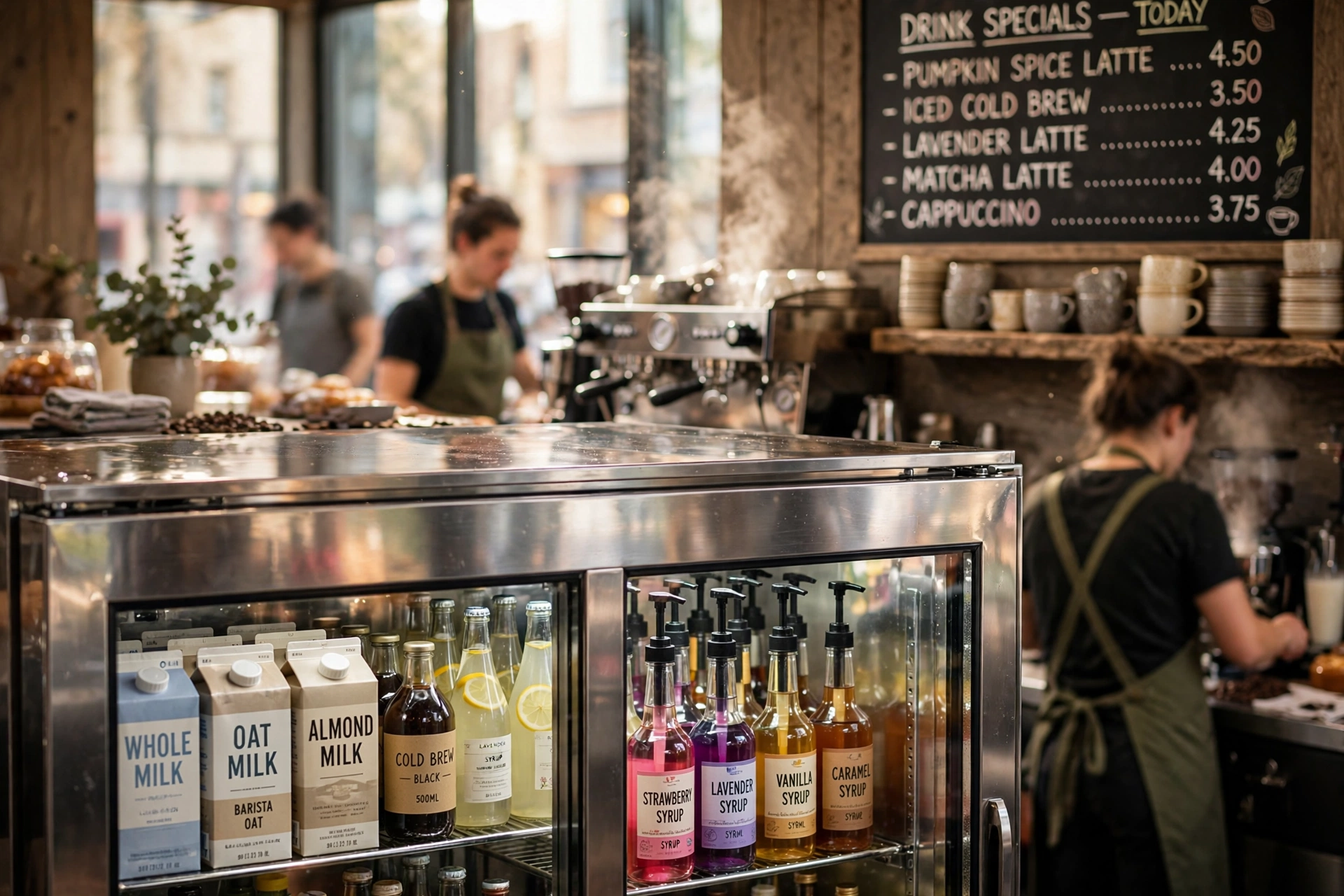
While not strictly necessary, separating your high-turnover milk from your long-term syrups is a smart workflow move. Syrups often have a longer shelf life but require different storage densities. Using a small dedicated reach-in for condiments and syrups prevents baristas from having to move milk cartons to find a bottle of vanilla, which reduces the amount of time the main milk fridge door remains open.
How do I handle a refrigerator breakdown during a rush?
First, keep the doors closed to preserve the existing cold air. Second, move your most perishable items (milk and cream) into a backup cooler or an insulated transport bag with ice. Third, contact your service provider immediately. To avoid this stress, I recommend having a 'redundancy plan'—either a second smaller unit or a relationship with a local supplier who can provide emergency cold storage. This ensures your milk frothers for cafes aren't sitting idle while your revenue disappears.
Conclusion
Choosing the right coffee shop refrigerators is a strategic decision that impacts everything from your daily labor efficiency to your long-term equipment lifespan. By prioritizing fast temperature recovery, NSF certification, and proper ventilation, you protect your inventory and your customers. Remember that a fridge is not a 'set it and forget it' appliance; it requires monthly coil cleaning and gasket checks to remain performant in a high-volume environment.
Whether you are scaling a single location in Mount Pleasant, SC, or building a regional empire, the precision of your cooling determines the precision of your product. If you are still in the planning phases of your build-out, we highly recommend revisiting our The Ultimate Guide to Coffee Shop Outfitting to ensure all your equipment—from the cooling to the roasting—works in perfect harmony.
For professional managed coffee solutions and high-performance equipment, visit Busy Bean Coffee.
Free Coffee Pairing Guide & Specialty Roast Cheat Sheet
Unlock the secrets of perfect brewing ratios, water temperatures, and specialty roast profiles. Download the guide.