📖This article is part of the complete guide to Ultimate Guide to Cafe Equipment Supply for Businesses.
Walk into any successful cafe, and behind the counter sits a workhorse—the commercial coffee machine. It's the heart of your operation, directly influencing customer satisfaction and your bottom line. But with so many options, choosing the wrong one can lead to costly downtime or bland espresso. After seeing hundreds of cafes at Busy Bean Coffee, I know that the right machine, paired with a solid service plan, makes all the difference. For a complete framework on equipping your cafe, start with our Ultimate Guide to Cafe Equipment Supply for Businesses.
What Are Commercial Coffee Machines for Cafes?
📚
Definition
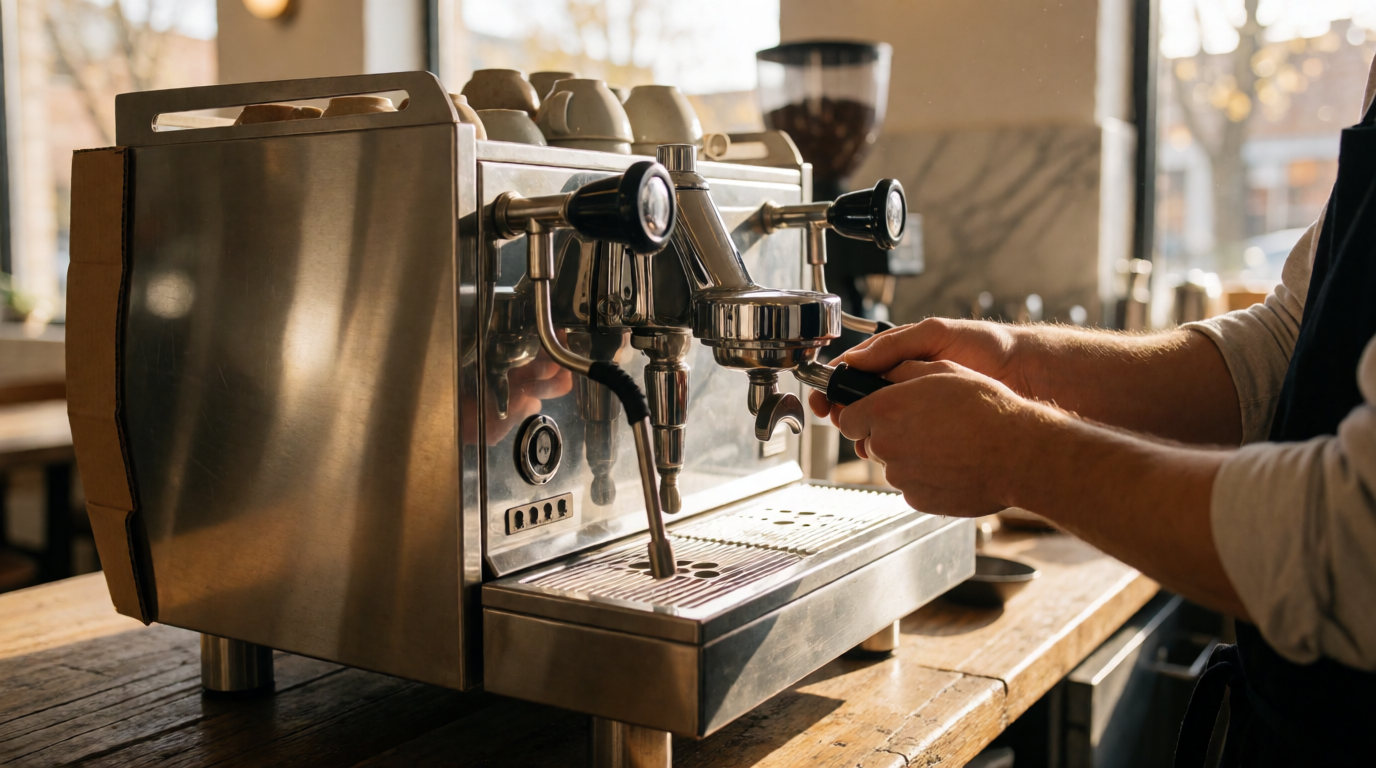
Commercial coffee machines for cafes are high-duty, NSF-approved equipment engineered to produce large volumes of espresso, drip coffee, or specialty drinks consistently during peak hours, often with multiple group heads and advanced temperature stability.
These machines are built for durability, speed, and precision—unlike residential models that overheat under constant use. The main types include:
- Super-automatic: Grinds, tamps, brews, and even cleans with a single button push. Ideal for high-volume, speed-focused cafes but may sacrifice some artisanal control.
- Semi-automatic: Requires a skilled barista to grind and tamp manually but allows for recipe customization and latte art. Used in specialty coffee shops.
- Bean-to-cup: Often super-automatic but sometimes semi-automatic; focuses on fresh grinding for each shot.
- Drip/batch brewers: For filter coffee and pour-over stations—great for high turnover of drip coffee.
| Feature | Super-Automatic | Semi-Automatic | Bean-to-Cup (Super-Auto) |
|---|---|---|---|
| Speed | Very high (up to 200 shots/hour) | Moderate (60–100 shots/hour) | High (150+ shots/hour) |
| Skill required | Minimal | High | Low to moderate |
| Consistency | Excellent (automated) | Barista-dependent | Excellent |
| Cost (new) | $8,000–$20,000+ | $5,000–$15,000 | $6,000–$18,000 |
| Maintenance | Automated cleaning cycles | Daily manual cleaning | Automated cycles |
According to the Specialty Coffee Association's 2024 Equipment Study, cafes using super-automatic machines report 22% faster drink throughput during peak hours. If you're leaning toward a managed service that includes top-tier equipment, check out our guide on Managed Coffee Service for Restaurants to see how it bundles machine, maintenance, and support.
Why Choosing the Right Machine Matters for Your Cafe
Your coffee machine directly impacts three critical areas: quality, speed, and cost per cup. Get it right, and you build a reputation that drives repeat business. Get it wrong, and you face long lines, inconsistent drinks, and expensive service calls.
A 2023 report by Allegra World Coffee Portal found that 73% of cafe customers consider coffee quality the number one reason for repeat visits. But consistency is equally important—a study from the University of California, Davis Coffee Center showed that even a 1°C variance in brew temperature can alter extraction yield by 18%, affecting flavor. Commercial machines with PID (proportional-integral-derivative) controllers maintain temperature within 0.5°C, ensuring every shot meets standards.
Cost per cup also varies dramatically. Manual machines with skilled baristas can yield higher margins if labor is well managed, but super-automatics reduce labor dependency. A typical cafe serving 200 espresso drinks per day can save $3,000–$5,000 annually in labor costs by switching from semi-auto to super-auto, according to data from the National Coffee Association.
Moreover, the machine's reliability affects your operational risk. Downtime during a morning rush can cost hundreds in lost sales and damage your brand. That's why many savvy owners move to a no-capex model—explore No Capex Coffee Equipment Solutions for Foodservice to see how you can avoid the upfront hit.
💡
Key Takeaway
The best machine is one that matches your volume, skill level, and service support. Don't buy based on price alone—factor in total cost of ownership and backup service.
How to Select the Best Commercial Coffee Machine for Your Cafe
Choosing the right machine requires a systematic approach. Here's the framework I've developed working with over 100 cafes at Busy Bean Coffee.
Step 1: Calculate your peak demand. Count how many espresso drinks you serve during the busiest hour. Multiply by 2 (for double shots). That's your required shot-per-hour capacity. A two-group super-auto can handle 150–200 shots/hour; a two-group semi-auto requires a skilled barista to sustain 100+.
Step 2: Decide on automation level. If you struggle to find experienced baristas (a common pain point in 2026), a super-automatic ensures consistency. If your brand relies on latte art and artisanal pour-overs, semi-automatic is the way.
Step 3: Evaluate water and electrical requirements. Most commercial machines need a 220V outlet and a water line with filtration. Poor water quality kills machines—hard water causes scale buildup. Invest in a reverse osmosis or deionization system.
Step 4: Consider service contracts and training. Even the best machine will break. Our White Glove Installation for Cafe Coffee Equipment includes setup, calibration, and on-site training—a model that reduces errors by 40%.
At Busy Bean Coffee, we offer an all-inclusive managed coffee membership that covers premium SENSA equipment, installation, full maintenance, and exclusive product pricing for one monthly fee. No capital expense, no surprise repair bills. It's a model that lets you focus on serving customers, not fixing machines.
Common Mistakes Cafe Owners Make When Buying Coffee Machines
I've seen the same pitfalls over and over. Avoid these to save thousands.
- Buying based on price alone. A cheap machine often means expensive repair visits and poor shot quality. The total cost of ownership over five years can be triple the purchase price if maintenance is neglected.
- Ignoring training. A semi-automatic machine is only as good as the barista. In my experience, cafes that invest in two weeks of hands-on training see 25% higher customer satisfaction scores.
- Underestimating maintenance. Daily backflushing, weekly deep cleaning, and quarterly descaling are non-negotiable. Neglect leads to blocked group heads and expensive part replacements.
- Choosing a machine too small for growth. A one-group machine that handles 60 shots/hour will choke during your first successful brunch rush. Always plan for 20% capacity headroom.
- Skipping water filtration. Hard water scales up heat exchangers, reducing efficiency and flavor. The Specialty Coffee Association recommends water with a total hardness of 50–175 ppm for optimal extraction.
For a deeper dive into how managed supply can eliminate these mistakes, read How to Cut Office Coffee Costs with Managed Supply—the principles apply to cafes too.
Frequently Asked Questions
How much does a commercial coffee machine cost?
Commercial espresso machines for cafes range from $5,000 for a basic single-group semi-auto to $25,000+ for a high-volume super-automatic with dual boilers and integrated grinders. Additionally, you'll need installation ($500–$2,000), water filtration ($300–$1,500), and a service deposit. Leasing or managed service options reduce upfront costs—some plans require $0 down with a monthly fee covering equipment and maintenance.
What is the best type of coffee machine for a small cafe?
For a small cafe serving 50–100 espresso drinks daily, a two-group semi-automatic (like a La Marzocco Linea Mini or Nuova Simonelli Appia) offers reliability and quality without overwhelming automation. If you lack barista skills or space, a compact super-automatic (e.g., Franke A300 or Jura Giga 5) can produce consistent shots in a smaller footprint. The best choice depends on your menu—if you focus on drip coffee, add a batch brewer like a Fetco CBS-2131.
How often should a commercial coffee machine be serviced?
Manufacturers recommend professional preventive maintenance every 3–6 months, including group head cleaning, seal replacement, and boiler descaling. Daily maintenance by staff (backflushing, wiping steam wands) is essential. In my experience, cafes that skip the quarterly professional check see machine breakdowns increase by 60%. Many managed service contracts include scheduled maintenance as part of the monthly fee.
Can I lease a commercial coffee machine?
Yes, leasing is common. You can lease from equipment dealers or through a managed coffee service provider. Leasing typically involves 3–5 year terms with monthly payments of $200–$800, plus a maintenance contract. At Busy Bean Coffee, we offer an all-inclusive membership that covers everything—machine, installation, maintenance, and coffee—for one predictable monthly fee. This simplifies budgeting and eliminates capital expenditures.
What is the difference between a semi-automatic and super-automatic machine?
Semi-automatic machines require the barista to grind, tamp, and start the shot manually. They offer control over extraction parameters but demand skill and consistency. Super-automatic machines grind, dose, tamp, brew, and often clean automatically with a button press. They are faster and more consistent but limit customization for latte art or single-origin profiles. Super-automatics are ideal for high-volume, speed-focused cafes; semi-automatics for specialty coffee shops prioritizing craftsmanship.
Conclusion
Selecting the right commercial coffee machine for your cafe is a strategic decision that impacts quality, efficiency, and profitability. By assessing your volume, automation needs, and support infrastructure, you can avoid costly mistakes and build a loyal customer base. Whether you choose to buy or lease, ensure you have a robust service plan.
For a turnkey solution that includes premium equipment, professional installation, and full maintenance, explore Busy Bean Coffee's managed coffee membership at www.busybeancoffee.com. And for a complete overview of equipping your cafe, visit our pillar guide: Ultimate Guide to Cafe Equipment Supply for Businesses.

Recommended Readings
To deepen your understanding of these topics, we recommend reading the following articles:
- No Capex Options for Coffee Equipment
- Specialty Coffee Dispensers for Hotels and Resorts
- Reliable Coffee Equipment for Retirement Communities
- Coffee Stations to Elevate Medical Clinic Experience
About the Author
Travis Estes is the CEO and Founder of Busy Bean Coffee. With over a decade of experience helping hundreds of cafes and restaurants optimize their coffee programs, he specializes in cost-effective, high-quality beverage solutions.
Free Coffee Pairing Guide & Specialty Roast Cheat Sheet
Unlock the secrets of perfect brewing ratios, water temperatures, and specialty roast profiles. Download the guide.