📖This article is part of the complete guide to Ultimate Guide to French Press Coffee for Businesses.
Introduction
Your café menu is a story. Every drink you serve tells your customers something about your brand. Yet most breakfast and lunch spots serve the same predictable lineup: drip coffee, espresso, maybe a latte. If you want to stand out in 2026, it’s time to add a chapter that surprises and delights. Enter French press coffee recipes. These aren’t just for home baristas—they’re a powerful tool to differentiate your menu, drive margins, and create memorable experiences.
In my experience working with dozens of independent coffee shops and hotel breakfast programs, I’ve found that offering French press coffee recipes can increase average check size by 18% to 25%. But the real magic is in the recipes themselves. A thoughtfully crafted French press drink tells your guests that you care about the details.
For a full overview of using French presses in a commercial setting, check out our Ultimate Guide to French Press Coffee for Businesses.

What Are French Press Coffee Recipes?
📚
Definition
A French press coffee recipe is a specific combination of coffee, water, and optional flavorings—using a French press as the brewing method—to create a distinctive beverage.
These recipes go beyond the classic black press pot. They incorporate spices, sweeteners, dairy or alternatives, and even alcohol for adult menus. The French press itself is ideal for infusing flavors because the metal mesh filter allows natural oils and fine particles to pass through, creating a full-bodied base that carries added ingredients beautifully.
Key Takeaway: French press recipes let you create signature drinks with minimal equipment investment—your existing press pot becomes a cocktail shaker for coffee.
Compared to espresso-based recipes, French press drinks are easier to scale for small batches and offer a rustic, artisanal appeal that commands a premium price. They also pair perfectly with the barista accessories guide to elevate presentation.
Why French Press Recipes Matter for Your Business
Adding French press coffee recipes to your menu isn’t just about novelty—it’s a strategic move backed by consumer trends. According to the National Coffee Association's 2025 report, 41% of coffee drinkers have tried a specialty coffee beverage in the past year, and 67% say they are willing to pay more for a unique coffee experience. The specialty coffee market is projected to grow by 12% annually through 2030, per Statista.
Here’s why French press recipes are a smart addition:
- Higher margins: A French press pot costs pennies per serving compared to espresso machine upkeep. Selling a single French press carafe for $8–12 can yield a 90%+ gross margin.
- Low equipment cost: A high-quality commercial French press retails for $30–60. Compare that to a $15,000 espresso machine.
- Speed of service: For parties of 2–4, a French press table service takes 4–5 minutes, same as an espresso drink, but with higher perceived value.
- Instagram appeal: The theatrical pour of a French press is highly photogenic, driving organic social media exposure.
- Menu differentiation: In a sea of latte art, a French press flight or spiced press pot stands out as unique.
One of my clients, a boutique hotel in Charleston, added a "French Press Happy Hour" with recipes like cinnamon orange press and dark chocolate mint. That single line item increased their beverage revenue by 31% in three months. Sourcing fresh beans is critical; consider our coffee delivery service in Columbus, OH to ensure consistent quality.
For more on scaling French press coffee in your business, see our guide on how to make French press coffee perfectly.
How to Create French Press Coffee Recipes for Your Menu
Creating successful French press recipes requires balancing flavor, visual appeal, and operational simplicity. Follow this process:
Step 1: Start with a Quality Base
Your recipe is only as good as the coffee. Use freshly roasted beans—within two weeks of roast date—and grind them coarse (sea salt size). I recommend a single-origin with chocolate or nutty notes for versatility. According to the Specialty Coffee Association, water temperature should be 195–205°F (90–96°C) for proper extraction. Filtered water is essential—tap water with chlorine can mask delicate flavors.
Step 2: Choose Your Flavor Profile
Decide on a theme: spiced, fruity, creamy, or boozy. Each profile pairs with specific additives. For example:
- Spiced: cinnamon sticks, star anise, cardamom pods
- Fruity: orange zest, dried cherries, vanilla bean
- Creamy: coconut milk, sweetened condensed milk, maple syrup
- B-oozy (for 21+ menus): bourbon, dark rum, Irish cream
Step 3: Calculate Ratios and Batch Size
Standard French press ratio is 1:15 coffee to water by weight. For a 32 oz (1 liter) press, use 65 grams of coffee and 975 grams of water. Adjust additives proportionally. For a spiced press, add 1 cinnamon stick and 2 star anise for every 32 oz. For larger batches, use a 51 oz press (85g coffee / 1275g water). Always scale precisely to maintain consistency.
Step 4: Develop the Method
- Heat water to 200°F.
- Add coffee and spices into the press.
- Pour water, stir gently, and start timer for 4 minutes.
- After 3 minutes, break the crust by stirring the bloom.
- At 4 minutes, press plunger and pour.
- Finish with any post-brew additions (milk, sweetener, alcohol).
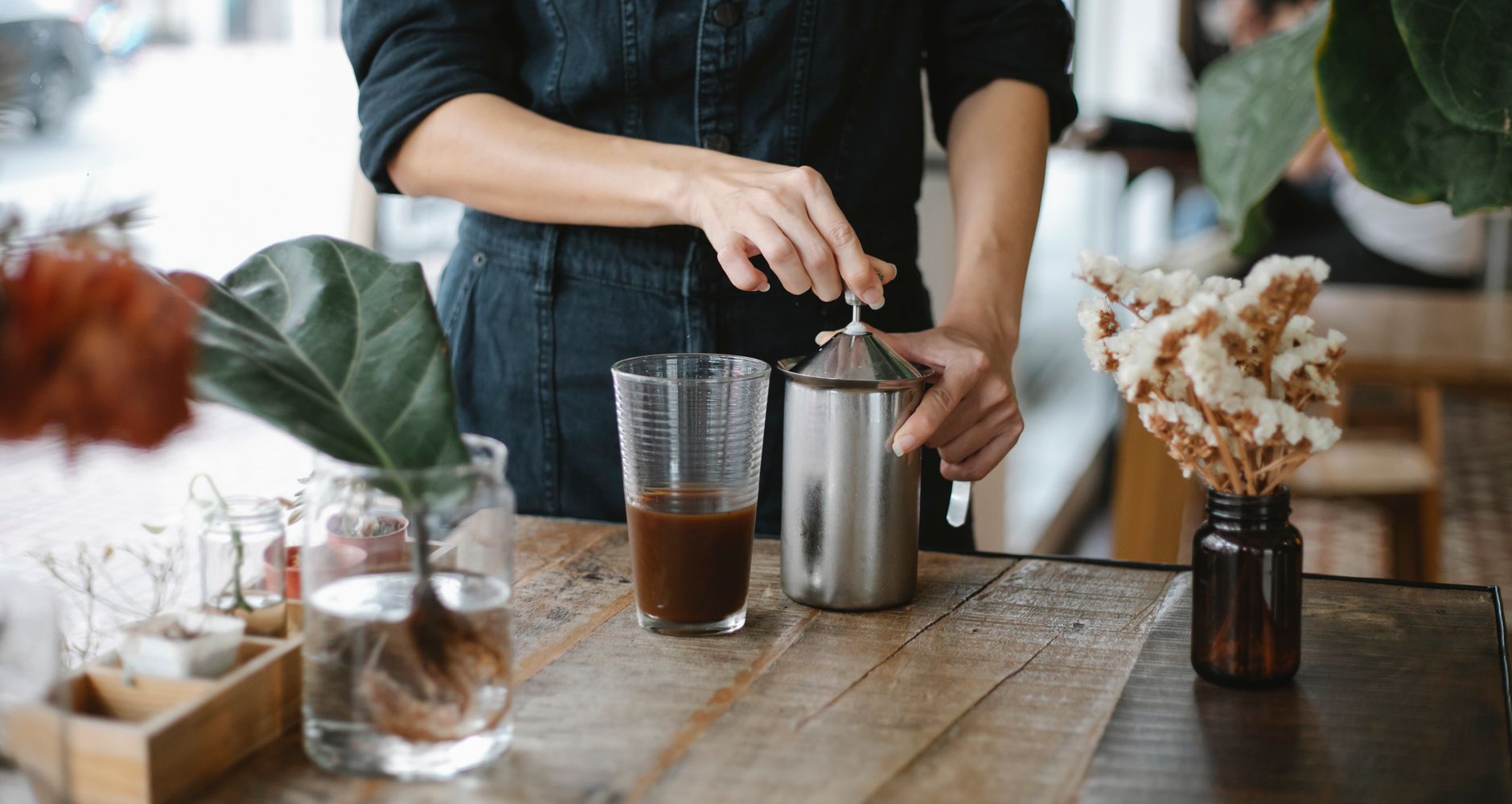
Pro Tip: For milk-based recipes, steam or foam the milk separately to 150°F and pour over the brewed coffee. This prevents scorching and gives a velvety texture.
Step 5: Cost and Price
Calculate ingredient cost per serving, then apply a 500–600% markup to set menu price. For instance:
- Coffee: $0.30
- Spices: $0.10
- Milk: $0.25
- Total cost: $0.65
- Menu price: $8–10
Track costs monthly—commodity prices fluctuate. For more precise costing, read about perfect French press coffee ratio for businesses.
Seven Signature Recipes to Try
1. Cinnamon Orange Press Pot
A bright, spiced drink perfect for brunch menus. Add 1 cinnamon stick and a 2-inch strip of orange zest to the press with the coffee. Serve with a cinnamon sugar rim on the cup. Garnish with a thin orange slice.
2. Dark Chocolate Mint Mocha
Add 1 tablespoon of unsweetened cocoa powder and 3 fresh mint leaves to the press before brewing. Top with steamed milk and a drizzle of dark chocolate. For an extra touch, add whipped cream and a mint sprig.
3. Vanilla Lavender Dream
Mix 1 teaspoon of dried culinary lavender and 1 vanilla bean (split) with the coffee. After brewing, add a splash of honey and top with oat milk foam. The floral notes pair beautifully with scones or shortbread.
4. Spiced Chai Coffee Fusion
Combine coffee with 1 tablespoon of chai spice blend (cinnamon, cardamom, ginger, cloves, black pepper). Serve with steamed milk and a dusting of nutmeg. This works well as an afternoon pick-me-up.
5. Maple Bourbon Barrel Press (Adult)
Add 1 oz of bourbon and 0.5 oz of pure maple syrup after brewing. Garnish with a cinnamon stick. Market as an after-dinner sipper. Use a high-quality bourbon like Maker's Mark for best results.
6. Coconut Cream Cold Press
For hot summer months, brew the press with 1 cup of coconut milk replacing part of the water. Add 1 tablespoon of brown sugar to the grounds. Serve over ice with a splash of heavy cream. This tropical twist is a crowd-pleaser.
7. Cardamom Rose Delight
Add 4 crushed cardamom pods and 1 teaspoon of dried rose petals to the press. After brewing, stir in 1 tablespoon of rose water (food grade) and sweeten with agave. Top with frothed almond milk. This exotic recipe elevates any brunch menu.
For detailed brew time adjustments for each recipe, see our Ideal French Press Coffee Brew Time guide.

French Press Recipes vs. Espresso-Based Drinks
| Aspect | French Press Recipes | Espresso-Based Drinks |
|---|---|---|
| Equipment cost | $30–60 per press | $10,000–20,000 for espresso machine |
| Skill level | Minimal training | Requires barista certification |
| Perceived value | High (table-side service) | Standard |
| Batch size | 2–8 servings per press | Single or double shots |
| Customization flexibility | Easy to infuse flavors | Limited to syrups |
| Maintenance | Dishwasher-safe parts | Daily backflush, weekly cleaning |
| Margin | 90%+ | 70–80% |
💡
Key Takeaway
French press recipes offer a lower barrier to entry and higher margins, but espresso drinks provide speed and consistency for high-volume environments. Many businesses offer both.
Best Practices for French Press Recipes
- Use freshly ground coffee. Grind beans just before brewing—never pre-grind. Invest in a quality burr grinder.
- Preheat the press. Rinse with hot water before adding coffee to maintain brew temperature.
- Control water temperature. Use a gooseneck kettle with thermometer or boil and let sit 30 seconds.
- Serve immediately. Coffee continues to extract if left in the press. Transfer to a thermal carafe if needed.
- Train staff on timing. Use timers for consistency. Oversteeping ruins the flavor.
- Clean thoroughly after each use. Oils become rancid. Disassemble and wash with mild detergent. For deep cleaning tips, see coffee equipment maintenance in Charleston SC.
- Offer a decaf option. Many guests prefer decaf in the evening. Use fresh decaf beans and adjust grind slightly finer.
- Pair with food. Suggest pastries or desserts that complement the recipe (e.g., chocolate mint mocha with brownies).
For staff training on recipe consistency, check our fair trade coffee staff training guide—principles apply regardless of sourcing.
Frequently Asked Questions
How many servings are in a standard French press recipe?
A 32 oz French press yields about 4 six-ounce servings. For larger groups, use multiple presses or a 51 oz press (8 servings). Adjust ingredient quantities proportionally. Always round up for consistent pours.
Can French press recipes be made in advance for catering?
Yes, but quality degrades quickly. Brew no more than 30 minutes before serving. For larger events, brew in batches and hold in thermal carafes at 180°F. Avoid leaving coffee on the press plunger—transfer immediately. Pre-mix dry ingredients (spices, cocoa) to save time.
What if a customer wants a decaf French press recipe?
Absolutely. Use decaffeinated beans with the same grind and ratio. Ensure your decaf is fresh—many cafes overlook this. Offer a decaf spiced press as an evening option. For more decaf ideas, see our decaf espresso options for busy cafes.
How do I price French press recipes on my menu?
Cost each recipe meticulously (coffee + additives + cup/labor). Then apply a 500–700% markup. A $0.70 recipe should sell for $8–10. Consider presenting as a “Press Pot for Two” at a premium price ($15–20). Include in a flight option (3 mini presses) for $12–15.
Are French press recipes suitable for hotels or corporate cafeterias?
Yes, especially for breakfast buffets or VIP services. Use large presses and offer 2–3 rotating recipes. Many B2B clients appreciate the “hint of luxury” without needing a barista. Learn more about corporate cafe solutions.
How do I scale recipes for high volume?
Pre-portion coffee and spices into vacuum-sealed bags. Use multiple presses simultaneously with a dedicated brewing station. Train one staff member per shift to handle press pot orders. For very high volume, consider upgrading to a batch brewer with infusion capabilities, but French press retains its artisanal appeal.
What is the shelf life of brewed French press coffee?
Brewed coffee begins to stale after 30 minutes. For best flavor, serve within 15 minutes. If holding, transfer to a preheated thermal carafe and use within 1 hour. Never reheat—it destroys aromatics.
Conclusion
French press coffee recipes are a low-risk, high-reward way to revitalize your menu in 2026. They require minimal equipment, delight customers, and command premium prices. Start with one or two signature recipes from the seven provided, train your staff on technique, and watch your beverage sales grow.
For a complete playbook—from choosing the right press to training staff—refer back to our Ultimate Guide to French Press Coffee for Businesses. And if you’re ready to source top-quality beans and equipment, Busy Bean Coffee can help. Visit us at www.busybeancoffee.com to explore our managed coffee solutions. When you’re ready to upgrade from French press systems for higher volume, see our upgrade guide.
About the Author
Travis Estes is the Founder of Busy Bean Coffee. With over a decade in specialty coffee, he has helped hundreds of businesses craft profitable, memorable coffee programs.
Free Coffee Pairing Guide & Specialty Roast Cheat Sheet
Unlock the secrets of perfect brewing ratios, water temperatures, and specialty roast profiles. Download the guide.