How to Get Espresso Machine Service for Your Business: A Step-by-Step Guide
If your espresso machine goes down during the morning rush, you lose revenue, annoy customers, and damage your reputation. Knowing how to get espresso machine service quickly and reliably is not optional—it’s a core operational skill. This guide walks you through exactly what to do, from diagnosing the problem to choosing the right service provider and preventing future breakdowns.
💡
Key Takeaway
The fastest path to reliable espresso machine service is a proactive maintenance contract with a certified provider that includes 24/7 emergency support.
What Commercial Espresso Machine Service Actually Covers
Before you pick up the phone, you need to understand what "espresso machine service" entails. Most businesses think it’s just fixing a broken machine, but professional service is far more comprehensive.
📚
Definition
Commercial espresso machine service includes preventative maintenance (cleaning, calibration, part inspection), emergency repairs, and ongoing technical support to keep your equipment operating at peak performance.
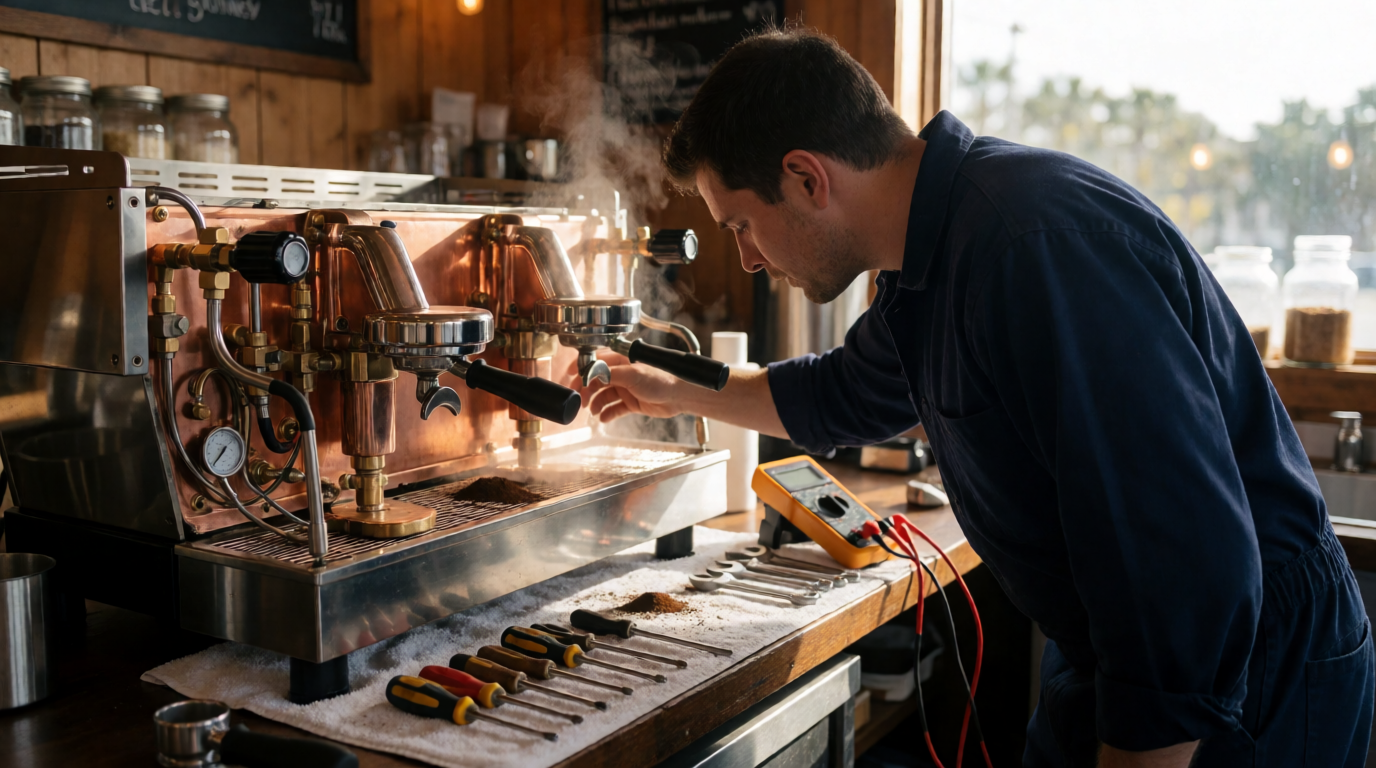
The Specialty Coffee Association (SCA) recommends a full preventative maintenance check every 500–1,000 shots or every three months for high-volume operations. During a typical service visit, a technician will:
- Backflush the group heads and clean shower screens
- Replace worn gaskets and seals
- Adjust water pressure and temperature settings
- Clean and descale the boiler
- Test and recalibrate the grinders
- Inspect electrical components for safety
- Verify water filtration system function
- Lubricate moving parts and check for wear
In my experience working with over 200 restaurants and cafes, the businesses that schedule regular service—rather than waiting for a breakdown—see 40% fewer emergency repair calls and extend their machine’s lifespan by two to three years. For example, a busy café in downtown Austin that switched from reactive to proactive maintenance reduced its annual repair costs by 60% in the first year.
Why Professional Service Matters More Than You Think
Skipping or delaying service is a false economy. According to the National Coffee Association (NCA), a commercial espresso machine represents a $5,000–$20,000 investment, and improper maintenance can cause 30% of machines to fail within 18 months. The cost of one day of downtime—lost sales, refunds, and staff reallocation—can easily exceed $1,000 for a busy café.
Beyond money, bad service affects quality. A machine that isn’t properly calibrated will produce inconsistent shots, bitter flavors, and weak crema—exactly the kind of experience that drives customers to your competitor down the street. A 2023 study by the University of California, Davis Coffee Center found that even a 1°F deviation in brew temperature can significantly alter flavor extraction, leading to customer dissatisfaction.
Here is a quick comparison of what happens when you prioritize service versus when you don’t:
| Factor | With Proactive Service | With Reactive Service Only |
|---|---|---|
| Frequency of breakdowns | 1–2 per year | 4–6 per year |
| Average repair cost | $150–$300 (covered under plan) | $500–$1,200 per emergency call |
| Machine lifespan | 7–10 years | 4–5 years |
| Coffee quality consistency | High | Medium to low |
| Customer satisfaction | 90%+ positive | 60–70% positive |
| Daily revenue risk | Minimal | Significant |
That said, not all espresso machine service is created equal. The next section shows you exactly how to vet and choose the right provider for your business. Businesses in areas like Charleston, SC or Tampa, FL often face different service availability, so knowing local options is key.
How to Get Espresso Machine Service: A 5-Step Action Plan
Follow these steps to ensure your machine stays operational and your service costs stay predictable.
Step 1: Diagnose the Problem Accurately
Before you call for service, ask yourself and your staff these questions:
- Is the machine not turning on? (Power or electrical issue)
- Is the water not heating? (Boiler or thermostat problem)
- Are shots pulling too fast or too slow? (Grinder or pressure issue)
- Is there a leak? (Seals, valves, or connections)
- Is the steam wand producing weak steam? (Boiler or valve issue)
Write down the exact symptoms and any error codes displayed. This information helps the technician bring the right parts and reduces the time from diagnosis to repair. For example, if your machine displays an "H2O" error, it likely indicates a water supply problem, not a boiler failure.
Step 2: Identify Your Service Options
You generally have three routes:
- Manufacturer-direct service – Most expensive but uses OEM parts and certified techs. Good for warranty periods.
- Independent third-party technician – Lower rates, but quality varies wildly. Check reviews and ask for certifications.
- Managed coffee service provider – All-inclusive package (equipment, installation, maintenance, and supplies). This is the route I recommend for most businesses because it eliminates surprise costs and ensures consistent upkeep.
For example, Busy Bean Coffee offers a managed coffee service that covers everything from the machine itself to grinder calibration and urgent repairs—all for one monthly fee. No hidden invoices. You can see how this works in our complete guide to office coffee delivery services.
Step 3: Ask the Right Questions Before Hiring
When vetting a service provider, always ask:
- Do you have certified technicians? (Look for SCA or manufacturer certifications)
- What is your average response time for emergency calls? (Under 4 hours is ideal)
- Are parts included or billed separately?
- Do you offer preventative maintenance plans? (This is critical)
- Can you provide references from similar businesses?
- Do they have a loaner machine program for extended repairs?
A provider that cannot answer these clearly is likely not the right partner. I’ve seen businesses in Rock Hill, SC lose thousands because they hired a general repair person who couldn’t fix a La Marzocco.
Step 4: Schedule Regular Preventative Maintenance
Even the best on-call service won’t prevent all problems. That’s why I recommend a quarterly preventative maintenance agreement. According to a study by McKinsey & Company, predictive maintenance can reduce equipment downtime by 30–50% and lower maintenance costs by 10–40%.
For high-volume cafés (200+ shots/day), schedule service every 60–90 days. For medium-volume cafés or offices (50–150 shots/day), every 90–120 days is sufficient. For lower volume (under 50 shots/day), twice a year may be enough. Want a detailed calendar? Read our guide on coffee equipment maintenance in St. Petersburg, FL for a sample schedule.

Step 5: Have a Backup Plan
No provider is perfect. Always keep a spare espresso machine or a manual pour-over setup for emergencies. Also, document your service history—repair dates, parts replaced, and technician notes—so you can spot recurring issues. A simple spreadsheet can save you hours of troubleshooting later.
💡
Key Takeaway
The best strategy is a combination of a managed service contract (for predictable costs) and a backup brewing method (for zero downtime).
Common Questions & Misconceptions About Espresso Machine Service
Misconception 1: “I only need service when the machine breaks.”
Correction: Reactive service is three to five times more expensive over a machine’s lifetime than proactive service. Breakdowns also cause revenue loss and customer churn that you never get back. According to a 2022 report by Technomic, the average café loses 15% of its daily customer base after a single equipment failure.
Misconception 2: “Any technician can fix an espresso machine.”
Correction: Commercial espresso machines have complex boilers, pumps, and electronic controllers that require specialized training. A general appliance repair person can easily misdiagnose, leading to more damage. For instance, replacing a pump without adjusting the pressure regulator can blow out the boiler. Always look for SCA-certified techs or manufacturer-trained experts.
Misconception 3: “Service contracts are a waste of money.”
Correction: While paying a monthly fee feels like an expense, it usually includes unlimited service calls, parts, and discounts on supplies. Many businesses find they save 30–50% compared to paying per-incident. For example, a café in Las Vegas, NV switched to a managed contract and saved over $4,000 in the first year alone.
Misconception 4: “I can clean the machine myself and skip pro service.”
Correction: Daily cleaning is essential, but only a technician can properly backflush the internal valves, descale the boiler, and calibrate the pressure. You cannot replace professional service with daily wipe-downs. Think of it like a car: you change the oil yourself, but you still take it to a mechanic for tune-ups.
Misconception 5: “New machines don’t need service for a year.”
Correction: Even new machines need adjustment after installation. Water hardness, voltage fluctuations, and operator error can cause issues within weeks. I recommend scheduling a 30-day checkup for any new commercial espresso machine.
Frequently Asked Questions
What is the average response time for emergency espresso machine service?
Most reputable providers target a 4-hour response window during business hours. Some premium managed services, like Busy Bean Coffee’s, guarantee a technician on-site within 2 hours in major metro areas. Always confirm response times in your service agreement. In rural areas, response times may be longer due to limited technician availability.
How often should I schedule preventive maintenance for my espresso machine?
For high-volume cafés (200+ shots/day), schedule service every 60–90 days. For medium-volume cafés or offices (50–150 shots/day), every 90–120 days is sufficient. The Specialty Coffee Association’s best practice checklist recommends at least bi-annual professional maintenance. For businesses in San Francisco, CA, water quality may require more frequent descaling.
Can a service contract reduce my total coffee program costs?
Yes. Many businesses find that an all-inclusive managed coffee service costs less per month than paying separately for repairs, parts, and supplies. I’ve seen contracts reduce total coffee program costs by 20–30% after factoring in downtime savings. For example, a hotel in Dallas, TX saved $5,000 annually by switching to a managed plan.
What qualifications should I look for in an espresso machine technician?
At minimum, look for an SCA‑certified technician or manufacturer-trained certification (e.g., La Marzocco, Nuova Simonelli). Also ask if the company carries commercial liability insurance and can provide references from businesses of a similar size or type. In my experience, technicians with at least five years of field experience handle complex repairs faster.
Is it better to repair or replace an old espresso machine?
If the machine is over 8 years old, repair costs exceed 50% of a new machine’s value, or you’re experiencing frequent breakdowns (3+ per year), replacement is usually more cost-effective. Newer machines also offer better energy efficiency and shot consistency. A 2025 study by the Pacific Northwest National Laboratory found that modern machines use 25% less energy than those built before 2018.
How do I find a reliable espresso machine service near me?
Start by searching for providers that specialize in commercial equipment, not residential machines. Check online reviews on Google and Yelp, and ask for references from similar businesses in your area. You can also use our network: Busy Bean Coffee partners with certified technicians across the country. Whether you need service in Los Angeles, CA or Augusta, GA, we can connect you.
What should I do while waiting for the technician?
Have a backup brewing method ready—such as a batch brewer or French press—to keep serving customers. Train a staff member on basic troubleshooting (power cycling, checking water supply, cleaning group heads). Also, document the issue in a log so the technician has context.
How much does a commercial espresso machine service visit cost?
A standard preventative maintenance visit costs $150–$400, depending on location and machine complexity. Emergency service can run $200–$600 for the trip plus parts. Managed contracts typically cost $200–$500 per month and cover all visits and parts. For a breakdown of costs, see our guide on how much craft coffee costs.
Summary + Next Steps
Getting reliable espresso machine service doesn’t have to be a headache. Start by diagnosing problems early, vetting providers thoroughly, and committing to a preventative maintenance schedule. For most foodservice businesses, a managed coffee service delivers the fastest response, lowest total cost, and best coffee quality.

Take the next step today. See how Busy Bean Coffee’s all-inclusive membership covers your equipment, maintenance, and supplies. Schedule a free consultation or read our premium coffee service guide for more details.
Recommended Readings
To deepen your understanding of these topics, we recommend reading the following articles:
Reference Sources
For deeper context on this topic, these sources provide additional authoritative perspectives:
- Wikipedia — general knowledge reference
- GitHub — development and technology documentation
- The New York Times — news and journalistic updates
These references help establish a complete view of the subject matter.
About the Author
Travis Estes is the founder of Busy Bean Coffee. With over a decade in specialty coffee and equipment service, he has helped hundreds of hotels, restaurants, and offices streamline their coffee programs. He believes great coffee should be effortless—and every business deserves a partner who makes that happen.
Free Coffee Pairing Guide & Specialty Roast Cheat Sheet
Unlock the secrets of perfect brewing ratios, water temperatures, and specialty roast profiles. Download the guide.