Which Industrial Coffee Roasters Provide the Best ROI for Your Business?
Scaling a coffee operation requires a shift from artisanal batches to systemic precision. When evaluating industrial coffee roasters, the right choice depends entirely on your intended throughput, your desired level of automation, and your specific fuel infrastructure. For most high-growth operations, the best option is typically a drum roaster for versatility or a fluid-bed roaster for sheer speed and consistency. If you are focusing on high-volume hospitality, integrating these with automatic coffee machines for hotels and hospitality in 2026 ensures that the quality of the roast is matched by the quality of the extraction.
The fundamental trade-off in industrial roasting is between control and capacity. Small-batch industrial machines allow for a high degree of nuance in the "first crack" stage, while massive commercial roasters prioritize uniformity across hundreds of kilograms. In my experience working with specialty coffee producers, the most common mistake is over-purchasing capacity. Many businesses buy a 60kg roaster when their actual daily demand only justifies a 15kg machine, leading to inefficient heat usage and inconsistent roast profiles due to under-filled drums.
Understanding the Mechanics of Industrial Coffee Roasting
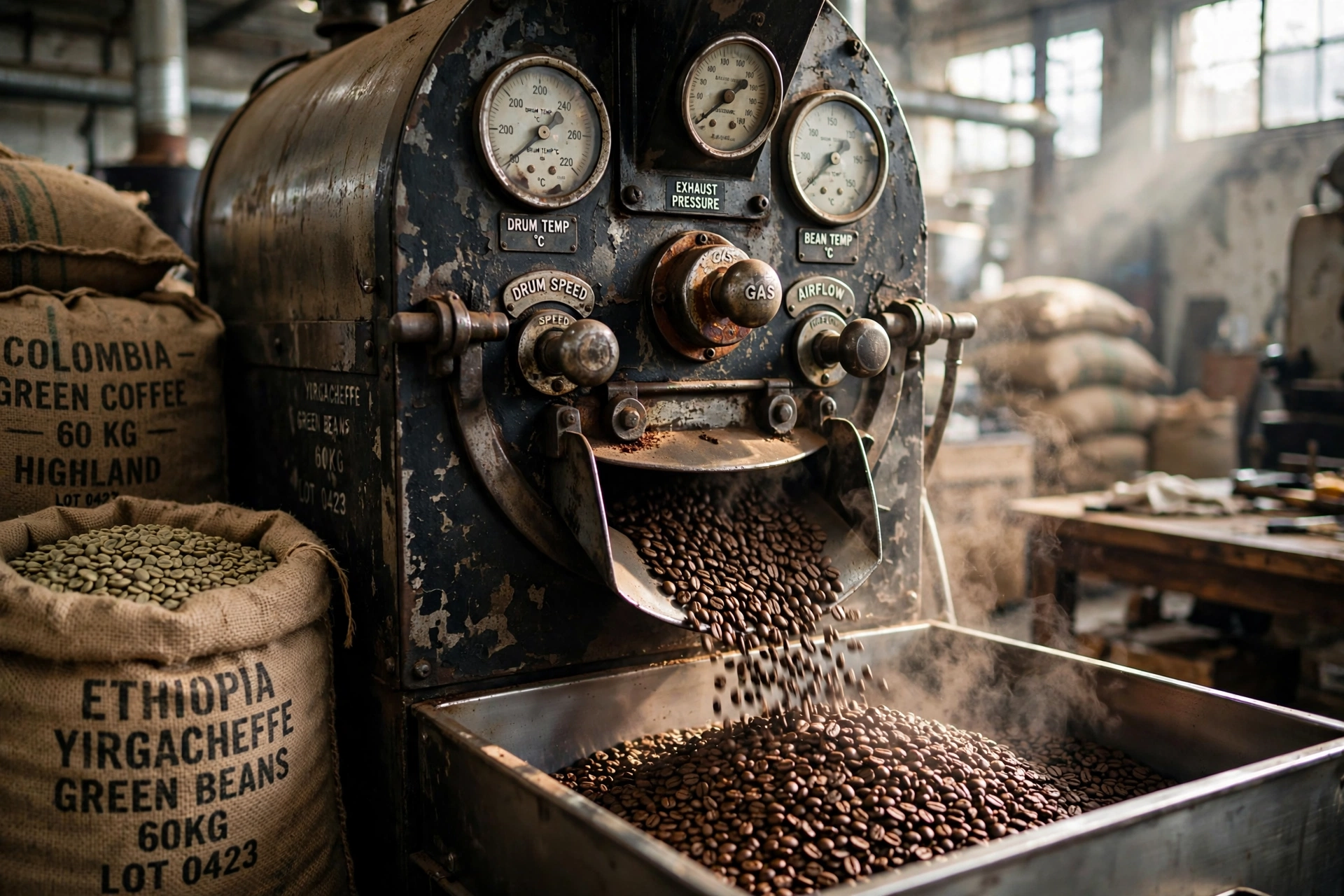
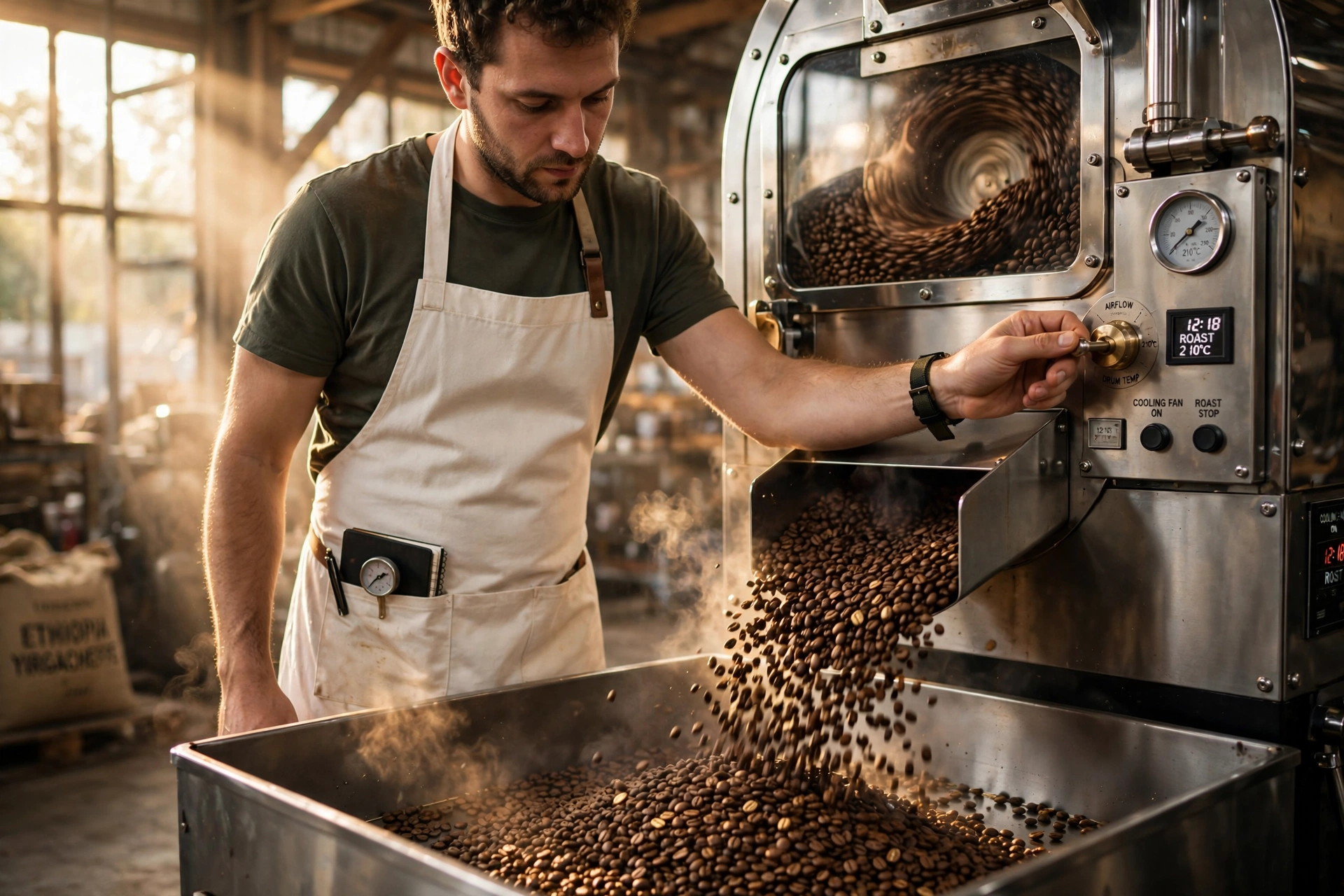
To choose the right equipment, you must first understand the thermodynamic process occurring inside the machine. Industrial roasting is not merely about applying heat; it is about managing the transfer of energy to the coffee bean to trigger the Maillard reaction and caramelization without scorching the exterior.
📚
Definition
Industrial coffee roasting is the process of using large-scale, mechanized equipment to transform raw green coffee beans into a consumable product through controlled thermal application, typically handling batches from 15kg to several hundred kilograms.
There are three primary heat transfer methods utilized in these machines: conduction (direct contact with the hot metal drum), convection (hot air flowing through the beans), and radiation (heat emanating from the burner). Most industrial coffee roasters utilize a hybrid of convection and conduction. According to the Specialty Coffee Association (SCA), maintaining a precise temperature curve is the only way to ensure that the complex acids and sugars in Coffea arabica are preserved rather than destroyed by excessive heat.
When you scale to an industrial level, you are no longer just roasting coffee; you are managing a supply chain. This means your choice of roaster must integrate with your cooling trays, destoners, and packaging lines. For those managing a foodservice coffee program in Chicago IL: complete guide, the ability to replicate a specific roast profile across multiple batches is the difference between a loyal customer base and a fluctuating product that confuses the palate.
Why the Right Roaster Choice Dictates Your Bottom Line
The financial implications of choosing the wrong industrial roasting setup are staggering. A mismatch between equipment and volume leads to "dead capital"—expensive machinery that sits idle—or "opportunity loss," where you cannot meet demand because your roast cycle is too slow.
From a data perspective, efficiency in roasting is measured by "throughput per kilowatt-hour" or "throughput per therm." According to the International Coffee Organization (ICO), the global coffee market is seeing a surge in specialty demands, which requires roasters that can handle varied profiles without needing hours of "re-seasoning" between batches. If your machine takes two hours to reach thermal equilibrium after a change in bean origin, you are losing billable production time.
Furthermore, the safety and regulatory requirements for industrial setups are rigorous. Equipment must meet NSF International standards for food safety and sanitation. Failure to invest in a roaster with an integrated smoke suppression system or a certified afterburner can lead to municipal fines or, worse, the closure of your facility due to environmental violations.
In the hospitality sector, especially for those implementing a Sensa coffee service in Charlotte, NC, the roast's stability directly affects the calibration of the espresso machines. A roast that drifts by even two degrees across a 50kg batch can change the extraction time of a shot by several seconds, forcing baristas to spend hours re-dialing in the equipment instead of serving customers.
Practical Implementation: Transitioning to Industrial Volume
Moving from a sample roaster to industrial coffee roasters requires a phased approach to prevent operational collapse. You cannot simply "turn up the heat" on a larger machine; the physics of the bean mass change the airflow requirements and the cooling time.
First, perform a volumetric analysis of your current sales. If you are roasting 20kg a day but projecting 200kg by the end of the year, you need a machine that is modular or has a high ceiling for expansion. Second, evaluate your gas lines. Industrial roasters require significantly higher BTU outputs than home or prosumer gear. I've seen countless businesses install a world-class roaster only to find their gas line is undersized, resulting in "temperature dip" during the middle of the roast cycle.
Third, focus on the "cooling phase." In industrial roasting, the roast doesn't end when the beans leave the drum; it ends when they hit 20-25°C. If your cooling tray is inefficient, the residual heat will continue to cook the beans, effectively turning a "Medium Roast" into a "Medium-Dark" in a matter of minutes.
At Busy Bean Coffee, we emphasize that the equipment is only as good as the service surrounding it. This is why we advocate for managed solutions. Whether you are looking for a Sensa coffee service in Raleigh NC or a full-scale roasting operation, the goal is to remove the friction of maintenance so you can focus on the profile.
💡
Key Takeaway
The most expensive roaster is not the one with the highest price tag, but the one that creates a bottleneck in your production line due to poor cooling or slow heating cycles.
Comparing Industrial Roasting Options
When deciding which industrial coffee roasters to invest in, you generally face a choice between three architectural styles. Each has distinct trade-offs regarding flavor, speed, and labor.
| Option | Pros | Cons | Best For |
|---|---|---|---|
| Drum Roasters | Exceptional flavor control, traditional "body", high versatility | Slower throughput, higher risk of scorching if not managed | Specialty roasters, boutique brands |
| Fluid Bed (Air) | Extremely fast, highly consistent, lower roast variability | Less "body" in the cup, louder operation, high energy cost | High-volume commercial, rapid scaling |
| Continuous Roasters | Maximum efficiency, minimal labor, massive output | Extremely high capital cost, lacks batch nuance | Global distributors, instant coffee plants |
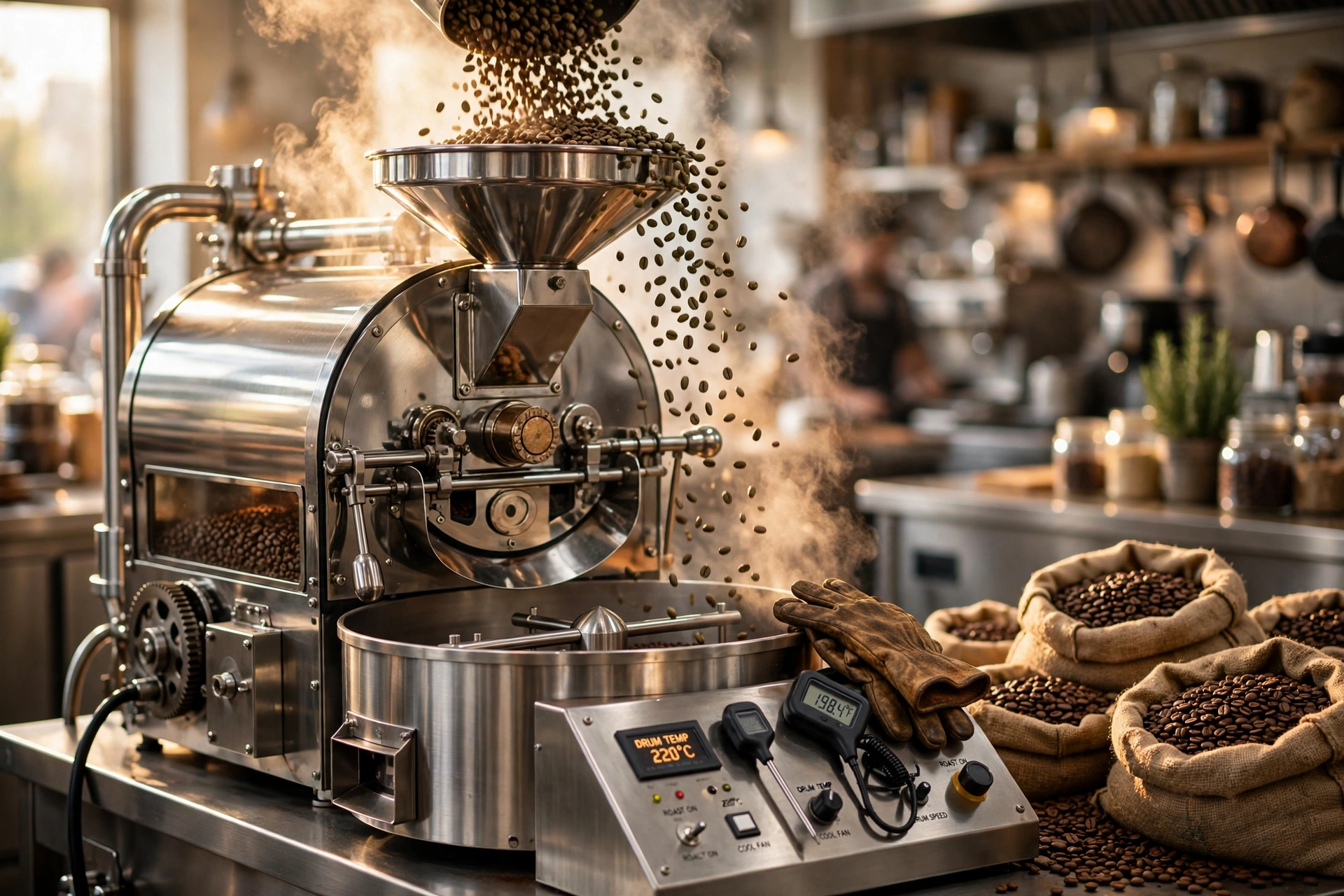
Drum roasters remain the gold standard for quality. They use a rotating cylinder to keep the beans moving, combining conduction and convection. This is essential for those who prioritize the "specialty" label. Fluid bed roasters, on the other hand, suspend the beans in a column of hot air. This eliminates the risk of beans sticking to a hot drum, making it a more "set-and-forget" option for those running a Sensa coffee service in Jacksonville, FL.
Now here's where it gets interesting: the rise of "Smart Roasting." Modern industrial machines now come with integrated software that logs every second of the roast. This allows a head roaster in one city to send a profile to a production facility in another, ensuring that the coffee tasted in a Sensa coffee service in Mount Pleasant SC is identical to the one in a different region.
Common Misconceptions in Industrial Roasting
Most guides get this wrong: they suggest that "bigger is always better." In the roasting world, an oversized drum is a liability. If you put 10kg of coffee into a 60kg roaster, the beans will not have enough mass to maintain the thermal momentum of the drum, often resulting in "baked" coffee that tastes like cardboard rather than a vibrant, complex brew.
Another myth is that automation removes the need for a skilled barista or roaster. While a machine can follow a curve, it cannot "smell" when a roast is peaking. The human element—the sensory analysis—is what prevents a 100kg batch from being wasted. Even with the best industrial coffee roasters, you need a Q-Grader to verify the output.
Finally, many believe that "industrial" means "low quality." In reality, modern industrial engineering allows for a level of precision that is impossible in a small pan. By controlling the exact airflow (CFM) and gas pressure, industrial machines can highlight the specific terroir of a bean from Ethiopia or Colombia with surgical precision. This is exactly how we maintain the high standards across our Sensa coffee service in Columbia SC operations.
Frequently Asked Questions
Which industrial coffee roaster is best for a startup focusing on specialty beans?
For a startup, a high-end drum roaster in the 15kg to 30kg range is almost always the correct choice. Drum roasters provide the necessary control over the Maillard reaction and caramelization, which are essential for highlighting the unique flavor notes of specialty coffees. Fluid bed roasters are faster but can sometimes "strip" the body from a high-altitude bean. Starting with a drum roaster allows you to build a signature profile that can later be scaled to larger machines. Ensure the machine has a digital probe for real-time bean temperature tracking.
How does the choice of fuel (Electric vs. Gas) affect the roasting process?
Gas-fired roasters (typically Natural Gas or Propane) are the industry standard for industrial volumes because they provide a more immediate and powerful heat response. This is essential for "charging" the drum and maintaining a steep temperature rise. Electric roasters are becoming more popular for smaller industrial footprints due to easier installation and lower emissions in some urban zones. However, for true industrial throughput, gas is significantly more cost-effective per kilogram of coffee. If you are operating in a city with strict zoning, check your local emissions laws before committing to a gas burner.
What is the relationship between roast capacity and roast consistency?
As capacity increases, the "thermal mass" of the machine becomes the dominant factor. In a small roaster, the bean temperature reacts quickly to changes in gas pressure. In a large industrial roaster, the drum itself holds a massive amount of heat. This means that once a large machine is "in the zone," it can produce incredibly consistent batches, provided the load is consistent. The danger arises when you vary the batch size; roasting 20kg in a 50kg machine will produce a completely different flavor profile than roasting 50kg, as the ratio of air-to-bean changes.
How often does industrial roasting equipment require maintenance to avoid downtime?
Industrial roasters require a rigorous maintenance schedule to prevent catastrophic failure and fire hazards. Chaff collectors must be emptied daily, as accumulated chaff is highly flammable. Lubrication of the drum bearings should happen monthly, and burner calibrations should be performed quarterly. I've seen operations lose entire weeks of production because a simple bearing seized due to heat and lack of grease. For those using a managed service like Busy Bean Coffee, this maintenance is handled proactively to ensure that your Sensa coffee service in Greenville SC never experiences a gap in supply.
Do I need an afterburner for an industrial roasting setup?
In most urban environments, yes. Roasting coffee releases volatile organic compounds (VOCs) and smoke that can be disruptive to neighbors and illegal under city ordinances. An afterburner incinerates these emissions at very high temperatures, rendering the exhaust virtually odorless and colorless. While they add to the initial capital expenditure and increase gas consumption, they are essential for long-term business viability. Without one, you risk receiving "nuisance" complaints that can lead to forced relocation or heavy fines from environmental agencies.
Final Thoughts on Choosing Industrial Coffee Roasters
Selecting the right industrial coffee roasters is not about finding the "best" machine on the market, but about finding the one that aligns with your specific growth trajectory and quality standards. Whether you prioritize the artisanal control of a drum roaster or the high-speed efficiency of a fluid bed system, the key is to balance your capacity with your actual demand.
If you find that the complexity of roasting, maintenance, and equipment procurement is taking you away from your core business, consider a managed approach. At Busy Bean Coffee, we specialize in taking the "hassle" out of high-end coffee. From professional installation to full maintenance coverage, we ensure your business serves a world-class product without the operational headaches of owning a roasting plant.
Ready to elevate your beverage program? Visit Busy Bean Coffee to explore our all-inclusive managed coffee solutions and find the perfect fit for your business.
Free Coffee Pairing Guide & Specialty Roast Cheat Sheet
Unlock the secrets of perfect brewing ratios, water temperatures, and specialty roast profiles. Download the guide.