Which Industrial Coffee Roaster is Right for Your Production Scale?
Scaling a roasting operation often leads to a critical crossroads: choosing between drum, air, or hybrid industrial coffee roasters. The "best" machine is not the one with the highest technical specs, but the one that aligns your specific throughput needs with your desired flavor profile and available capital. For most growing businesses, the choice comes down to a trade-off between the thermal stability of traditional drum roasters and the precision and speed of fluid-bed (air) systems.
In my experience working with roasting facilities in Mount Pleasant, South Carolina, the most expensive mistake a business owner can make is over-buying capacity. I have seen operators purchase 60kg industrial roasters when their actual demand only justified a 15kg machine, resulting in "under-loaded" drums that scorched the beans and wasted energy. To make the right choice, you must first quantify your daily peak demand and determine whether your brand identity relies on the traditional "body" of a drum roast or the "brightness" associated with air roasting.
Understanding the Mechanics of Industrial Coffee Roasting
To decide which machine to invest in, you must first understand the physics of heat transfer. Industrial roasting is essentially the management of three types of heat: conduction (direct contact with the drum), convection (hot air circulating), and radiation (heat from the drum walls).
📚
Definition
Convection is the transfer of heat through a fluid, such as air or water. In coffee roasting, convection is the primary driver of the "development" phase, where sugars caramelize and flavors are locked in.
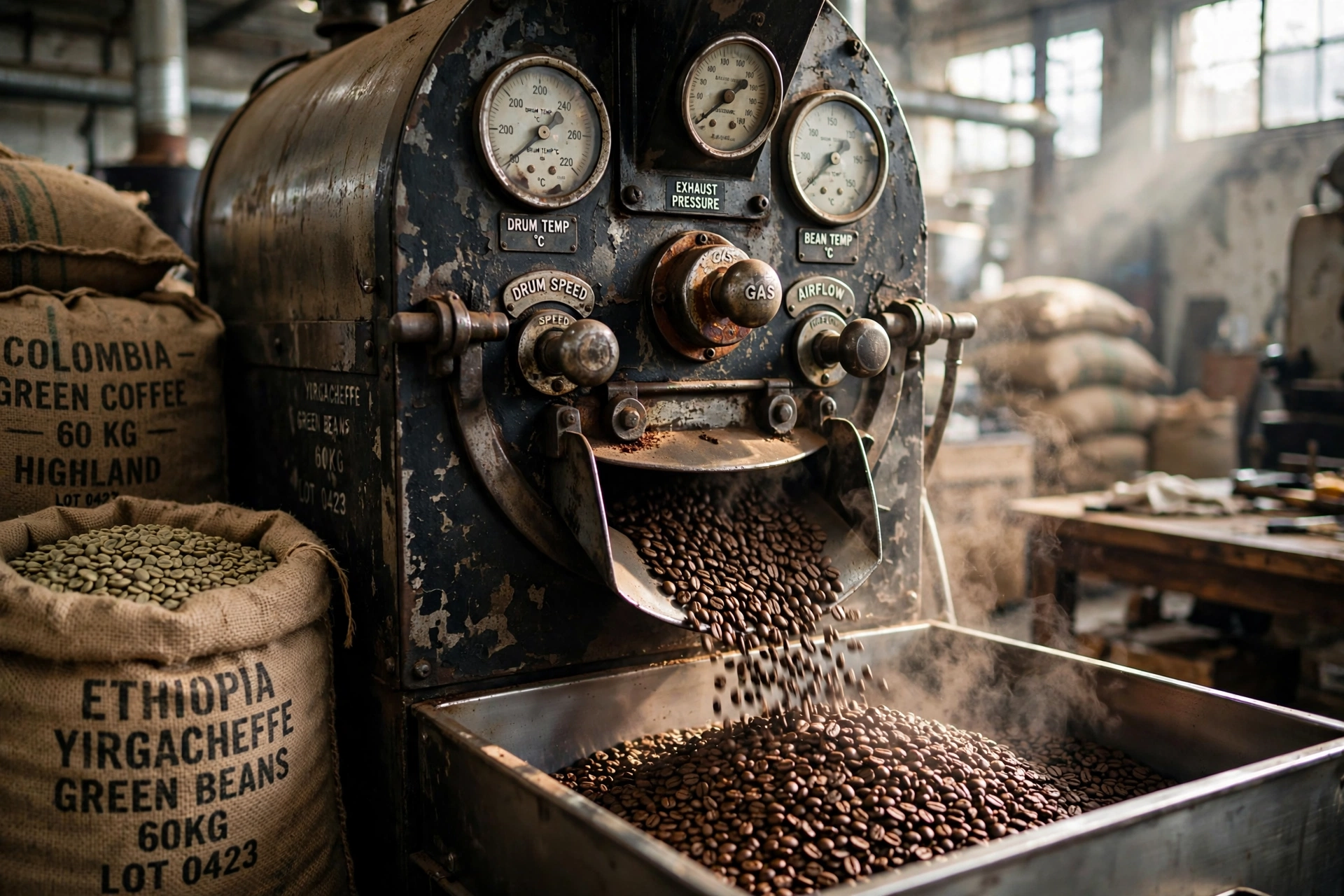
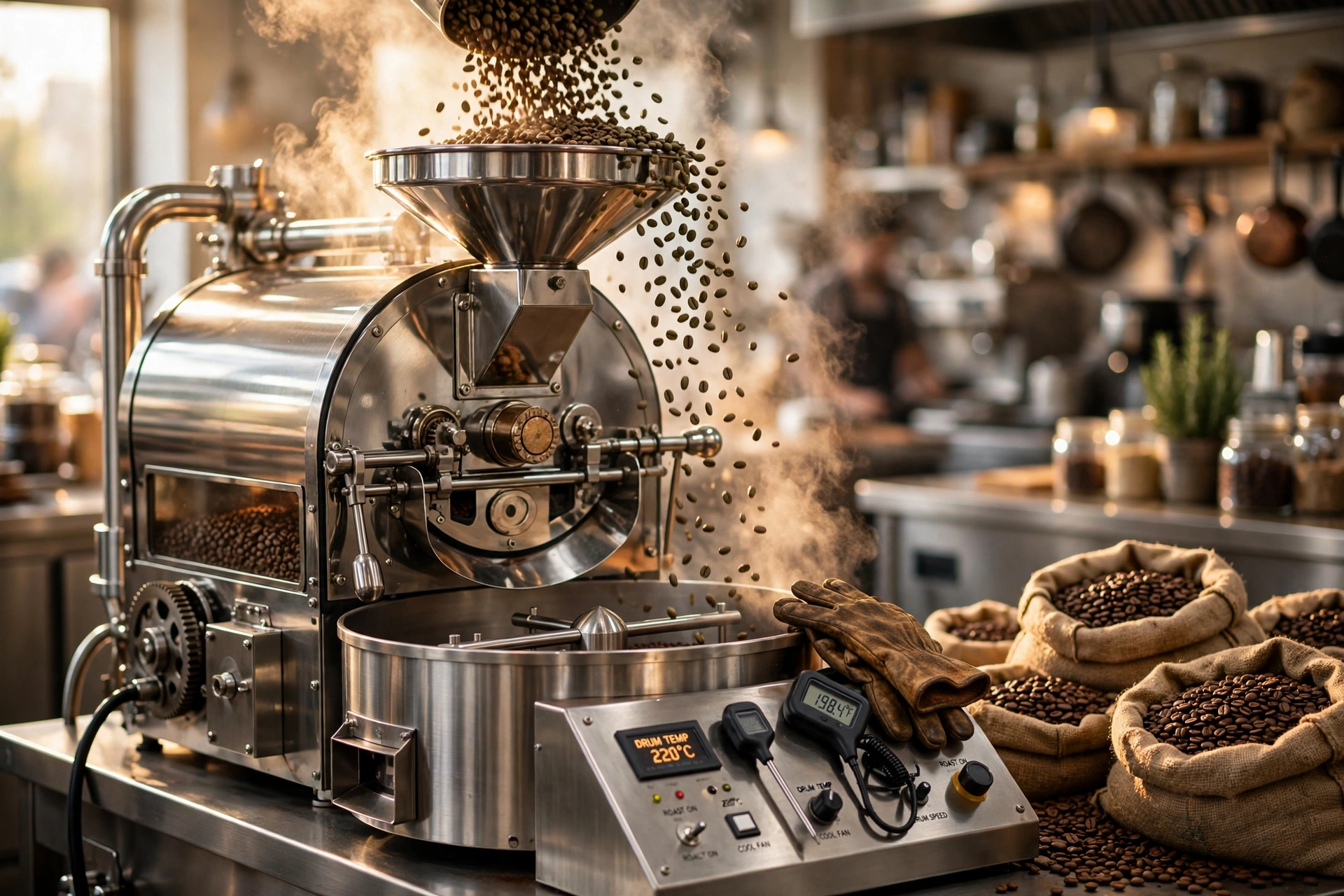
Traditional drum roasters rely heavily on conduction. The beans touch the hot metal, creating a distinct flavor profile often described as "bold" or "syrupy." However, this carries the risk of tipping—where the bean surface burns before the core is cooked. Conversely, fluid-bed roasters use a high-velocity stream of hot air to suspend the beans, relying almost exclusively on convection. This results in a more uniform roast and is generally faster, though some argue it lacks the depth of a traditional drum roast.
According to the Specialty Coffee Association (SCA), the precision of temperature control during the "First Crack" is what separates commercial-grade coffee from specialty coffee. Industrial systems that offer integrated PID controllers and real-time data logging allow roasters to replicate a profile across a thousand batches, which is a non-negotiable requirement for any business scaling beyond a single cafe. When you move into the industrial realm, you are no longer just roasting coffee; you are managing a thermal process where a 2-degree variance can ruin an entire shipment of high-value Coffea arabica.
Why the Right Equipment Choice Impacts Your Bottom Line
Selecting the wrong roasting technology doesn't just affect the taste; it directly impacts your operational overhead and scalability. The cost of energy is one of the largest variables in a roasting warehouse. Drum roasters, while efficient at holding heat, often have longer pre-heating and cooling cycles. If your workflow involves small, frequent batches, the energy wasted during these transition periods can erode your margins by 5% to 10% annually.
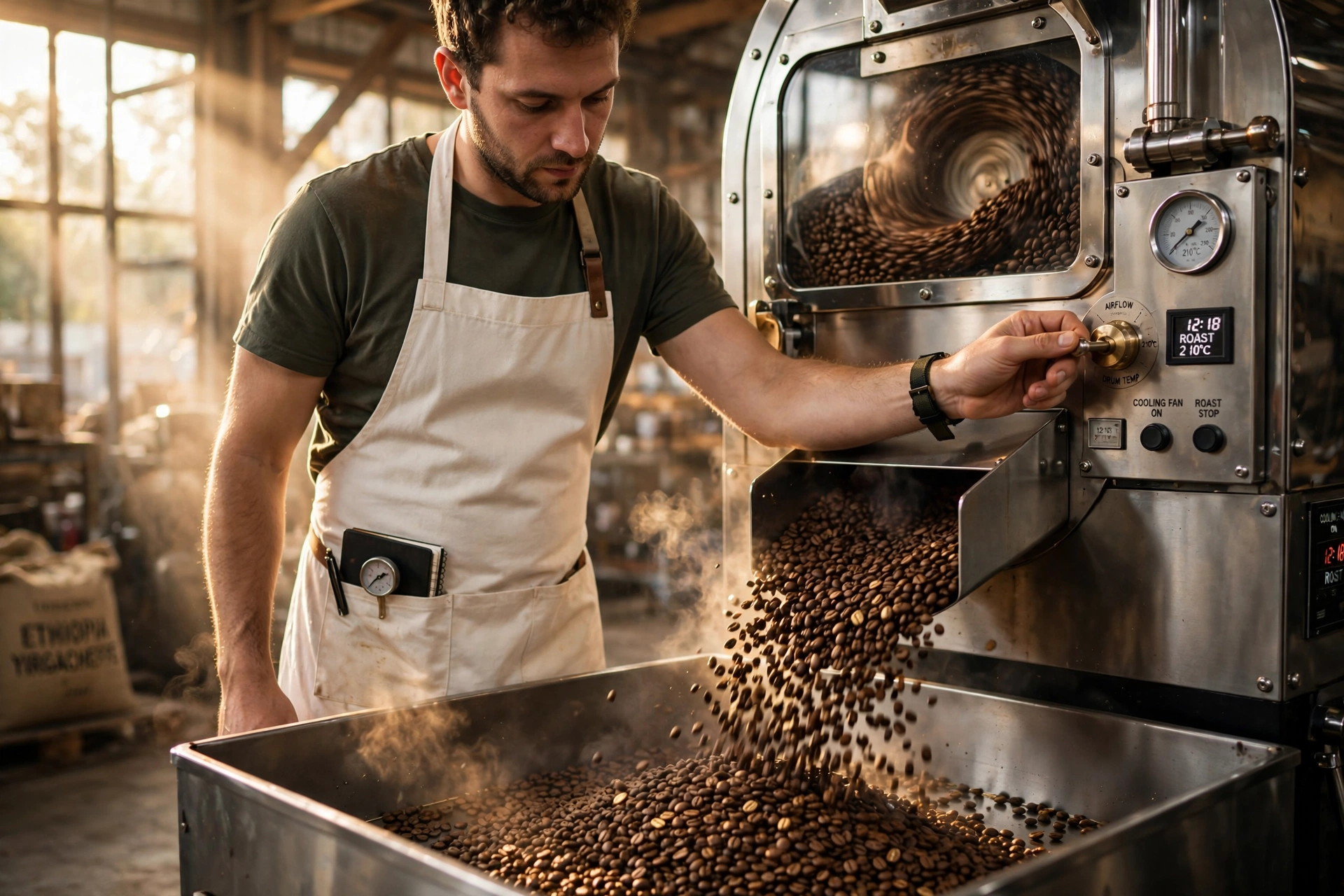
Beyond energy, labor costs are tied to the "ease of operation." A manual industrial roaster requires a highly skilled barista or roastmaster to constantly monitor the bean temperature and manually adjust gas valves. While this "artisan" approach is romantic, it is not scalable. If your lead roaster leaves, your product consistency disappears. High-end industrial coffee roasters with automation software mitigate this risk by treating the roast profile as a digital asset.
Data from the National Coffee Association USA (NCA) indicates that the demand for specialty coffee continues to grow, but consumer expectations for consistency are higher than ever. A customer in Mount Pleasant, SC, expects their morning latte to taste exactly the same on Tuesday as it did on Saturday. If your equipment cannot provide that repeatability, you will suffer from "customer churn," where patrons leave because the roast profile shifted from a medium to a medium-dark due to equipment instability.
Furthermore, the choice of equipment affects your regulatory compliance. Industrial roasters produce significant smoke and particulate matter. Investing in a machine that integrates seamlessly with an afterburner or a catalytic oxidizer is essential. According to NSF International, food-grade equipment must meet strict sanitation and safety standards to prevent contamination. A cheap, non-certified industrial roaster may save you money upfront, but it can lead to costly shutdowns during health inspections or, worse, insurance denials after a fire.
Implementing a Roasting Strategy with Busy Bean Coffee
Transitioning to industrial-scale production requires more than just buying a machine; it requires a workflow overhaul. The mistake I see constantly is businesses buying a roaster but ignoring the "bottleneck" stages: green bean storage, weighing, and the cooling process. If your roaster can output 30kg every 12 minutes, but your cooling tray takes 15 minutes to bring the beans to room temperature, your expensive machine is sitting idle for 3 minutes per batch.
At Busy Bean Coffee, we approach roasting as a managed ecosystem. Instead of simply selling a piece of hardware, we advocate for a solution that integrates the equipment with the bean supply chain. When setting up a production line, the process should follow this rigorous sequence:
- Demand Forecasting: Calculate your "theoretical maximum" throughput. If you need 500kg per week, don't buy a machine that can only do 400kg at 80% capacity. Always leave a 20% buffer for maintenance and growth.
- Infrastructure Audit: Ensure your facility in Mount Pleasant or elsewhere has the correct gas line pressure and electrical phase (3-phase power is often required for industrial blowers).
- Profile Development: Use software like Cropster or Artisan to map the "ideal" roast for your signature blend. This digital map becomes the blueprint for your industrial coffee roasters.
- Quality Control Loop: Implement a cupping protocol where every batch is graded by a Q-Grader. This ensures that the industrial scale hasn't compromised the specialty coffee quality.
💡
Key Takeaway
Industrial scaling is not about roasting more coffee; it is about roasting the same coffee more times. Automation is the only way to achieve this without increasing labor costs linearly.
By leveraging a managed coffee solution, businesses can avoid the massive capital expenditure (CAPEX) of buying a roaster outright and instead focus on the operational excellence of their beverage service. This shift allows a business to pivot their roast profiles quickly based on seasonal trends without being locked into a specific machine's limitations.
Comparing Industrial Roasting Options: Which One Wins?
Choosing between the three main types of industrial systems requires a cold analysis of your business goals. You cannot have the absolute highest speed, the absolute lowest cost, and the absolute highest "traditional" flavor profile all in one machine.
| Roasting Technology | Pros | Cons | Best For |
|---|---|---|---|
| Traditional Drum | Deep flavor, high thermal mass, industry standard | Slower cooling, higher risk of scorching, slower start-up | Heritage brands, medium-to-dark roasts |
| Fluid Bed (Air) | Extreme consistency, very fast, cleaner taste | Higher energy cost (blowers), "lighter" body | High-volume specialty, light roasts, precision labs |
| Hybrid Systems | Balanced flavor, flexible profiles, efficient | Complex maintenance, higher initial price point | Scaling businesses, diverse product catalogs |
If you are targeting the "third wave" coffee market, where brightness and origin notes are paramount, air roasters are the superior choice. They allow for a very precise "dry" phase, ensuring that the internal structure of the coffee bean is developed without burning the exterior. However, if your brand is built on a rich, chocolatey espresso that pairs well with milk, a drum roaster's conductive heat is what creates those heavy, syrupy notes.
Now, here's where it gets interesting: many modern industrial coffee roasters are moving toward "Smart Drums." These are drum roasters that use high-pressure air injection to simulate the convection of a fluid-bed roaster. This hybrid approach is becoming the gold standard for businesses that want the best of both worlds—the body of a drum roast and the precision of an air roast.
Common Misconceptions About Industrial Roasting
Most guides get this wrong by suggesting that "bigger is always better." In the roasting world, a machine that is too large for your current volume is a liability, not an asset. This is because roasting involves a specific ratio of bean mass to air volume. If you put 5kg of beans in a 30kg roaster, the airflow will be too aggressive, stripping the beans of their natural oils and resulting in a flat, tasteless cup.
Another common myth is that "automatic" roasting removes the need for a skilled roastmaster. This is false. Automation only executes a profile; it does not create it. A machine cannot tell you that a specific shipment of beans from Ethiopia is slightly more moist than the previous batch, requiring a lower charge temperature to avoid under-roasting. You still need a human expert to adjust the "digital recipe" based on the raw material's variables.
Finally, there is the misconception that industrial roasting is "too expensive" for small-to-medium enterprises. While the upfront cost is high, the cost per pound drops significantly as you scale. The real expense isn't the machine; it's the waste. Inefficient roasting processes can lead to a 3-5% "shrinkage" or loss of product due to roasting errors. When you are processing tons of coffee, a 5% loss is a catastrophic blow to the bottom line.
Frequently Asked Questions
How do I determine the correct capacity for my industrial coffee roasters?
To calculate the necessary capacity, you must determine your peak daily volume rather than your average weekly volume. For example, if you sell 1,000kg per month, but 60% of that is sold in the first two weeks of the month, your "average" is misleading. You need a machine that can handle the peak load without running 24 hours a day, as this leads to equipment fatigue and employee burnout. I generally recommend calculating your maximum projected growth for the next three years and choosing a machine that can handle that volume at 70% capacity. This ensures you have room for "specialty" small-batch runs without disrupting your main production.
What is the difference between a batch roaster and a continuous roaster?
A batch roaster processes a specific amount of coffee, cools it, and then starts again. This is the standard for specialty coffee because it allows for total control over each individual batch. A continuous roaster, on the other hand, is a conveyor-belt system where green beans enter one end and roasted beans exit the other. While continuous roasters offer massive throughput (thousands of pounds per hour), they sacrifice the nuance and precision of the roast. If your brand identity is built on "Specialty Coffee" and "Coffea arabica" excellence, stay with batch roasting. Continuous roasting is reserved for industrial commodity coffee where volume outweighs flavor profile.
How does the environment of Mount Pleasant, SC affect roasting?
Local climate, specifically humidity and ambient temperature, significantly impacts how coffee roasts. In a humid environment like Mount Pleasant, South Carolina, the moisture content of the green beans can fluctuate, and the air density entering the roaster's blower changes. This means a roast profile that worked in the dry heat of October may not work in the humid air of July. Industrial coffee roasters with adaptive controllers can compensate for these atmospheric shifts. If you are roasting in the Lowcountry, you must ensure your facility has climate control for green bean storage to prevent mold and inconsistent roasting results.
Which is better for energy efficiency: gas or electric industrial roasters?
In the industrial sector, gas-fired roasters are almost always more cost-effective for high-volume production. The energy density of natural gas or propane allows for a faster "ramp-up" to roasting temperature and a more consistent heat application in the drum. Electric roasters are excellent for small-scale labs or "sample roasters" due to their precision, but scaling them to industrial levels often results in astronomical electricity bills and longer pre-heating times. However, if your facility has access to subsidized renewable energy, electric systems are becoming more viable as a "green" branding move.
Do I really need an afterburner for an industrial coffee roaster?
Yes, if you are operating in a commercial or residential zone. Roasting coffee releases volatile organic compounds (VOCs) and a significant amount of smoke (chaff and oils). Without an afterburner—which incinerates these emissions at high temperatures—your facility will likely violate local air quality regulations and create a nuisance for neighboring businesses. Beyond legality, an afterburner prevents the "smoky" smell from clinging to your facility and your staff. In my experience, skipping the afterburner is the fastest way to get a cease-and-desist order from the local municipality.
Final Thoughts on Choosing Industrial Coffee Roasters
Selecting the right industrial coffee roasters is a strategic business decision that dictates your product's quality and your company's scalability for years. Whether you opt for the robust body of a traditional drum system or the clinical precision of a fluid-bed air roaster, the goal remains the same: consistency. As the specialty coffee market grows in 2026, the winners will be those who can merge the art of the roast with the science of industrial automation.
If you are overwhelmed by the technical requirements of equipment installation or the volatility of sourcing high-grade beans, there is a more efficient path. Instead of managing the headache of equipment maintenance and CAPEX, you can leverage a managed solution. At Busy Bean Coffee, we provide the infrastructure and the expertise, allowing you to focus on growth while we handle the technical precision of the roast.
Stop guessing which machine fits your budget and start focusing on your customers. Visit www.busybeancoffee.com to see how our managed coffee solutions can scale your business without the industrial overhead.
Recommended Readings
To deepen your understanding of these topics, we recommend reading the following articles:
- The Complete Guide to White Glove Coffee Service
- Ultimate Guide to All-Inclusive Coffee Service for Businesses
- Ultimate Guide to Automated Coffee Machines for Business
- Ultimate Guide to Specialty Coffee Equipment for Business
Free Coffee Pairing Guide & Specialty Roast Cheat Sheet
Unlock the secrets of perfect brewing ratios, water temperatures, and specialty roast profiles. Download the guide.