What Are Industrial Coffee Roasters and How Do They Work?
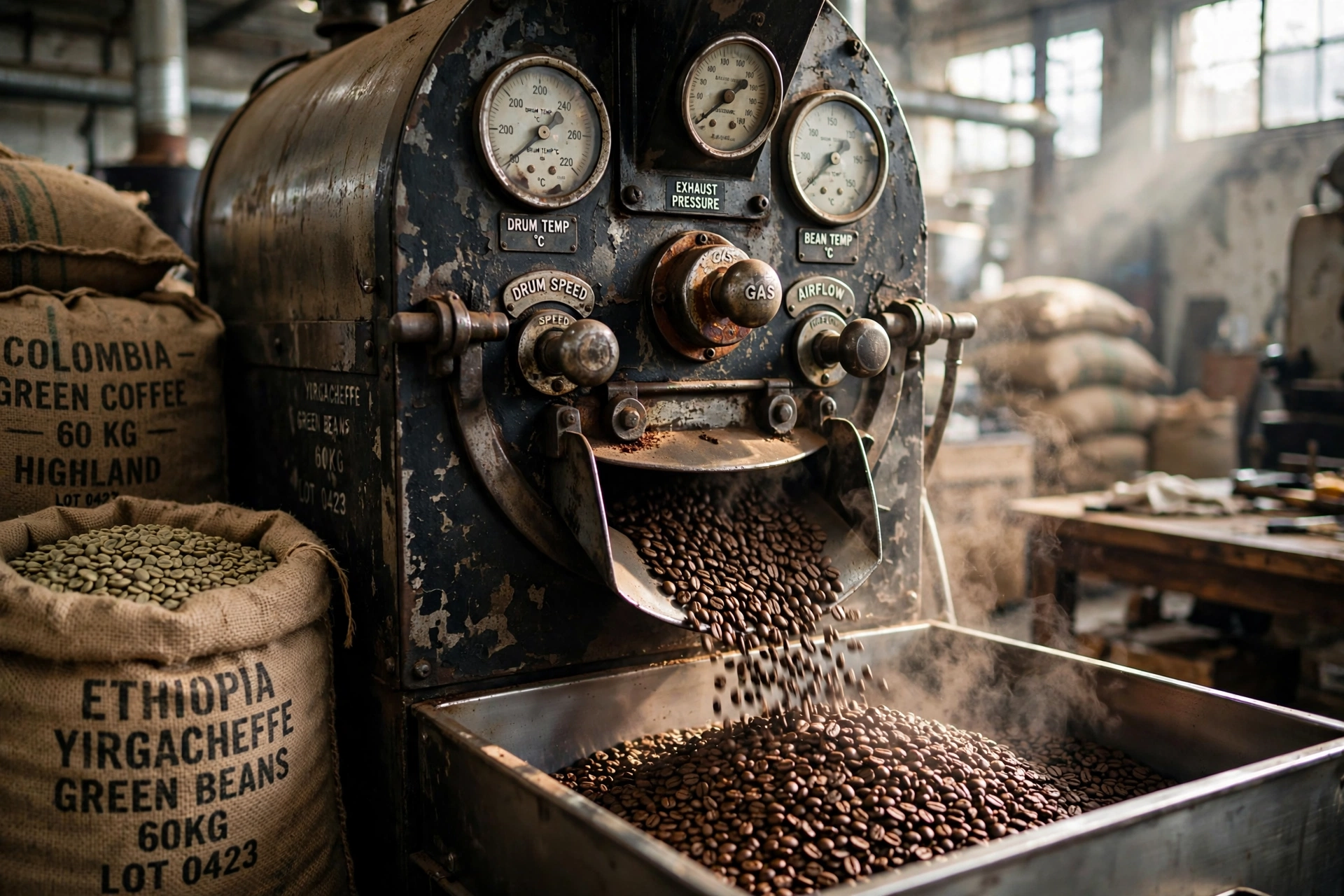
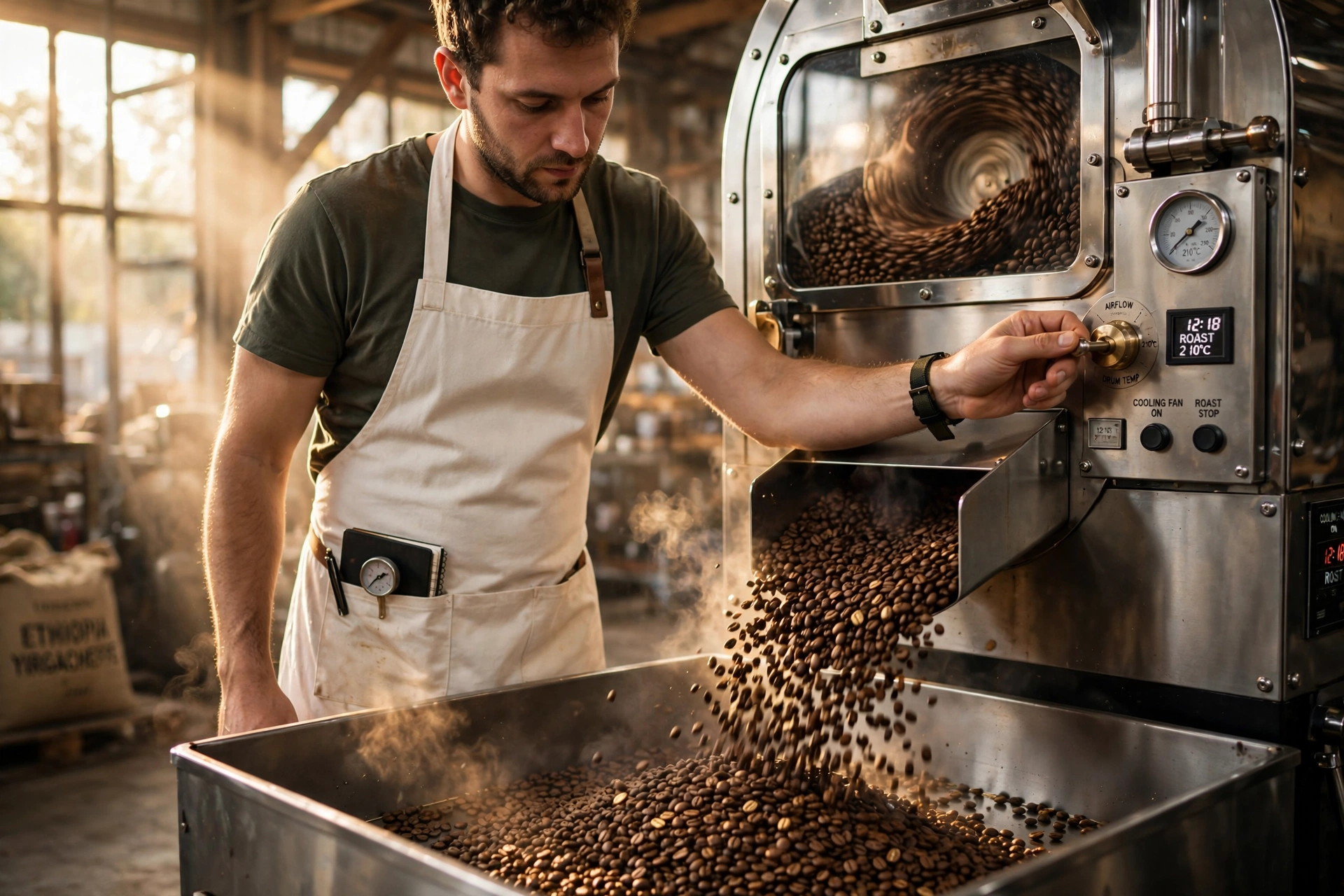
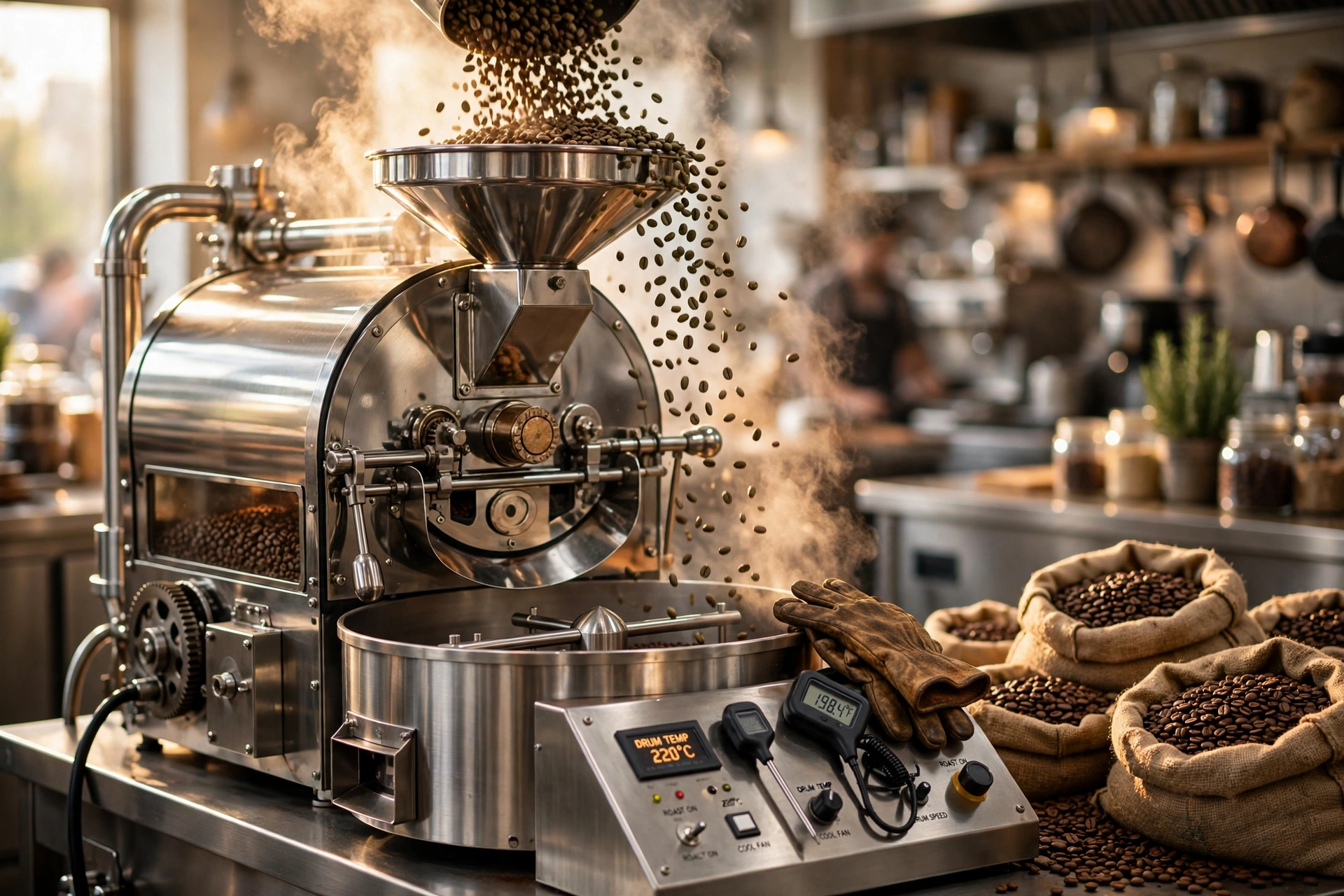
Scaling a coffee business from a small-batch operation to a commercial powerhouse requires a fundamental shift in hardware. When a business moves beyond the limits of sample roasters, they transition into the realm of industrial coffee roasters, which are heavy-duty machines engineered to process large quantities of green coffee beans with extreme precision and repeatability. Unlike home or small-shop units, these systems are designed for continuous operation, utilizing advanced thermodynamics to ensure that every pound of Coffea arabica is roasted to a consistent profile, regardless of the batch size.
📚
Definition
Industrial coffee roasters are commercial-grade thermal processing systems designed to roast large volumes of green coffee beans (typically from 15kg to 120kg+ per batch) using controlled heat application—via conduction, convection, or radiation—to trigger the chemical reactions that develop flavor and aroma.
In my experience working with hospitality groups and independent cafe owners, the most common mistake I see is "scaling too fast with the wrong gear." Many beginners buy a machine based on maximum capacity rather than "usable capacity." A 30kg roaster that only produces a specialty-grade cup at 15kg is effectively a waste of floor space and energy. To get this right, you have to understand that industrial roasting isn't just about heat; it is about airflow, drum speed, and the ability to manage the "first crack" across a massive volume of beans.
The core mechanism involves a rotating drum that prevents the beans from scorching while they are heated. These machines typically use natural gas or electricity as a heat source. As the beans heat up, the moisture inside begins to evaporate, and the chemical structure of the coffee bean changes. According to the Specialty Coffee Association (SCA), the precision of temperature control during the Maillard reaction is what separates a generic commercial roast from a true specialty product. In an industrial setting, this is managed through sophisticated software that tracks the Rate of Rise (RoR), allowing the roastmaster to replicate a specific flavor profile day after day.
Why Does Industrial Scaling Matter for Your Business Bottom Line?
Transitioning to industrial-scale equipment is not merely a luxury; it is a financial necessity for any business aiming for a specific ROI in the 2026 market. The primary driver is the reduction of the "cost per pound." When roasting in small batches, the labor cost associated with loading, unloading, and monitoring each cycle is disproportionately high. Industrial systems allow a single operator to manage significantly higher volumes, slashing the labor-to-output ratio.
Beyond labor, consistency is the biggest risk to brand equity. If a customer buys a bag of your roast in January and another in March, any variance in taste is a failure of quality control. Industrial roasters mitigate this through automated profiling. According to data from the National Coffee Association USA (NCA), consumer demand for specialty coffee continues to rise, and the ability to maintain a consistent "signature roast" across multiple outlets is a key differentiator for successful brands.
The consequences of sticking with underpowered equipment are severe. You face "opportunity cost" where you cannot fulfill larger wholesale contracts because your production ceiling is too low. Furthermore, inefficient smaller machines often lack the thermal stability required for high-volume runs, leading to "baked" coffee—a flat, bread-like flavor caused by stalling the roast. When you move to a professional industrial setup, you aren't just buying a machine; you are buying the ability to scale your revenue without increasing your waste.
The energy efficiency of modern industrial units also plays a role. While they consume more fuel per hour, the energy used per kilogram of coffee is often lower than that of multiple smaller machines running simultaneously. In a competitive landscape, these marginal gains in utility costs and labor efficiency can be the difference between a 5% and a 15% net profit margin.
How to Implement an Industrial Roasting Workflow Step-by-Step
Moving into industrial roasting requires more than just plugging in a machine. It requires a systemic approach to the entire production chain. If you treat an industrial roaster like a giant home roaster, you will create a bottleneck that kills your efficiency.
Step 1: Capacity Planning and Layout
Before purchasing, calculate your peak demand. Do not buy for where you are now; buy for where you will be in 24 months. Ensure your facility has the correct ventilation. Industrial roasters produce significant smoke and chaff (the skin of the coffee bean), which is highly flammable. According to NSF International, commercial food equipment must meet strict sanitation and safety standards, including proper exhaust hood installation and fire suppression systems.
Step 2: Sourcing the Green Coffee
Industrial roasting consumes raw materials at a rapid pace. You must establish a supply chain that can provide consistent quality. This is where the distinction of specialty coffee becomes vital. Sourcing high-altitude Arabica requires relationships with importers who can guarantee the moisture content of the beans, as variations in moisture can throw off an industrial roast profile by several degrees.
Step 3: Profile Development and Calibration
This is the "science" phase. You start by creating a "benchmark roast" on a small sample roaster. Once you find the ideal flavor, you translate that curve to the industrial machine. This involves adjusting the gas pressure and airflow to ensure the heat penetrates the center of the large bean mass without burning the exterior.
Step 4: Integration with Managed Services
For many businesses, the overhead of maintaining an industrial roaster is too high. This is why we developed the managed coffee membership at Busy Bean Coffee. Instead of taking on the massive capital expense and technical headache of roasting and maintenance, businesses can leverage our professional infrastructure. We provide the high-end equipment and the precision roasting, removing the risk of equipment downtime.
Step 5: Quality Control (QC) and Cupping
Every industrial batch must be cupped. A Q-Grader should sample the coffee to ensure the roast matches the intended profile. If the roast is too light or too dark, the batch must be adjusted or repurposed.
💡
Key Takeaway
Industrial roasting is a game of thermodynamics and logistics. The most successful operators focus as much on the "outflow" (packaging and distribution) as they do on the "inflow" (roasting and QC).
Comparing Roasting Approaches: Manual vs. AI vs. Industrial
Not all "professional" roasting is created equal. There is a massive divide between the traditional craft approach and the modern industrial standard. Many beginners are tempted by cheap, automated "AI" roasters that promise "push-button" perfection, but these often lack the thermal mass and build quality required for true commercial longevity.
| Feature | Traditional Small-Batch | Cheap "AI" Automation | Modern Industrial (Busy Bean Standard) |
|---|---|---|---|
| Consistency | Variable (Human Error) | High (but often flat flavor) | Extreme (Data-driven precision) |
| Throughput | Low (Slow growth) | Medium | High (Scalable for wholesale) |
| Control | Manual/Intuitive | Locked Algorithms | Hybrid (Expert-led, Software-backed) |
| Durability | High (Simple builds) | Low (Electronics fail in heat) | Very High (Heavy-duty steel/cast iron) |
| Best For | Micro-roasters/Hobbyists | Low-volume tech cafes | Hotels, Restaurants, Large Cafes |
The "Cheap AI" approach often relies on software to mask poor hardware. In the roasting world, physics always wins. If the drum isn't balanced or the airflow is uneven, no amount of software can fix a scorched bean. A true industrial approach uses software to enhance the physics, not replace them. This is why we emphasize the synergy between a skilled barista or roastmaster and the machine's technical capabilities.
Common Misconceptions About Industrial Roasting
Most guides for beginners get the "entry point" wrong. They suggest that you should start by buying the cheapest industrial-style machine you can find. Here is the truth: a cheap industrial roaster is the most expensive mistake you can make.
Myth 1: "More capacity always equals more profit."
This is false. If you buy a 60kg roaster but only have the sales volume for 10kg per batch, you will suffer from "thermal inefficiency." The machine will not reach the optimal temperature for the small load, and you'll waste a massive amount of gas. Always match your machine's "sweet spot" to your average batch size.
Myth 2: "Automation replaces the need for a roastmaster."
Now, here's where it gets interesting: software tells you what happened, but it doesn't always tell you why. A computer can tell you the bean hit 205°C at the 10-minute mark, but it can't tell you that the roast tastes "ashy" because the airflow was too low. You still need a human with a trained palate to guide the machine.
Myth 3: "Industrial roasting ruins the 'craft' feel of the coffee."
Actually, the opposite is true. When you remove the volatility of manual roasting, you can actually push the boundaries of flavor more aggressively. Precision allows you to highlight the specific notes of a coffee roasting process, such as the floral acidity of an Ethiopian Yirgacheffe, with a level of consistency that is impossible in a manual setup.
Myth 4: "You can just put an industrial roaster in any commercial kitchen."
Absolutely not. The heat output of these machines can warp ceiling tiles and trigger fire alarms in seconds. You need a dedicated space with high-grade ventilation and specific electrical offsets.
Frequently Asked Questions
What is the ideal batch size for a beginner industrial roaster?
For most businesses starting their transition, a batch size between 5kg and 15kg is the ideal starting point. This range allows you to fulfill small wholesale contracts for local cafes while remaining agile enough to experiment with different roast profiles without wasting huge amounts of expensive green beans. If you go too large (e.g., 30kg+), you risk creating huge amounts of unsellable inventory if a profile is slightly off. The goal is to find a balance where the machine is running at 70-80% capacity, which is typically where the thermal stability is most consistent.
How do I maintain an industrial coffee roaster to prevent downtime?
Maintenance in an industrial setting is about fire prevention and precision. The most critical task is the daily removal of chaff from the collector; accumulated chaff is a primary cause of roaster fires. Weekly, you should inspect the gas lines and lubrication points of the drum bearings. Monthly, a deep clean of the cooling tray and the air ducts is essential to ensure airflow remains constant. I've seen businesses lose thousands in revenue because a clogged exhaust pipe caused their roast temperature to spike, ruining an entire day's production. Regular calibration of the thermocouples is also necessary to ensure the temperature readings remain accurate.
Can I roast different types of coffee in the same industrial machine?
Yes, but it requires a "reset" of the thermal mass. Roasting a dense, high-altitude Arabica from Kenya requires a different heat application than a softer Brazilian bean. Because industrial roasters have significant metal mass, the drum retains heat from the previous batch. This is known as "charge temperature." If you switch from a dark roast to a light roast without adjusting the charge temperature, the second batch will likely over-roast. Experienced roastmasters use a "cooling period" or adjust the initial gas settings to compensate for the residual heat in the drum.
What are the energy requirements for running industrial coffee roasters?
Energy requirements vary wildly depending on whether the machine is gas-fired or electric. Gas roasters (natural gas or propane) are generally more common in industrial settings because they provide more consistent, high-intensity heat and are typically cheaper to operate at scale. However, you will still need significant electrical power for the drum motor, the cooling fans, and the control systems. You must ensure your facility has a dedicated circuit to avoid tripping breakers during a production run. Furthermore, the ventilation system—which includes a powerful blower motor—often consumes as much electricity as the roaster itself.
How does the "managed coffee" model differ from owning an industrial roaster?
Owning an industrial roaster means you are now in the equipment business as much as the coffee business. You are responsible for the capital expenditure (CAPEX), the maintenance, the technician visits, and the risk of equipment failure. A managed coffee solution, like the one offered by Busy Bean Coffee, shifts that burden. We handle the high-end equipment, the professional installation, and the roasting precision. This allows the business owner to focus on the customer experience and sales growth rather than worrying about whether a heating element is about to fail or if the chaff collector is full.
Final Thoughts on Industrial Coffee Roasters
Entering the world of industrial coffee roasters is a pivotal moment for any beverage business. It represents the transition from "making coffee" to "manufacturing a premium product." While the technical barrier to entry is higher—requiring knowledge of thermodynamics, ventilation, and supply chain logistics—the reward is a scalable, consistent, and highly profitable operation.
The key to success in 2026 is not just having the biggest machine, but having the most reliable system. Whether you choose to manage the roasting process in-house or partner with a managed service provider, the goal remains the same: delivering a perfect cup every single time. If the technical overhead of industrial roasting feels overwhelming, remember that you don't have to do it alone.
Ready to upgrade your coffee game without the stress of equipment ownership? Explore the all-inclusive managed solutions at Busy Bean Coffee and let us handle the complexity while you enjoy the growth.
Recommended Readings
To deepen your understanding of these topics, we recommend reading the following articles:
- The Complete Guide to White Glove Coffee Service
- Ultimate Guide to All-Inclusive Coffee Service for Businesses
- Ultimate Guide to Automated Coffee Machines for Business
- Ultimate Guide to Specialty Coffee Equipment for Business
Free Coffee Pairing Guide & Specialty Roast Cheat Sheet
Unlock the secrets of perfect brewing ratios, water temperatures, and specialty roast profiles. Download the guide.