What Are Industrial Coffee Roasters and How Do They Work?
The difference between a home-roasted batch and a commercial operation comes down to thermal mass and precision. When businesses scale, they transition to industrial coffee roasters, which are high-capacity machines designed to process large volumes of raw green coffee beans into a roasted product while maintaining a consistent flavor profile across thousands of pounds. These systems are the engine of the specialty coffee industry, allowing for the precise control of heat, airflow, and time to unlock the complex chemical compounds within the bean.
For those managing high-volume environments, the logistics of roasting are often secondary to the delivery of the final cup. If you are operating a large-scale facility, you might find that a foodservice coffee program in Chicago IL offers a more sustainable way to acquire these professionally roasted beans without the overhead of owning the machinery.
📚
Definition
Industrial coffee roasters are heavy-duty mechanical systems that use conductive, convective, and radiative heat to transform raw Coffea arabica or Robusta seeds into aromatic coffee beans at a commercial scale, typically ranging from 15kg to several tons per batch.
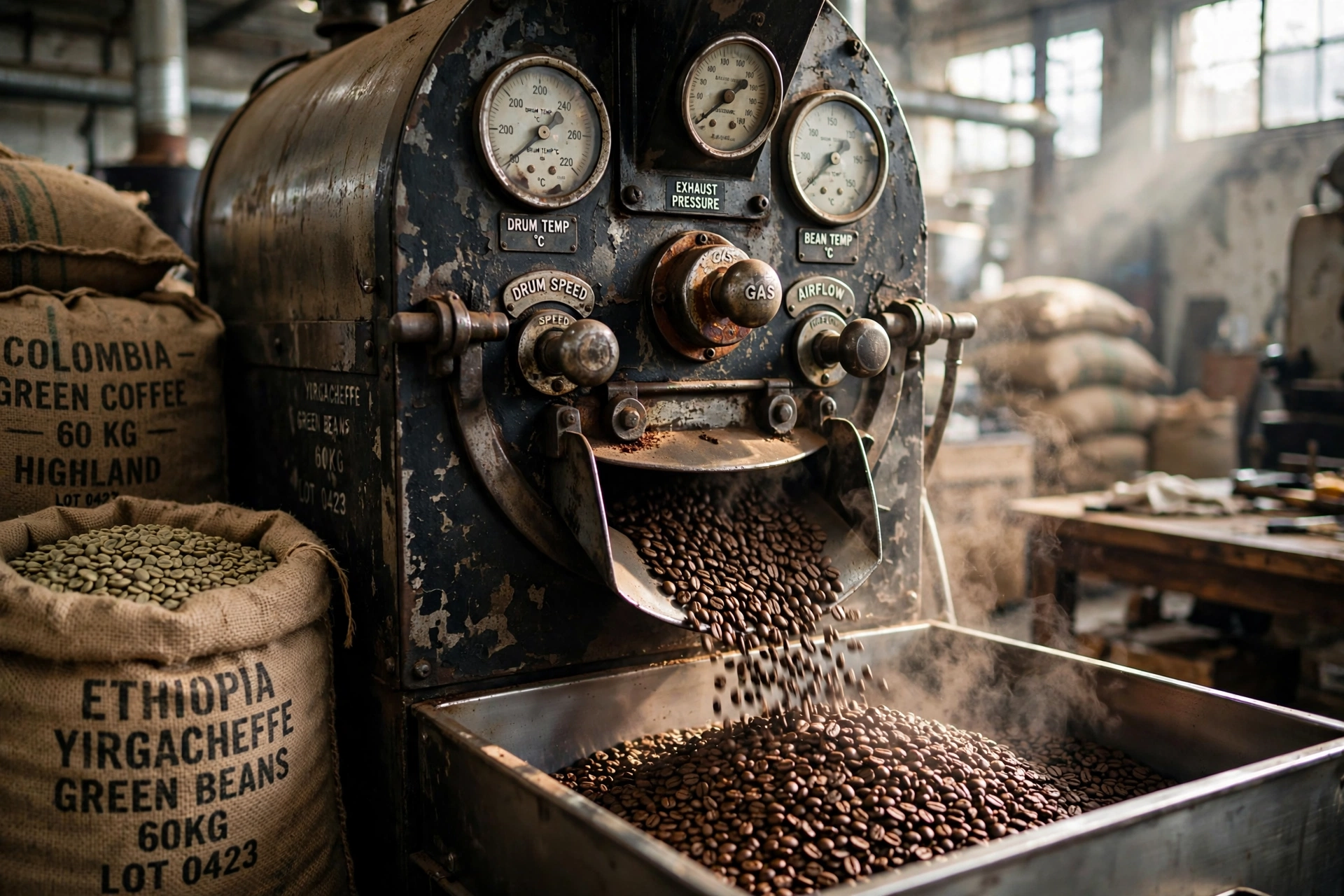
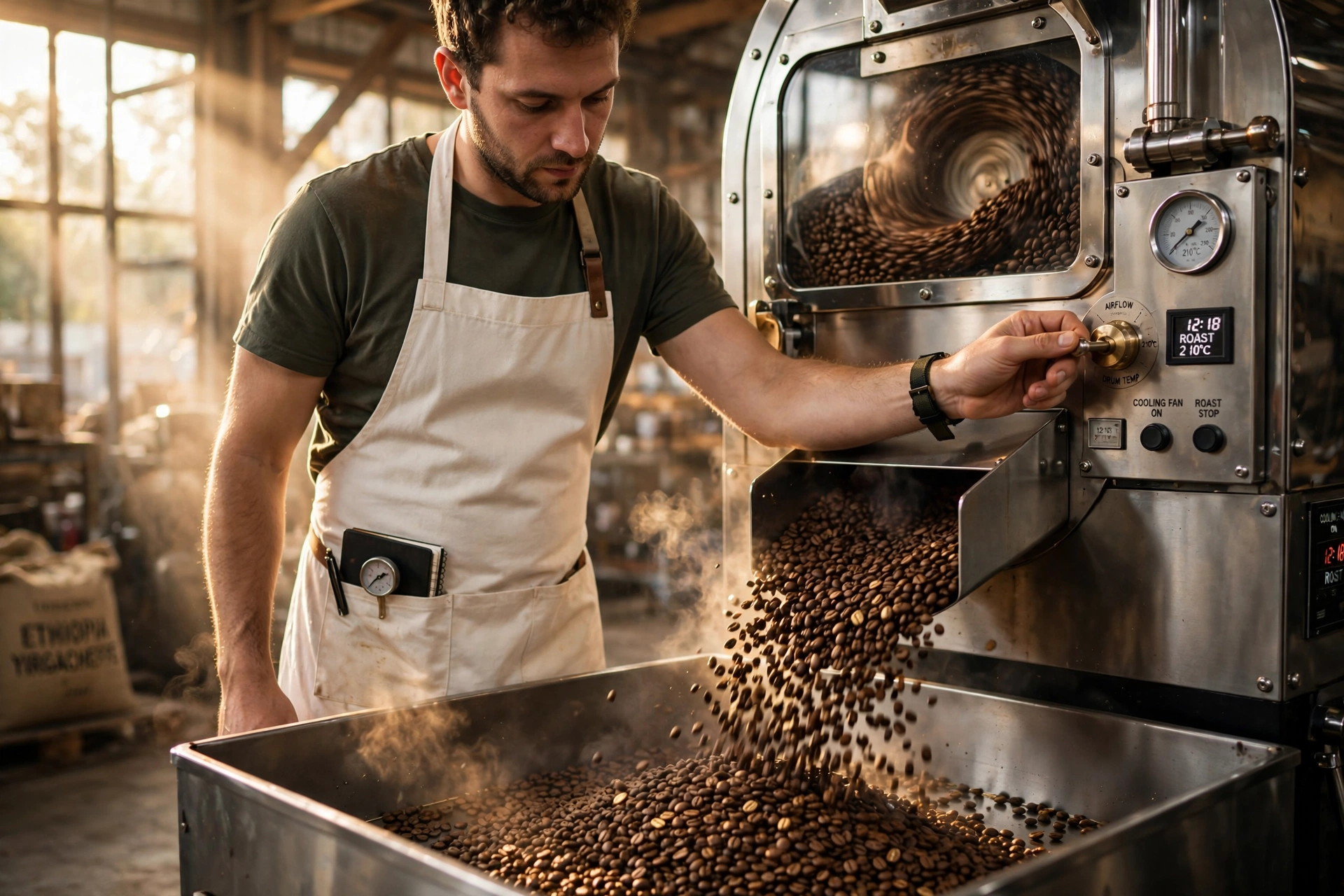
The process begins with the loading of green beans into a hopper, which feeds into a rotating drum. As the drum spins, the beans are exposed to heat—either through a gas burner or electric elements. The primary goal is to trigger the Maillard reaction, where amino acids and reducing sugars create the brown color and complex flavors we associate with coffee. Unlike small-batch roasters, industrial units must manage "thermal inertia," meaning the machine retains a massive amount of heat that must be carefully modulated to avoid scorching the beans.
According to the Specialty Coffee Association (SCA), the precision of the roast profile—the specific curve of temperature over time—is what separates a commodity product from a specialty grade coffee. In my experience as a Q-Grader, I have seen many roasting facilities struggle with "batch-to-batch drift," where the first roast of the day tastes entirely different from the tenth. This happens when operators fail to account for the rising internal temperature of the metal drum, a common mistake that industrial automation helps solve.
Why Does Industrial Roasting Capacity Matter for Business ROI?
Scaling your coffee production isn't just about quantity; it is about the economic efficiency of the heat applied per bean. Industrial coffee roasters allow businesses to achieve economies of scale that are impossible with smaller units. By increasing the batch size, the energy cost per pound of coffee drops significantly, and the labor requirement for monitoring a single roast cycle is spread across a much larger volume of product.
From a financial perspective, the ability to control the roast profile at scale ensures brand consistency. If a hotel chain or a large medical office relies on a specific flavor profile, any variance can lead to customer dissatisfaction. This is why many high-traffic locations opt for automated coffee machines for clinics and medical offices, as these machines are designed to handle the high-grade, consistent output that only industrial roasting can provide.
Data from the International Coffee Organization (ICO) indicates that the global demand for specialty coffee continues to rise, pushing producers to find ways to maintain "small-batch quality" at "industrial volume." When a company can roast 100kg per batch instead of 5kg, they reduce their production timeline by 95%, allowing them to move product from the roaster to the customer faster, which preserves the volatile aromatic compounds and increases the perceived value of the coffee.
The consequences of neglecting roasting precision are stark. Over-roasting a large batch doesn't just ruin the flavor; it results in significant financial loss. If an industrial roaster malfunctions or a profile is set incorrectly, a business could potentially waste thousands of dollars in green beans in a single 20-minute cycle. This risk is precisely why professional managed services, such as the Sensa Coffee Service in Charlotte, NC, are becoming more attractive; they remove the capital risk and technical burden from the business owner.
How Do You Implement Industrial Roasting in a Commercial Workflow?
Implementing industrial coffee roasters into a business workflow requires more than just buying a machine; it requires a complete rethink of the facility's infrastructure. These machines require industrial-grade ventilation, gas lines capable of sustaining high BTUs, and significant floor reinforcement to handle the weight of the equipment and the raw beans.
The implementation process generally follows these five critical steps:
- Capacity Planning: Calculate your daily peak demand. If you are serving a high-volume hospitality environment, you need to account for the "roast-to-shelf" time. For those in the Southeast, exploring a Sensa Coffee Service in Raleigh NC can provide insights into how to scale without managing the roasting hardware yourself.
- Environmental Controls: Install a high-efficiency afterburner. Industrial roasting produces significant smoke and "chaff" (the skin of the coffee bean). Without an afterburner, your facility will smell like a campfire, and local air quality regulations may shut you down.
- Profile Development: Use software like Cropster or Artisan to map the "first crack"—the moment the bean physically expands and releases aroma. This is where the science of the Q-Grader meets the engineering of the machine.
- Quality Control (QC) Integration: Establish a cupping lab. Every single batch from an industrial roaster must be sampled to ensure it matches the master profile.
- Distribution Logistics: Design a workflow that moves roasted beans from the cooling tray to the degassing silo and then into packaging.
💡
Key Takeaway
The most expensive mistake in industrial roasting is ignoring the "degassing" phase. Beans must rest for 24 to 72 hours to release carbon dioxide before they are brewed; brewing them immediately after an industrial roast leads to a metallic, overly acidic taste.
For businesses that want the quality of an industrial roast without the operational headache, Busy Bean Coffee provides a seamless alternative. By leveraging our managed membership, you get the benefits of professionally roasted specialty coffee and high-end SENSA equipment without needing to manage the complex infrastructure of a roasting plant. Whether you need a Sensa Coffee Service in Augusta GA or a similar solution in another city, the goal is to eliminate the friction between the roaster and the cup.
What Are the Different Types of Industrial Roasting Technologies?
Not all industrial coffee roasters are created equal. The choice of technology dictates the flavor profile and the energy efficiency of the operation. The three most common types are drum roasters, fluid bed (air) roasters, and convection roasters.
Drum roasters are the industry standard. They use a rotating metal drum to keep the beans moving while heat is applied to the drum wall. This creates a mix of conductive and convective heat. Fluid bed roasters, on the other hand, suspend the beans in a column of hot air. This is generally faster and provides a "cleaner" taste, though some argue it lacks the depth of a drum roast.
The following table compares these approaches to help business owners understand the trade-offs:
| Technology | Heat Transfer Method | Pros | Cons | Best For |
|---|---|---|---|---|
| Drum Roasting | Conduction & Convection | Deep, traditional flavor; high control | Slower; risk of scorching | Specialty coffee shops & boutique roasters |
| Fluid Bed (Air) | Pure Convection | Extremely fast; very consistent | Higher energy cost; "lighter" flavor | Large scale commercial blends |
| Industrial Convection | High-Velocity Air | Maximum efficiency; scalable | High initial capital expense | Global coffee brands & massive wholesalers |
Now, here's where it gets interesting: the industry is currently shifting toward "smart" convection roasting. These machines use AI-driven sensors to adjust the heat in real-time based on the bean's moisture content. For those managing hospitality venues, this level of precision is why we recommend automatic coffee machines for hotels and hospitality in 2026, as they are tuned to extract the maximum flavor from these technologically advanced roasts.
Common Misconceptions About Industrial Coffee Roasting
Most guides get this wrong by suggesting that "bigger is always better." In the world of industrial coffee roasters, excessive scale can actually degrade quality if the airflow is not perfectly balanced. There is a common myth that industrial roasting "burns" the flavor out of the coffee. This is a misconception based on old-school commodity roasting. Modern industrial equipment, when operated by a certified Q-Grader, can produce a cup that is indistinguishable from a 1kg sample roast.
Another common error is the belief that roasting is a "set it and forget it" process. Many believe that once a profile is programmed into the machine, the operator is redundant. That said, green coffee is an agricultural product. A shipment of beans from Ethiopia in 2026 will have different moisture levels than a shipment from the same region in 2025. An experienced operator must adjust the "charge temperature" (the temp of the drum when beans are added) to compensate for these natural variations.
Lastly, many believe that industrial roasting is only for "big coffee." In reality, small-to-medium enterprises are increasingly using industrial-scale roasting as a white-label service. Instead of buying a machine, they partner with a managed provider. For example, a business might use a Sensa Coffee Service in Jacksonville, FL to get the consistency of industrial roasting without the $50,000+ entry cost of the hardware.
Frequently Asked Questions
How long does it take to roast a batch in an industrial coffee roaster?
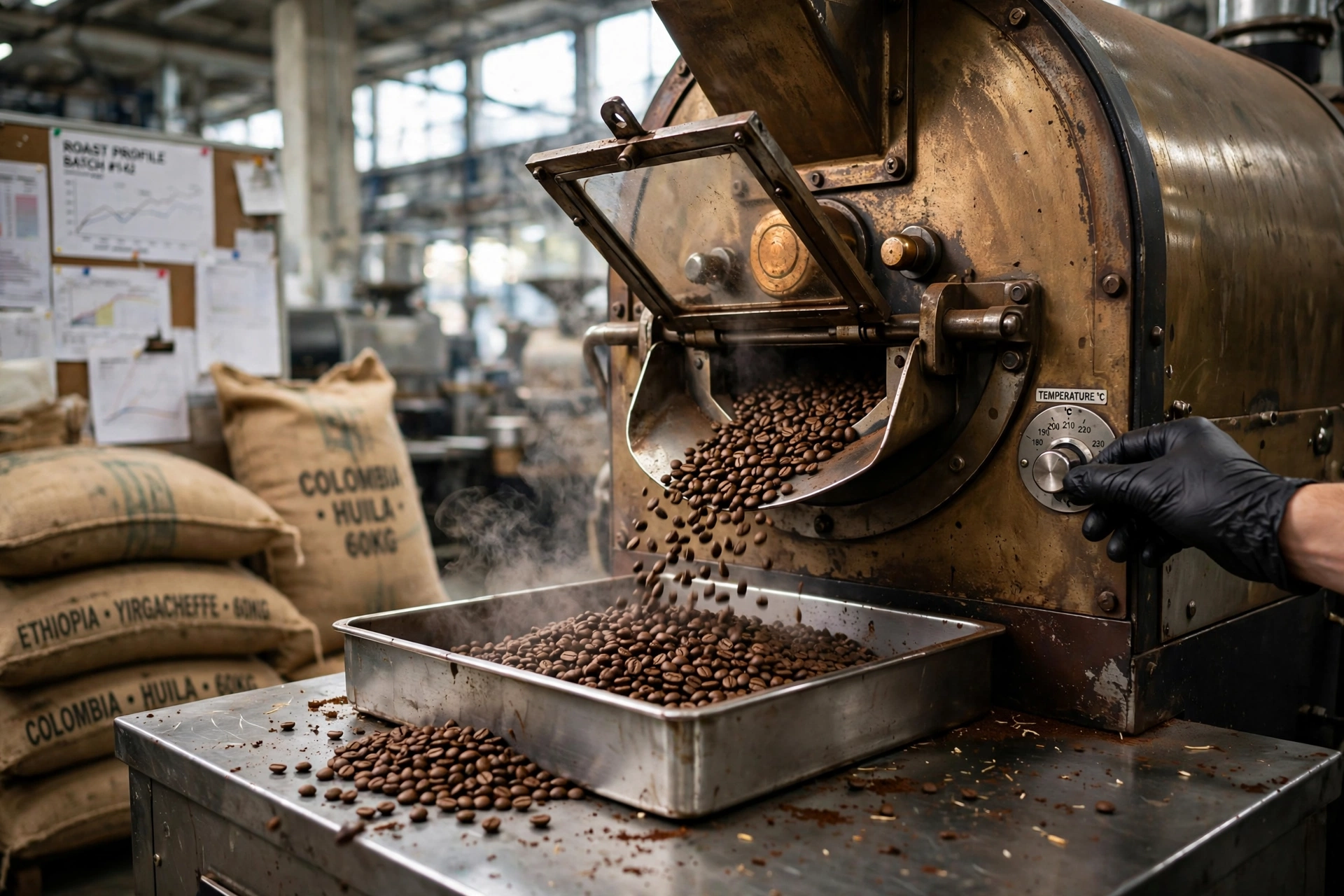
Depending on the desired roast level (light, medium, or dark), a typical industrial cycle takes between 8 and 15 minutes. However, the total "cycle time" is longer because you must account for loading the green beans and the cooling process. In a professional setting, beans are dropped into a cooling tray and agitated with a mechanical arm to stop the roasting process instantly. If the beans are not cooled within 3 to 5 minutes, the internal heat will continue to cook the bean, leading to a "baked" flavor that lacks acidity and brightness.
What is the difference between a commercial and an industrial coffee roaster?
While the terms are often used interchangeably, a commercial roaster typically refers to a machine used in a retail cafe setting (e.g., 1kg to 15kg batches). An industrial coffee roaster is designed for wholesale production, often handling 30kg to 120kg per batch or using continuous roasting technology. Industrial machines require specialized electrical phases (3-phase power) and advanced gas manifolds that would be impractical for a standard storefront. They are built for 24/7 operation and prioritize throughput and repeatability over the manual "artisan" tweaks found in commercial units.
Do industrial roasters affect the caffeine content of the bean?
Roasting does not significantly change the caffeine content of the coffee bean. Caffeine is a very stable molecule and withstands the high temperatures of an industrial coffee roaster. The misconception that dark roasts have more caffeine comes from the fact that dark roasted beans are less dense and physically smaller. If you measure your coffee by weight, a dark roast might have slightly more caffeine per scoop because you are using more beans. However, if you measure by the number of beans, the caffeine levels remain virtually identical regardless of the roast level.
How do you maintain consistency across different batches in industrial roasting?
Consistency is achieved through the use of "Roast Profiles." Modern industrial roasters use software to track the Rate of Rise (RoR), which is the speed at which the bean temperature increases. By ensuring the RoR follows a specific curve, roasters can replicate the exact flavor of a "master batch." This is supported by the NSF International standards for food equipment, ensuring that the machines operate within safe and predictable temperature ranges. In my experience, the key to consistency is the rigorous cleaning of the drum and chaff collector every few batches to prevent "scorched" remnants from affecting new coffee.
Is it possible to roast specialty coffee using industrial equipment?
Yes, it is entirely possible and is currently the standard for the global specialty market. The challenge is managing the thermal mass. To maintain "specialty" status, roasters must avoid "tipping" (burning the ends of the beans) and "scorching." This is solved by using high-end convection technology and precision airflow. When we coordinate a Sensa Coffee Service in Columbia SC, we ensure the beans are sourced from industrial roasters that utilize these precision controls, guaranteeing that the delicate notes of the Arabica bean are preserved despite the massive volume of production.
Final Thoughts on Industrial Coffee Roasters
Industrial coffee roasters are the bridge between the farm and the final cup for millions of people. By mastering the balance of heat, airflow, and time, these machines allow the nuanced flavors of specialty coffee to be shared on a global scale. For the business owner, the choice is simple: either invest in the massive infrastructure required to operate these machines or partner with a provider who has already mastered the science.
If you are looking to elevate your beverage program without the risk of managing a roasting plant, Busy Bean Coffee is the ideal partner. We bring the precision of industrial roasting and the quality of a Q-Grader to your doorstep through our all-inclusive managed memberships. From the heart of the Southeast to the busiest hubs, we ensure your guests get a perfect cup every time.
Explore our professional solutions and see how we can transform your business at www.busybeancoffee.com. For those looking to expand their reach in specific markets, consider our Sensa Coffee Service in Mount Pleasant SC as a blueprint for success.
Free Coffee Pairing Guide & Specialty Roast Cheat Sheet
Unlock the secrets of perfect brewing ratios, water temperatures, and specialty roast profiles. Download the guide.