What Is Coffee Equipment Maintenance and Why Is It Essential?
A single calcium deposit in a boiler or a clogged grinder burr can be the difference between a five-star guest experience and a ruined morning rush. In my experience working with high-volume foodservice operators, I have seen countless businesses ignore the subtle signs of equipment wear until a total system failure occurs during their busiest hour. Proper coffee equipment maintenance is the systematic process of cleaning, calibrating, and repairing brewing hardware to ensure consistent flavor profiles, operational safety, and maximum machine longevity.
It is not merely about wiping down a steam wand; it is a comprehensive strategy involving chemical descaling, lubrication of moving parts, and the replacement of perishable seals and gaskets. When a business prioritizes this upkeep, they are protecting their most expensive assets and ensuring that every cup of specialty coffee meets a rigorous quality standard. For those managing large-scale operations, integrating Automatic Coffee Machines for Hotels and Hospitality in 2026 often simplifies this process, but the underlying need for a disciplined maintenance schedule remains a fundamental requirement for profitability.
Understanding the Core Concept of Equipment Upkeep
To truly understand coffee equipment maintenance, we must look beyond the surface. Most operators view maintenance as a reactive task—something you do when the machine stops working. However, true professional maintenance is categorized into three distinct tiers: preventive, corrective, and predictive.
📚
Definition
Preventive maintenance is a scheduled series of actions performed on a piece of equipment to prolong its life and prevent unplanned downtime, such as daily backflushing or monthly filter replacements.
Preventive maintenance is the baseline. This includes the daily "housekeeping" that every barista should perform, such as cleaning group heads and emptying drip trays. However, for a commercial operation, this must extend to deep-cleaning cycles using specialized detergents. According to the Specialty Coffee Association (SCA), precision in water chemistry and equipment cleanliness is the only way to maintain the sensory integrity of a roast. If the equipment is contaminated with old coffee oils (which turn rancid over time), no amount of high-quality Coffea arabica can save the flavor.
Corrective maintenance happens when something breaks. This is the "emergency" phase where a technician is called to replace a blown heating element or a cracked pump. Predictive maintenance is the gold standard; it uses data—such as cycle counts or pressure fluctuations—to replace a part just before it is expected to fail.
Now, here's where it gets interesting: the interaction between water and metal. Most coffee machines are essentially complex water heaters. The minerals in your water supply, specifically calcium and magnesium, create "scale." This scale acts as an insulator, forcing the machine to work harder and run hotter to reach the desired temperature, which eventually burns out the heating element. This is why water filtration is not an optional accessory; it is the first line of defense in any maintenance program. For businesses in regions with hard water, implementing a Sensa Coffee Service in Charlotte, NC ensures that these filtration systems are monitored and replaced on a professional cadence.
Why Equipment Maintenance Directly Impacts Your Bottom Line
The financial implications of neglecting your hardware are staggering. When a machine goes offline, the cost is not just the technician's hourly rate; it is the lost revenue from every customer who walks away and the labor cost of staff standing idle.
According to the National Coffee Association USA (NCA), consumer expectations for beverage quality have risen sharply, and consistency is the primary driver of repeat business. If your espresso machine is not maintained, the temperature will fluctuate. A variance of just two degrees can shift a coffee's taste from "sweet and balanced" to "sour and under-extracted." This inconsistency destroys brand loyalty.
Beyond flavor, there is the issue of safety and compliance. Commercial equipment must adhere to strict sanitary standards. The U.S. Food and Drug Administration (FDA) provides clear guidelines on food-contact surfaces. A machine with milk residue buildup in the steam wand or mold in the hopper is not just a quality issue; it is a health code violation that can lead to heavy fines or forced closure.
Furthermore, the lifespan of your equipment depends entirely on your maintenance rigor. A high-end machine that is neglected may last only three to five years before requiring a total overhaul. Conversely, a well-maintained unit can easily exceed a decade of service. This represents a massive difference in capital expenditure over a ten-year period. In my experience, businesses that shift from "break-fix" to "preventive" models see an average reduction in emergency repair costs by 30% to 50%. For those managing medical environments, such as through Automated Coffee Machines for Clinics and Medical Offices, this reliability is even more critical as it impacts the overall patient and staff experience.
Practical Application: Implementing a Maintenance Framework
Building a maintenance schedule doesn't have to be overwhelming. The mistake I made early on—and that I see constantly in new cafe owners—is trying to do everything at once on a Sunday afternoon. Instead, maintenance should be layered by frequency.
Daily Maintenance (The Barista's Duty)
Daily tasks are about hygiene and immediate performance.
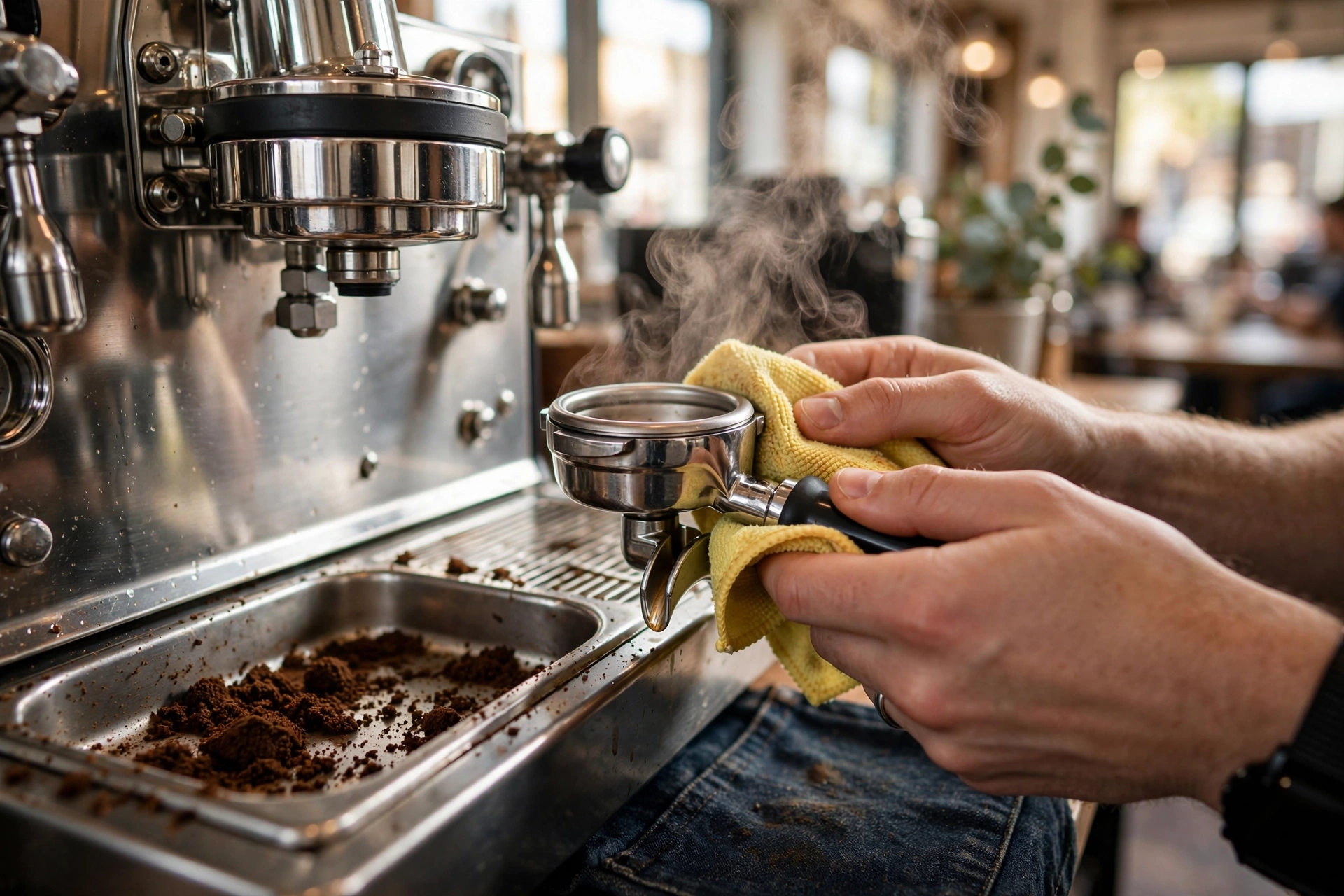
- Backflushing: Using a blind filter and detergent to clear the internal valves of the group head.
- Steam Wand Purging: Purging the wand before and after every single use to prevent milk from being sucked back into the boiler.
- Grinder Clearing: Emptying the hopper and wiping the exterior to prevent old beans from oxidizing.
Weekly Maintenance (The Manager's Oversight)
Weekly tasks focus on deeper cleanliness.
- Deep Soak: Removing gaskets and screens and soaking them in a specialized cleaning solution.
- Drain Cleaning: Clearing the drip tray drains to prevent backups and odors.
- Calibration Check: Testing the grind size and dose to ensure the coffee bean is being extracted perfectly.
Quarterly and Annual Maintenance (The Professional's Domain)
This is where Busy Bean Coffee provides the most value. Quarterly maintenance involves replacing water filters and checking boiler pressure. Annually, a full "tear-down" is necessary, where seals, O-rings, and gaskets are replaced regardless of whether they look worn.
💡
Key Takeaway
Treat your coffee equipment like a vehicle; you wouldn't drive a car for 50,000 miles without changing the oil. Regular "oil changes" for your coffee machine—in the form of descaling and gasket replacement—prevent catastrophic engine failure.
For businesses that want to eliminate this stress entirely, our managed coffee membership is the answer. By utilizing a Sensa Coffee Service in Raleigh NC (2026 Overview), operators shift the burden of maintenance to us. We handle the installation, the professional cleaning, and the proactive part replacement, allowing the owner to focus on growth rather than plumbing.
Comparing Maintenance Approaches: Manual vs. Managed
Not all maintenance strategies are created equal. Some businesses prefer a DIY approach, while others use a generic third-party repair service or a managed membership like Busy Bean Coffee.
| Feature | Traditional DIY Approach | Generic Repair Service | Busy Bean Managed Service |
|---|---|---|---|
| Cost Structure | Low upfront, high risk of failure | Per-visit fee + Parts | Predictable monthly fee |
| Downtime | Long (Wait for parts/tech) | Variable (Based on schedule) | Minimal (Proactive replacement) |
| Consistency | Low (Depends on staff skill) | Medium (Different techs) | High (Standardized protocols) |
| Equipment Life | Short (Reactive only) | Medium (Corrective) | Long (Preventive & Predictive) |
| Best For | Small home-office setups | Occasional repairs | High-volume foodservice |
As the table shows, the "Traditional" approach is a gamble. You save money on the monthly budget but lose it all in one afternoon when the boiler cracks. The "Generic" service is better, but it is still reactive. The "Modern" approach—the managed service—turns maintenance from a variable risk into a fixed operational cost. This is especially vital for those integrating a Foodservice Coffee Program in Chicago IL: Complete Guide, where the sheer volume of cups per day makes equipment failure a high-probability event.
Common Questions and Misconceptions
There are several myths in the industry that lead to expensive mistakes. Most guides get this wrong by suggesting that "if it's working, don't touch it." In the world of high-pressure boilers, that is a recipe for disaster.
Myth 1: "Vinegar is a great cheap alternative to professional descaler."
This is a dangerous misconception. While vinegar is an acid, it is not powerful enough to remove heavy calcium carbonate deposits in commercial boilers, and it can leave behind a distinct taste and smell that ruins the flavor of specialty coffee. Professional descalers are formulated to be food-safe, rinse away completely, and target the specific minerals found in commercial water lines.
Myth 2: "New machines don't need maintenance for the first year."
Incorrect. Maintenance starts on Day 1. A new machine is only "perfect" for the first few dozen cycles. The moment water enters the boiler and coffee oils hit the group head, the degradation process begins. Waiting for the warranty to end before starting a maintenance schedule is a mistake that often leads to the machine being in poor condition the moment the warranty expires.
Myth 3: "Automatic machines handle their own cleaning."
While many automated systems have "clean" cycles, these are often superficial. They may clean the brew group but rarely address the scale buildup in the internal piping or the oxidation in the grinder. For those using Sensa Coffee Service in Jacksonville, FL, we find that even the most advanced automated machines require manual professional oversight to maintain their peak performance.
Frequently Asked Questions
How often should I realistically descale my commercial espresso machine?
The frequency of descaling depends entirely on your water hardness. In areas with "hard" water, you may need to descale every 30 to 60 days. In areas with soft water, once a quarter might suffice. However, the most reliable method is to use a water hardness test kit. If your water exceeds 120 ppm (parts per million) of calcium carbonate, you should be on a more aggressive schedule. Ignoring this leads to "scale bridging," where minerals physically block the flow of water, causing the pump to overheat and fail.
What happens if I ignore the "clean me" light on an automated machine?
Ignoring a cleaning alert is essentially inviting a decrease in coffee quality and an increase in mechanical friction. When the "clean me" light triggers, it means the machine has reached a specific number of cycles where coffee oils have accumulated. These oils turn rancid and create a bitter, burnt taste. More importantly, the buildup can jam the internal brewing unit, leading to a mechanical failure that requires a full teardown and replacement of the brew group, which is far more expensive than a bottle of cleaning tablets.
Why is water filtration considered part of equipment maintenance?
Water filtration is the "preventive" part of preventive maintenance. By removing minerals and chlorine before they ever enter the machine, you are reducing the amount of scale that forms inside the boiler. According to NSF International, proper filtration not only protects the hardware but also ensures the beverage is safe and tastes consistent. Without it, you are essentially fighting a losing battle against chemistry; you can descale every week, but you will still be damaging the metal every single day.
Can a barista perform all the necessary maintenance, or do I need a professional?
A skilled barista can and should handle the daily and weekly tasks—backflushing, scrubbing group heads, and cleaning wands. However, they are not trained to open a boiler, check pressure valves, or replace internal gaskets. Attempting to perform "deep" maintenance without professional training can lead to leaks or, worse, electrical hazards. This is why we recommend a hybrid approach: daily staff care and quarterly professional audits. This ensures the machine is clean on the outside and healthy on the inside.
How does coffee equipment maintenance affect the taste of the coffee?
Maintenance is the invisible ingredient in a great cup of coffee. Old coffee oils (lipids) accumulate in the group head and baskets, where they oxidize. When fresh water passes through these old oils, it picks up a rancid, acrid flavor. Furthermore, scale buildup in the boiler causes "temperature swings." If the water is too hot, it burns the coffee; too cold, and it tastes sour. Only a clean, calibrated machine can deliver the precise 195-205°F temperature required for a perfect extraction.
Final Thoughts on Coffee Equipment Maintenance
Maintaining your hardware is not a chore—it is a strategic investment in your business's reliability and reputation. From the daily rigor of a barista cleaning the steam wand to the professional precision of a quarterly boiler audit, every action protects your revenue. When you neglect coffee equipment maintenance, you aren't saving money; you are simply delaying a more expensive disaster.
Whether you are operating a boutique cafe or a large hotel chain using Sensa Coffee Service in Mount Pleasant SC: Complete Guide, the goal is the same: consistency. By focusing on preventive care, you ensure that your customers receive a world-class beverage every single time they visit.
If the idea of managing schedules, ordering chemicals, and hunting for technicians sounds like a nightmare, let Busy Bean Coffee handle it for you. Our all-inclusive managed coffee membership provides the equipment and the expertise, so you can stop worrying about your boilers and start focusing on your guests.
Visit www.busybeancoffee.com to discover how we can streamline your beverage program.
Free Coffee Pairing Guide & Specialty Roast Cheat Sheet
Unlock the secrets of perfect brewing ratios, water temperatures, and specialty roast profiles. Download the guide.