How Much Do Commercial Espresso Machines Actually Cost?
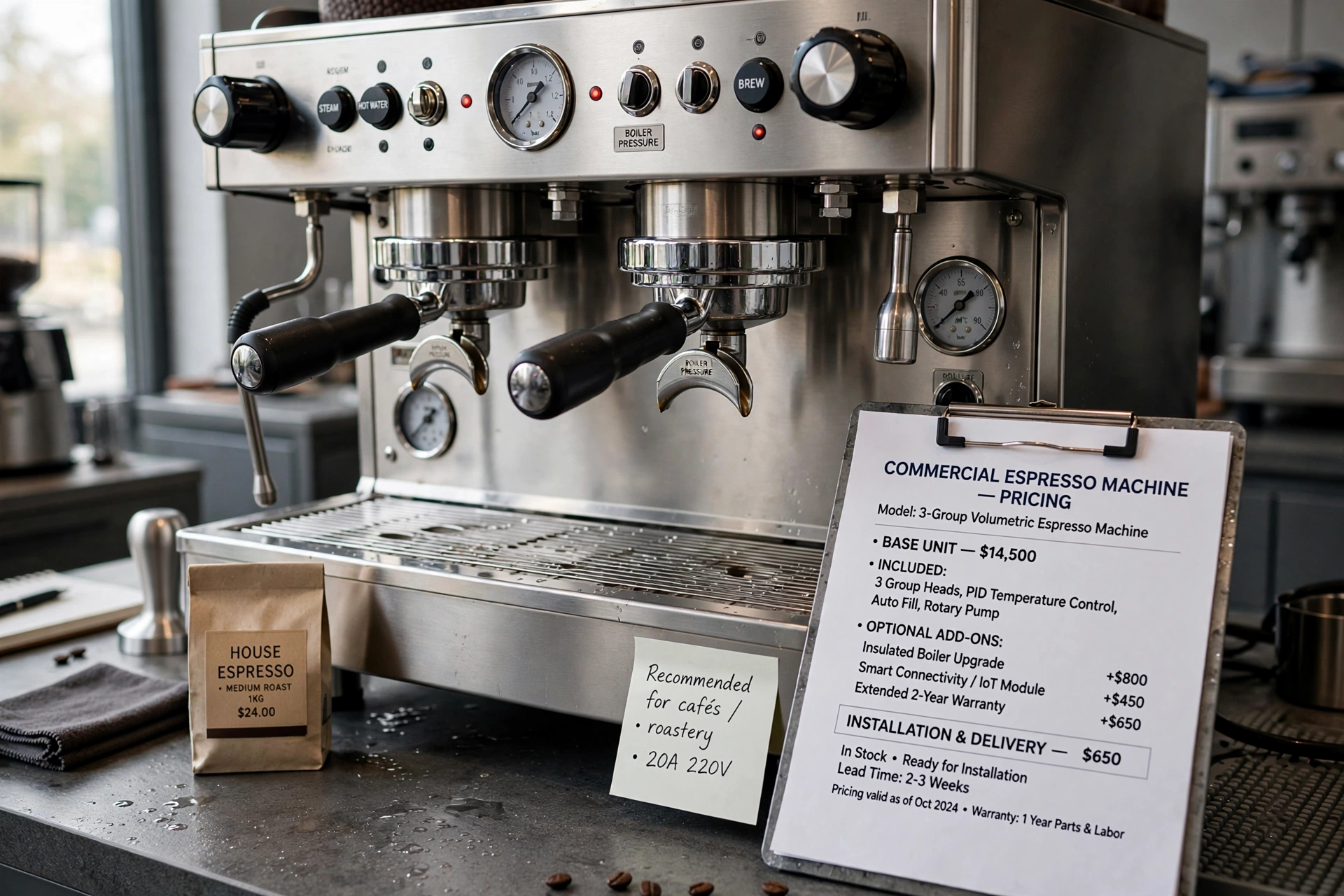
Investing in professional beverage equipment is one of the most significant capital expenditures for any foodservice operation. Depending on the scale of your business, commercial espresso machines typically range in price from $2,000 for entry-level single-group machines to over $25,000 for high-volume, multi-boiler behemoths. However, the sticker price is often a distraction from the total cost of ownership, which includes installation, water filtration, and the inevitable wear-and-tear of high-volume service. In my experience working with dozens of cafes, the biggest mistake owners make is buying a machine based on the purchase price rather than the projected daily cup volume, leading to either massive overspending or frequent, costly breakdowns.
What Determines the Pricing of Commercial Espresso Equipment?
The cost of a professional machine isn't arbitrary; it is a direct reflection of the thermal stability and volumetric consistency the machine can maintain under pressure. When you pay a premium, you aren't paying for a brand name—you are paying for the engineering that prevents the temperature from dropping when you pull ten shots in a row.
📚
Definition
Thermal Stability refers to a machine's ability to maintain a consistent water temperature throughout the extraction process, ensuring that the flavor profile of the Coffea arabica remains consistent from the first cup to the five-hundredth.
The primary price driver is the boiler system. Single-boiler machines are the most affordable but require the user to wait between brewing and steaming. Dual-boiler systems, which are common in the mid-to-high range, allow for simultaneous operations and offer far superior temperature control. According to the Specialty Coffee Association (SCA), precise temperature control is fundamental to achieving the quality standards required for specialty coffee, as even a two-degree variance can shift a shot from sweet to bitter.
Another major factor is the number of "groups." A group is essentially the brew head where the portafilter locks in. A one-group machine is suitable for low-volume settings, while three- or four-group machines are designed for high-traffic environments where multiple baristas must work simultaneously. The jump from a two-group to a three-group machine doesn't just increase the price; it increases the electrical requirements and the necessary water flow rate, adding to the hidden infrastructure costs of your build-out.
Why Accurate Budgeting for Espresso Infrastructure Matters
Many operators treat the machine as a standalone purchase, but the "machine cost" is only about 70% of the initial investment. If you ignore the supporting infrastructure, you risk catastrophic equipment failure within the first six months. The most overlooked expense is water filtration. In many regions, particularly in areas with hard water, failing to install a high-grade reverse osmosis or ion-exchange system will lead to scale buildup in the boiler.
The financial implications of downtime are staggering. For a medium-sized cafe, a machine failure during a morning rush can result in a loss of $500 to $2,000 in revenue per day, not including the cost of emergency technician call-outs. This is why we emphasize a holistic approach to pricing. According to the National Coffee Association USA (NCA), the consumer demand for high-quality, espresso-based beverages continues to grow, meaning the opportunity cost of a "down" machine is higher than ever in 2026.
Beyond the immediate loss of sales, there is the "quality erosion" factor. When a cheap machine fluctuates in temperature, the consistency of your product drops. In the world of specialty coffee, consistency is the only thing that builds customer loyalty. If a customer gets a perfect latte on Tuesday but a sour, under-extracted shot on Wednesday, they aren't blaming the bean—they are blaming the cafe. Investing in high-tier commercial espresso machines is effectively an insurance policy against brand degradation.
Practical Application: How to Choose Your Equipment Tier
Selecting the right machine requires a cold, hard look at your projected "cups per hour." I've seen owners buy a $20,000 machine for a lobby where they only sell ten coffees a day, and I've seen them buy a "prosumer" machine for a breakfast rush that does 100 cups an hour. The latter is a recipe for a melted gasket and a frustrated staff.
To implement a successful equipment strategy, follow these steps:
- Audit Your Peak Volume: Calculate the maximum number of drinks you expect to serve in a 60-minute window. If that number exceeds 40, you are in two-group territory. If it exceeds 80, you need a three-group machine.
- Evaluate Electrical Capacity: Check your panel. High-end machines often require 220V/240V power and specific amperage. Upgrading a panel in a leased space can add $1,000 to $3,000 to your startup costs.
- Plan for Water Quality: Do not plug a machine directly into a city line. Invest in a system that meets NSF International standards for commercial food equipment to ensure longevity and taste.
- Consider the Managed Model: For those who want to avoid the massive upfront capital expenditure, the managed coffee solution is the most logical path. At Busy Bean Coffee, we provide the equipment, installation, and maintenance for a predictable monthly fee. This shifts the cost from a CAPEX (Capital Expenditure) to an OPEX (Operating Expenditure), which is significantly healthier for your cash flow.
💡
Key Takeaway
Never buy a machine based on the "maximum capacity" listed in the brochure. Always buy for your peak hour, not your average hour, or you will create a bottleneck that kills your customer experience.
Comparing Equipment Approaches: The Cost-Benefit Matrix
When analyzing how much you should spend, you have to choose between three distinct philosophies of procurement. Most guides suggest just "buying a good brand," but that ignores the financial reality of running a business.
| Feature | Traditional Purchase | Cheap/Entry-Level AI-Driven | Busy Bean Managed Solution |
|---|---|---|---|
| Upfront Cost | Very High ($5k - $25k) | Moderate ($2k - $5k) | Zero / Low Setup Fee |
| Maintenance | Owner's Responsibility | High Risk of Failure | Fully Managed/Included |
| Quality Control | Variable (Based on Skill) | Low (Inconsistent Temp) | Expert (Q-Grader Backed) |
| Cash Flow Impact | Heavy Initial Hit | Moderate Initial Hit | Predictable Monthly Fee |
| Best For | Established Flagships | Low-Volume Kiosks | Scaling Foodservice/Hotels |
Now, here is where it gets interesting: the "Cheap" approach is often the most expensive in the long run. I once consulted for a bakery that bought a "budget" commercial machine to save $4,000. Within eighteen months, they had spent $6,000 in fragmented repairs and lost an estimated $12,000 in revenue due to three separate week-long outages. The math simply doesn't support cutting corners on your primary revenue driver.
Common Questions and Misconceptions
There is a lot of noise in the industry, and most guides get the "value" conversation wrong. They focus on the machine's features rather than the business's needs.
Myth 1: "A more expensive machine automatically makes better coffee."
This is a common fallacy. A $20,000 machine is not "better" than a $8,000 machine if your barista isn't trained in proper puck preparation and tamping. The expensive machine simply provides a wider window of consistency. If you have a world-class barista, they can make a great shot on a mid-range machine. If you have an untrained employee, the most expensive machine in the world won't save the drink.
Myth 2: "Buying used equipment is the best way to save money."
In my experience, buying used commercial espresso machines is a gamble that rarely pays off unless you are a certified technician. You are inheriting someone else's lack of maintenance. If the previous owner didn't change the gaskets or descale the boiler, you are buying a ticking time bomb. The "savings" vanish the moment you have to replace a cracked heat exchanger.
Myth 3: "Semi-automatic machines are just as good as automatics for high volume."
This depends on your labor model. While semi-automatics allow for more artisan control, they require a highly skilled operator. In a high-volume environment, the variance between a skilled barista and a novice is huge. Super-automatic or volumetric machines remove the human error from the dosing and timing, ensuring that the 100th customer gets the same quality as the first.
Frequently Asked Questions
How much does a typical commercial espresso machine setup cost in total?
When budgeting, you must look beyond the machine. A complete professional setup usually includes the machine, a high-quality burr grinder, a water filtration system, and professional installation. For a standard two-group setup, you should budget between $8,000 and $15,000. This includes a grinder (typically $1,000–$3,000), water treatment ($500–$1,500), and labor for installation. If you opt for a managed service through Busy Bean Coffee, these upfront costs are largely eliminated in exchange for a monthly membership fee, which preserves your working capital for marketing and staffing.
Should I choose a single-boiler or dual-boiler machine for my business?
For any business intending to sell more than 20 lattes per hour, a dual-boiler machine is non-negotiable. Single-boiler machines struggle with "thermal recovery," meaning the temperature drops significantly after steaming milk, requiring a wait time before the next shot can be pulled. This creates a bottleneck in your workflow. Dual-boilers isolate the brewing and steaming processes, allowing for continuous operation. While the upfront cost is higher, the increase in throughput and drink quality makes it the only viable choice for professional coffee service.
How long do commercial espresso machines typically last?
A well-maintained professional machine can last 10 to 15 years, but this is entirely dependent on water quality and service intervals. According to standards set by NSF International, equipment that is not kept up to sanitary and technical codes will fail prematurely. The most common "killers" of these machines are calcium buildup from hard water and the failure to replace group gaskets every six months. Regular preventative maintenance is the difference between a machine that lasts a decade and one that dies in three years.
Is a super-automatic machine worth the higher price tag?
Super-automatic machines are worth the investment if your business model relies on speed and consistency over "craft" aesthetics. They are ideal for hotels or high-traffic corporate environments where you may not have a dedicated, trained barista on staff. These machines handle the grinding, tamping, and dosing automatically. While they have a higher initial cost and more complex internal electronics to maintain, they drastically reduce labor costs and eliminate the waste associated with "dialing in" the espresso throughout the day.
What is the difference between "Prosumer" and "Commercial" machines?
The difference lies in the "duty cycle." A prosumer machine is designed for a home environment where it might pull 5 to 10 shots a day. A commercial machine is designed to pull 300 to 500 shots a day, every day, for years. Commercial machines use heavier-duty pumps, larger boilers with more thermal mass, and industrial-grade components that can withstand constant heat and pressure. Using a prosumer machine in a commercial setting is a violation of most warranties and almost always leads to premature pump failure.
Final Thoughts on Commercial Espresso Machines
Understanding the pricing of commercial espresso machines is about more than just comparing spec sheets; it is about calculating the relationship between throughput, quality, and long-term reliability. Whether you are sourcing a high-end multi-boiler system or looking for a streamlined entry-point, the goal is to minimize the "cost per cup" while maximizing the customer experience.
The most expensive machine is not the one with the highest price tag—it is the one that breaks during your busiest hour of the week. To avoid these pitfalls and ensure your business has the best equipment without the crushing upfront debt, explore the managed coffee solutions at Busy Bean Coffee. We remove the guesswork and the capital risk, allowing you to focus on roasting and serving the perfect cup.
Recommended Readings
To deepen your understanding of these topics, we recommend reading the following articles:
- The Complete Guide to White Glove Coffee Service
- Ultimate Guide to All-Inclusive Coffee Service for Businesses
- Ultimate Guide to Automated Coffee Machines for Business
- Ultimate Guide to Specialty Coffee Equipment for Business
Free Coffee Pairing Guide & Specialty Roast Cheat Sheet
Unlock the secrets of perfect brewing ratios, water temperatures, and specialty roast profiles. Download the guide.