How Much Does Cafe Equipment Supply Actually Cost in 2026?
Setting up a professional beverage program requires a significant capital investment, typically ranging from $15,000 for a minimalist kiosk to over $80,000 for a full-scale specialty cafe. When analyzing cafe equipment supply costs, the price is rarely just about the machine; it is about the integration of water filtration, electrical infrastructure, and ongoing maintenance. In my experience working with dozens of foodservice operators, the most common mistake is budgeting only for the "big box" items while ignoring the 15-20% "invisible cost" of installation and plumbing.
For those looking to avoid these massive upfront expenditures, managed coffee solutions have become the standard in 2026. By shifting from a Capital Expenditure (CapEx) model to an Operational Expenditure (OpEx) model, businesses can acquire premium SENSA equipment and professional installation for a predictable monthly fee rather than a six-figure lump sum.
What Exactly is Included in a Professional Cafe Equipment Supply?
When we talk about cafe equipment supply, we are discussing a complex ecosystem of hardware designed to handle high-volume output without sacrificing the integrity of the specialty coffee. It is not simply a matter of buying a brewer; it is about creating a workflow that minimizes waste and maximizes throughput.
📚
Definition
Cafe Equipment Supply refers to the comprehensive procurement of all hardware necessary for beverage production, including espresso machines, grinders, water filtration systems, brewers, and refrigeration, along with the technical installation required to make them operational.
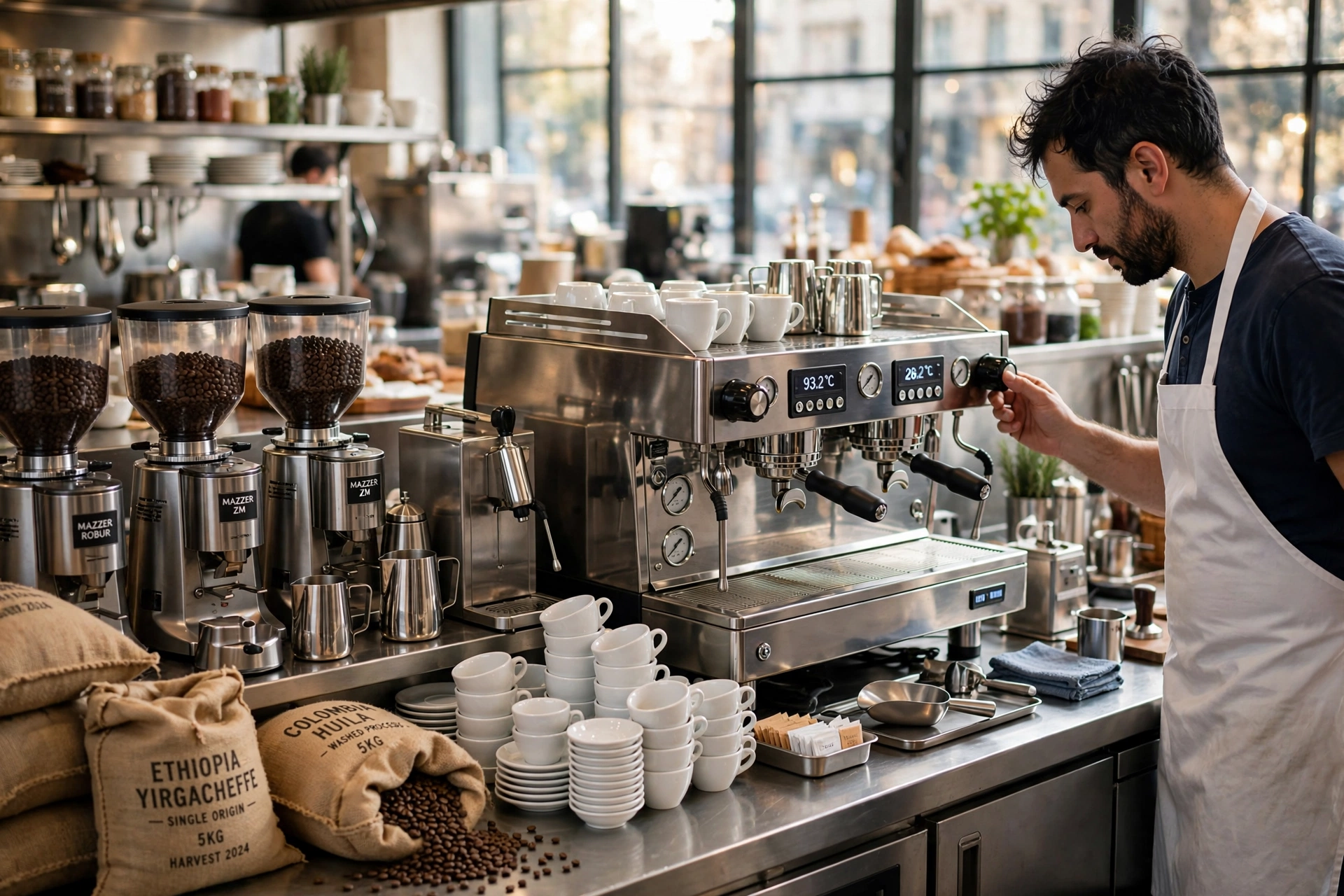
The core of any supply list is the espresso machine. In 2026, the industry has shifted heavily toward multi-boiler and hybrid-boiler systems to ensure thermal stability. A professional two-group machine typically costs between $8,000 and $22,000 depending on the brand and automation level. However, the machine is useless without a high-precision grinder. I've seen operators spend $15,000 on a machine and then pair it with a $500 home-grade grinder; this is a recipe for inconsistency. A commercial-grade on-demand grinder usually adds another $1,500 to $4,000 to the budget.
Beyond the "coffee center," you must account for the support infrastructure. Water is the most critical ingredient in any cup, and according to the Specialty Coffee Association (SCA), water chemistry directly impacts the extraction of Coffea arabica and the longevity of the machine. A professional reverse osmosis (RO) system or a sophisticated mineralization filter can cost between $500 and $2,500. Without this, you are essentially inviting limescale buildup that can destroy a $10,000 boiler in less than two years.
Why Does Equipment Quality Directly Impact Your Bottom Line?
Investing in high-tier cafe equipment supply isn't about prestige; it is about the mathematical relationship between precision and waste. In the coffee industry, "dialing in" a shot involves adjusting the grind size to achieve a specific yield. Cheap equipment lacks the volumetric precision to do this consistently, leading to "dumped" shots.
According to research from the National Coffee Association USA (NCA), consumer expectations for specialty beverages have reached an all-time high, with a significant increase in demand for precise temperature control and milk texture. If your equipment cannot maintain a steady 200°F (93°C) during a morning rush, your quality drops, and your customer churn increases.
The real cost of "cheap" equipment manifests in downtime. A machine failure on a Saturday morning during a peak period doesn't just cost you the price of a repair; it costs you the lifetime value of every customer who walked away because you couldn't serve them. In my experience, a "budget" machine has a 30% higher failure rate in its first 24 months of high-volume use compared to professional-grade equipment.
Moreover, energy efficiency has become a primary cost driver. Modern machines now utilize PID controllers and insulated boilers to reduce electricity consumption. When you multiply a 10% energy saving across a 12-hour operational day over five years, the "expensive" machine actually becomes the cheaper option.
How to Implement Your Equipment Strategy Without Breaking the Bank
The traditional way to handle cafe equipment supply is to buy everything outright. This creates a massive cash-flow hole at the start of your business. For most operators, the smarter approach is a managed membership. At Busy Bean Coffee, we've streamlined this by providing all-inclusive managed coffee solutions. Instead of spending $30,000 on day one, you get premium equipment, installation, and maintenance for one predictable monthly fee.
Here is the step-by-step process for planning your equipment layout:
- Analyze Your Projected Volume: Calculate your "peak hour" transactions. If you expect 60 customers per hour, a single-group machine will create a bottleneck that kills your revenue. You need a two-group or three-group setup to maintain speed.
- Map Your Electrical and Plumbing: Before a single piece of equipment arrives, you must verify your voltage. Most professional espresso machines require 220V power. If your space only has 110V, you are looking at an unplanned $2,000 electrical upgrade.
- Prioritize the "Golden Triangle": The distance between the grinder, the espresso machine, and the milk steaming station should be minimal. Every step a barista takes is a second lost. In a high-volume environment, saving three seconds per drink can add up to an extra 10-15 drinks served per hour.
- Secure a Maintenance Contract: Equipment fails. It is an inevitability. Whether you buy the machines or use a managed service, you must have a guaranteed response time for repairs.
💡
Key Takeaway
The most expensive piece of equipment is the one that is broken during your busiest hour. Prioritize reliability and service agreements over the lowest initial purchase price.
Comparing Equipment Procurement Models
Choosing how to acquire your cafe equipment supply depends on your risk tolerance and available capital. Most operators choose between three paths: the "DIY" buy, the "Lease-to-Own" model, and the "Managed Membership" model.
| Procurement Method | Upfront Cost | Maintenance | Risk Level | Best For |
|---|---|---|---|---|
| Direct Purchase | Very High | Owner's Expense | High (Equipment Failure) | Established brands with deep cash reserves. |
| Leasing | Moderate | Mixed/Contractual | Medium (Payment Obligations) | Growing cafes with steady credit. |
| Managed Membership | Very Low | Included | Low (Guaranteed Uptime) | New ventures and high-growth foodservice businesses. |
The "DIY" approach often seems attractive to new owners, but it is a trap. When you buy a machine from a generic supplier, you are often just buying a piece of metal. You aren't buying the expertise of a Q-Grader or the guarantee that the machine will be calibrated for the specific coffee bean you are roasting. The Managed Membership provided by Busy Bean Coffee eliminates this friction by bundling the hardware with professional installation and ongoing support.
Common Misconceptions About Equipment Pricing
Most guides on cafe equipment supply get the priorities wrong. They tell you to spend the most money on the "brand" of the machine. Here is the reality: a brand name doesn't make coffee; precision and consistency do.
Myth 1: "I can start with a prosumer machine and upgrade later."
This is a costly mistake. Prosumer machines are designed for 5-10 drinks a day. When you push them to 100 drinks a day, the pumps overheat and the seals fail. You will spend more in repairs and lost revenue in six months than you would have spent on a commercial machine on day one.
Myth 2: "More features mean better coffee."
Fancy touchscreens and automated milk frothing can be helpful for training new staff, but they are also more points of failure. In my experience, the most reliable cafes use high-quality manual or semi-automatic machines that allow the barista to feel the pressure and hear the steam.
Myth 3: "Water filtration is an optional add-on."
It is the most essential part of the system. According to NSF International, equipment that is not properly protected from mineral buildup fails significantly faster and can even pose sanitary risks if scale accumulates in internal piping. Filtration is not an "extra"; it is a requirement for operational survival.
Frequently Asked Questions
How much should I budget for a basic cafe equipment supply?
For a small-to-medium cafe, you should budget between $20,000 and $40,000 for the core equipment. This includes a professional two-group espresso machine, two high-end grinders (one for espresso, one for drip), a commercial brewer, and a high-capacity water filtration system. However, this figure does not include the "soft costs" of plumbing and electrical work, which can add another $3,000 to $7,000 depending on your location. Using a managed service like Busy Bean Coffee can reduce this upfront burden to almost zero.
Do I really need a separate grinder for drip coffee and espresso?
Yes, absolutely. Espresso requires a microscopic, precise grind to create the necessary pressure for extraction. Drip coffee requires a coarser grind to allow water to flow through the bed. If you try to use one grinder for both, you will spend hours every day adjusting the burrs, and you will never achieve a perfect extraction for both. This inconsistency will lead to wasted coffee beans and unhappy customers. Professional cafe equipment supply always separates these two functions to ensure speed and quality.
What is the expected lifespan of commercial espresso equipment?
A high-quality commercial machine, if maintained correctly, can last 10 to 15 years. However, "maintenance" doesn't just mean cleaning it at the end of the day. It means annual gasket replacements, group head cleaning, and periodic boiler descaling. If you neglect the water filtration or skip the quarterly service, that lifespan can drop to 3-5 years. This is why we emphasize a managed approach; we handle the maintenance so the equipment reaches its maximum theoretical lifespan.
How does the "Managed Coffee Solution" differ from a traditional lease?
A traditional lease is a financial agreement where you pay for the equipment over time, but you are still responsible for the "headache" of ownership. If the machine breaks, you call a technician and pay the bill. A managed solution from Busy Bean Coffee is a service agreement. We provide the equipment, the installation, and the maintenance. You aren't paying for a machine; you are paying for a guaranteed, high-performing coffee program. It shifts the risk from your balance sheet to ours.
Is it better to buy new or used equipment for a startup?
While used equipment can save you 40-60% upfront, it is a high-risk gamble. You don't know the service history of the machine or if it was run on unfiltered water. A used machine with internal scale buildup is a ticking time bomb. Unless you have a certified technician inspect the boiler and pumps, buying used is often more expensive in the long run due to unexpected downtime. We recommend new, certified equipment with a full warranty to ensure business continuity.
Final Thoughts on Cafe Equipment Supply
Navigating the costs of cafe equipment supply can be overwhelming, but the goal should always be the same: maximizing consistency while minimizing downtime. Whether you are roasting your own specialty coffee or partnering with a provider, the hardware is the foundation of your guest experience.
In 2026, the most successful operators are those who stop thinking like equipment owners and start thinking like service providers. By eliminating the massive upfront capital expense and the stress of maintenance, you can focus on what actually matters: the quality of the brew and the experience of the customer.
If you are ready to launch or upgrade your beverage program without the financial stress of a $30,000 invoice, explore the managed solutions at Busy Bean Coffee. We provide the equipment, the expertise, and the support you need to thrive.
Recommended Readings
To deepen your understanding of these topics, we recommend reading the following articles:
- The Complete Guide to White Glove Coffee Service
- Ultimate Guide to All-Inclusive Coffee Service for Businesses
- Ultimate Guide to Automated Coffee Machines for Business
- Ultimate Guide to Specialty Coffee Equipment for Business
Free Coffee Pairing Guide & Specialty Roast Cheat Sheet
Unlock the secrets of perfect brewing ratios, water temperatures, and specialty roast profiles. Download the guide.