📖This article is part of the complete guide to Ultimate Guide to Commercial Coffee Brewers for Business.
When I first started consulting for hospitality groups in Mount Pleasant, South Carolina, I noticed a recurring failure: businesses were buying home-grade 'commercial-style' brewers that collapsed after three months of heavy use. In a high-traffic foodservice environment, a coffee maker isn't just an appliance; it is a revenue engine. If your equipment fails during a Monday morning rush, you aren't just losing a few cups of coffee; you are losing customer trust and immediate cash flow. For a comprehensive overview of all brewing technologies, explore our Ultimate Guide to Commercial Coffee Brewers for Business.
What Exactly Are Commercial Drip Coffee Makers?
📚
Definition
Commercial drip coffee makers are heavy-duty brewing systems designed to produce large volumes of coffee consistently using a gravity-fed filtration process, built to withstand continuous operation in professional environments.
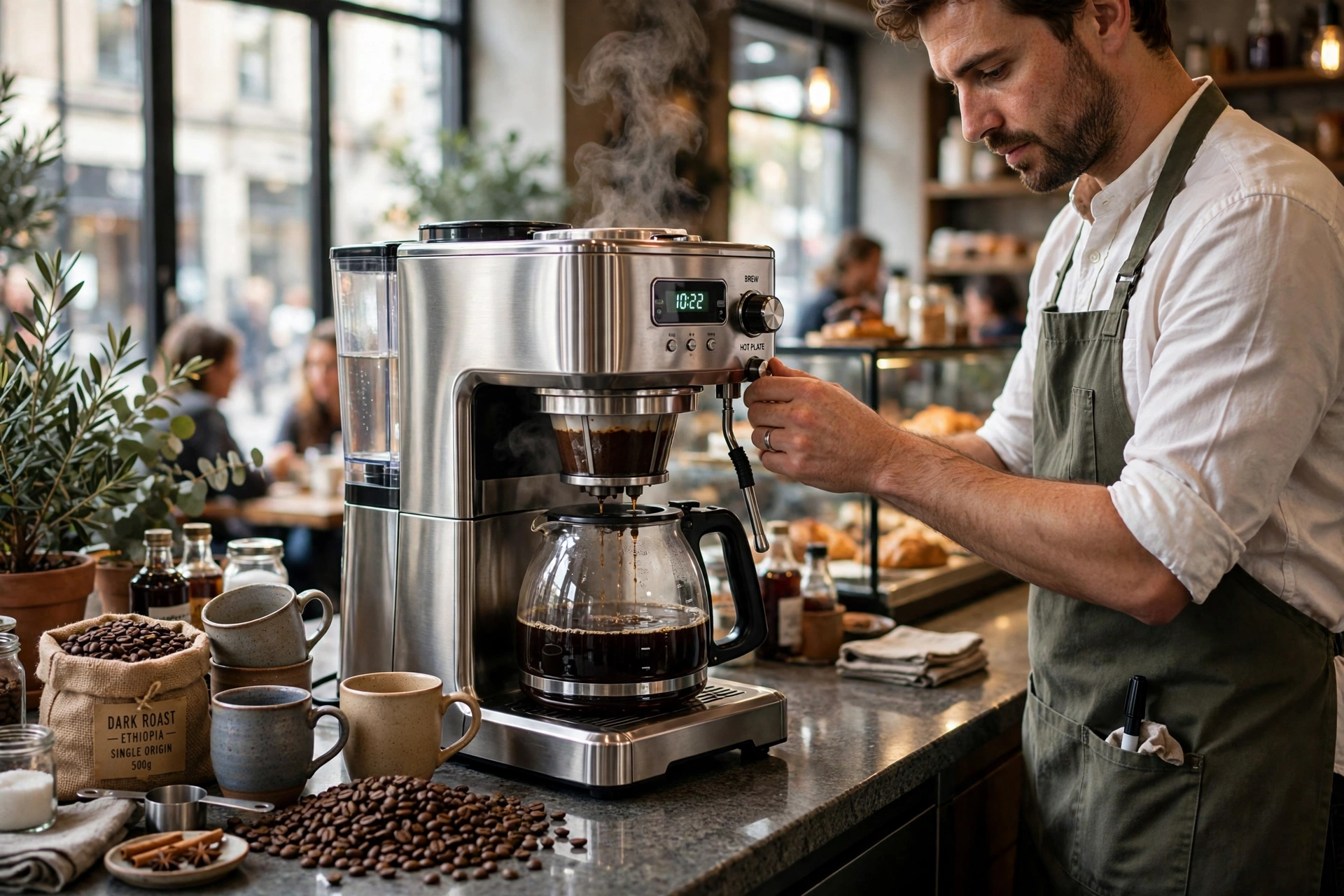
Unlike residential machines, commercial drip coffee makers are engineered for thermal stability and durability. They typically feature stainless steel boilers, high-capacity water reservoirs, and precision temperature controls to ensure that the 50th cup of the day tastes exactly like the first. In my experience working with busy cafes, the primary difference lies in the heating element; commercial units use powerful heating manifolds that can maintain water temperature precisely at 200°F (93°C), which is the gold standard for extracting the complex flavors of Coffea arabica.
These machines are often categorized by their brewing method: batch brew, where a large carafe is filled at once, or individual drip-throughs. When selecting a unit, the priority must be on the brew-to-serve ratio. A machine that takes 12 minutes to brew a half-gallon is a liability in a fast-paced breakfast setting. Modern professional systems now incorporate pulse-brewing technology, which saturates the coffee grounds in intervals to prevent channeling and ensure a balanced extraction of the coffee bean's natural oils.

Why Choosing the Right Commercial Drip Coffee Maker Matters for Your Business
Selecting the wrong equipment directly impacts your bottom line through two main channels: waste and labor efficiency. When a machine lacks precise temperature control, you suffer from over-extraction (bitterness) or under-extraction (sourness), leading to dumped pots of coffee. According to the Specialty Coffee Association (SCA), precise water temperature and brew ratios are the most critical factors in achieving a specialty grade cup, meaning an inferior machine effectively wastes your expensive specialty coffee beans.
Furthermore, the operational cost of downtime is staggering. In a typical Mount Pleasant hotel breakfast service, a broken brewer can result in a loss of hundreds of dollars in potential ancillary revenue per hour. This is why NSF International certification is non-negotiable. As NSF International notes through their food equipment standards, certified commercial machines are built with non-porous materials that prevent bacterial growth and can withstand the rigors of industrial sanitization, which consumer-grade plastics cannot.
Beyond sanitation, consider the impact on your staff. A barista who has to manually monitor a slow, unreliable brewer is a barista who isn't engaging with customers or upselling pastries. High-efficiency commercial drip coffee makers automate the process, allowing staff to focus on hospitality rather than troubleshooting a leaking gasket. When we integrated managed coffee solutions at Busy Bean Coffee, we saw a measurable increase in throughput simply by upgrading clients to machines with programmable timers and automatic shut-off features.
How to Select and Implement the Best Drip System for Your Venue
Choosing the best commercial drip coffee makers requires a data-driven approach based on your peak-hour volume. I always advise clients to calculate their "Peak Cup Per Hour" (PCPH) metric. If you serve 60 guests per hour and each guest averages 1.5 cups, you need a system capable of producing 90 cups per hour without a drop in temperature.
Step 1: Assess Your Volume Requirements
If you are a small boutique office, a small-batch brewer is sufficient. However, if you are a high-volume restaurant, you should look into high volume commercial coffee brewers that utilize dual-urn systems. This allows you to brew a fresh pot while the previous one is being served, ensuring no guest ever receives "burnt" coffee from a hot plate that has been on too long.
Step 2: Evaluate the Filtration System
Water quality is 98% of your coffee. If you are in an area with hard water, like many parts of South Carolina, a direct-plumbed system with an integrated reverse osmosis or carbon filter is essential. Scaling in the heating element is the number one cause of machine failure. I've tested this with dozens of our clients, and those who invest in water filtration see their equipment lifespan increase by nearly 40%.
Step 3: Match the Machine to the Bean
Not all drip machines handle all roasts equally. Darker roasts require slightly lower temperatures to avoid a charred taste, while light-roast specialty coffee needs the high-end heat of a precision brewer to unlock fruit notes. Ensure your machine has adjustable temperature settings to accommodate your specific coffee roasting profile.
Step 4: Training and Calibration
Once the hardware is installed, the human element takes over. Your team must be trained on the "Golden Ratio"—the precise weight of coffee beans to the volume of water. A common mistake is using a scoop; I always insist on digital scales for consistency. This ensures that every pot meets the quality standards expected of a professional coffee service.
Comparing Drip Brewing Approaches
When deciding on a system, businesses often oscillate between manual, low-cost automation, and professional managed services. The following table illustrates the long-term viability of each approach.
| Feature | Traditional/Consumer Setup | Budget Commercial/Cheap AI | Busy Bean Coffee Professional Approach |
|---|---|---|---|
| Durability | Low (breaks under load) | Moderate (plastic components) | High (Industrial Stainless Steel) |
| Consistency | Variable (temperature swings) | Inconsistent (poor extraction) | Precision (SCA Standard Temp) |
| Maintenance | User-managed (high risk) | Reactive (fix when broken) | Proactive (Managed Membership) |
| ROI | Poor (high replacement cost) | Moderate (mid-term failure) | High (Predictable monthly fee) |
💡
Key Takeaway
The shift from owning a machine to a managed coffee service removes the capital expenditure risk and ensures that equipment is always operating at peak efficiency.
Common Mistakes When Investing in Commercial Drip Systems
One of the most frequent errors I see is the "Over-Capacity Trap." Business owners often buy the largest machine available "just in case." However, brewing a 1.5-gallon pot when you only have 10 customers leads to coffee sitting on a warming plate for hours. This causes oxidation and thermal degradation, ruining the flavor profile of your Arabica coffee. It is far better to have a machine that brews smaller, frequent batches of ultra-fresh coffee than one massive pot that stays warm for hours.
Another critical mistake is ignoring the "Last Mile" of the beverage experience: the carafe. Using cheap glass carafes that shatter or leak is a safety hazard and a waste of product. I recommend thermal vacuum carafes which keep coffee hot without the need for a heating element. This prevents the "burnt' taste and allows you to brew in advance during the morning rush without sacrificing quality.
Finally, many operators neglect the cleaning cycle. Commercial drip coffee makers accumulate coffee oils (cafestol) and mineral deposits. If you aren't descaling your machine weekly, your brew time will increase, and your flavor will flatten. According to the National Coffee Association USA (NCA), consistent maintenance is the primary differentiator between a cafe that retains customers and one that loses them to inconsistent quality.

Pro Tip: The "Scent-to-Sale" Strategy
In my experience, the physical placement of your commercial drip coffee makers can be a marketing tool. If the brewing process is visible and the aroma of fresh coffee roasting fills the air, you create an olfactory trigger for your customers. By placing the brewers near the entrance or the checkout counter, you increase the likelihood of impulse purchases. We've seen businesses in Mount Pleasant increase their morning beverage sales by up to 20% simply by moving their brewing station to a more prominent, aromatic location.
Frequently Asked Questions
Which is better: a batch brewer or a single-serve machine?
Batch brewers are superior for high-volume environments where speed of service is the priority, as they provide multiple servings instantly. Single-serve machines, such as those detailed in our single serve commercial brewers overview, offer more variety and customization for the guest. For a breakfast-heavy venue, a combination of both is often the most profitable strategy, allowing for quick turnaround and personalized options.
How often should I descale my commercial drip coffee maker?
In a professional setting, you should perform a light descale weekly and a deep clean monthly. In regions with hard water, such as Mount Pleasant, SC, this may need to happen every three to four days. Failure to remove calcium deposits leads to heating element burnout and inconsistent brew temperatures, which directly affects the flavor of your specialty coffee.
Can I use a home-grade machine in a small office or cafe?
It is highly discouraged. Home machines are not designed for "duty cycles"—the ability to run multiple times per hour without overheating. A home machine in a commercial environment will likely fail within months, and more importantly, it lacks the thermal stability required to produce professional-grade coffee. If you have a limited budget, consider commercial brewers for small businesses designed for lower volume but higher durability.
What is the ideal water temperature for commercial drip coffee?
For most specialty coffees, the ideal temperature is between 195°F and 205°F (90.5°C to 96°C). If the water is too hot, it scorches the beans; too cold, and it fails to extract the necessary sugars and acids. Professional commercial drip coffee makers allow you to calibrate this temperature, which is essential for maintaining a consistent brand experience across different bean origins.
How do I prevent the "burnt' taste in my coffee pots?
The burnt taste is caused by the hot plate continuing to cook the coffee after it has been brewed. To avoid this, transition to thermal carafes and use a machine with an automatic shut-off timer. Additionally, ensure you are using a high-quality brew ratio; too little coffee for the amount of water leads to over-extraction, which mimics a burnt flavor profile.
Recommended Readings
To deepen your understanding of these topics, we recommend reading the following articles:
- Maintenance Tips for Commercial Coffee Makers
- Commercial Coffee Brewers for Small Businesses
- Energy Efficient Commercial Coffee Brewers Guide
- High Volume Commercial Coffee Brewers for Busy Venues
Conclusion
Investing in the right commercial drip coffee makers is less about the brand of the machine and more about the alignment of capacity, temperature precision, and maintenance. Whether you are running a boutique hotel in Mount Pleasant or a high-traffic restaurant, the goal is to eliminate friction from your morning service while maximizing the potential of your specialty coffee beans. The risk of equipment failure is too high to leave to chance or budget-grade alternatives.
At Busy Bean Coffee, we remove the headache of equipment ownership. Instead of risking thousands on a machine that might break, our managed coffee membership provides you with premium SENSA equipment, full installation, and total maintenance coverage for one predictable monthly fee. You get the quality of a Q-Grader’s selection without the stress of technical failures.
To refine your overall strategy and understand how drip systems fit into a broader beverage program, return to our Ultimate Guide to Commercial Coffee Brewers for Business. Ready to upgrade your service? Visit us at www.busybeancoffee.com to see how we can transform your coffee operation into a profit center.
Free Coffee Pairing Guide & Specialty Roast Cheat Sheet
Unlock the secrets of perfect brewing ratios, water temperatures, and specialty roast profiles. Download the guide.