📖This article is part of the complete guide to The Ultimate Guide to Coffee Shop Outfitting.
I once walked into a high-end cafe in Mount Pleasant, SC, where a $15,000 multi-boiler espresso machine was sitting idle during a morning rush. The reason? The head barista had accidentally clogged the group head with old coffee oils and didn't know how to perform a backflush. This is a recurring nightmare in the foodservice industry: investing in top-tier hardware but neglecting the human element. High-end equipment is only as effective as the person operating it.
For a comprehensive overview of setting up your space, explore our guide on coffee shop outfitting.
What is Equipment-Focused Barista Training?
📚
Definition
Equipment-focused barista training is a technical education process that prioritizes the mechanical operation, calibration, and preventative maintenance of coffee hardware over simple recipe adherence.
Equipment-focused barista training is the systematic process of teaching staff not just how to make a latte, but how the espresso machine and grinder actually function. While traditional training focuses on the 'what' (the drink), technical training focuses on the 'how' (the machine). In my experience working with dozens of hospitality groups, the gap between a 'drink-maker' and a 'machine-operator' is where most profit leaks occur. When a barista understands the relationship between grind size and extraction time, they can pivot in real-time as the humidity in the room changes, ensuring every shot of specialty coffee remains consistent.
This training covers the entire lifecycle of the equipment: the initial morning calibration, the mid-day adjustment, and the end-of-day deep clean. It transforms the staff from passive users into active stewards of the business's most expensive assets. By focusing on the mechanical nuances of the gear, businesses can significantly extend the lifespan of their machines and reduce the frequency of emergency technician visits. This technical approach is what separates a chaotic cafe from a streamlined operation.

Why Technical Training Matters for Your Business ROI
Technical mastery of equipment directly impacts the bottom line by reducing waste and increasing throughput. According to the Specialty Coffee Association (SCA), consistency in extraction is the primary driver of quality in specialty coffee. When baristas are untrained on their equipment, they often 'dial in' the coffee by guessing, leading to kilograms of wasted coffee beans during the morning setup. If a barista wastes just 500g of coffee per day due to poor calibration, a shop can lose thousands of dollars in annual margin.
Furthermore, the cost of improper maintenance is staggering. Many businesses ignore the importance of water chemistry and filtration, leading to scale buildup that can destroy a boiler. I've seen machines that could have lasted 10 years fail in three because the staff wasn't trained to monitor the filtration system. By implementing a strict technical training regimen, you shift from reactive maintenance (fixing things when they break) to preventative maintenance (stopping them from breaking).
Beyond the hardware, there is the customer experience factor. A barista who is struggling with a machine is a barista who isn't engaging with the customer. When the equipment feels like an extension of the barista's hand, the workflow becomes fluid. This efficiency allows for higher volume during peak hours, directly increasing the revenue per square foot of the service area. This is particularly vital when using high-end gear, such as the options found in our guide on best espresso machines for coffee shops, where the complexity of the machine requires a matching level of skill to operate effectively.
How to Implement a Technical Training Program Step-by-Step
Implementing an effective training program requires moving away from the 'shadowing' method, where a new hire simply watches a veteran. Instead, you need a formalized technical checklist. The first step is the Mechanical Orientation. This involves showing the barista every switch, lever, and gauge on the machine. They must understand what a 'pressure gauge' is and what a reading of 9 bars actually means for the extraction of Coffea arabica. If they don't understand the physics of pressure, they cannot troubleshoot a sour shot.
Next, focus on Grind Calibration. The relationship between the grinder and the espresso machine is the most critical link in the chain. Training should include a deep dive into how to adjust the collar on a commercial grinder to achieve a precise micron size. For more details on selecting the right gear for this process, see our analysis of how to choose commercial coffee grinders. Baristas should be taught to perform 'test shots' every two hours, adjusting for temperature and humidity changes that affect how the coffee bean behaves in the hopper.
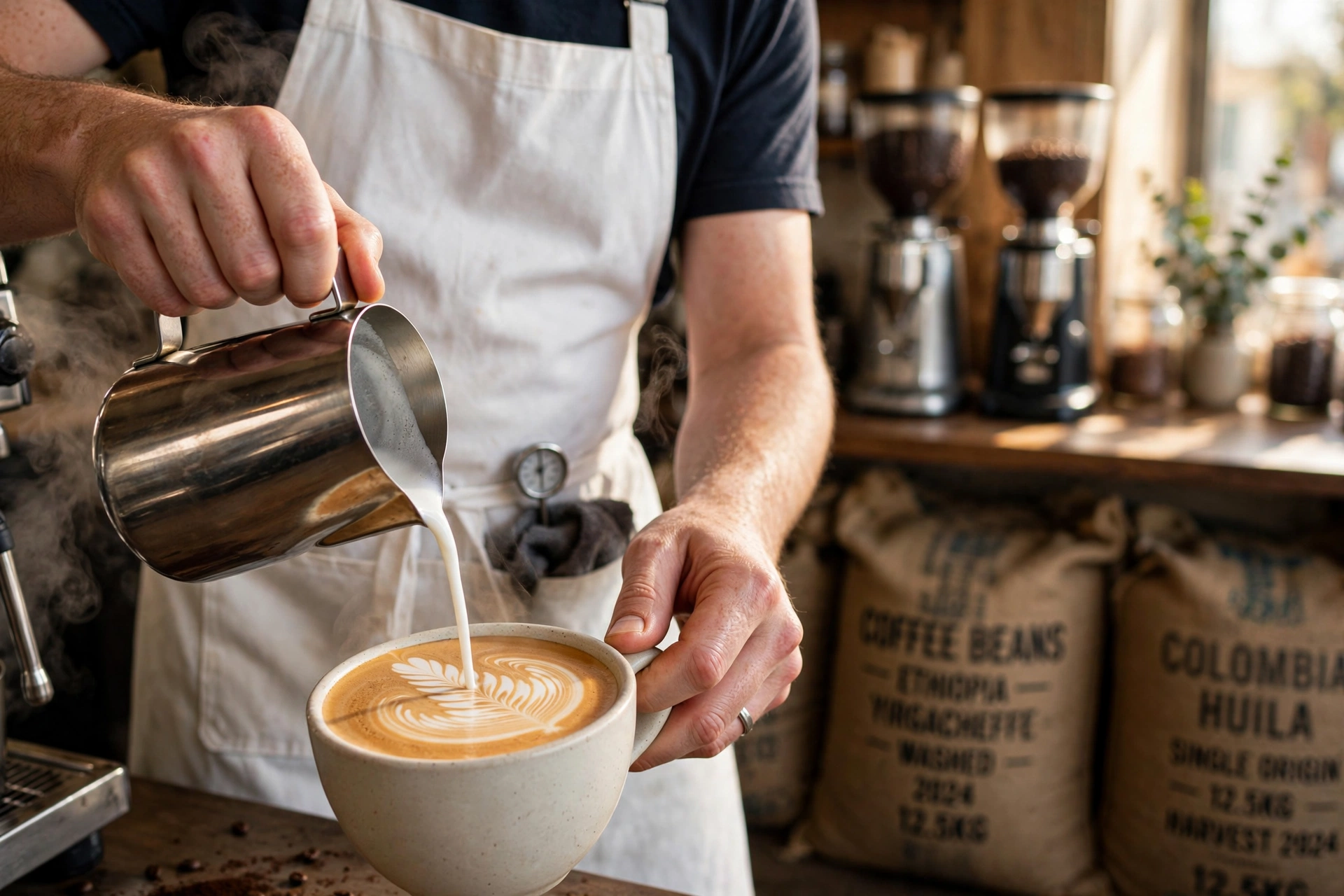
Third is the Milk Texture and Steam Integration. Steam wands are often the most abused part of the machine. Training must cover the 'stretch' and 'roll' phases of steaming milk, but more importantly, the immediate purge of the wand after every single use. Failure to purge leads to milk buildup, which is not only a hygiene risk but can eventually block the steam orifices, requiring a professional repair. This is why integrating the right tools, such as those mentioned in our guide on essential milk frothers for busy cafes, is only half the battle; the technique is what creates the profit.
Finally, establish a Cleaning Protocol. This is the non-negotiable part of the day. Training must include the use of chemical cleaners (like Cafiza) for backflushing group heads and the scrubbing of gaskets. I've analyzed several businesses where the 'cleaning' was just a quick wipe of the tray. The result? Bitter oils accumulated in the group head, ruining the taste of the coffee regardless of the bean quality. A certified training program ensures that the end-of-day checklist is followed with clinical precision.

Traditional vs. Generic vs. Professional Training Approaches
To understand the value of a structured program, we must compare how different businesses handle staff education. Most shops fall into the 'Traditional' trap, which relies on tribal knowledge rather than documented standards.
| Feature | Traditional Approach | Generic/Cheap Training | Professional Technical Training |
|---|---|---|---|
| Method | Shadowing/Observation | Basic Video Tutorials | Standardized Technical Manuals |
| Focus | Recipe & Drink Names | Basic Button Pressing | Mechanical Physics & Calibration |
| Maintenance | Reactive (Fix when broken) | Minimal/Superficial | Preventative (Scheduled) |
| Waste Level | High (Trial and error) | Medium (Inconsistent) | Low (Precise Dial-in) |
| Equipment Lifespan | Shortened by misuse | Average | Maximized via stewardship |
As shown in the table, the professional approach treats the equipment as a capital asset that requires a specialized operator. When you combine this with the right operational software, such as the best POS systems for coffee shops, you create a business that is scalable because the quality is tied to a system, not a specific person's mood or memory.
Common Equipment Training Mistakes to Avoid
One of the most frequent mistakes I see is Training for the 'Perfect' Day. Many owners train their staff when the shop is empty and the weather is mild. However, the real test of a barista is a rainy Tuesday morning with a line out the door and a grinder that is drifting. If your training doesn't include 'stress-testing'—where you intentionally change the grind or temperature and ask the barista to fix it—they will panic when a real crisis occurs. They need to develop the intuition to recognize a 'channeling' shot just by looking at the flow from the portafilter.
Another critical error is Ignoring the Water Chain. Baristas are often trained on the machine but never on the filtration system. According to NSF International, the mineral content of water is the single most important variable in equipment longevity. If a barista doesn't know how to check a filter gauge or identify when a cartridge needs replacing, your espresso machine is essentially a ticking time bomb of limescale. I've seen $20,000 machines ruined because the staff thought 'water is just water'.
Lastly, there is the 'Set it and Forget it' Mentality. Some owners believe that once a barista is trained, they are 'certified' for life. In reality, coffee is a biological product. The moisture content of a coffee bean changes every day it sits in the hopper. Training must be a continuous loop. I recommend a monthly 'Calibration Audit' where the head barista tests every staff member's ability to dial in a new roast. This ensures that standards don't slip as the business grows.
💡
Key Takeaway
Equipment training is not a one-time event; it is a continuous operational requirement that prevents capital loss and ensures product consistency.
Frequently Asked Questions
How often should baristas be retrained on equipment?
Technical retraining should occur quarterly, but 'micro-training' should happen daily. Every morning, the lead barista should spend 10 minutes reviewing the dial-in process with the staff. Quarterly sessions should be more formal, involving a deep-dive into equipment maintenance and a review of any new brewing standards released by the National Coffee Association USA (NCA). This prevents 'habit creep,' where baristas start taking shortcuts that compromise the machine's health or the coffee's flavor.
What is the most important technical skill for a barista to master?
While latte art gets the social media attention, the most important technical skill is grind calibration. The ability to manipulate the particle size of the coffee bean to control the flow rate of water is what determines the taste. A barista who cannot calibrate a grinder is merely a button-pusher. Mastery of the grinder allows the business to maintain a consistent flavor profile regardless of whether they are using a light-roast Ethiopian bean or a dark-roast Brazilian blend, directly impacting customer retention.
Do I need a certified Q-Grader to train my staff?
While having a Q-Grader on staff is an incredible asset for quality control, you do not need one for basic equipment training. However, the training curriculum should be based on the standards set by organizations like the Specialty Coffee Association (SCA). You can hire a consultant to set up your technical manuals and then use your most experienced senior barista to execute the daily training. The goal is to create a repeatable system that doesn't depend on a single expert's presence.
How does equipment training reduce waste?
Waste occurs primarily during the 'dialing-in' phase. An untrained barista might pull five or six shots, changing the grind randomly, before finding the sweet spot. A technically trained barista understands the relationship between dose, yield, and time. They can look at the espresso flow and know exactly how many notches to move the grinder collar. This precision can reduce coffee waste by 20-30% per day, which adds up to thousands of dollars in saved inventory over a year.
What happens if we ignore the technical side of training?
Ignoring technical training leads to three inevitable outcomes: increased equipment downtime, inconsistent product quality, and higher staff turnover. When machines break frequently, the stress on the staff increases, and customers notice the inconsistency in their drinks. This creates a cycle of frustration. Moreover, the U.S. Food and Drug Administration (FDA) maintains strict guidelines on food safety; a barista who isn't trained in proper equipment sanitization puts the business at risk of health code violations and potential closures.
Conclusion
Investing in the finest espresso machines and grinders is only the first step in building a successful coffee business. The real value is unlocked through rigorous, technical barista training that treats your hardware as a precision instrument rather than a kitchen appliance. When your team understands the physics of extraction and the necessity of preventative maintenance, you protect your capital investment and guarantee a world-class experience for every customer who walks through your door.
If you are still in the planning stages of your venture, ensure you have a holistic strategy for your hardware and layout. For a complete roadmap on everything from machine selection to spatial flow, revisit our Ultimate Guide to Coffee Shop Outfitting.
For those looking for a more managed approach to their coffee service, including professional installation and maintenance, visit Busy Bean Coffee to explore our all-inclusive memberships.
Free Coffee Pairing Guide & Specialty Roast Cheat Sheet
Unlock the secrets of perfect brewing ratios, water temperatures, and specialty roast profiles. Download the guide.