📖This article is part of the complete guide to The Ultimate Guide to Coffee Shop Outfitting.
I once watched a high-volume cafe in Mount Pleasant, SC, lose nearly three minutes per order simply because their baristas were hunting for tamping mats and cleaning brushes. In a fast-paced environment, a missing five-second tool creates a bottleneck that ripples through the entire customer experience. When you operate a professional coffee service, the difference between a chaotic counter and a streamlined operation isn't just the machine; it is the precision of the tools surrounding it.
For a comprehensive overview of setting up your space, explore our guide on coffee shop outfitting.
What Are Professional Barista Tools?
📚
Definition
Barista tools are the specialized manual instruments and accessories used to prepare, extract, and serve coffee, designed to ensure consistency, precision, and hygiene in a commercial environment.
Barista tools are the unsung heroes of the coffee industry. While the espresso machine provides the power, the tools provide the control. These accessories encompass everything from the precision of a calibrated tamper to the sanitation of a dedicated milk pitcher rinser. In my experience working with specialty coffee shops, the tools are where the actual "craft" of the barista meets the operational needs of the business. Without standardized tools, you cannot achieve a repeatable flavor profile, regardless of how expensive your roast is.
When we analyze the workflow of a top-tier cafe, we see that the most efficient baristas use tools that minimize movement. This is known as "mise en place" for coffee. Every tool—the distribution tool, the scale, the knock box—has a dedicated home. This eliminates the cognitive load on the staff and allows them to focus on the quality of the extraction and the interaction with the guest. In 2026, the trend has shifted toward ergonomic tools that reduce repetitive strain injuries (RSI), such as weighted tamps and precision-engineered pitchers, which allow for longer shifts with less physical fatigue.

Why Do High-Quality Barista Tools Matter for Your Business?
Precision in coffee preparation is not a luxury; it is a financial necessity. The primary reason high-quality barista tools matter is the reduction of waste. According to the Specialty Coffee Association (SCA), consistency in dosing and tamping is the most critical factor in preventing "channeling," where water finds the path of least resistance through the coffee bed, resulting in an unbalanced, sour, or bitter shot.
When you use a calibrated distribution tool, you ensure that the coffee bean grounds are level before tamping. This simple step prevents the waste of expensive specialty coffee that occurs when a shot is pulled incorrectly and must be discarded. If a cafe wastes just three shots per hour due to poor preparation tools, that can translate to hundreds of dollars in lost revenue over a year. High-quality tools ensure that every gram of Arabica coffee is utilized to its full potential.
Furthermore, the speed of service is directly tied to the quality of accessories. A professional knock box allows a barista to clear a portafilter in one second rather than spending ten seconds banging it against a trash can. When integrated with essential milk frothers for busy cafes, these tools create a seamless loop of production. Efficiency in the "back-end" of the bar allows you to handle peak morning rushes without increasing your staff count, directly improving your bottom line.
Finally, there is the aspect of food safety and compliance. Using NSF-certified tools is not just about quality; it is about meeting health codes. The NSF International provides standards (such as NSF/ANSI 4) that ensure equipment is easy to clean and does not harbor bacteria. Using professional-grade stainless steel tools instead of plastic alternatives ensures your business remains compliant with health inspections and provides a hygienic environment for your customers.
How to Select and Use the Right Barista Tools?
Selecting the right tools requires a balance between precision and durability. I have tested dozens of setups, and the pattern is clear: the best tools are those that remove human error from the equation. To implement a professional toolset, start by auditing your current workflow. Where is the friction? If your baristas are struggling to get a level surface on the coffee, a distribution tool is your first priority.
The Precision Extraction Workflow
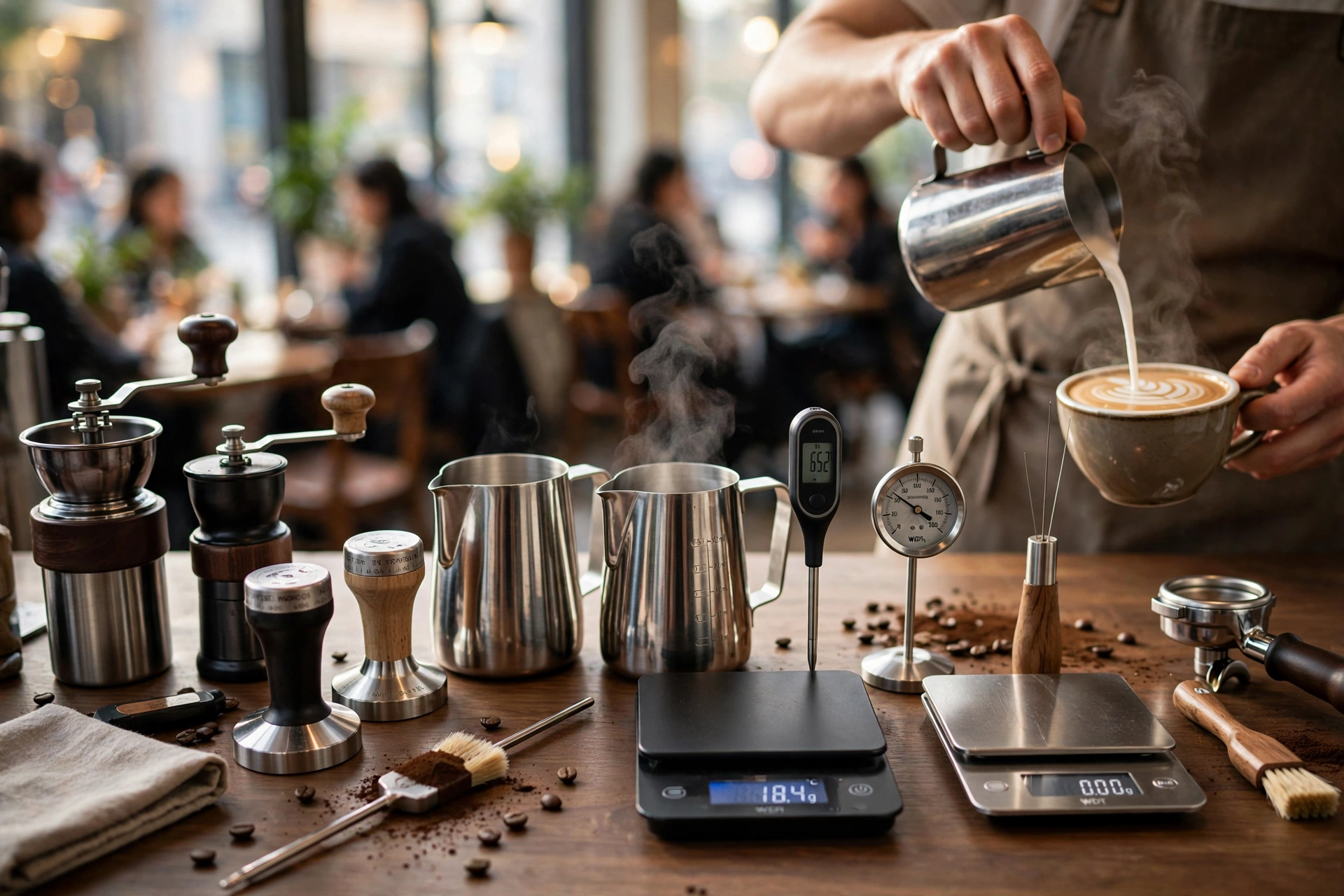
- Distribution: Use a rotary distribution tool to level the grounds. This ensures that the water flows evenly through the puck, preventing the channeling mentioned earlier. This is especially critical when using a high-end espresso machine.
- Tamping: Use a calibrated tamper. A calibrated tamper provides the same amount of pressure (typically 30 lbs) every single time. This removes the variability between a new trainee and a seasoned veteran.
- Measurement: Use a digital scale with 0.1g accuracy. Weighing the dose and the yield is the only way to ensure that the ratio of coffee to water is perfect.
- Milk Texturing: Use a series of pitchers in different sizes (12oz, 20oz). Using a pitcher that is too large for the volume of milk leads to wasted product and poor aeration.
Integration with Equipment
Your tools must complement your hardware. If you have invested in commercial coffee grinders, your tamping station should be positioned immediately adjacent to the grinder to minimize the distance the portafilter travels. This prevents the coffee from cooling or settling unevenly. Similarly, your milk pitchers should be placed within arm's reach of the steam wand to ensure that the milk does not sit too long before being poured into the cup.
💡
Key Takeaway
The goal of professional tools is to standardize the process. When the tool dictates the pressure and the level, the barista can focus on the nuance of the flavor and the speed of the service.
Barista Tools vs. Home Brewing Gear
Many business owners make the mistake of buying "prosumer" gear for a commercial environment. While a home-grade tamper might look identical to a commercial one, it lacks the durability and precision required for 200 shots a day.
| Feature | Home/Prosumer Gear | Generic Cheap Tools | Professional Barista Tools |
|---|---|---|---|
| Material | Plastic/Thin Steel | Low-grade Aluminum | 304 Stainless Steel / Hardened Steel |
| Consistency | Variable (Manual) | Unreliable | Calibrated/Standardized |
| Durability | Medium (Wears out) | Low (Bends/Rusts) | High (Industrial Grade) |
| Sanitation | Home Dishwasher | Difficult to sanitize | NSF Certified / Easy-Clean |
As you can see, the generic approach often leads to higher long-term costs because the tools must be replaced frequently. A professional set from Busy Bean Coffee is an investment in infrastructure. When we provide our managed coffee solutions, we ensure that the tools provided are matched to the volume of the business, preventing the common failure point where tools break down during the busiest hours of the week.

Common Mistakes When Outfitting a Barista Station
One of the most frequent mistakes I see is the "tool clutter" phenomenon. Business owners often buy every accessory they see in a catalog, but they don't assign them a specific place. This leads to a cluttered workspace where tools are misplaced, and cleaning is ignored. A barista station should be a sterile, efficient laboratory, not a junk drawer.
Another critical error is ignoring the cleaning tools. Many focus on the production tools (tampers, pitchers) but forget the maintenance tools. A professional station must have a dedicated group head brush, a microfiber cloth for the steam wand (kept in a sanitized container), and a high-quality blind filter for backflushing. Without these, even the most expensive commercial drip coffee makers or espresso machines will degrade in quality within months due to oil buildup and scale.
Lastly, avoid the temptation of "gimmick" tools. There are many gadgets on the market that claim to revolutionize coffee, but most are unnecessary. Stick to the fundamentals: distribution, tamping, weighing, and steaming. If a tool doesn't either increase speed, improve consistency, or enhance hygiene, it is likely just taking up space on your counter.
Implementation Guide: Building Your Tool Kit
If you are starting from scratch or upgrading your station in 2026, follow this tiered approach to ensure you aren't overspending while still maintaining professional standards.
Tier 1: The Essentials (The Foundation)
- Calibrated Tamper: Ensure it matches the basket size of your machine (usually 58mm). This is the most important tool for consistency.
- Digital Scale: A scale that can handle the weight of the portafilter and the cup.
- Stainless Steel Pitchers: At least three of different sizes to avoid waste.
- Knock Box: A heavy-duty, non-slip knock box to protect your counters.
Tier 2: Efficiency Boosters (The Speed Layer)
- Distribution Tool: To ensure a perfectly flat bed of coffee every time.
- Tamping Mat: A silicone mat that protects the counter and provides a stable base for the tamper.
- Precision Thermometers: For those not using digital temperature control on their machines.
- Milk Pitcher Rinser: A built-in rinser that allows the barista to clean the pitcher in 3 seconds between drinks.
Tier 3: The Master's Kit (The Quality Layer)
- WDT Tool (Weiss Distribution Technique): For eliminating clumps in the coffee bed.
- Precision Baskets: High-tolerance baskets that ensure an even extraction.
- Professional Cleaning Kit: Including espresso machine detergent and specialized brushes.
At Busy Bean Coffee, we specialize in this exact orchestration. Our managed coffee membership doesn't just provide the machine; we help you curate the specific toolset that fits your volume. Whether you are running a small clinic or a full-scale hotel restaurant, the toolset should be tailored to the expected ticket volume to prevent burnout and waste.
Frequently Asked Questions
Why is a calibrated tamper better than a standard one?
A standard tamper relies entirely on the barista's physical strength and feel. This creates inconsistency; a tired barista in the afternoon will tamp lighter than a fresh barista in the morning, leading to faster water flow and under-extracted coffee. A calibrated tamper uses a spring mechanism to ensure the same amount of pressure is applied every single time, regardless of who is operating the machine. This guarantees a consistent flavor profile and ensures that your quality remains high throughout the entire business day.
How often should I replace my barista tools?
Most high-quality stainless steel tools, like tampers and pitchers, should last for years if maintained correctly. However, silicone mats and rubber gaskets in knock boxes can wear down every 6 to 12 months depending on volume. I recommend a quarterly audit of all manual tools. Check for any warping in the tamps or scratches in the pitchers that could harbor bacteria. Replacing worn-out gaskets and mats prevents slips and spills, which is essential for maintaining a safe and professional workspace in a high-traffic cafe.
Do I really need a distribution tool if I have a good grinder?
Yes, because grinders—even the best ones—can leave small clumps of coffee or create an uneven mound in the portafilter. When you tamp an uneven surface, the water will naturally find the lowest point or the gaps in the coffee bed, causing "channeling." A distribution tool levels the bed before the tamp is applied. This ensures the water meets a uniform wall of resistance, resulting in a balanced extraction and a much more consistent taste, which is the hallmark of specialty coffee.
What is the best way to clean milk pitchers during a rush?
The most efficient method is the installation of an automatic pitcher rinser. This device is built into the counter and uses high-pressure water to clean the inside of the pitcher in seconds. If you do not have a rinser, the second-best method is a dedicated "steam wand cloth" that is kept in a sanitizing solution. Baristas should wipe the wand immediately after every use and rinse the pitcher with hot water between different types of milk to prevent cross-contamination and buildup of milk proteins.
Are digital scales necessary for every drink?
In a professional environment, scales are essential for the "dialing-in" process at the start of the day. While you may not weigh every single shot during a massive rush, you must weigh them periodically to ensure the grinder has not drifted. According to industry standards, a shift in just 0.5 grams of coffee can noticeably change the taste of the espresso. Using a scale ensures that your baristas are adhering to the recipe, reducing waste and ensuring that the customer receives the exact same product every time they visit.
Conclusion
Investing in the right barista tools is the final step in transforming a coffee station from a simple beverage point into a professional production line. By focusing on calibration, distribution, and hygiene, you remove the unpredictability from your service and replace it with a repeatable, high-quality process. When you reduce the friction of the workflow, your baristas are happier, your waste is lower, and your customers receive a superior product.
If you are looking to optimize your entire operation, from the initial layout to the final accessory, we recommend reviewing our Ultimate Guide to Coffee Shop Outfitting. Whether you are in the planning phase or looking to upgrade your current setup, the right infrastructure is what separates a struggling cafe from a thriving coffee destination. Let Busy Bean Coffee help you build a system that works as hard as you do.
Visit us at www.busybeancoffee.com to discover how our managed coffee memberships can provide you with the best equipment and tools without the massive upfront capital expense.
Free Coffee Pairing Guide & Specialty Roast Cheat Sheet
Unlock the secrets of perfect brewing ratios, water temperatures, and specialty roast profiles. Download the guide.