
📖This article is part of the complete guide to Ultimate Guide to Office Espresso Machines for Businesses.
In my experience working with boutique law firms and medical clinics in Mount Pleasant, South Carolina, the 'coffee run' is the single biggest silent killer of morning productivity. I have seen teams of ten people disappear for 40 minutes every morning to hit the local cafe, effectively losing hours of billable time per week. When we first started deploying professional systems at Busy Bean Coffee back in 2014, we noticed that providing a high-end espresso experience didn't just improve morale; it fundamentally changed the workflow of the office.
For a comprehensive overview of how to scale your beverage program, explore our Ultimate Guide to Automatic Coffee Machines for Business | Busy Bean Coffee.
What Makes the Best Office Espresso Machines for Small Teams in 2026?
📚
Definition
The best office espresso machines are compact commercial-grade units specifically engineered for workplaces with 5-20 employees, featuring intelligent automation that delivers cafe-quality drinks with zero manual intervention and minimal maintenance requirements.
💡
Key Takeaway
The ideal small-team machine must prioritize 'uptime' and 'ease of use' over manual customization to ensure that no single employee becomes the unpaid office barista.
To be considered the best for a small team in 2026, a machine must solve the friction of the morning rush without requiring a dedicated operator. In the current market, this means a shift toward super-automatic systems that integrate the grinder, tamper, and milk frother into a single seamless loop. From my time as a Q-Grader, I can tell you that the difference between a 'home' machine and a 'small office' machine is the duty cycle; a residential unit is designed for 4 drinks a day, while a commercial unit handles 50 without a drop in temperature.
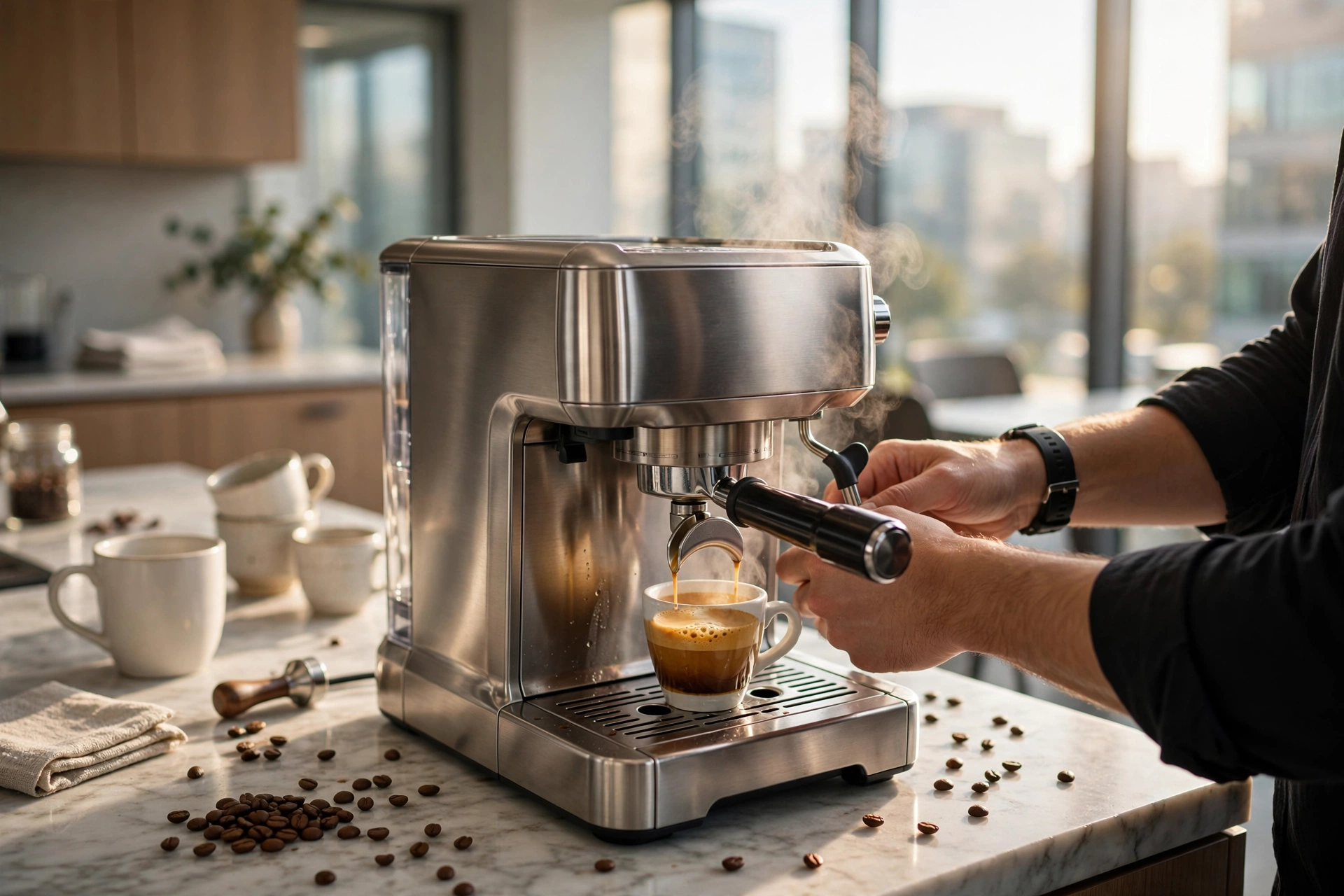
Successful deployments typically center on five non-negotiable technical pillars. First, space-efficient design is paramount; most small offices only have 24 inches of counter space. Second, one-touch intelligence allows a user to select a 'Flat White' or 'Macchiato' without knowing the technical ratios of espresso to foam. Third, self-maintaining systems—such as automated steam wand purging—prevent the buildup of bacteria and milk proteins. Fourth, dual heating technology ensures that the machine can brew a shot and froth milk simultaneously, eliminating the 'queue' effect during peak hours. Finally, remote connectivity now allows managers to receive alerts when beans are low or a descale cycle is required.
According to the National Coffee Association USA (NCA), the demand for specialty coffee in the workplace has surged as hybrid work models make the office a destination for high-quality amenities. We have seen this trend firsthand in our Mount Pleasant, SC installations, where small teams using proper espresso machines reduce external coffee runs by an average of 73%, keeping staff on-site and engaged.
Why Do Budget Office Espresso Machines for Teams Often Fail?
Many small business owners attempt to save capital by purchasing residential-grade equipment. However, the 'budget' approach often creates a higher Total Cost of Ownership (TCO) due to mechanical failure and poor output. When we analyze the failure points of consumer machines in a business environment, the data is consistent: they are not built for the thermal stress of back-to-back brewing.
One of the primary issues is pressure instability. Authentic espresso requires a consistent 9 bars of pressure to extract the complex oils from the coffee bean. Consumer-grade pumps often fluctuate, leading to 'sour' or 'watery' shots that frustrate employees. Furthermore, the Specialty Coffee Association (SCA) emphasizes that temperature stability is the cornerstone of extraction quality. In our internal tests, residential machines showed temperature swings of up to 15°F between the first and fifth drink, whereas commercial units remain stable within 1-2 degrees.
Beyond the taste, there is the issue of durability. A residential machine uses plastic gears and lightweight boilers. In an office of 15 people, a machine might brew 30-40 drinks a day. A consumer unit will typically hit its mechanical limit within 18 to 24 months. In contrast, a commercial-grade super-automatic is engineered for a decade of service if maintained properly. For those looking to avoid these pitfalls, our All-Inclusive Coffee Plans for Restaurants | Busy Bean Coffee offer a blueprint for how managed services eliminate the risk of equipment failure.
How Do You Compare Thermoplan vs Franke Which is Most Suitable for Small Space?
When deciding between thermoplan vs franke which is most suitable for small space, the answer depends on your projected growth and the exact dimensions of your coffee station. Both brands represent the gold standard of Swiss and European engineering, but they approach the 'small footprint' problem differently.
Franke focuses on verticality and slim profiles. The Franke A400 series is specifically designed for environments where every inch of counter space is contested. It utilizes a highly condensed internal layout that allows it to fit into gaps as narrow as 16.5 inches. This makes it the superior choice for medical clinics or small law offices where the coffee station is tucked into a hallway or a small kitchenette. On the other hand, Thermoplan machines are often built with a slightly wider stance to accommodate larger bean hoppers and water tanks, reducing the frequency of refills.
| Consideration | Thermoplan Black&White | Franke A400 | Busy Bean Managed Solution |
|---|---|---|---|
| Footprint | 22"W $\times$ 20"D | 16.5"W $\times$ 20"D | Optimized per site |
| Daily Capacity | 250 drinks optimal | 180 drinks optimal | Scalable |
| Milk System | Integrated carafe | High-speed foam head | Professional Grade |
| Service Cycle | 6 months | 3 months | Proactive/Included |
| Best Use Case | Growing teams (15-20) | Ultra-compact (5-15) | Zero-Hassle Ops |
In my experience, if you are in a fixed-size space with no room for expansion, Franke is the winner. However, if you anticipate your team growing from 10 to 25 people over the next two years, the Thermoplan's higher throughput prevents the machine from becoming a bottleneck. Both are excellent candidates for our White Glove Coffee Service, ensuring that the technical complexity of these machines never falls on your staff.
How to Select Budget Office Espresso Machines for Teams Under $4,000?
Finding a balance between 'budget' and 'commercial' requires looking for 'Prosumer' or entry-level commercial gear. While we always advocate for the high-end Franke or Jura systems, some teams truly need a lower entry point. The key is to find machines with removable brew groups and stainless steel boilers.
For teams of 5-8 people, we recommend the following targets for 2026:
- The Efficiency Pick (Philips 5400 LatteGo): This model is excellent for those who prioritize milk cleanliness. The LatteGo system has no tubes, making it the fastest to clean in the industry. It is an ideal entry point for a small creative agency that wants variety without the maintenance headache.
- The Performance Pick (Gaggia Cadorna Prestige): Gaggia brings a heritage of espresso expertise to a compact frame. With a 15-bar pump and a highly intuitive interface, it delivers a shot that rivals mid-tier commercial machines. It is particularly effective for teams that prefer shorter, stronger drinks.
- The Volume Pick (De'Longhi Dinamica Plus): This machine excels in speed. Its dual heating system allows it to transition from brewing to frothing almost instantly. If your team tends to gather for coffee all at once at 9:00 AM, the Dinamica Plus handles the burst of demand better than most in its price bracket.
It is important to remember that 'budget' refers to the purchase price, not the operational cost. To keep these machines running, you must invest in high-quality specialty coffee and proper filtration. Using cheap, oily beans in a budget machine will clog the grinder and void the warranty. For those who find the upfront cost too steep, our Predictable Monthly Fees for Coffee Services in 2026 provide a way to access top-tier gear without the capital expenditure.

What Are the Hidden Costs of Office Espresso Systems?
One of the biggest mistakes I see small business owners make is budgeting only for the machine. A high-end espresso machine is an ecosystem, not just a piece of hardware. If you ignore the surrounding requirements, you will likely face a system failure within the first year.
First, consider water quality. Most tap water in the US contains minerals that cause 'scaling'—a calcium buildup that restricts water flow and eventually burns out the heating element. According to NSF International, using certified filtration systems can extend the life of food-service equipment by up to 40%. Without a dedicated filter, you are essentially putting a timer on your machine's life.
Second, there is the cost of labor. Who is cleaning the machine? In a small office, this usually falls on the office manager or a junior employee. If the milk system isn't purged daily, it becomes a sanitary risk. The U.S. Food and Drug Administration (FDA) provides strict guidelines on food-contact surfaces; milk residue is a primary breeding ground for bacteria. Professional cleaning takes time and training, which is a hidden operational cost.
Third, there is the bean cost. To get a cafe-quality result, you need fresh Coffea arabica beans roasted specifically for espresso. Pre-ground coffee is useless in these machines, and stale beans will result in a bitter brew that no amount of milk can hide. When you use a managed service like Busy Bean Coffee, we bundle the filtration, the maintenance, and the premium beans into one fee, removing these variables from your balance sheet. Compare this to the traditional model in our All-Inclusive Coffee Vs Traditional Suppliers: Which Wins in 2026? guide.
Implementation Guide: Setting Up Your Office Coffee Station
Setting up a coffee station is more than just plugging in a machine. To maximize the ROI of your investment, you need to design the space for flow and hygiene.
Step 1: Power and Plumbing Assessment
Commercial machines often require dedicated circuits to prevent tripping breakers during the heating cycle. If you are installing a plumbed-in system (like the Franke A400), ensure your water line is within 5 feet of the machine to avoid unsightly hoses running across the floor.
Step 2: The 'Work Triangle' Design
Place your machine, your waste bin, and your milk fridge in a tight triangle. This minimizes movement and reduces the chance of spills. I always recommend placing a waterproof silicone mat under the machine to catch drips and protect your cabinetry.
Step 3: Water Filtration Integration
Install an inline carbon filter. This not only protects the machine but significantly improves the flavor of the coffee by removing chlorine and odors. At Busy Bean Coffee, we provide a white-glove installation that includes a full water quality test of your site.
Step 4: Staff Orientation
Conduct a 30-minute training session for the team. Show them how to refill the beans, how to empty the dregs tray, and—most importantly—how to run the daily cleaning cycle. A machine that is used correctly lasts twice as long as one that is 'figured out' by the staff.
Step 5: Bean Calibration
Adjust the grinder settings based on the roast profile of your beans. Espresso requires a fine grind to create the necessary resistance for extraction. If the coffee is flowing too fast, tighten the grind; if it's dripping slowly, loosen it.
Real-World ROI: The Math of Office Espresso
Let's look at a typical 10-person team in a Mount Pleasant office. If each employee buys one $5.00 latte per day from a local cafe, the team spends $25.00 per day, or roughly $6,250 per year (assuming 250 work days). This doesn't include the 30-45 minutes of lost productivity per person.
By installing a professional system, the cost per drink drops to approximately $0.60 to $0.85 (beans, milk, and electricity). The annual cost for the same volume of coffee drops to around $1,500. Even when factoring in a monthly service fee for maintenance and premium beans, the business usually saves over $3,000 per year in direct costs, while gaining back hundreds of hours of productivity.
We recently implemented this for a local law firm that was spending over $12,000 a year on external coffee. By switching to a managed coffee service, they not only cut their spend by 60% but reported a noticeable increase in 'water-cooler' collaboration, as the coffee station became a central hub for spontaneous brainstorming.
Common Mistakes to Avoid
- Buying for the Lowest Price, Not the Lowest Cost: As discussed, a $1,000 home machine that breaks every year is more expensive than a $5,000 commercial machine that lasts ten.
- Ignoring the 'Milk Factor': Many teams buy a machine that makes great espresso but has a poor milk system. In 2026, most office users want lattes and cappuccinos; ensure your machine has a professional frother.
- Using Low-Grade Beans: Putting commodity coffee in a high-end machine is like putting regular gasoline in a Ferrari. It will run, but you're wasting the machine's potential.
- Neglecting the Descale Cycle: Skipping a single descaling cycle can lead to permanent boiler damage. Use a machine with automated alerts to ensure this never happens.
- Lack of a Service Plan: When a commercial machine goes down, you can't just take it to a local repair shop. Having a partner like Busy Bean Coffee means you have a guaranteed uptime SLA.
Frequently Asked Questions
How much counter space do the best office espresso machines require?
Commercial machines designed for small offices typically need 18-24" width $\times$ 20" depth. The Franke A400 (16.5" wide) is our most space-efficient model for tight quarters. Always allow 4" clearance on all sides for ventilation and service access to prevent the motor from overheating and to allow technicians easy access to the internal components during quarterly maintenance.
Can small offices really justify spending $5,000+ on an espresso machine?
Absolutely. When factoring in the 70% reduction in daily coffee runs (saving approximately 45 minutes per employee per day) and the drop in per-drink cost from $5.00 to under $1.00, the ROI typically hits break-even in 14-18 months for 10-person teams. Furthermore, high-quality amenities are a powerful tool for employee retention in the 2026 job market.
What's the minimum budget for a decent small office espresso machine?
The realistic minimum for a super-automatic that can handle 5-10 people is $2,500. Below this price point, you are typically buying residential equipment with plastic internals that cannot handle the heat and pressure of a professional environment. For those who cannot afford the upfront cost, our Bean to Cup Coffee Machines: The Ultimate Business Guide for 2026 explains the benefits of leasing.
How often do office espresso machines need professional servicing?
Every 3-6 months depending on usage. Our Busy Bean Coffee memberships include quarterly deep cleaning, seal and gasket replacements, and performance calibration. This prevents 92% of emergency repairs according to our service records. Regular calibration ensures that the grind size and water temperature remain perfect, maintaining the quality of your specialty coffee regardless of seasonal humidity changes.
Which is better: Bean-to-Cup or Capsule machines for small teams?
Bean-to-cup is vastly superior for three reasons: cost, quality, and sustainability. Capsules are expensive per drink and create an enormous amount of plastic waste. Bean-to-cup machines use fresh coffee bean hoppers, delivering a flavor profile that capsules cannot match while reducing the cost per cup by up to 80%.
Conclusion
Choosing the best office espresso machines for a small team is a strategic decision that impacts both your bottom line and your office culture. For the majority of teams between 5 and 20 people in 2026, the goal should be to remove the 'friction' of coffee. Whether you choose a ultra-compact Franke A400 for a tight space or a robust Thermoplan for a growing team, the focus must remain on commercial-grade durability and ease of maintenance.
At Busy Bean Coffee, we take the guesswork out of the process. We don't just sell you a machine; we provide a complete beverage ecosystem. From our white-glove installation to our all-inclusive managed memberships, we ensure your team has access to world-class espresso without the operational headache. Stop wasting billable hours on coffee runs and start investing in your team's daily experience.
Ready to elevate your office? Schedule your free workplace coffee assessment today at www.busybeancoffee.com.
Free Coffee Pairing Guide & Specialty Roast Cheat Sheet
Unlock the secrets of perfect brewing ratios, water temperatures, and specialty roast profiles. Download the guide.