Why Your Business Coffee Experience is Likely Failing Your Team
I once walked into a corporate office in Mount Pleasant, South Carolina, where the "coffee station" consisted of a massive urn of burnt, lukewarm brew and a stack of plastic pods that tasted like cardboard. The employees weren't just unhappy with the coffee; they were leaving the building three times a day to visit a local café. That is a massive loss in productivity and a missed opportunity for culture building. When you provide subpar coffee, you send a subtle message that the details don't matter. In 2026, the expectations for office and hospitality beverages have shifted. People want a barista-quality experience without the 15-minute wait.
For a comprehensive overview of how to integrate these systems into your workflow, explore our complete guide on bean to cup coffee machines.

What Are Bean to Cup Coffee Machines and How Do They Work?
📚
Definition
Bean to cup coffee machines are fully automated espresso systems that handle the entire process—grinding whole beans, tamping the grounds, extracting the espresso, and frothing milk—at the touch of a single button.
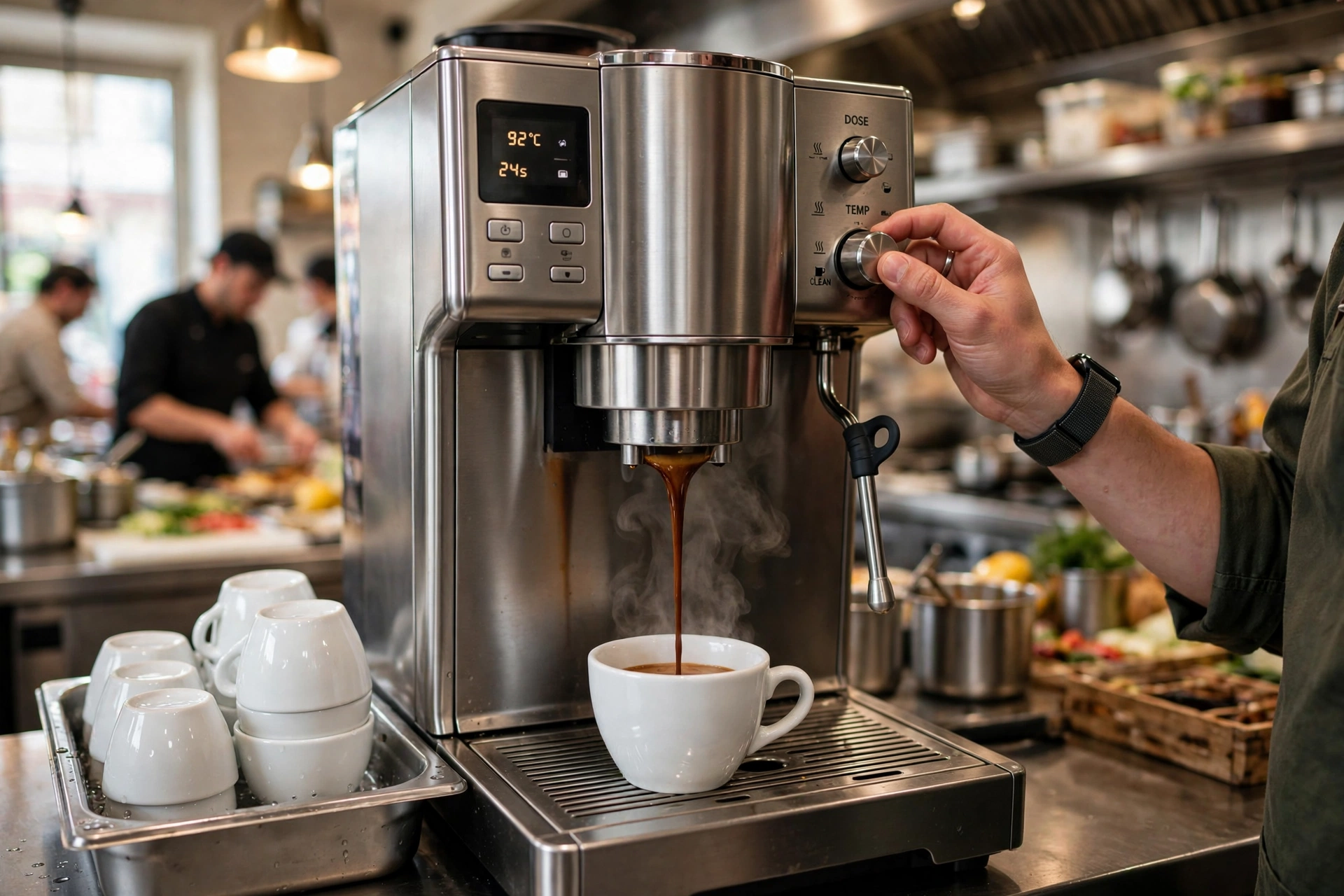
Bean to cup coffee machines represent the convergence of precision engineering and convenience. Unlike traditional espresso machines that require a trained barista to manually dose and tamp, or pod machines that rely on pre-packaged plastic, these systems integrate a professional-grade burr grinder directly into the chassis. When a user selects a drink, the machine grinds the exact amount of coffee beans needed for that specific beverage, compresses the powder, and forces hot water through it under high pressure.
In my experience working with foodservice businesses, the magic happens in the calibration. A true commercial bean to cup machine allows the operator to adjust the grind size and temperature to suit the specific roast of the coffee bean being used. This ensures that the volatile aromatic compounds of a light roast aren't burnt, and a dark roast doesn't taste overly bitter. The automation removes the human error factor, meaning the 100th cup of the day tastes exactly like the first.
💡
Key Takeaway
The primary value of bean to cup technology is the elimination of the "skill gap," providing specialty coffee quality without requiring a certified barista on staff.
Why Bean to Cup Technology Matters for Your Business Growth
Investing in professional coffee equipment is not about the caffeine; it is about the environment you create for your clients and employees. According to the National Coffee Association USA (NCA), coffee consumption patterns in the workplace have evolved toward a preference for specialty beverages, with a significant rise in the demand for espresso-based drinks like lattes and cappuccinos.
1. Drastic Reduction in Operational Waste
One of the biggest headaches I see in hospitality management is the waste generated by pod-based systems. Thousands of plastic capsules end up in landfills every year. Bean to cup machines use whole beans and organic grounds, which are compostable. For businesses aiming for ESG (Environmental, Social, and Governance) goals in 2026, switching to a bean-to-cup model is the fastest way to green your beverage program.
2. Superior Cost-per-Cup Economics
While the initial investment in a high-end machine is higher than a pod machine, the cost per cup is significantly lower. Buying premium coffee beans in bulk is exponentially cheaper than buying proprietary pods. When you analyze the ROI over a 24-month period, the savings on consumables often pay for the machine itself. This is why I always recommend our Bean to Cup Coffee Machine Buying Guide for Businesses to clients who are scaling their operations.
3. Enhancement of Employee Retention and Culture
Coffee stations are the "water coolers" of the modern era. They are where spontaneous collaboration happens. By providing an automated coffee service that produces a genuine espresso, you create a high-value perk that employees actually appreciate. It transforms a mundane break into a luxury experience, signaling to your team that you value their comfort and quality of life.
4. Consistency Across Multiple Locations
For businesses with multiple branches or offices, consistency is the hardest thing to maintain. A barista in one location might pull a shot differently than one in another. With bean to cup machines, the parameters are locked in. Whether your client is in a lobby in Denver or a boardroom in Los Angeles, the coffee tastes identical because the machine follows a precise digital recipe.
How to Implement a Bean to Cup System in Your Commercial Space
Implementing a professional coffee system requires more than just plugging in a machine. You need a strategy that considers volume, water quality, and user flow. If you are operating a high-traffic environment, you might need a White Glove Coffee Service in Los Angeles CA to ensure the setup is seamless.
Step 1: Analyze Your Daily Volume
Before choosing a machine, track your peak hours. Do you have 50 people arriving at 8:00 AM, or a steady trickle of 10 people per hour? A machine with a small bean hopper or a slow boiler will create bottlenecks, leading to frustrated employees. For smaller teams, we often suggest looking at the Best Office Espresso Machines for Small Teams in 2026.
Step 2: Prioritize Water Filtration
This is where most businesses fail. Coffee is 98% water. If you use hard tap water, calcium deposits will build up in the boiler, leading to scale and eventual machine failure. I have seen thousands of dollars in equipment ruined because a manager ignored the filtration system. Always install a professional water softener or reverse osmosis system to protect your investment and ensure the flavor profile of the Coffea arabica remains untainted.
Step 3: Select the Right Bean Profile
Not all beans work in all machines. For bean to cup systems, you want a bean that is roasted consistently. Oily, very dark roasts can sometimes clog grinders or leave a residue that affects the taste of subsequent drinks. Working with a specialty coffee roaster ensures you get a bean specifically profiled for automated extraction.
Step 4: Establish a Maintenance Schedule
Automation does not mean "zero work." Milk lines must be purged daily to prevent bacterial growth, and the brew group must be cleaned to remove old coffee oils. To avoid downtime, I highly recommend following a strict Bean to Cup Coffee Machine Maintenance Guide.

Comparing Coffee Solutions for the Modern Business
When choosing a system, you have to weigh the trade-offs between speed, quality, and cost. Many businesses assume a cheap machine is a bargain, but the hidden costs of downtime and poor taste are high.
| Feature | Traditional Manual Espresso | Generic/Cheap AI Pod Systems | Busy Bean Coffee Modern Approach |
|---|---|---|---|
| Skill Required | High (Professional Barista) | None | None (One-Touch) |
| Taste Quality | Exceptional (if skilled) | Mediocre/Processed | Specialty Grade |
| Waste Level | Low | Extremely High (Plastic) | Minimal (Compostable) |
| Speed per Cup | Slow (Manual process) | Fast | Fast & Consistent |
| Long-term Cost | High Labor Costs | High Consumable Costs | Low Operating Cost |
Common Mistakes to Avoid When Scaling Your Coffee Service
In my years of managing coffee solutions, I've noticed a pattern of mistakes that lead to expensive failures. Avoiding these will save you thousands of dollars and a lot of stress.
1. Ignoring the "Hidden" Cost of Pods
Many managers look at the low entry price of a pod machine and ignore the monthly spend on capsules. When you calculate the cost per ounce, pods are often 4x to 10x more expensive than whole beans. This is a classic case of "cheap to buy, expensive to own."
2. Neglecting Milk System Hygiene
Milk is a biological product. If the automated frothing system isn't cleaned according to FDA safety standards, it becomes a breeding ground for bacteria. I've seen businesses face health code violations simply because they didn't realize the internal milk tubes needed a daily chemical rinse.
3. Buying Consumer-Grade Machines for Commercial Use
Buying a machine from a big-box retail store and putting it in an office with 40 people is a recipe for disaster. Consumer machines are designed for 2-4 cups a day. Commercial-grade machines are built with stainless steel boilers and heavy-duty motors designed for 100+ cycles per day. Always verify the "daily duty cycle" of the machine.
4. Overlooking Ergonomics and Placement
Putting a coffee machine in a narrow hallway creates a traffic jam. Ensure there is enough space for a queue to form and easy access for the person who has to refill the water tank and beans. If you are in a larger city, seeking a Coffee delivery service in Charlotte NC can help you manage the logistics of bean supply so your staff isn't running to the store every Tuesday.
5. Failing to Train Staff on Basic Operation
Even the most intuitive machine needs a basic orientation. If users don't know how to empty the dreg drawer or refill the bean hopper, the machine will stop working mid-morning. A simple 5-minute training session for your office manager can prevent 90% of all support calls.
Deep Dive: The Technical Edge of Bean to Cup
To truly understand why these machines outperform others, we have to look at the physics of extraction. The Specialty Coffee Association (SCA) emphasizes that the quality of an espresso depends on the precision of the grind and the stability of the water temperature.
In a manual setup, a barista uses a tamper to create a puck of coffee. If the pressure is uneven, water finds the path of least resistance, resulting in "channeling," which makes the coffee taste sour or bitter. Modern bean to cup machines use motorized tamping systems that apply exactly the same pressure every single time. This ensures a uniform extraction, pulling the complex sugars and oils out of the coffee bean without over-extracting the bitter tannins.
Furthermore, professional systems use PID (Proportional-Integral-Derivative) controllers to manage temperature. A difference of just 2 degrees Celsius can completely change the flavor of a specialty coffee. By maintaining a rock-steady temperature, bean to cup machines deliver a consistent sensory experience that was previously only possible in high-end cafes.
Implementation Guide: Scaling Your Coffee Experience
If you are moving from a basic setup to a professional bean to cup system, follow this implementation roadmap to ensure a smooth transition.
Phase 1: Audit and Planning (Week 1)
- Map out your peak usage times.
- Identify a location with a dedicated power outlet and water access.
- Determine the variety of drinks required (e.g., do you need only black coffee, or are lattes and flat whites essential?).
Phase 2: Equipment Selection (Week 2)
- Compare models based on the duty cycle. For high-volume areas, consider an Automated Coffee Service in Fort Worth TX.
- Select a bean that complements the machine's capabilities (Arabica coffee is generally preferred for these systems).
Phase 3: Installation and Calibration (Week 3)
- Install professional water filtration.
- Calibrate the grinder for the specific roast of your beans.
- Set up the digital menu to include the most popular drinks to reduce user confusion.
Phase 4: Maintenance and Optimization (Ongoing)
- Set a daily cleaning schedule for the milk system.
- Schedule quarterly professional deep-cleans to remove scale.
- Review consumption data to optimize bean ordering.
At Busy Bean Coffee, we simplify this entire process. Our managed solutions provide the equipment, the installation, and the maintenance for one predictable fee, removing the capital expense and the technical headache from your plate.
Frequently Asked Questions
Are bean to cup machines hard to maintain?
While they are automated, they do require consistent care. Daily maintenance includes emptying the coffee grounds container (dreg drawer) and cleaning the milk system. Weekly tasks involve deeper cleaning of the brew group. However, when you use a managed service, much of the heavy lifting—like descaling and technical calibration—is handled by professionals, meaning your staff only has to worry about the basics. Neglecting these simple steps can lead to flavor degradation and mechanical failure over time.
How does the cost compare to using coffee pods?
Bean to cup machines have a higher upfront cost but a significantly lower cost per cup. Pods are priced for convenience, meaning you pay a premium for the packaging and the proprietary system. Whole beans are bought in bulk and are much more affordable. For most businesses, the switch to bean to cup pays for itself within 12 to 18 months simply through the reduction in consumable spending, while simultaneously improving the quality of the beverage.
Can I use any coffee beans in these machines?
Technically, yes, but for the best results, you should use high-quality specialty coffee beans. Avoid using pre-ground coffee (which defeats the purpose of the machine) or extremely oily, dark-roasted beans that can clog the internal grinder. We recommend 100% Arabica coffee for its balanced acidity and sweetness, which performs best in automated extraction systems. Always ensure your beans are fresh, as oxidized beans will produce a flat, bitter cup regardless of the machine's quality.
Do bean to cup machines produce real espresso?
Yes, they do. They use the same principle as a manual espresso machine: forcing hot water through finely-ground coffee at high pressure (typically around 9 bars). The only difference is that the grinding, tamping, and extraction are handled by a computer rather than a human. As long as the machine is calibrated correctly and uses fresh beans, the resulting shot is a genuine espresso with a rich crema and intense flavor.
How long do these machines typically last?
A commercial-grade bean to cup machine can last 5 to 10 years if properly maintained. The lifespan depends almost entirely on two factors: water quality and cleaning habits. Machines used with unfiltered hard water will fail much sooner due to limescale buildup in the boiler. Conversely, a machine that is regularly descaled and has its seals replaced will continue to operate at peak performance for a decade. This is why professional maintenance is essential.
Is the coffee quality as good as a cafe?
For 95% of business users, the answer is yes. While a world-class barista can push the limits of a manual machine to create a unique flavor profile, a high-end bean to cup machine provides a consistent, high-quality result that far exceeds standard office coffee. When you use specialty-grade beans and a calibrated machine, the difference between an automated latte and a cafe latte is negligible to the average consumer.
How much space do I need for a professional machine?
Most commercial bean to cup machines require a footprint of approximately 20x20 inches, but you need to account for "operational space." This includes room to open the bean hopper from the top, access the water tank or plumbing from the back, and provide a landing area for cups and sugar. I recommend a dedicated counter space of at least 3 feet in width to ensure the area doesn't become congested during peak morning rushes.
What happens if the machine breaks down?
In a traditional ownership model, a breakdown means calling a technician and waiting days for a part, during which your office is without coffee. This is why the managed membership model is so popular in 2026. With a service like Busy Bean Coffee, we provide rapid response maintenance and often provide a loaner machine or an immediate technician visit, ensuring your business beverage service never truly goes offline.
Recommended Readings
To deepen your understanding of these topics, we recommend reading the following articles:
- SENSA Coffee Machines Ideal for Businesses
- Managed Coffee Service Restaurants
- Cost Savings with Automated Coffee Machines in | Busy Bean Coffee
Conclusion
Moving your business to a professional bean to cup system is one of the simplest ways to upgrade your corporate culture and improve your daily operational efficiency. By eliminating the waste of pods and the inconsistency of manual brewing, you provide a luxury experience that resonates with both employees and clients. In 2026, coffee is no longer just a utility; it is a statement of quality and care.
Whether you are looking to optimize a small team's breakroom or managing a massive hospitality project in an Automated Coffee Service in Wilmington NC, the key is to prioritize water quality, professional-grade equipment, and a sustainable bean source. Don't settle for lukewarm urns or plastic pods that hurt the planet and your palate.
If you're ready to stop worrying about the logistics of your coffee program and start enjoying the results, it's time to explore a managed solution. For more detailed information and to see which system fits your volume, visit our comprehensive guide on bean to cup coffee machines.
Upgrade your experience today at www.busybeancoffee.com.
Free Coffee Pairing Guide & Specialty Roast Cheat Sheet
Unlock the secrets of perfect brewing ratios, water temperatures, and specialty roast profiles. Download the guide.