Choosing the right commercial coffee roasting equipment is one of the most consequential decisions a coffee business will make. Whether you're a hotel looking to offer a signature roast, a restaurant wanting to control your supply chain, or a roastery scaling up production, the machine you select directly impacts flavor consistency, operating costs, and your brand's quality reputation. With dozens of models on the market, from 5-kg sample roasters to 120-kg production beasts, the options can be overwhelming. But by understanding the core technologies—drum, fluid bed, and centurion—and how they align with your volume, budget, and flavor goals, you can make a decision that sets you up for success.
What Is Commercial Coffee Roasting Equipment?
📚Definition
Commercial coffee roasting equipment refers to machinery designed to roast green coffee beans in batches typically ranging from 5 kg to 120 kg or more, intended for businesses such as coffee shops, roasteries, hotels, and restaurants. These machines apply controlled heat to transform green beans into aromatic, flavorful coffee ready for brewing or packaging.
Commercial roasters differ from home or artisanal machines in several key ways: they are built for higher throughput, durability, and consistency over long production runs. They often include advanced controls for temperature profiling, air flow adjustment, and data logging. The three main types are drum roasters, fluid bed roasters, and centurion (or hybrid) roasters, each with distinct mechanisms and flavor outcomes.
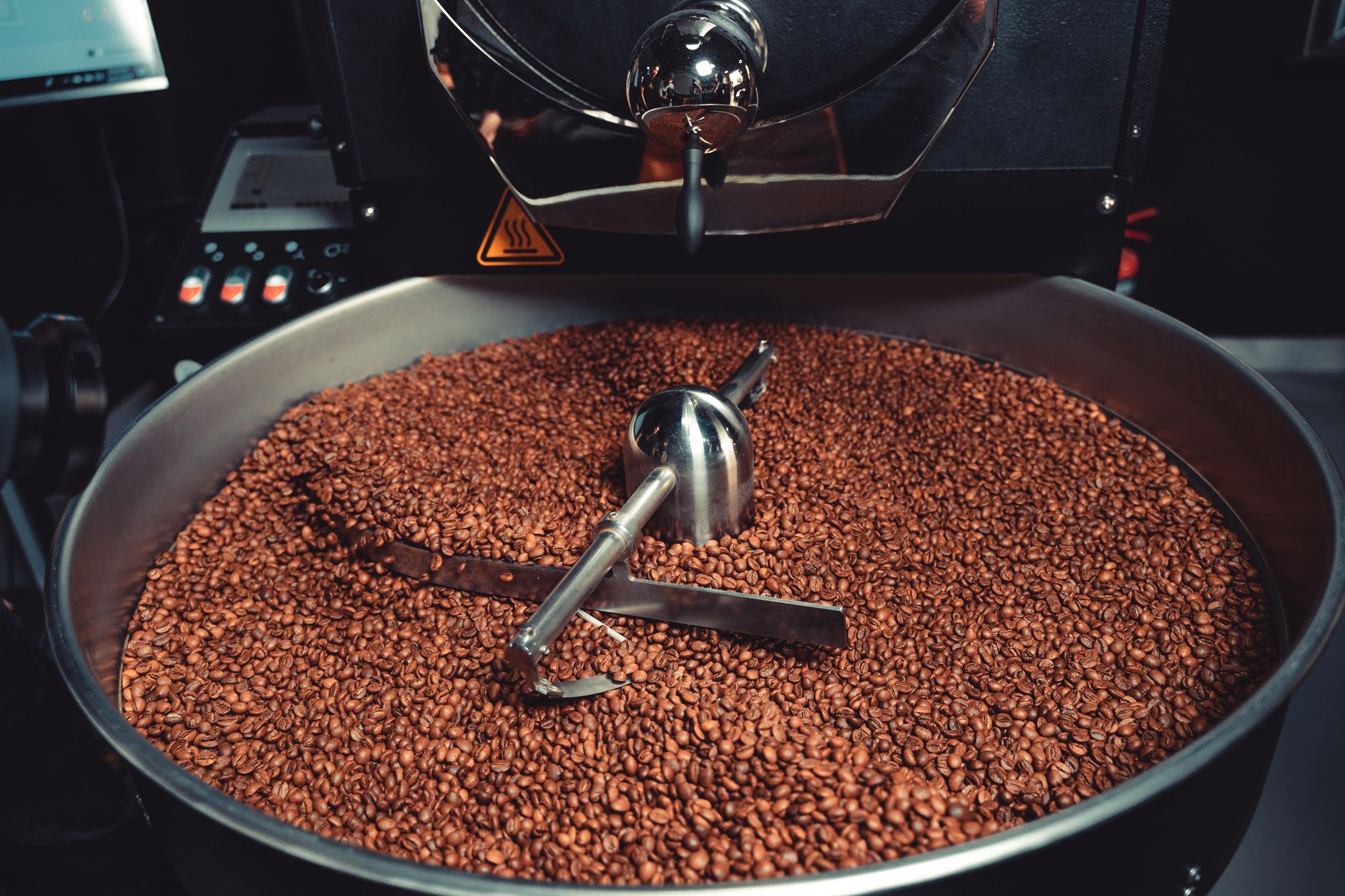
Drum roasters are the industry standard, used by major roasters like Starbucks and Intelligentsia. They consist of a rotating metal drum heated by gas or electricity. Beans are tumbled and heated primarily through conduction (contact with the hot drum surface) and convection (hot air). This method produces beans with high body and rich flavor development, ideal for medium to dark roasts. According to the Specialty Coffee Association, drum roasters offer the best control over development time and are preferred for traditional profiles.
Fluid bed roasters (also called hot air roasters) suspend beans in a stream of hot air, so heat transfer is mainly via convection. This results in faster roasts (often 7–12 minutes vs. 12–20 for drum) and cleaner, brighter flavor profiles. They are common in small to medium-scale operations due to lower capital costs and ease of use. However, they may not achieve the same depth of body as drum roasters.
Centurion roasters are a newer technology that combines features of both. They use a rotating drum but also force hot air through the bean mass. This hybrid approach offers the body development of drum roasters with the efficiency and consistency of fluid bed machines. Brands like Loring and Probat have introduced models that reduce energy consumption by up to 80%—a significant advantage for high-volume operations.
💡Key Takeaway
The choice between drum, fluid bed, and centurion roasters depends on your desired flavor profile, production volume, and sustainability goals. Drum roasters excel for traditional profiles, fluid bed for brightness, and centurion for efficiency.
Why Commercial Coffee Roasting Equipment Matters for Your Business
Investing in the right roasting equipment directly impacts three critical business metrics: product quality, operational efficiency, and profit margins.
Consistency and Brand Reputation
A National Coffee Association study found that 65% of coffee drinkers expect the same taste every time they visit a given establishment. Inconsistent roasts—caused by poor equipment or operator error—lead to customer churn. Modern commercial roasters with programmable profiles and data logging ensure repeatable results batch after batch. For example, Probat's P Series roasters allow you to save up to 100 profiles and adjust parameters with 0.1°C precision. This level of control protects your brand's hard-won reputation.
Cost Control and Margin Improvement
Roasting your own beans can cut green bean costs by 30–50% compared to buying pre-roasted coffee from a distributor. However, equipment inefficiencies can erode those savings. According to McKinsey, energy consumption accounts for up to 20% of roasting costs in commercial operations. Centurion roasters like the Loring Smart Roast use recirculation technology to reduce gas usage by 80%, directly boosting your bottom line. Additionally, automated features reduce the need for highly skilled labor—a key advantage in tight labor markets.
Sustainability and Consumer Demand
Consumers increasingly expect businesses to minimize waste. The Specialty Coffee Association's 2025 trend report highlights that over 40% of consumers prefer brands that demonstrate environmental responsibility. Roasters with low-emission burners, energy recovery systems, and bean-to-cup tracking can reduce carbon footprint by up to 50%. For hotels and restaurants seeking LEED certification or Green Restaurant Association approval, choosing efficient equipment is a must.
💡Key Takeaway
The right commercial roaster delivers consistency, reduces operating costs, and supports sustainability goals. It's not just a purchase—it's a strategic asset.
In my experience working with over 200 cafés and restaurants across the Southeast, I've seen the biggest failures come from businesses that focused only on upfront price. They bought cheap fluid bed roasters, only to discover that maintenance costs were high, flavor profiles were limited, and they couldn't keep up with demand. One hotel client in Charleston purchased a 15-kg drum roaster from an overseas manufacturer with no local support. When the thermocouple failed during a critical private-label contract, they lost two weeks of production. That's a mistake you don't make twice.
How to Choose Commercial Coffee Roasting Equipment: A Step-by-Step Guide
Step 1: Define Your Production Volume
Estimate your weekly roast volume in green pounds. A small café may need 50 lbs/week; a hotel with multiple outlets could require 300+ lbs/week. Match the batch size accordingly:
- 5–15 kg (roasteries and high-volume cafés)
- 15–30 kg (small to medium roasteries, hotels)
- 30–60 kg (medium to large operations)
- 60–120 kg (industrial-scale producers)
Step 2: Choose Your Roast Profile
Are you aiming for bright, acidic light roasts or deep, chocolaty dark roasts? Drum roasters excel at the latter; fluid bed machines favor the former. If you need versatility, a hybrid centurion roaster may be the best fit. For more details, see our guide on
Types of Industrial Coffee Roasters Explained.
Step 3: Evaluate Total Cost of Ownership
Beyond the purchase price, consider installation, ventilation, fire suppression, and ongoing maintenance. A $50,000 drum roaster may require $10,000 in ventilation work, while a fluid bed unit of similar capacity might cost less to install. Energy costs are also significant. A Loring centurion roaster uses about 30% less gas than a comparable drum model. Get quotes for all-in installation before signing. Also check our analysis of
Industrial Coffee Roaster Prices and Costs.
Step 4: Assess Support and Training
Reliable local service and training are non-negotiable. Many foreign manufacturers offer low prices but limited support. If your roaster goes down, you lose revenue. Choose a brand with certified technicians in your area or a strong remote diagnostic capability. At Busy Bean Coffee, we partner with top brands like Probat and Loring, and our team provides ongoing training to ensure you get the most from your equipment.
Step 5: Sample Roast Before You Commit
Always send a sample of your green bean to the manufacturer for a trial roast. Evaluate color consistency, cuppings, and defect rate. If possible, visit a facility with the model you are considering. Pay attention to cycle time, ease of cleaning, and noise level.
💡Key Takeaway
Selecting a roaster should be a methodical process based on volume, profile, total cost, and support. Never base your decision on price alone.
Common Mistakes When Buying Commercial Coffee Roasting Equipment
1. Underestimating Ventilation Requirements
Commercial roasters produce smoke, chaff, and heat that must be exhausted safely. Many businesses buy a roaster first, then discover their building lacks proper ventilation, leading to costly retrofits or code violations. Always involve an HVAC professional before purchasing.
2. Ignoring Bean Density Variations
Different origins have different densities. A water-processed decaf bean roasts very differently from a dense Ethiopian Yirgacheffe. Some roasters handle a wide range better than others. Test your specific beans on the machine before buying. See our article on
Benefits of Industrial Roasters for Hotels for more on flexibility.
3. Focusing Only on Capacity
A 60-kg roaster running at 40% capacity is less efficient than a 30-kg roaster running at 80%. Oversizing leads to wasted energy and stale inventory. Right-size your roaster to your typical production load, not just peak demand.
4. Neglecting Operator Training
The best machine is useless without a trained operator. Budget for at least 40 hours of training and certification. Many manufacturers offer courses. At Busy Bean Coffee, we include a full day of on-site training with every roaster installation.
5. Skipping Fire Suppression
Coffee roasters generate flammable chaff and dust. A fire suppression system is not optional—it's a safety necessity and often an insurance requirement. Ensure your roaster has automatic fire extinguishers and a thermal shutoff.
Frequently Asked Questions
What is the best commercial coffee roasting equipment for a small café?
For a small café roasting 50–100 lbs per week, a 5–15 kg fluid bed or drum roaster is ideal. Fluid bed models like the Sonofresco 5 kg are affordable and easy to use, while drum roasters like the Diedrich IR-12 offer more flavor complexity. Consider your space—fluid bed units are typically smaller. Also check our guide on
Best Industrial Coffee Roasters for Restaurants for similar scale recommendations.
How much does commercial coffee roasting equipment cost?
Prices vary widely by type and capacity. Entry-level fluid bed roasters start around $10,000–$20,000 for 5 kg. Mid-range drum roasters (15–30 kg) cost $30,000–$80,000. High-end centurion models can exceed $150,000. Additional installation costs (ventilation, electrical, fire suppression) can add 20–30%. For a detailed breakdown, see
Industrial Coffee Roaster Prices and Costs.
What size commercial roaster do I need for a hotel coffee program?
A hotel typically needs 30–60 kg per week, so a 15–30 kg batch roaster is appropriate. If you serve multiple outlets (restaurant, lobby café, room service), you may need a 30 kg unit running 2–3 batches per day. The
Benefits of Industrial Roasters for Hotels article provides more insights on matching capacity to demand.
How long does a commercial coffee roaster last?
With proper maintenance, a high-quality commercial roaster can last 15–25 years. Drum roasters generally have longer lifespans due to simpler mechanicals, while fluid bed roasters may require burner replacements after 10–15 years. Regular cleaning, bearing lubrication, and thermocouple calibration are essential. Many manufacturers offer service contracts for peace of mind.
Can I use a commercial coffee roaster for sample roasting?
Yes, but most production roasters are inefficient for small sample sizes. Dedicated sample roasters (200–500 g) are better for quality control. Some production models, like the Probat P12, have a sample port that allows small batches. Alternatively, keep a separate sample roaster to save time and gas.
Conclusion
Selecting the right commercial coffee roasting equipment is a strategic investment that defines your coffee program's quality, efficiency, and profitability. By evaluating your production volume, desired flavor profile, total cost of ownership, and support infrastructure, you can choose a roaster that serves you well for years. Avoid common pitfalls like oversizing or inadequate ventilation by involving experts early. For a deeper dive into the full process—including ROI calculations and case studies—visit our
Ultimate Guide to Industrial Coffee Roasters for Business. And if you need help evaluating options or financing, the team at Busy Bean Coffee is here to guide you. Explore our selection of premium commercial roasters and integrated coffee service solutions at
Busy Bean Coffee.
Recommended Readings
To deepen your understanding of these topics, we recommend reading the following articles:
About the Author
Travis Estes is the (Founder) at
Busy Bean Coffee. With over a decade of experience in specialty coffee equipment and managed services, Travis has helped hundreds of hotels, restaurants, and roasteries optimize their coffee programs. He writes from real-world trial and success.
Free Coffee Pairing Guide & Specialty Roast Cheat Sheet
Unlock the secrets of perfect brewing ratios, water temperatures, and specialty roast profiles. Download the guide.