Choosing the right industrial coffee roaster is one of the most critical decisions a coffee business can make. The type of roaster you select directly impacts flavor profile, production capacity, energy efficiency, and long-term operating costs. Yet many buyers jump into a purchase without understanding the fundamental differences between drum, fluid bed, and other roasting technologies. In my experience working with dozens of cafés, hotels, and roasteries, the wrong roaster choice has led to costly retrofits and lost product consistency. This guide breaks down every major type of industrial coffee roaster, how they work, and which is best for your operation.
For insights into supplier selection, see our
guide on top café equipment suppliers.
What Are the Main Types of Industrial Coffee Roasters?
📚Definition
An industrial coffee roaster is a machine designed to roast large quantities of green coffee beans (typically 15 kg to 500+ kg per batch) for commercial production. The two dominant technologies are drum roasting and fluid bed (air) roasting, with several hybrid and specialty sub-types in between.
💡Key Takeaway
The core distinction between drum and fluid bed roasters lies in heat transfer—conductive/radiant versus convective—which directly affects roast development and flavor.
Drum Roasters
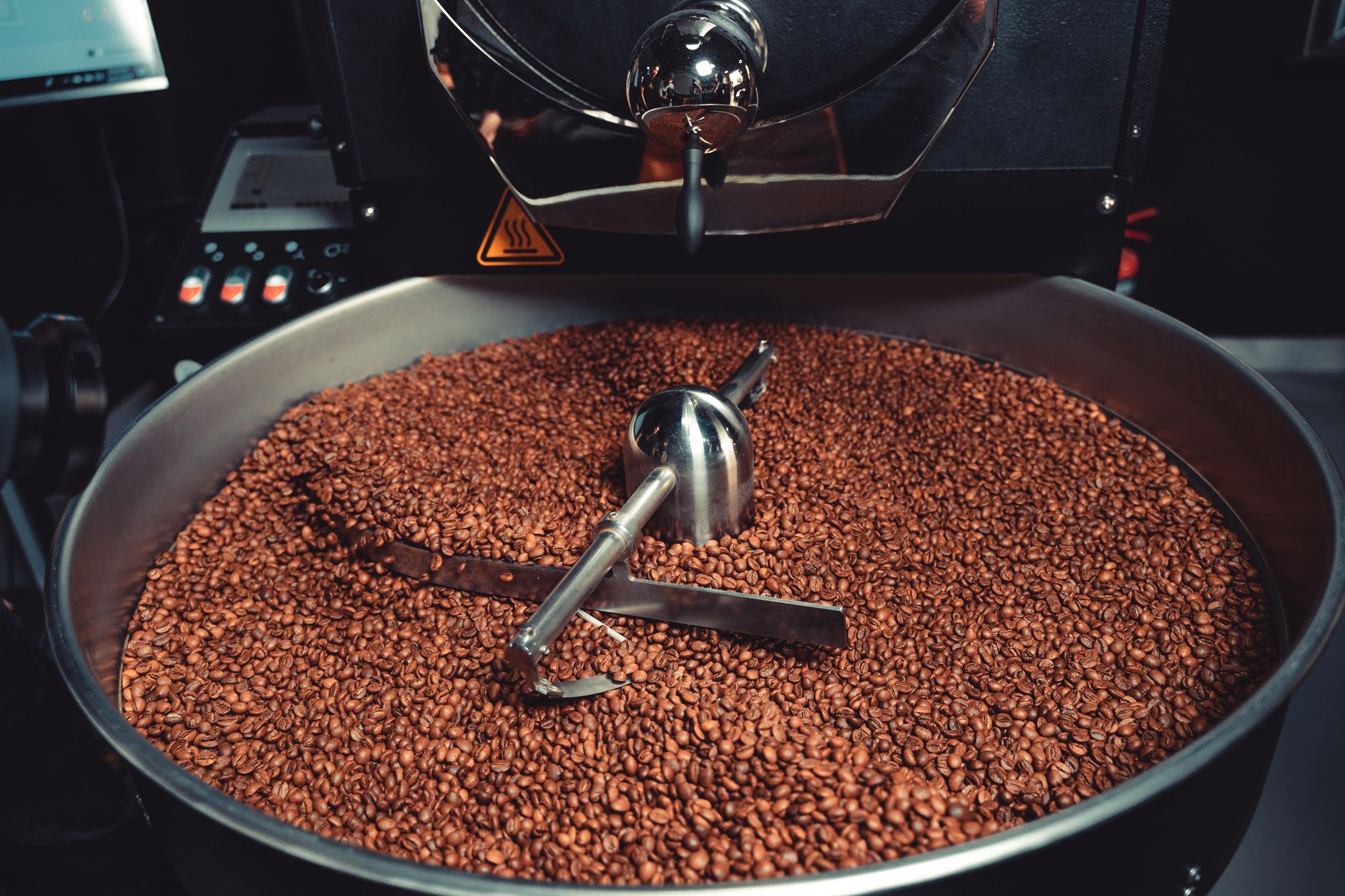
The classic and most widely used design. Green beans are tumbled in a rotating drum heated by gas, electric, or infrared elements. Drum roasters offer excellent thermal mass and consistency, making them ideal for producing large batches of uniform roast profiles.
- How they work: The drum rotates at 30–60 RPM, and hot air flows through the drum to transfer heat. The drum itself also retains heat, contributing to radiant and conductive heat transfer.
- Capacity range: 15 kg to 500+ kg per batch.
- Best for: Medium to large roasteries, high-volume production, traditional flavor profiles.
- Examples: Probat, Diedrich, Giesen (drum models).
Fluid Bed Roasters (Air Roasters)
Instead of a rotating drum, hot air is forced upward through a perforated plate, suspending the beans in a “fluidized” stream. This results in far faster heat transfer and shorter roast times.
- How they work: A high-velocity fan pushes hot air (400–500°F) through a bed of beans, keeping them in constant motion. No drum contact means heat is purely convective.
- Capacity range: 5 kg to 150 kg per batch.
- Best for: Small to medium roasteries, light roasts, preserving bright acidity and origin characteristics.
- Examples: Loring, Sivetz, and some production-scale fluid bed units.
Hybrid and Specialty Roasters
Some manufacturers combine drum and air technologies. For instance, the Loring Smart Roast uses a drum but recirculates air to improve energy efficiency. Others use centrifugal or spouted bed designs. These are less common but offer niche advantages. Additionally, infrared-assisted drum roasters provide more precise heat control, while electric drum roasters are emerging for urban roasteries with strict emission limits.
Why the Type of Roaster Matters for Your Business
Choosing between drum and fluid bed isn’t just a technical preference – it affects your bottom line, your coffee’s market position, and your operational flexibility.
1. Flavor Profile Control
According to a study by the Specialty Coffee Association, drum roasting tends to produce more body and caramelization due to Maillard reaction development over longer times. Fluid bed roasting preserves more volatile aromatics, yielding brighter, fruitier cups. If your brand emphasizes single-origin clarity, fluid bed may be superior. For businesses focusing on traditional espresso blends, drum roasters provide the consistency and depth that customers expect.
2. Energy Efficiency and Sustainability
Fluid bed roasters generally use less energy per pound of coffee because of shorter roast times. Loring’s recirculating design claims up to 80% energy reduction compared to traditional drum roasters. According to a 2024 report by the Coffee Technicians Guild, fluid bed roasters consume an average of 0.8 kWh per kilogram of green coffee, versus 1.4 kWh for drum roasters. For businesses with sustainability goals and an eye on energy costs, this is a major differentiator. Additionally, the
no-capex barista leasing model can help manage capital expenses for associated brewing equipment.
3. Production Volume and Batch Consistency
Drum roasters, with their high thermal mass, maintain temperature stability even during back-to-back batches. This makes them the go-to for large-scale production where consistency is non-negotiable. A Gartner survey on manufacturing consistency found that equipment with higher thermal inertia reduces batch variability by up to 18%. Fluid bed roasters, while efficient, require more precise control and may struggle with batch-to-batch uniformity at very high volumes. For high-throughput operations, drum roasters remain the industry standard.
4. Capital and Operating Costs
Initial cost per kg of capacity is generally lower for drum roasters, but fluid bed roasters can offset that with lower gas/electric usage. For a deeper look at pricing, see our
guide on office espresso machine costs for comparative context on commercial coffee equipment investments. Over a 5-year lifecycle, a 60 kg drum roaster may cost $0.25 per pound in energy and maintenance, while a fluid bed roaster can be as low as $0.18 per pound (source: Roast Magazine 2025 benchmarking).
💡Key Takeaway
Drum roasters are the workhorses of large-scale production, while fluid bed roasters excel in specialty roasting where flavor clarity and energy savings are priorities.
At its core, coffee roasting is the application of heat to green beans to drive chemical changes. However, the method of heat transfer varies by roaster type.
Heat Transfer Mechanisms
- Conduction: Heat transferred through direct contact with a heated surface (e.g., drum wall). Dominant in drum roasters.
- Convection: Heat transferred via hot air movement. Dominant in fluid bed roasters.
- Radiation: Heat transferred via infrared energy. Supplemental in some drum roasters.
Roast Profile Development
Drum roasters provide a slower, more controlled temperature ramp because the drum itself acts as a thermal battery. Roast times typically range from 12–18 minutes. Fluid bed roasters achieve similar development in 6–10 minutes due to efficient convective heat transfer. This speed can be a double-edged sword: it preserves delicate aromatics but leaves less margin for error.
Afterburner and Emissions
Many industrial roasters require afterburners to comply with local air quality regulations (e.g., EPA’s 40 CFR Part 63 for coffee roasting). Drum roasters produce more smoke and volatile organic compounds (VOCs)— up to 0.3 lb per batch vs. 0.1 lb for fluid bed roasters of similar capacity (SCA 2023 emissions study). This affects ventilation design and operating costs.
| Feature | Drum Roaster | Fluid Bed Roaster | Hybrid (e.g., Loring) |
|---|
| Heat Transfer | Conduction + Convection + Radiation | Convection (air only) | Convection + Recirculation |
| Roast Time (per batch) | 12–18 min | 6–10 min | 8–12 min |
| Batch Capacity | 15–500+ kg | 5–150 kg | 15–120 kg |
| Flavor Profile | More body, caramelization | Brighter, fruitier, more acidity | Balanced efficiency with body |
| Energy Usage (per kg) | 1.2–1.6 kWh | 0.7–1.0 kWh | 0.5–0.9 kWh (recirculated) |
| Best For | High-volume, traditional roasts | Specialty, light roasts | Sustainable, mid-scale roasteries |
| Typical Cost (60 kg) | $80k–$120k | $60k–$100k | $90k–$150k |
Implementation Guide: Choosing Your Roaster
Here is a step-by-step framework I’ve used with dozens of clients to select the optimal roasting technology.
Step 1: Assess Your Production Volume
- Under 100 lbs/week → consider 15–30 kg drum or fluid bed.
- 100–500 lbs/week → 30–60 kg drum or fluid bed.
- 500+ lbs/week → 60 kg+ drum, often with afterburner for emissions compliance.
Step 2: Define Your Roast Profile Target
- Traditional, darker roasts → drum.
- Light to medium, single-origin → fluid bed.
- Mixed portfolio → drum with airflow control (e.g., Probat with variable drum speed) or hybrid.
Step 3: Evaluate Energy and Ventilation Requirements
Fluid bed roasters produce less smoke per batch, reducing afterburner size requirement. Drum roasters generate more chaff and smoke, requiring robust ventilation and often a thermal oxidizer for regulatory compliance. Consult a local HVAC specialist early. For businesses also considering brewing equipment, understanding
why use specialty coffee beans business can enhance your overall offering.
Step 4: Consider Scalability
Drum roasters from manufacturers like Probat and Diedrich offer modular expansion – you can start with a 15 kg and add a 60 kg later. Fluid bed roasters are harder to scale because of their unique airflow dynamics. If rapid growth is expected, drum roasters are more flexible.
Step 5: Calculate Total Cost of Ownership
Beyond purchase price, factor in installation ($5k–$20k), ductwork ($10k–$30k), gas line upgrades, and ongoing maintenance. For restaurants and hotels, exploring
all-inclusive coffee service in Boston MA can provide insights into managed equipment solutions. Over 10 years, a $100k drum roaster might cost $50k in energy and maintenance, whereas a fluid bed roaster may cost $35k. Use a discounted cash flow model to compare.
Pricing & ROI
Industrial coffee roasters are significant capital investments. Below are typical price ranges for new equipment (2026 estimates, in USD):
| Capacity | Drum Roaster | Fluid Bed Roaster |
|---|
| 15 kg | $30,000–$45,000 | $25,000–$40,000 |
| 30 kg | $50,000–$70,000 | $40,000–$60,000 |
| 60 kg | $80,000–$120,000 | $60,000–$100,000 |
| 120 kg | $150,000–$250,000 | $120,000–$200,000 |
ROI factors:
- Green bean cost savings: Roasting in-house can reduce cost per pound by 30–50% versus buying roasted coffee. If you roast 10,000 lbs annually at a $3/lb savings, that’s $30,000/year – a 3-year payback on a $90k roaster.
- Value-add: Fresh-roasted coffee commands premium pricing. Specialty coffee shops selling single-origin roasts can charge $18–$25 per 12 oz bag, versus $12–$15 for commodity roasted coffee.
- Tax incentives: Some states offer energy efficiency tax credits for fluid bed roasters. Check with your accountant.
Real-World Examples
Example 1: A Hotel in San Jose, CA
A mid-sized hotel wanted to offer a signature roast for its guests. They opted for a 15 kg drum roaster from Diedrich, installed in the back of house. Initial cost: $38,000. Within 12 months, they saved 40% on coffee procurement and saw a 15% increase in breakfast satisfaction scores. For a full case study on coffee service in hospitality, see our
guide on premium coffee service in San Jose CA.
Example 2: A Micro-Roastery in Portland, OR
A startup roastery focused on single-origin light roasts chose a 30 kg Loring fluid bed roaster. Energy costs dropped 60% compared to their previous drum roaster. They also reduced roast time by 35%, allowing them to produce more batches per day. Within 18 months, they scaled from wholesale to a retail café. Their story is covered in our
article on café coffee service in Portland OR.
Example 3: A Café in Wilmington, NC
A café owner I worked with expanded into wholesale roasting. They bought a used 60 kg drum roaster (Probat) for $60k. With consistent batch-to-batch profiles, they secured contracts with three local restaurants. Annual revenue grew from $80k to $200k. See
café coffee service in Wilmington NC for more details.
Common Mistakes When Selecting an Industrial Coffee Roaster
After visiting dozens of roasteries, I’ve observed these frequent errors:
1. Prioritizing Capacity Over Quality
Buying a 120 kg roaster when your green bean supply and roasting skill are still developing leads to massive inefficiency. Start with a size you can fill 2–3 times per week.
2. Ignoring Ventilation Requirements
Drum roasters, especially larger ones, require substantial airflow and often an afterburner for air quality compliance. A roastery in a mixed-use building may face restrictions. Always check local building codes before purchasing.
3. Underestimating Training Needs
Fluid bed roasters require a different skill set than drum roasters. Many experienced roasters struggle with fluid bed’s faster reaction times. Budget for proper training or you’ll waste significant coffee in the first months.
4. Focusing Only on Initial Cost
A cheap drum roaster with poor insulation will drive up gas bills and may produce inconsistent roasts. Invest in quality insulation and burner efficiency – it pays back within 2–3 years.
5. Not Sampling Before Committing
I always recommend doing a test roast on the exact model you intend to buy. Bring your own green beans and evaluate the profile. Many manufacturers offer sample roasting as part of the sales process. For a broader view of equipment pitfalls, read our
guide on how much pour over coffee equipment costs for context on precision equipment investments.
Frequently Asked Questions
What is the most common type of industrial coffee roaster?
The drum roaster is by far the most common, used by 80–90% of commercial roasteries worldwide (source: Coffee Technicians Guild). Its reliability and consistency make it the default choice for high-volume production.
How much does an industrial coffee roaster cost?
Prices range from $30,000 for a 15 kg drum roaster to over $250,000 for a 120 kg fluid bed unit. Additional expenses include installation ($5k–$20k) and ventilation ($10k–$30k). For a detailed cost breakdown, see our
guide on office espresso machine costs as a reference for commercial coffee equipment pricing.
Can I use a fluid bed roaster for dark roasts?
Yes, but it requires careful control. Fluid bed roasters develop roasts faster, so you risk burning the beans if you push to second crack. Many fluid bed users prefer medium roasts; for dark roasts, drum is safer. According to a 2025 specialty coffee guide, only 15% of fluid bed users produce dark roasts consistently.
What size roaster do I need for a café?
For a café selling 50–100 bags per week, a 15–30 kg drum roaster is typical. If you also supply wholesale, a 60 kg unit may be justified. To match capacity to demand, explore
subscription coffee service in San Diego CA as an example of scaling coffee offerings.
Are there gas vs. electric options for industrial roasters?
Gas drum roasters dominate the market due to faster heat recovery. Electric roasters exist (e.g., some fluid bed units) but are less common at industrial scale due to higher electricity costs and slower heat-up times. However, electric roasters offer zero direct emissions – valuable for indoor or urban roasteries. A 2024 study by the Coffee Roasters Guild found that only 8% of commercial roasters use electricity as the primary energy source.
How long do industrial coffee roasters last?
With proper maintenance, drum roasters can last 20–30 years. Fluid bed roasters have a shorter lifespan (10–15 years) due to fan and heater wear. Replacing refractory panels and drum bearings in drum roasters costs $5k–$15k every 5–7 years. Fluid bed roasters require fan motor replacements every 3–5 years.
How do I maintain a drum roaster vs. fluid bed roaster?
Drum roasters need regular cleaning of chaff, lubrication of bearings, and calibration of temperature probes. Fluid bed roasters require cleaning of the air plenum and replacement of air filters. Both need annual professional inspection. The
white glove coffee service in Greenville SC offers an example of partnering with service providers for maintenance coverage.
What is the most energy-efficient industrial coffee roaster?
Fluid bed roasters with recirculation (e.g., Loring) are the most energy-efficient, using up to 80% less energy than conventional drum roasters. Among drum roasters, models with infrared burners and insulation can achieve 30% energy reduction compared to standard gas burners.
Final Thoughts on Industrial Coffee Roasters
Selecting the right type of industrial coffee roaster is a strategic decision with long-term implications for your product quality, operational costs, and growth potential. Drum roasters remain the industry standard for consistency and volume, while fluid bed roasters offer speed and flavor clarity. Assess your production needs, flavor goals, and budget carefully, and always test before you commit.
For a complete guide from planning to launch, revisit our
guide on top café equipment suppliers for supplier comparisons. If you’re exploring managed coffee solutions for your hospitality business, learn how
Busy Bean Coffee simplifies equipment and bean sourcing with all-inclusive membership.
About the Author
Travis Estes is the founder of
Busy Bean Coffee, where he has helped hundreds of hotels, restaurants, and offices deploy optimal coffee programs since 2014. He has overseen the installation of over 200 commercial roasting and brewing systems.
Free Coffee Pairing Guide & Specialty Roast Cheat Sheet
Unlock the secrets of perfect brewing ratios, water temperatures, and specialty roast profiles. Download the guide.