

Introduction
Walk into any bustling restaurant kitchen or hotel breakfast service between 6:30 and 8:30 a.m., and you’ll see the same scene: a countertop cluttered with half-empty carafes, a flustered server wrestling with a brewing cycle that won’t start, and that telltale burnt smell that says “someone forgot to flush the group head.” It’s a scene that costs hospitality businesses thousands of dollars in lost sales and reputational damage every year. And the culprit isn’t the roast, the water quality, or the barista’s skill — it’s neglected commercial coffee brewer maintenance.
I’ve spent the last decade helping foodservice operators keep their coffee programs running profitably. The difference between a brewer that lasts five years and one that flames out after eighteen months almost always comes down to a handful of preventive habits. But most guides on this topic are either too generic (“clean your machine daily”) or too technical (“replace the O‑rings on the solenoid valve”). This guide is different. It’s built for real operators who need practical, actionable steps that fit into a busy shift schedule without extra labor costs.
By the time you finish this article, you’ll know exactly what to do — day by day, week by week, month by month — to keep your commercial coffee brewer in peak condition, avoid emergency service calls, and deliver a consistently great cup of coffee to every customer.
What Commercial Coffee Brewer Maintenance Actually Covers
Let’s define the scope. A commercial coffee brewer — whether it's a pour-over batch brewer, a super-automatic espresso machine, or a bean-to-cup unit — is a complex piece of equipment. It has heating elements, pumps, valves, grinders, brew baskets, and internal plumbing. Maintenance means systematically addressing each component to prevent scale buildup, bacterial growth, mechanical wear, and flavor deterioration.
💡
Key Takeaway
Maintenance isn’t one action — it’s a layered system of daily, weekly, monthly, and quarterly tasks. Skipping any layer accelerates equipment failure and degrades coffee quality.
The four primary areas of concern are:
- Water quality and scaling – Hard water deposits (calcium carbonate) insulate heating elements, reduce flow rates, and eventually clog valves. Most commercial brewers have a built-in water filter, but filters need replacement every 3–6 months depending on usage and local water hardness.
- Brew group and basket cleanliness – Coffee oils and fines accumulate in brew baskets, dispersion screens, and spray heads. These residues go rancid, imparting off-flavors and increasing the load on the machine’s internal components.
- Grinder burr and chute condition – For any machine with an integrated grinder, stale coffee left in the chute and worn burrs lead to inconsistent particle size, which directly affects extraction efficiency and shot taste.
- Seals and gaskets – Rubber gaskets on brew heads and steam wands harden over time, causing leaks or steam pressure loss. Annual replacement is cheap insurance compared to a flooded counter or a machine that won’t hold pressure.
Why This Matters for Your Business
If you manage a restaurant, hotel, cafe, or office breakroom, your coffee brewer is a silent profit center — or a silent profit drain. Here’s what neglected maintenance costs you in real terms.
Revenue Lost to Downtime
A single brew cycle takes about 3–5 minutes. If your machine goes down during peak breakfast rush, you can lose 10–15 cycles per hour. At an average revenue of $3.50 per cup and a 50‑cup per hour demand, that’s $175 of lost sales per hour. A full repair could take two days. Do the math: $175 × 16 hours = $2,800 in lost revenue. That buys a lot of descaling solution.
Consistency Builds (or Kills) Brand Loyalty
Customers don’t notice when the coffee is good — they notice when it’s bad. A machine that’s not regularly descaled will produce bitter, over-extracted coffee. A dirty brew basket adds a rancid, oily taste. A clogged spray head results in uneven extraction. If a guest gets one bad cup, they’ll remember it. If they get two, they might not come back.
I worked with a boutique hotel in Dallas that switched to a subscription coffee service two years ago. Their previous approach was “clean it when it stops working.” After the first quarter with our managed plan — which includes quarterly deep maintenance — their comment card scores for breakfast coffee jumped from a 3.2 to a 4.8 out of 5. That’s the difference between “good enough” and “memorable.”
Longevity of Your Investment
A quality commercial coffee brewer costs anywhere from $3,000 to $15,000. With proper maintenance, you can expect 7–10 years of service. Without it, you’ll be shopping for a replacement in 3–4 years. The savings from maintaining your current machine easily justify the time investment — especially when you compare it to the capital expense of buying new equipment.
Health and Safety Compliance
Local health departments in most U.S. cities inspect commercial coffee equipment. Milk residues, coffee grounds, and standing water are breeding grounds for bacteria like E. coli and Listeria. A health violation on your coffee station could cost you a fine or, worse, a temporary closure. Regular cleaning schedules keep you compliant.
Practical How‑To: A Step‑by‑Step Maintenance Plan
Most operators fall into one of two traps: either they do too little (a quick rinse every few days) or they do too much (a deep clean once a month but skip the daily steps). The sweet spot is a balanced, documented routine. Below is a schedule I recommend to every client I work with.
Daily Tasks (5 minutes total)
| Task | What to Do | Why |
|---|---|---|
| Flush brew head | Run a full cycle of fresh water (no coffee) through the brew basket. | Removes residual coffee oils and grounds from the spray head and exit chute. |
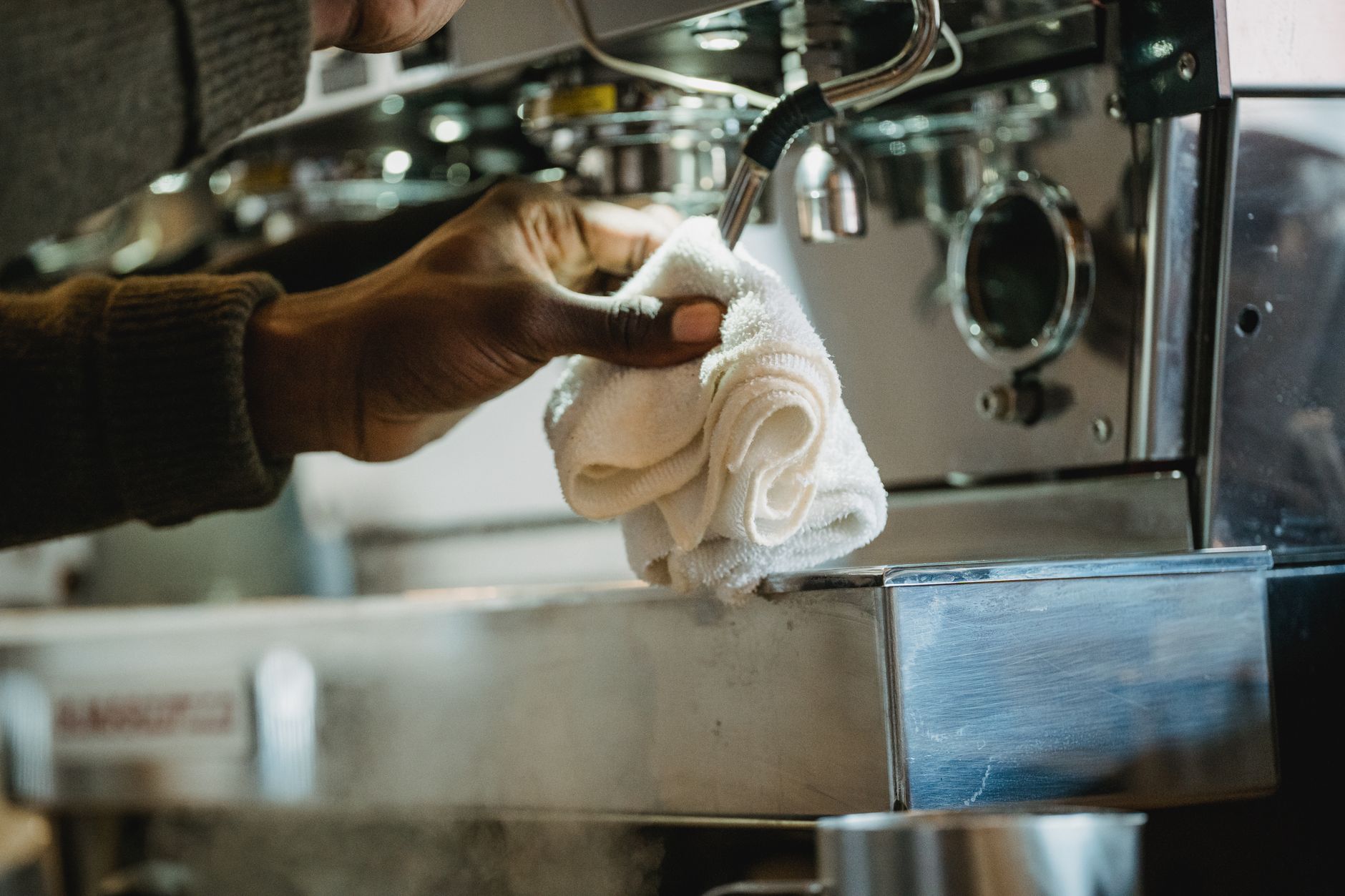
| Wipe down exterior | Use a damp, food‑safe cloth to wipe all surfaces, including the drip tray and warming plate. | Prevents sticky buildup and bacteria from drying onto stainless steel. |
| Empty and rinse drip tray | Remove and rinse the drip tray with hot water. | Standing water in the tray breeds bacteria and odors. |
| Check carafe/thermal server | Rinse each carafe with hot water; do not use soap on thermal carafes — it can cling to walls. | Residual coffee oils in carafes go rancid and taint the next batch. |
💡
Pro Tip
Train your opening staff to do these tasks during the first 5 minutes of their shift, before any coffee is brewed. Tie it to a task list on a whiteboard or a tablet-based checklist. Accountability is everything.
Weekly Tasks (15 minutes)
| Task | What to Do | Why |
|---|---|---|
| Remove and clean brew basket | Soak the brew basket in a solution of hot water & commercial de‑scaling powder for 10 minutes; use a soft brush. | Removes baked‑on coffee oils that daily rinsing misses. |
| Inspect spray head | Remove and check spray head for buildup. Clean with a pin or brush if clogged. | A clogged spray head causes uneven water distribution. |
| Clean grinder hopper (if applicable) | Empty the bean hopper and vacuum any chaff or dust. Wipe inside with a dry cloth. | Stale oil residue in the hopper contaminates fresh beans. |
| Descaling cycle (if recommended by manufacturer) | Run a descaling solution through the machine per manufacturer instructions. | Prevents scale accumulation on heating elements. |
I recommend writing the weekly tasks on a calendar with a specific day (e.g., every Monday morning). If you use a coffee service in Dallas TX that includes weekly cleaning, let the provider handle it — that’s part of our managed plan.
Monthly Tasks (30 minutes)
| Task | What to Do | Why |
|---|---|---|
| Deep descale | Use a stronger descaling solution (typically a full cycle with a descaling chemical, then two rinse cycles). Use only descalers approved by the manufacturer — never vinegar. | Monthly descaling prevents mineral deposits from hardening into scale that damages the boiler. |
| Check and replace water filter | Cut a new water filter into the line at the 3‑month mark (sooner if water is very hard). | A clogged filter restricts flow and bypasses filtration, introducing scale and chlorine taste. |
| Inspect all gaskets and seals | Visually check brew head gasket, steam wand tip, and water inlet seals for cracks or hardening. | Worn seals cause leaks that waste water and damage electronics. |
| Clean air intake vents (if fan‑cooled) | Use compressed air or a vacuum to remove dust from ventilation grilles. | Overheating is a leading cause of electronics failure in modern brewers. |
💡
Key Takeaway
If you’re not comfortable doing monthly descaling yourself, many managed coffee services include it. Our all‑inclusive subscription at Busy Bean Coffee covers all descaling and filter replacements as part of the monthly fee.
Quarterly Tasks (1–2 hours, or professional service)
| Task | What to Do | Why |
|---|---|---|
| Full system flush with professional cleaner | Run a commercial cleaning chemical (e.g., Puro Caf or Universal Cleaner) through all internal lines. | Removes biofilm and mineral scale that can restrict flow in internal tubing. |
| Calibrate dose and grind (espresso machines) | Adjust grinder settings and brew pressure according to manufacturer specs. | Inconsistent espresso requires recalibration after heavy use or seasonal bean changes. |
| Replace group head gasket | If you’re using an espresso machine, replace the group head gasket every 3 months (sooner if leaking). | A $2 gasket prevents $200 water damage. |
| Professional deep maintenance | Schedule a technician to check the boiler pressure, thermostat, and pump function. | Catches wear before it becomes catastrophic. |
Our commercial coffee machine maintenance service covers all quarterly tasks with a certified technician visit. Many of our clients prefer this because it frees their staff to focus on guests.
Common Mistakes in Commercial Coffee Brewer Maintenance
After hundreds of service calls, here are the three mistakes I see most often — and what to do instead.
1. Using Vinegar or Household Cleaners
Vinegar is acidic enough to dissolve scale, but it also attacks rubber gaskets and leaves an unpleasant smell that clings to plastic components for days. Many manufacturers void warranties if they detect vinegar residue.
Fix: Use only descalers and cleaning chemicals that are NSF‑certified and recommended by your machine’s manufacturer. Brands like CleanCaf and Puro are industry standards.
2. Skipping the Daily Flush
The most common rationale I hear: “We rinse the basket at the end of the day.” But by then, coffee oils have already cooled and solidified on the spray head and inside the brew chamber. A quick flush right after your last brew cycle clears out the majority of residue before it hardens.
3. Ignoring the Water Filter
“Our water is fine — we use a filter already.” That’s great, but filters have a limited capacity. A typical carbon block filter lasts 3 months or 1,500 gallons. Most operators forget to change it for 6–12 months. Old filters don’t just stop working — they actively harbor bacteria that get into the brew water.
4. Not Keeping a Maintenance Log
I can’t tell you how many managers tell me, “We clean the machine every week.” But when I ask them when the last descaling was, they guess. Without a log, tasks fall through the cracks when staff turnover happens. Simple. Keep a binder or use a digital checklist (Google Sheets, Trello, or even a shared Notes file). Document the date, task, and person who did it.
Comparison: Three Approaches to Commercial Coffee Brewer Maintenance
| Traditional DIY Approach | Generic “Cheap” Cleaning Service | Modern Managed Solution (Busy Bean Coffee) |
|---|---|---|
| Staff does it ad‑hoc; no system in place | You hire a third‑party cleaner who may not know your machine’s specs | Professional technician follows manufacturer’s exact schedule |
| Risk of skipped tasks, inconsistent cleaning | Cleaner may use harsh chemicals or skip descaling to save time | Uses NSF‑approved chemicals; descaling and filter replacement included |
| No log or accountability | Minimal oversight; no written report | After each visit you get a digital service log |
| Full liability on your staff | Low cost but high risk of equipment damage | Predictable monthly fee; no surprise repair costs |
| Average machine lifespan: 3–4 years | Average lifespan: 4–5 years (if technician is competent) | Average lifespan: 8–10 years with proactive monitoring |
Which one sounds better for your bottom line? The upfront monthly cost of a managed plan is often less than the revenue lost during a single day of downtime.

Frequently Asked Questions
1. How often should I descale my commercial coffee brewer?
Most manufacturers recommend descaling every 3 to 6 months, depending on water hardness. If your local water is very hard (above 7 grains per gallon), descale every 3 months. Soft water (below 3 grains) may allow you to stretch to 6 months. A simple water hardness test strip ($5 at a hardware store) gives you the answer in one minute.
2. Can I use generic descaling tablets?
No. Always use the descaling product specified by your machine’s manufacturer. Generic tablets can contain acids that attack seals, voids, and internal coatings — and will almost certainly void your warranty. Stick with brands like CleanCaf, Puro, or the OEM‑branded tablets.
3. What’s the best way to clean a thermal carafe?
Never put thermal carafes in a dishwasher. The extreme heat and detergent degrade the vacuum seal and leach chemicals into the stainless steel. Instead, fill with hot water, add a tablespoon of professional carafe cleaner (or white vinegar if your manufacturer allows it), swirl, let sit 15 minutes, and rinse thoroughly.
4. My machine is leaking water — what should I do?
First, check the drip tray sensor: if the tray is full, the machine may stop brewing. If that’s not it, a leaking machine usually means a worn gasket, a cracked hose, or a stuck solenoid valve. Stop using the machine immediately to prevent water damage to electronics or flooring. Call a certified technician — this is not a DIY fix.
5. How do I know if my grinder burrs need replacing?
You’ll know by the taste: coffee becomes more bitter or sour in the same recipe, or shots pull faster/slower than expected. Also, if you see fines (coffee dust) accumulating in the grind chamber, that’s a sign. Most commercial burrs last 500–1,500 pounds of coffee. Track your bean usage — when you pass 1,000 lbs, schedule a burr inspection.
6. Do I really need a water filter if I already have a whole‑house softener?
Yes. A whole‑house softener removes calcium and magnesium via ion exchange, but it doesn’t remove chlorine, sediment, or other organic compounds that affect coffee flavor. A dedicated coffee water filter (carbon block or reverse osmosis) is essential for both taste and machine longevity.
7. What’s the difference between daily and weekly cleaning?
Daily cleaning focuses on removing coffee residues and surface bacteria. Weekly cleaning digs deeper — cleaning the brew basket thoroughly, inspecting spray heads, and descaling if required. Both layers are necessary. Skipping weekly cleaning allows scale and oil‑based deposits to harden.
8. Should I clean the machine myself or hire a service?
It depends on your team’s bandwidth and expertise. Daily tasks can definitely be done by staff. Weekly tasks, if your team is trained, are manageable. But monthly and quarterly tasks — especially descaling and gasket replacement — often require specialized knowledge and tools to avoid damage. If you’re short‑staffed or want peace of mind, a managed service like ours makes financial sense. Most clients find that the cost of our plan is less than the lost revenue from one emergency service call.
Recommended Readings
To deepen your understanding of these topics, we recommend reading the following articles:
- The Ultimate Guide to Commercial Coffee Brewers
- Best Commercial Coffee Brewers for Restaurants
- Commercial Coffee Brewers for Hotels and Hospitality
- Commercial Coffee Brewers for Office Breakrooms
Conclusion
Keeping your commercial coffee brewer in top condition isn’t rocket science, but it does require a system. Daily flushes, weekly deeper cleans, monthly descaling, and quarterly professional inspections — each layer prevents problems that would otherwise cost you money, customers, and sanity.
If you want to simplify the whole process and never worry about skipped tasks or emergency repairs, we offer a comprehensive commercial coffee machine maintenance service that covers everything from filter changes to full descaling and calibration. But even if you choose to handle maintenance in‑house, the guide above gives you everything you need to extend your brewer’s life and protect your coffee program.
For the complete deep dive — including troubleshooting steps, a printable checklist, and a breakdown of costs — check out our Ultimate Guide to Commercial Coffee Machine Maintenance.
About the Author
I’ve been managing coffee programs for foodservice businesses since 2014. At Busy Bean Coffee, we’ve helped hundreds of hotels, restaurants, and offices turn their coffee breaks into revenue generators by pairing premium equipment with predictable, worry‑free maintenance. No fluff, just real results.
Free Coffee Pairing Guide & Specialty Roast Cheat Sheet
Unlock the secrets of perfect brewing ratios, water temperatures, and specialty roast profiles. Download the guide.