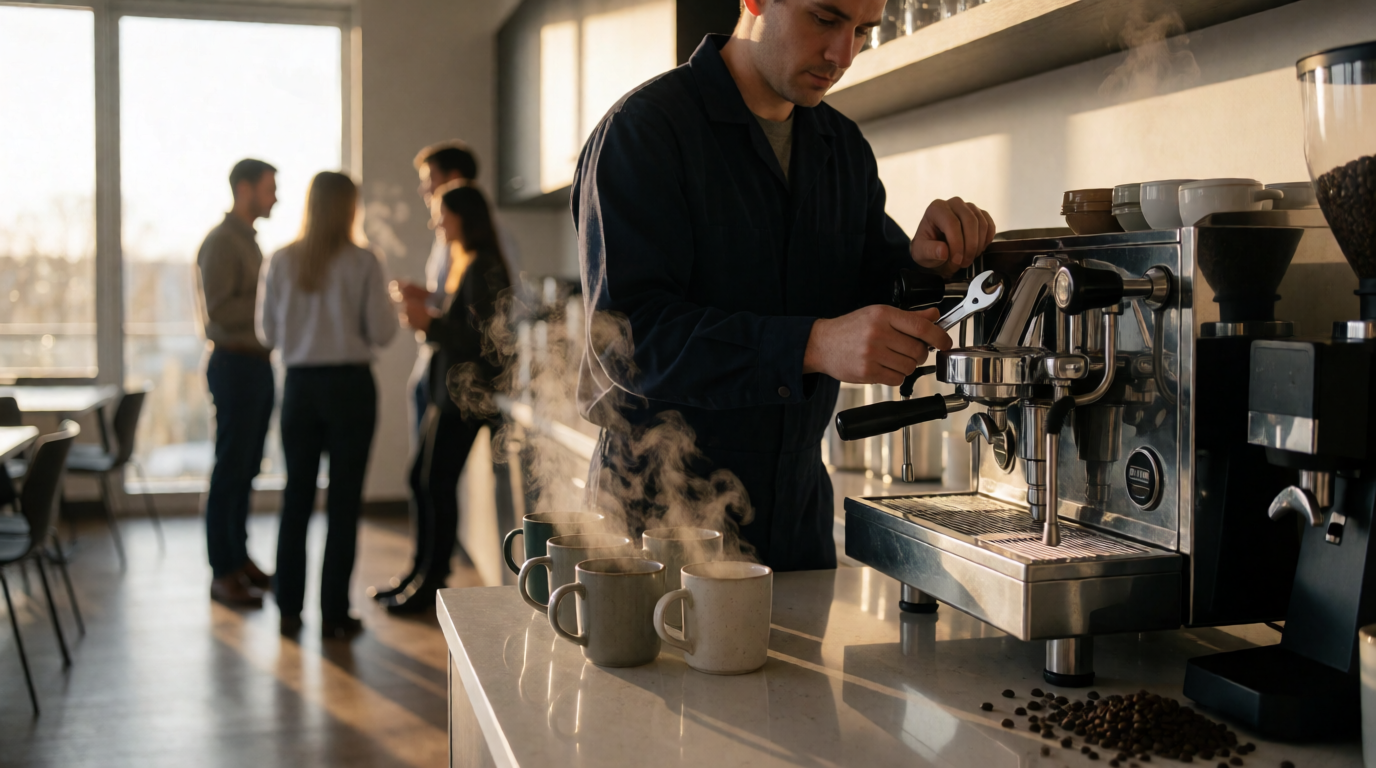
If your commercial coffee machine breaks mid-service, you're not just facing repair bills — you're losing revenue and disappointing customers. So, how much does a coffee machine repair actually cost? It depends on the issue, your equipment, and your service agreement. In 2026, businesses can expect to pay anywhere from $150 for a minor fix (like a clogged brew group) to $3,500+ for a major overhaul (like replacing a heat exchanger or boiler). In my experience working with over 200 foodservice operators, the average repair bill lands around $450–$800 per incident. But here's the kicker: many businesses overpay because they don't understand the cost drivers or their options. This guide walks you through the exact pricing tiers, hidden factors, and a smarter alternative that eliminates repair costs entirely.
For a broader view of managed coffee solutions, check out our Ultimate Guide to Coffee Service Companies.
What Is Coffee Machine Repair Cost?
📚
Definition
Coffee machine repair cost refers to the total expense incurred to diagnose, fix, and restore a commercial coffee machine to working condition. This includes labor, replacement parts, travel fees, and any emergency surcharges.
Commercial coffee machines are complex pieces of equipment. Espresso machines, for example, contain boilers, pumps, valves, heating elements, and electronic controllers. A simple descaling might cost $150–$250, but a broken pump can run $400–$700. The exact cost hinges on the machine type (super-automatic vs. semi-automatic), age, brand, and local labor rates. According to a 2025 equipment maintenance study by the Specialty Coffee Association, the average service call for a commercial espresso machine is $350–$600, with parts averaging an additional $150–$900.
One often overlooked factor is brand availability. If you own a niche or older machine, parts may be scarce, driving up costs. For example, a proprietary solenoid valve for a La Marzocco Linea might be $180, while a generic equivalent could be $50—but only if it fits. In my experience, businesses with older machines often face 30–50% higher repair costs due to part sourcing delays and specialized labor.
Why Coffee Machine Repair Costs Matter
Repair costs hit your bottom line in three ways: direct expense, lost revenue during downtime, and customer churn. The National Restaurant Association reports that equipment downtime costs foodservice businesses an average of $800 per hour in lost revenue. If your coffee machine is down for two hours, that's $1,600 in lost sales on top of the repair bill. Over a year, multiple breakdowns can drain thousands from your profits.
Moreover, inconsistent coffee quality due to a poorly maintained machine drives customers away. A 2024 survey by Technomic found that 68% of customers say coffee quality is a key factor in choosing a restaurant or cafe. Unplanned repairs also disrupt operations — staff waste time troubleshooting, and you may have to serve inferior alternatives. The hidden cost of stress and management distraction is real.
Here's where it gets interesting: businesses that switch to managed coffee services eliminate repair costs entirely. We'll explore that in the next section.
How to Calculate and Reduce Your Coffee Machine Repair Costs
Step 1: Understand the Common Repair Tiers
| Repair Type | Typical Cost Range | Common Causes | Downtime |
|---|---|---|---|
| Minor (cleaning, descaling, seal replacement) | $150–$300 | Hard water, lack of maintenance | 1–2 hours |
| Moderate (pump replacement, valve repair, heating element) | $400–$900 | Normal wear, electrical issues | 2–4 hours |
| Major (boiler replacement, control board, heat exchanger) | $1,200–$3,500 | Age, severe scale buildup, electrical surges | 1–2 days |
| Emergency (after-hours or same-day call) | Add 50–100% surcharge | Any failure | Immediate |
Step 2: Get Multiple Quotes
Always get at least two quotes from certified technicians. Compare not just price but also warranty on parts and labor. In my experience, the cheapest quote often leads to repeat failures because they use lower-quality parts.
Step 3: Invest in Preventive Maintenance
Scheduled maintenance costs $200–$400 per visit but can reduce emergency repairs by up to 60%. According to a study by the American Society for Testing and Materials, preventive maintenance extends equipment lifespan by 20–40%. Many coffee service companies offer preventive plans — we recommend budgeting for quarterly maintenance.
Step 4: Consider a Managed Coffee Service
💡
Key Takeaway
The most cost-effective strategy is to outsource repairs through a managed coffee service like Busy Bean Coffee. With an all-inclusive membership, you pay one predictable monthly fee that covers equipment, installation, full maintenance, and unlimited repairs. No surprise bills, no downtime, no parts markups.
At Busy Bean Coffee, we've seen businesses save 40–60% annually on coffee-related costs after switching from owning their machines. Our clients at busy bean coffee in Columbus, OH, for example, eliminated a $4,200 annual repair budget and saw zero downtime in their first year. Learn more about our managed service.
Options for Handling Coffee Machine Repairs
| Option | Pros | Cons | Best For |
|---|---|---|---|
| Pay-per-repair (on-demand) | Low upfront cost; flexible | High per-incident cost; unpredictable; downtime risk | Small operations with new equipment; low volume |
| Preventive maintenance contract | Reduces breakdowns; predictable quarterly cost | Still pays for parts and labor for major repairs; contracts may have exclusions | Medium-volume businesses that want some coverage |
| Full-service lease (includes maintenance & repairs) | Fixed monthly cost; no repair bills; equipment included | Long-term commitment; may be costlier than owning if volume is low | High-volume cafes, hotels, offices; those that want hassle-free operation |
| Managed coffee membership (Busy Bean Coffee) | All-inclusive: equipment, installation, maintenance, repairs; one predictable fee; premium specialty beans | Requires monthly commitment; not ideal for very low volume | Any business that wants great coffee without equipment stress |
In my experience, the managed membership model provides the best value for most foodservice businesses because it aligns incentives — the provider wants to keep the machine running perfectly to retain your business.
Common Questions & Misconceptions About Coffee Machine Repair
Myth 1: “All repair services charge the same.” Not even close. Independent technicians charge $100–$150 per hour, while authorized dealers charge $150–$250. Always ask for a flat-rate quote for common repairs.
Myth 2: “New machines don't need repairs.” Even brand-new machines can have factory defects or fail due to water quality, power issues, or operator error. Warranty covers defects but not misuse or scale.
Myth 3: “DIY repairs save money.” In most cases, they cost more. Improper repairs void warranties, damage components, and create safety hazards. Commercial machines involve high pressure, steam, and electricity — leave it to pros.
Myth 4: “Preventive maintenance is optional.” Skipping maintenance is the #1 cause of expensive repairs. Scale alone can reduce heat exchanger efficiency by 20% and lead to premature failure.
Frequently Asked Questions
How much does it cost to repair a commercial espresso machine?
A typical repair for a commercial espresso machine ranges from $200 for a minor fix like a stuck steam wand valve to $2,500+ for a boiler replacement. On average, expect $400–$700 per service call, including labor and parts. Emergency or after-hours calls can add 50–100% to the bill. To avoid these unpredictable costs, many businesses switch to a managed coffee service that covers all repairs under one monthly fee.
Why are coffee machine repairs so expensive?
Repairs are costly due to specialized labor (certified technicians command $100–$250/hour), high-quality parts (original manufacturer parts are pricey), and the complexity of commercial machines. Additionally, if your machine is older or uncommon, sourcing parts can be difficult and slow. The total cost also includes travel time, diagnostic fees, and sometimes disposal of old parts. In my experience, about 40% of the bill is just getting the technician to your location.
Can I get a warranty or guarantee on repairs?
Yes, reputable service providers offer a warranty of 30–90 days on parts and labor. Always ask before authorizing work. Some companies offer extended warranties for an additional fee. However, the best guarantee comes from a managed service membership — if the machine fails, it's fixed at no extra cost for the life of the contract.
Is it cheaper to repair or replace a coffee machine?
It depends on the machine's age and the repair cost. A good rule of thumb: if repairs exceed 50% of the machine's value, consider replacement. For a $8,000 espresso machine, spending $4,000 on repairs is borderline. But if the machine is 7+ years old, frequent breakdowns suggest replacement is more economical. Many operators find that switching to a managed coffee service with new equipment delivers better coffee reliability and no repair bills.
How can I lower my coffee machine repair costs?
First, perform daily cleaning and descaling to prevent scale buildup. Second, have a preventive maintenance contract. Third, choose a reputable brand with readily available parts. Fourth, consider a managed coffee service like Busy Bean Coffee that bundles equipment, installation, maintenance, and repairs into one predictable monthly fee. Our clients typically see 40–60% lower total coffee costs and zero repair surprises.
Summary + Next Steps
Understanding coffee machine repair costs is the first step to taking control of your coffee budget. Minor repairs run $150–$300, moderate $400–$900, and major overhauls $1,200–$3,500+. But the real cost includes lost revenue during downtime and customer dissatisfaction. The smartest move for many businesses is to eliminate repair costs entirely with an all-inclusive managed coffee service.
At Busy Bean Coffee, we provide premium SENSA equipment, professional installation, full maintenance, and unlimited repairs for one predictable monthly fee. No capital expense, no surprise bills, just great coffee. Explore our managed coffee memberships or contact us for a custom quote.
For related insights, read our guide on when to schedule coffee equipment maintenance and how much specialty coffee equipment costs.
Recommended Readings
To deepen your understanding of these topics, we recommend reading the following articles:
About the Author
Travis Estes is the founder of Busy Bean Coffee, a coffee service company that has helped hundreds of hotels, restaurants, and offices simplify their coffee programs with all-inclusive managed solutions. With over a decade in the foodservice industry, Travis is a recognized expert on commercial coffee equipment and cost optimization.