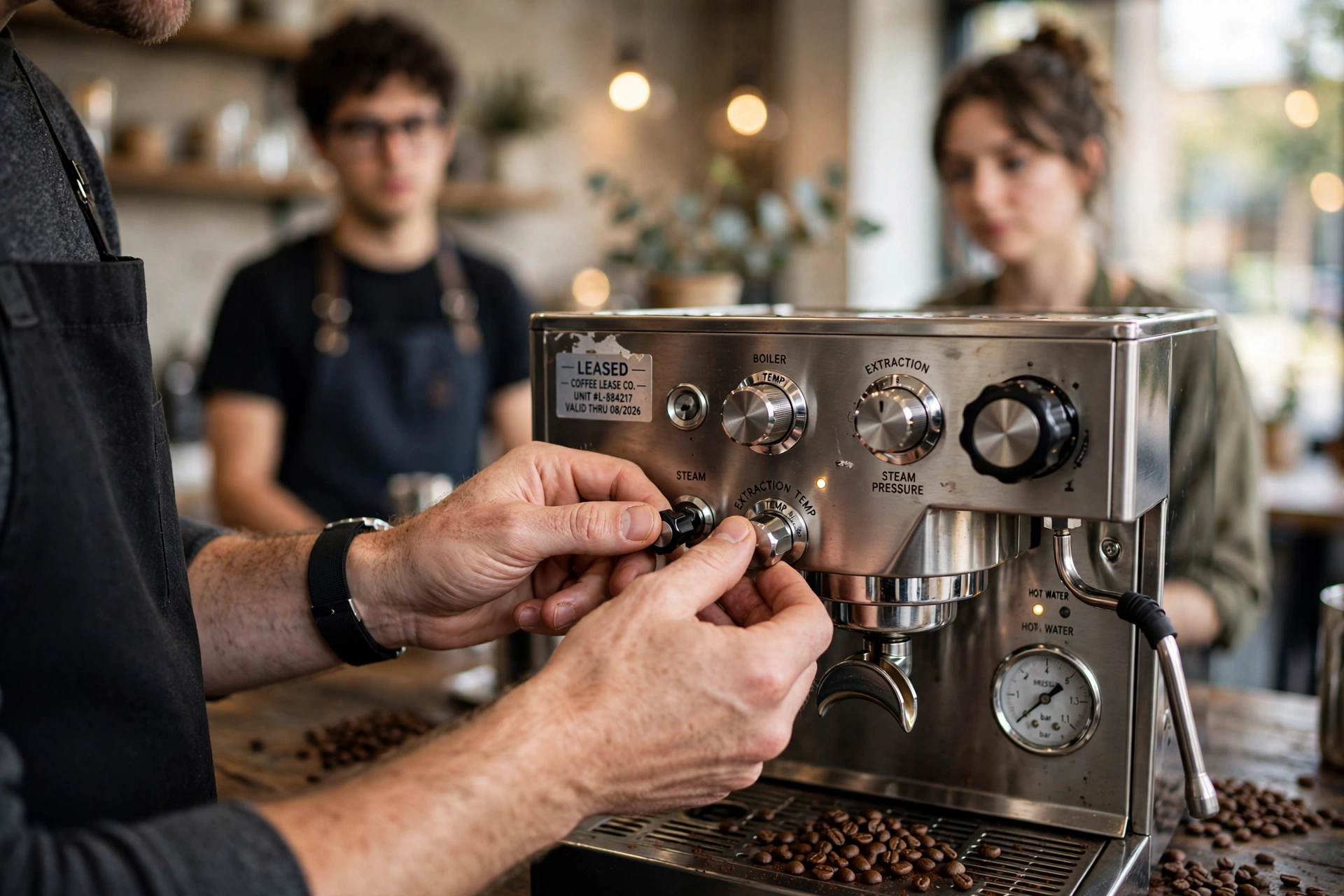
Operating a high-end espresso machine without proper staff training is the fastest way to turn a premium asset into an expensive paperweight. In my experience working with high-volume hospitality groups, the most common cause of equipment failure isn't mechanical age, but operator error. When a business invests in a leased system, they often forget that the hardware is only as good as the person pressing the buttons. If your team cannot dial in the grind or maintain the steam wand, you are effectively paying a monthly lease for substandard beverages.
For a comprehensive overview of this process, explore our guide on coffee machine lease training. Ensuring your team understands the nuances of specialty coffee and equipment maintenance is the only way to protect your bottom line and ensure consistent quality across every cup served in 2026.
What is Coffee Machine Lease Training?
📚
Definition
Coffee machine lease training is a structured educational program designed to teach staff how to operate, maintain, and troubleshoot commercial coffee equipment provided through a lease or managed service agreement.
Coffee machine lease training is the process of aligning your human capital with your hardware capabilities. Unlike a purchased machine where training is often a one-time event, lease training focuses on the longevity of the asset and the consistency of the output. It encompasses everything from basic operation and milk texturing to deep-cleaning protocols and basic troubleshooting that prevents unnecessary service calls. Because leased equipment often comes with strict maintenance clauses, training is not just about quality, it is about risk mitigation.
When we implement training for our clients at Busy Bean Coffee, we focus on the "Golden Trio": Extraction, Texture, and Sanitation. Extraction involves understanding the relationship between the coffee bean and the water, Texture focuses on the chemistry of milk aeration, and Sanitation ensures the machine meets health codes and performs optimally. In 2026, where labor turnover in the foodservice industry remains a challenge, a standardized training manual becomes a vital business asset that ensures a new hire can reach productivity in hours rather than weeks.

Why Does Coffee Machine Lease Training Matter for Your Business?
Staff training is the bridge between paying for a premium machine and actually delivering a premium experience. Without it, businesses face a hidden cost known as "operational leakage," where wasted beans, spoiled milk, and machine downtime erode the profit margins of every drink sold. According to the Specialty Coffee Association (SCA), consistency in brew ratios and temperature is the primary driver of customer retention in specialty coffee environments. If your staff is guessing the dose, your customers will taste the inconsistency.
First, training significantly reduces the Total Cost of Ownership (TCO). Leased machines often have service level agreements (SLAs) that cover mechanical failure but exclude "user-inflicted damage." When a staff member fails to purge a steam wand or ignores a backflush alert, the resulting clog is often billed as a technician visit rather than a warranty repair. By investing in training, you eliminate these avoidable expenses. In my experience, businesses with certified training programs see a 30% to 40% reduction in emergency service calls within the first six months.
Second, it empowers your employees. A barista who understands the physics of Coffea arabica and the mechanics of an espresso machine is more engaged and takes more pride in their work. This leads to higher quality control and a better customer experience. When staff can explain why a certain roast requires a specific temperature, they move from being "button pushers" to being brand ambassadors for your coffee service. This transition is essential for those utilizing high-end solutions like Sensa Coffee Service in Dallas TX, where the equipment is designed for precision.
Third, food safety and compliance are non-negotiable. The NSF International provides rigorous standards for food equipment sanitation. Poorly trained staff often neglect the internal gaskets and brew groups, leading to bacterial buildup and off-flavors. Professional training ensures that every employee follows a strict sanitation schedule, protecting your guests and your business from health code violations.
How to Implement Coffee Machine Lease Training Effectively?
Implementing a training program requires a shift from "showing someone how it works" to creating a repeatable system. The goal is to create a standard of excellence that persists regardless of who is behind the counter. For those operating in competitive markets, such as those using Sensa Coffee Service in Seattle WA, this level of precision is what separates a mediocre cafe from a destination spot.
Step 1: Establish a Baseline Technical Standard. Before training staff, define what a "perfect cup" looks like for your specific coffee bean. This includes the target brew time, the weight of the dose, and the temperature of the milk. Without a benchmark, training is subjective. Use a digital scale and a timer to create a "recipe card" that is taped next to the machine.
Step 2: Conduct Hands-On Technical Workshops. Theory is helpful, but muscle memory is what matters during a morning rush. Training should be divided into three modules: Preparation (grinding and tamping), Execution (pulling the shot and steaming), and Recovery (cleaning and purging). Each staff member must demonstrate the ability to pull three consecutive shots within a 2-second variance of the target time before they are cleared for solo operation.
Step 3: Implement a Daily Maintenance Checklist. The machine should have a physical or digital checklist that must be signed off every shift. This includes the morning calibration, the mid-day purge, and the end-of-day chemical backflush. If you are utilizing a No Capex Coffee Service in Mount Pleasant SC, maintaining the equipment is part of the partnership agreement. Documentation proves that you are upholding your end of the lease.
Step 4: Quarterly Refresher Courses. Taste buds drift and habits form. Every three months, conduct a "calibration session" where the team tastes the coffee together and identifies flaws. This keeps the staff sharp and ensures that the quality doesn't degrade over time. This is particularly useful for businesses in growing hubs, similar to those seeking Sensa Coffee Service in Austin TX, where customer expectations for specialty coffee are exceptionally high.
Coffee Machine Lease Training vs. Self-Taught Operation
Many business owners make the mistake of assuming that if a staff member "knows how to make coffee," they can operate a commercial leased machine. This is a dangerous assumption. Commercial equipment operates at pressures and temperatures that can be destructive if mishandled. The difference between professional training and a "learn-as-you-go" approach is the difference between an asset and a liability.
| Feature | Self-Taught/Casual | Generic Online Tutorial | Professional Lease Training |
|---|---|---|---|
| Consistency | Low; varies by staff member | Moderate; lacks tactile feedback | High; standardized recipes |
| Machine Lifespan | Reduced due to poor cleaning | Average; basic knowledge | Maximized through preventative care |
| Waste Levels | High; excessive dial-in waste | Moderate | Low; precision dosing techniques |
| Troubleshooting | Call technician for every error | Guesswork; high risk of break | First-line resolution of common issues |
| Compliance | Hit-or-miss sanitation | Theoretical knowledge | Verified NSF/FDA standard cleaning |
As the table illustrates, the professional approach focuses on the intersection of quality and sustainability. When you use a managed service like those provided in Sensa Coffee Service in Chicago IL, the training is integrated into the service, ensuring that the equipment's performance is matched by the operator's skill. Relying on a generic YouTube video for a $15,000 machine is an unacceptable business risk.

Common Mistakes to Avoid in Staff Training
One of the most frequent errors I see is the "One-and-Done" training session. A manager spends two hours with a new hire on Monday, and by Friday, the new hire is tamping too hard and ignoring the steam wand purge. Training is not an event; it is a continuous process. If you don't audit the output, the staff will naturally revert to the easiest, not the best, method.
Another critical mistake is neglecting the "Why" behind the "How." When you tell a barista to purge the steam wand, they might do it because they were told to. But when you explain that milk proteins build up and create a breeding ground for bacteria and alter the taste of the coffee, they do it because they understand the risk. This intellectual buy-in is what ensures compliance when the manager isn't looking. According to the National Coffee Association USA (NCA), consumer demand for specialty coffee is driven by a desire for transparency and quality, which starts with the staff's knowledge.
Avoid the temptation to over-complicate the initial training. If you dump twenty years of roasting knowledge on a part-time employee in one afternoon, they will freeze. Break the training into tiers: Level 1 is basic operation and cleaning; Level 2 is dial-in and calibration; Level 3 is advanced troubleshooting and flavor profiling. This tiered approach prevents burnout and allows for a clear progression path for employees, which can actually help with staff retention.
Finally, do not ignore the water filtration system. Many training programs focus entirely on the coffee and milk, forgetting that the water is 98% of the drink. Training should include how to check the filtration system and when to alert the provider for a filter change. Neglecting this is the fastest way to cause scale buildup, which is a leading cause of machine failure and is often not covered under standard lease agreements. Whether you are in a high-humidity environment or a dry climate, such as those using Sensa Coffee Service in Phoenix AZ, water quality is the foundation of equipment longevity.
Frequently Asked Questions
How long should the initial coffee machine lease training take?
Initial training should be spread over three to five days rather than a single session. The first day should focus on safety and basic operation. The second and third days should cover milk texturing and shot extraction. The final days should be dedicated to cleaning protocols and a practical exam. This spacing allows the staff to absorb the information and practice in a low-pressure environment before the business opens to the public.
Does training reduce the cost of my monthly lease?
While training does not typically lower the monthly lease payment itself, it dramatically reduces the total cost of operation. By preventing user-inflicted damage and reducing the need for emergency technician visits, you avoid expensive out-of-pocket repairs. Furthermore, precision training reduces coffee bean waste during the dial-in process, which directly increases the profitability of every cup served, effectively lowering your overhead.
What happens if a staff member is not following the training?
Correction should be immediate and based on the established "recipe card." When a shot is pulled incorrectly, the manager should not just fix it but have the staff member identify the error. This reinforces the training. If a staff member consistently fails to follow sanitation protocols, it becomes a liability issue. Use a signed training acknowledgement form to ensure employees understand that following the cleaning checklist is a requirement of their role.
Can we train staff using online videos instead of in-person sessions?
Online videos are excellent for theoretical knowledge and as a refresher, but they cannot replace tactile training. Coffee is a sensory experience. A video cannot teach a barista how a portafilter should feel when it is locked in or how the sound of the steam wand changes when the milk reaches the correct temperature. A hybrid approach, online theory followed by in-person certification, is the most effective method for 2026 standards.
How often should we update our training for leased equipment?
Training should be updated whenever you change your coffee bean supplier or when the lease provider updates the machine's firmware or hardware. Additionally, a full review of the training manual should occur annually to incorporate new industry standards from bodies like the SCA. This ensures your team remains current with evolving specialty coffee trends and maintains the highest possible quality standards.
Conclusion
Investing in coffee machine lease training is not an optional luxury; it is a fundamental requirement for any business that wants to maximize the ROI of its equipment. When you bridge the gap between high-end hardware and professional skill, you eliminate waste, protect your assets from avoidable damage, and deliver a consistent product that keeps customers coming back. In the 2026 landscape, the quality of your coffee is a direct reflection of the quality of your training.
Whether you are managing a small boutique or a large corporate office, the principles of precision, sanitation, and continuous education remain the same. If you have noticed a dip in quality or an increase in machine downtime, it is time to audit your staff's skills. For a deeper dive into establishing these standards, refer back to our guide on coffee machine lease training to ensure your team is performing at their peak.
If you are looking for a seamless, all-inclusive solution that combines world-class equipment with the professional support needed to keep your business running, discover how Busy Bean Coffee Blog can transform your beverage service. From professional installation to end-to-end managed memberships, we ensure your coffee is always an asset, never a hassle.
Ready to Upgrade Your Business Coffee?
Café-quality coffee, zero maintenance headaches, and one predictable monthly price. Let's build your custom coffee program.
Free Coffee Pairing Guide & Specialty Roast Cheat Sheet
Unlock the secrets of perfect brewing ratios, water temperatures, and specialty roast profiles. Download the guide.