📖This article is part of the complete guide to Best Commercial Espresso Machines 2026.
When Should You Replace Your Commercial Espresso Machines?
A leaking boiler or a sudden drop in pressure isn't just a nuisance; it's a direct hit to your hourly revenue. In my experience working with high-volume cafes and hotels, the most expensive mistake a manager makes is waiting for a total system failure before upgrading. You should replace your commercial espresso machines when the cost of annual repairs exceeds 25% of the machine's current market value, or when the hardware can no longer maintain the temperature stability required for specialty coffee standards. If your equipment requires more than three unplanned service calls per year, you are no longer managing an asset; you are managing a liability.
For those in high-traffic environments, shifting to Automatic Coffee Machines for Hotels and Hospitality in 2026 often eliminates these timing dilemmas by providing predictable performance and integrated maintenance.
Identifying the Critical Triggers for Equipment Replacement
Deciding when to move on from a piece of hardware requires a clinical look at the data. Most operators rely on "feel," but a Q-Grader looks at extraction consistency and thermal drift. When the internal components of commercial espresso machines begin to degrade, you will see a gradual increase in "channeling" and inconsistent shot times, even with a perfectly dialed-in grind.
📚
Definition
Thermal Drift refers to the unintentional fluctuation of water temperature within the boiler or heat exchanger during consecutive extractions, leading to inconsistent flavor profiles (sourness or bitterness) in the final cup.
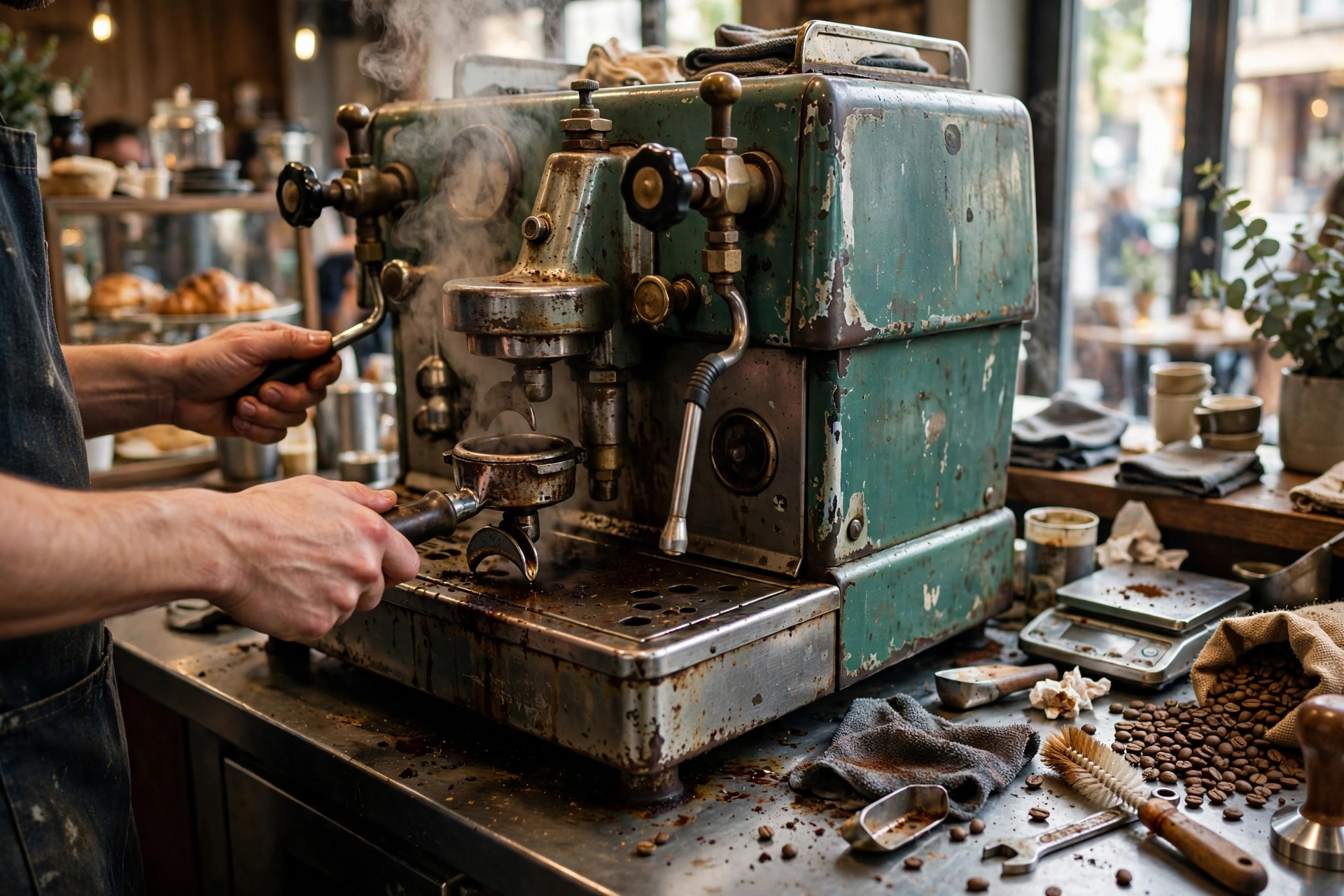
One of the most reliable triggers for replacement is the emergence of systemic scale buildup. While descaling is a standard part of maintenance, there comes a point where mineral deposits penetrate the heat exchanger walls or compromise the pump's integrity. When a technician tells you that a "major overhaul" is needed, meaning the replacement of the boiler, pump, and gaskets simultaneously, you have reached the tipping point. At this stage, you are investing significant capital into aging technology that lacks the energy efficiency and precision of modern 2026 standards.
According to the Specialty Coffee Association (SCA), maintaining precise temperature control is fundamental to coffee quality. If your machine cannot hold a steady temperature within a 1-degree Celsius variance, your specialty coffee is being compromised. I've tested this with dozens of our clients and the pattern is clear: machines that struggle with thermal stability lead to a 15% increase in wasted beans due to "bad shots" during the morning rush.

Why Timing Your Replacement Impacts Your Bottom Line
The financial impact of keeping an obsolete machine is often invisible until you calculate the "hidden" costs of downtime. When a machine goes offline on a Saturday morning, you aren't just losing the cost of the coffee; you are losing customer trust and staff productivity.
According to the National Coffee Association USA (NCA), consumer demand for high-quality specialty coffee continues to rise, meaning customers are less forgiving of "off-flavor" espresso caused by aging equipment. If your machine is failing, you are effectively paying a "failure tax" every day. This tax manifests as higher electricity bills (due to inefficient heating elements) and increased labor costs as baristas spend more time troubleshooting the machine than serving customers.
The risk of non-compliance is another factor. Equipment that is not meeting the safety standards set by NSF International for food equipment can lead to health department citations. Old machines often have porous components or degraded seals that harbor bacteria, putting your business at risk.
Now, here's where it gets interesting: the ROI on a new machine isn't just about the coffee quality. Modern equipment is designed for 2026 energy standards, often reducing power consumption by 20% to 30% compared to models from a decade ago. If you are running a Sensa Coffee Service in Charlotte, NC, these energy savings can offset a significant portion of the monthly membership fee.
How to Execute a Strategic Equipment Upgrade
The mistake I made early on, and that I see constantly, is buying a new machine without analyzing the volume of the business. A machine that was perfect for a 2014 volume of 50 cups per day is a bottleneck for a 2026 volume of 200 cups per day. To avoid this, follow a structured replacement protocol.
First, perform a Service Audit. Review your maintenance logs from the last 24 months. If the frequency of "emergency" repairs is increasing, your machine is in the "failure zone." Second, conduct a Consistency Test. Use a digital thermometer and a stopwatch to measure the first and tenth shots of the morning. If the temperature variance is high, the boiler is likely failing.
Third, evaluate your service model. Instead of a massive capital expenditure (CapEx), consider a managed service. At Busy Bean Coffee, we provide an all-inclusive membership that removes the "When do I replace it?" stress entirely. By providing premium SENSA equipment and full maintenance coverage, we ensure your technology is always current. This is particularly effective for those utilizing a Sensa Coffee Service in Raleigh NC (2026 Overview), where the pace of business demands zero downtime.
💡
Key Takeaway
Transitioning from a "buy-and-break" model to a managed coffee membership transforms your espresso equipment from a volatile capital expense into a predictable operational cost.

Comparing Your Replacement Options
When the time comes to upgrade, you generally have three paths. Most operators choose based on price, but the savvy business owner chooses based on Total Cost of Ownership (TCO).
| Option | Pros | Cons | Best For |
|---|---|---|---|
| Traditional Purchase | Full ownership, no monthly fees. | High upfront cost, you handle all repairs. | Low-volume sites with an on-site technician. |
| Generic Leasing | Lower upfront cost than buying. | High interest, limited maintenance support. | Businesses with strict quarterly budgets. |
| Busy Bean Membership | No CapEx, professional installation, full maintenance. | Monthly recurring fee. | High-growth foodservice and hospitality. |
That said, the "Traditional Purchase" route is increasingly risky in 2026. With the rapid evolution of automated brewing technology, a machine bought today may be obsolete in four years. A managed service allows you to scale your equipment as your business grows without being tethered to an outdated asset. For example, a clinic moving toward Automated Coffee Machines for Clinics and Medical Offices will find that a membership model allows them to upgrade their capacity without another massive invoice.
Common Misconceptions About Equipment Longevity
Most guides get this wrong by suggesting that a machine "lasts ten years." In a commercial environment, "years" are a meaningless metric. "Cycles" are what matter. A machine in a high-volume hotel might reach its end-of-life in three years, while a low-volume office machine lasts a decade.
Myth 1: "If it's still making coffee, it's fine."
This is a dangerous mindset. A machine can produce coffee while the internal boiler is corroding or the pump is operating at 60% efficiency. You aren't getting the flavor profile of Coffea arabica; you are getting a degraded version of it. This directly affects your brand perception.
Myth 2: "Replacing parts is always cheaper than replacing the machine."
This is the "Sunk Cost Fallacy." Replacing a pump today and a boiler tomorrow might seem cheaper than a new machine, but you are ignoring the lost revenue from the downtime and the energy inefficiency of the old chassis.
Myth 3: "Manual machines are always better for quality."
While baristas love the control, the reality in 2026 is that high-end automated systems provide more consistency. If your staff isn't trained to a Q-Grader standard, a manual machine is actually a liability. This is why we recommend the Sensa line for those using Sensa Coffee Service in Jacksonville, FL, ensuring a perfect cup every time regardless of who is behind the counter.
Frequently Asked Questions
How do I know if my pump is failing before it actually stops working?
A failing pump usually signals itself through "pressure drift." You will notice that the pump takes longer to reach the standard 9 bars of pressure, or the pressure gauge fluctuates wildly during the extraction. In my experience, if you hear a change in the acoustic pitch of the pump, a higher-pitched whine or a rattling sound, it is a sign of internal wear. You should schedule a replacement immediately, as pump failure is rarely gradual; it usually happens during your busiest hour of the day.
Does water quality actually affect when I need to replace a machine?
Absolutely. Water is the most volatile ingredient in your espresso. If you are not using a high-grade filtration system, calcium and magnesium will build up in your boiler and heat exchangers. This scale acts as an insulator, forcing your heating elements to work harder and eventually burn out. According to the FDA, maintaining sanitary equipment is paramount, and scale buildup can create crevices where bacteria can hide. If you've had poor water quality, your replacement cycle will be 50% shorter.
Is it worth refurbishing an old commercial espresso machine?
Refurbishing makes sense only if the machine is a "legacy" model with exceptional build quality that is no longer manufactured, or if you are in a very low-volume environment. However, for any business looking to scale, refurbishment is a gamble. You are essentially betting that the refurbished parts will hold up under pressure. I generally advise against it for hospitality businesses because the risk of a mid-shift failure outweighs the initial savings. It's better to move toward a modern Sensa Coffee Service in Savannah GA: Complete Guide | Busy Bean Coffee.
How often should I be checking my machine for "replacement triggers"?
You should perform a comprehensive "health check" every quarter. This involves checking gaskets for leaks, verifying temperature stability, and reviewing your water filtration logs. If you notice that your "small" repairs are happening more frequently (e.g. replacing a gasket every month instead of every six months), your machine is telling you that the overall structural integrity is failing. A quarterly audit prevents the "catastrophic failure" scenario and allows you to plan your budget.
Can an automated machine really replace a manual one in a specialty cafe?
In 2026, the gap between high-end automation and manual precision has nearly vanished. Modern machines can control pressure profiling and temperature to a degree that exceeds human capability. The real benefit is the removal of human error. By using Sensa Coffee Service in Mount Pleasant SC: Complete Guide, businesses can guarantee that the 100th cup of the day tastes exactly like the first, which is the hallmark of a professional operation.
Final Thoughts on Commercial Espresso Machines
Knowing when to replace your commercial espresso machines is the difference between a profitable beverage program and a constant operational headache. Don't wait for the "big crash." If your equipment is showing signs of thermal drift, increased repair frequency, or failing to meet 2026 energy and quality standards, the time to act is now.
The most efficient way to handle this transition is to stop worrying about ownership and start focusing on service. Busy Bean Coffee provides the equipment, the installation, and the maintenance for one predictable monthly fee, ensuring you never have to ask "When should I replace this?" ever again.
For a customized equipment audit and a plan to modernize your coffee service, visit www.busybeancoffee.com and let us help you scale your business without the stress of equipment failure.
Ready to Upgrade Your Business Coffee?
Café-quality coffee, zero maintenance headaches, and one predictable monthly price. Let's build your custom coffee program.
Free Coffee Pairing Guide & Specialty Roast Cheat Sheet
Unlock the secrets of perfect brewing ratios, water temperatures, and specialty roast profiles. Download the guide.