How Much Do Commercial Espresso Machines Actually Cost?
Buying a professional coffee setup is rarely as simple as picking a price tag off a website. In my experience working with dozens of hospitality clients, the actual cost of commercial espresso machines typically ranges from $2,000 for entry-level prosumer models to over $30,000 for high-volume, multi-group masterpieces. However, the "sticker price" is often just 60% of the total cost of ownership; the remaining 40% is absorbed by water filtration, installation, electrical upgrades, and the inevitable maintenance required to keep a boiler from scaling.
If you are budgeting for a new cafe or upgrading a restaurant beverage program in 2026, you must account for the "hidden" infrastructure. A $15,000 machine that requires a 220V dedicated circuit and a plumbed-in reverse osmosis system can easily cost another $3,000 to $5,000 before you even pull your first shot of espresso. For those who want to avoid this capital expenditure entirely, managed service memberships, like the all-inclusive solutions we provide at Busy Bean Coffee, have become the gold standard for maintaining cash flow.
What Determines the Price of Commercial Espresso Equipment?
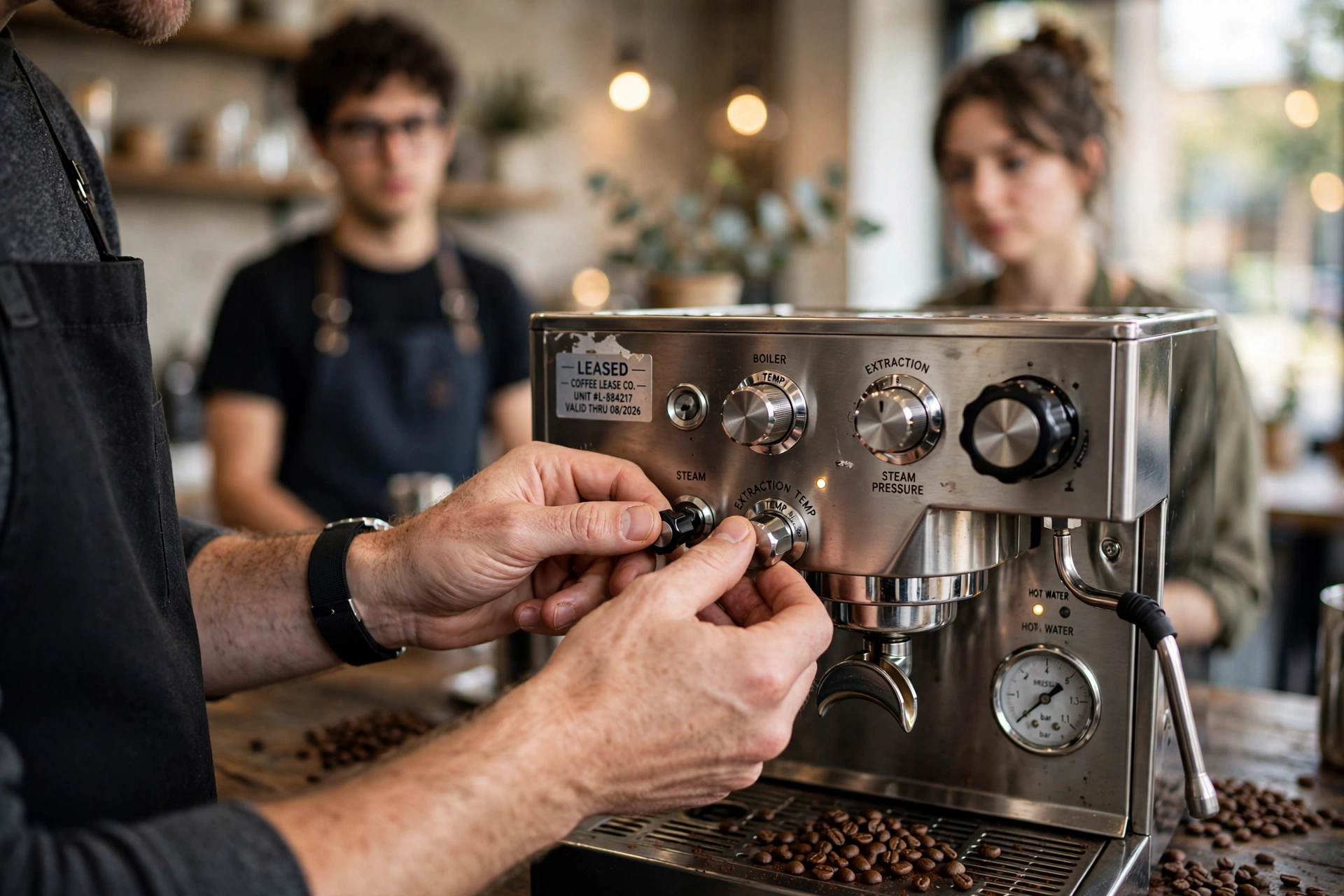
When evaluating the cost of professional equipment, the price variance is driven primarily by thermal stability, boiler capacity, and the level of automation. A machine is not just a heater; it is a precision instrument designed to maintain a consistent temperature within 0.1 degrees Celsius while under the stress of a morning rush.
📚
Definition
Thermal Stability is the ability of an espresso machine to maintain a constant water temperature throughout the brewing process, preventing "temperature surfing" which leads to sour or bitter coffee.
The most significant price jump occurs when moving from a single boiler to a dual-boiler system. In a single-boiler machine, the unit must switch between brewing temperature and steaming temperature, which creates a lag. Dual-boiler machines dedicate one boiler to the brew head and another to the steam wand, allowing a barista to steam milk and pull shots simultaneously. This is non-negotiable for any business serving more than 20 customers per hour.
According to the Specialty Coffee Association (SCA), precise temperature control is a fundamental pillar of specialty coffee quality. Without this precision, you are not just losing quality; you are wasting expensive Coffea arabica beans through inconsistent extraction. High-end machines often include PID (Proportional-Integral-Derivative) controllers, which are digital thermostats that eliminate the guesswork of traditional pressure switches.
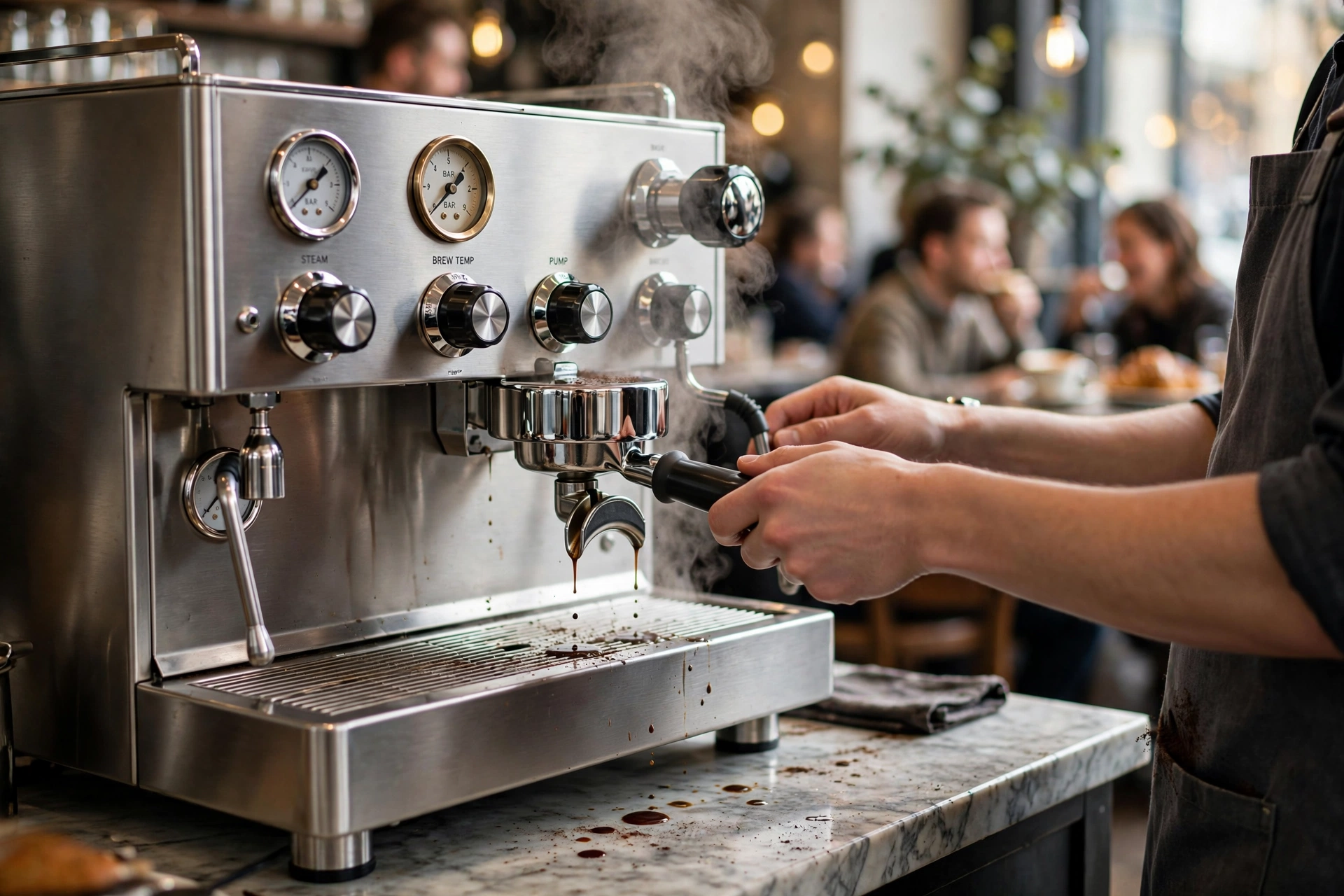
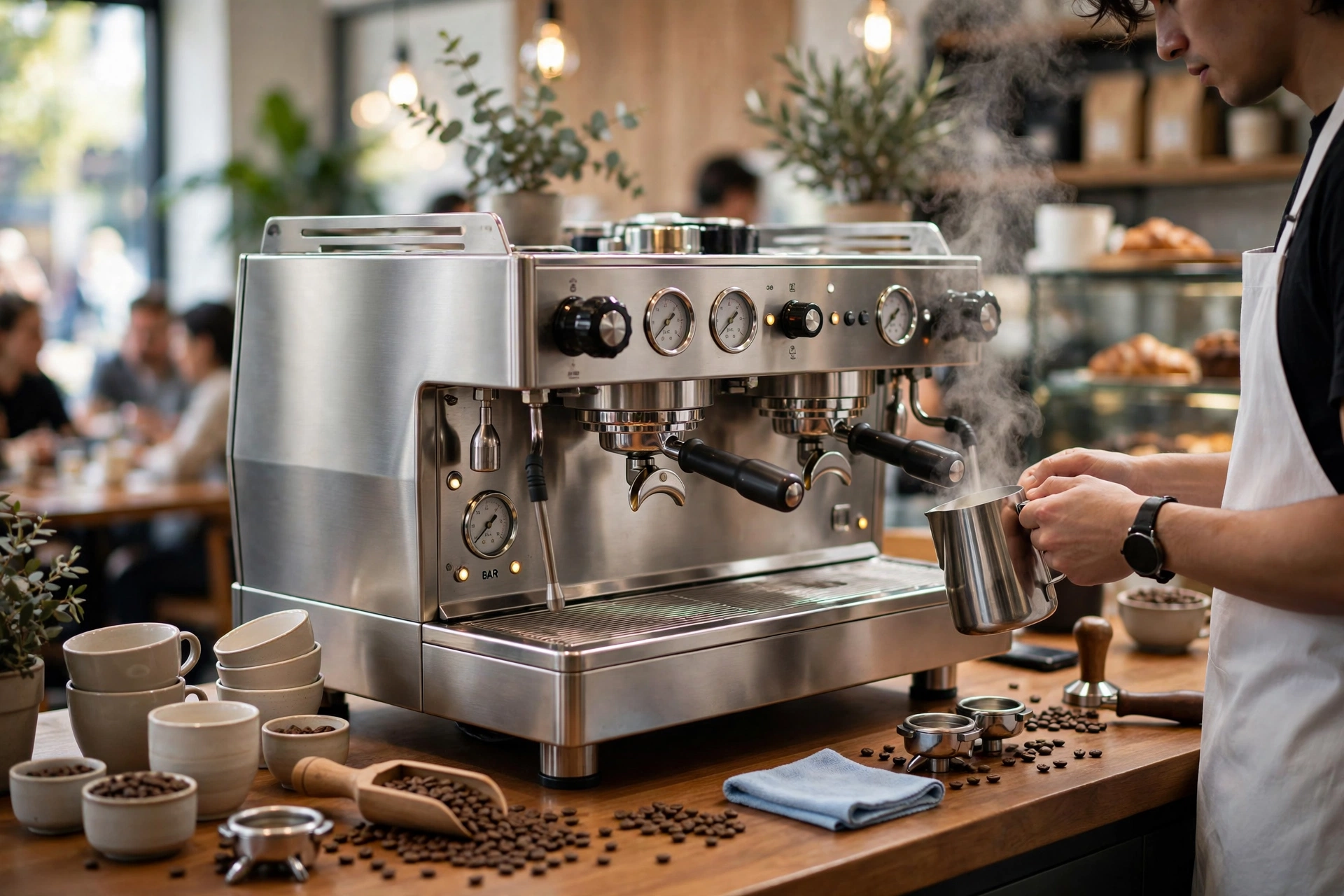
The number of "groups" also dictates the price. A group is essentially the water outlet and portafilter assembly. A 1-group machine is suitable for low-volume offices, while 2-group and 3-group machines are the workhorses of the industry. Each additional group increases the machine's footprint, power draw, and price, but exponentially increases your "shots per hour" capacity.
Why Does Investing in High-End Equipment Impact Your Bottom Line?
The financial implication of choosing a cheap machine over a professional grade system isn't just about the initial layout; it is about the cost of failure and the cost of waste. When a low-tier machine fluctuates in temperature, the result is "channeling" or under-extraction, meaning you are throwing away 15% to 20% of your coffee beans due to poor quality.
From a business perspective, downtime is the ultimate profit killer. According to data from NSF International, equipment that meets strict sanitary and engineering standards has a significantly lower failure rate in high-humidity environments. A machine that breaks down on a Saturday morning during a holiday weekend can cost a medium-sized cafe upwards of $2,000 in lost revenue in a single day.
Furthermore, the efficiency of the workflow directly impacts labor costs. A high-end machine with volumetric dosing allows a barista to press a button and walk away, knowing the machine will stop at exactly 36 grams. This allows them to prep milk or take another order. In contrast, manual machines require a person to stand and watch a timer or a scale for every single drink. Over a year, this efficiency gap can save a business hundreds of labor hours.
I've seen the mistake of "buying for today" rather than "buying for three years from now" constantly. A business owner buys a $3,000 machine because they have 50 customers a day, but as they grow to 150, that machine becomes a bottleneck. Replacing a machine while your business is growing is twice as expensive as buying the right one at the start because you are now paying for the lost productivity of the downtime.
How to Budget and Implement Your Coffee Station Step-by-Step
Planning the installation of commercial espresso machines requires a holistic approach. If you simply buy the machine and plug it into a wall, you are setting yourself up for a technical disaster. Here is the professional implementation path I recommend to all our clients.
Step 1: Electrical and Plumbing Audit
Before purchasing, verify your power. Most professional machines require 220V/240V power and a dedicated circuit. You cannot run a multi-group machine on a standard 110V outlet without risking a blown breaker. Simultaneously, check your water source. Commercial machines must be plumbed directly into the water line to ensure constant pressure.
Step 2: Water Filtration Strategy
This is where most owners fail. Coffee is 98% water. If your water is too hard (high mineral content), your boiler will develop scale deposits within six months, leading to overheating and expensive repairs. You need a professional-grade filtration system, preferably one with a reverse osmosis membrane or a high-capacity ion-exchange resin, to protect your investment.
Step 3: Selecting the Machine for Volume
Match your machine to your peak hour, not your average hour. If your busiest hour sees 40 drinks, you need a machine that can comfortably handle 60 to avoid customer frustration. This is where the choice between a 2-group and 3-group machine becomes a financial decision.
Step 4: Barista Training and Calibration
The most expensive machine in the world will produce mediocre coffee if the barista isn't trained in "dialing in." This involves adjusting the grind size of the coffee bean to match the pressure and temperature of the machine.
At Busy Bean Coffee, we eliminate this entire headache. Instead of spending $20,000 upfront and gambling on installation, our all-inclusive managed coffee membership provides the premium SENSA equipment, professional installation, and full maintenance for one predictable monthly fee. We take the technical risk off your plate so you can focus on running your business.
💡
Key Takeaway
The cost of the machine is a secondary expense compared to the cost of improper water filtration and electrical setup, which can shorten a machine's lifespan by 50% if neglected.
Comparing Equipment Tiers: Traditional vs. Modern Approaches
Not all "commercial" machines are created equal. There is a massive difference between a "prosumer" machine used in a small office and a "high-volume" machine used in a busy transit hub.
| Feature | Entry-Level Prosumer | Mid-Range Commercial | High-Volume Enterprise |
|---|---|---|---|
| Price Range | $2,000-$5,000 | $6,000-$15,000 | $16,000-$35,000+ |
| Boiler Type | Single or Heat Exchanger | Dual Boiler / PID | Multi-Boiler / Saturated |
| Daily Capacity | 10-30 drinks | 50-200 drinks | 200+ drinks |
| Maintenance | User-serviceable | Professional required | Dedicated technician |
| Best For | Small offices, B&Bs | Independent Cafes | High-traffic restaurants |
Now, here is where it gets interesting: the "Cheap AI" or "Automatic" approach. Many businesses are tempted by super-automatic machines that do everything from grinding to frothing at the touch of a button. While these look attractive on a spreadsheet due to lower labor costs, they often result in a significant drop in coffee quality. The "Generic" approach often lacks the pressure profiling and manual control needed to produce true specialty coffee.
The "Modern Professional" approach, which we advocate for, combines the precision of high-end manual controls with the reliability of a managed service. By utilizing a managed membership, you get the enterprise-grade equipment without the enterprise-grade debt.
Common Questions & Misconceptions About Machine Pricing
Most guides get this wrong by focusing only on the purchase price. They tell you that a $5,000 machine is a "bargain" for a startup. That is a dangerous simplification.
Myth 1: "I can just use a high-end home machine for my small cafe."
This is a recipe for disaster. Home machines are not designed for "thermal recovery." In a home setting, you make two lattes and then stop. In a cafe, you make twenty. A home machine's boiler will deplete, the temperature will plummet, and your coffee will taste sour. Commercial machines have larger boilers and high-wattage heating elements designed for constant use.
Myth 2: "More groups always mean more profit."
Not necessarily. If you have a 3-group machine but only one barista, two of those groups are wasting energy and taking up counter space. You must balance your hardware with your staffing. A 2-group machine operated by a skilled professional is often more profitable than a 3-group machine operated by an overwhelmed novice.
Myth 3: "Automatic machines save money on labor."
While they reduce the need for a certified barista, they increase the cost of maintenance. Super-automatics have hundreds of moving parts that can fail. When an automatic machine breaks, the entire shop stops. A manual machine allows you to keep serving (perhaps slightly slower) even if one group head has an issue.
Myth 4: "Water filtration is an optional add-on."
Absolutely not. According to the International Coffee Organization (ICO), the chemical composition of water directly affects the extraction of oils and acids from the coffee bean. More importantly, using unfiltered water in a commercial machine is the fastest way to void your warranty. Calcium buildup in the heat exchanger is the leading cause of boiler failure.
Frequently Asked Questions
How much should I budget for a complete espresso station including accessories?
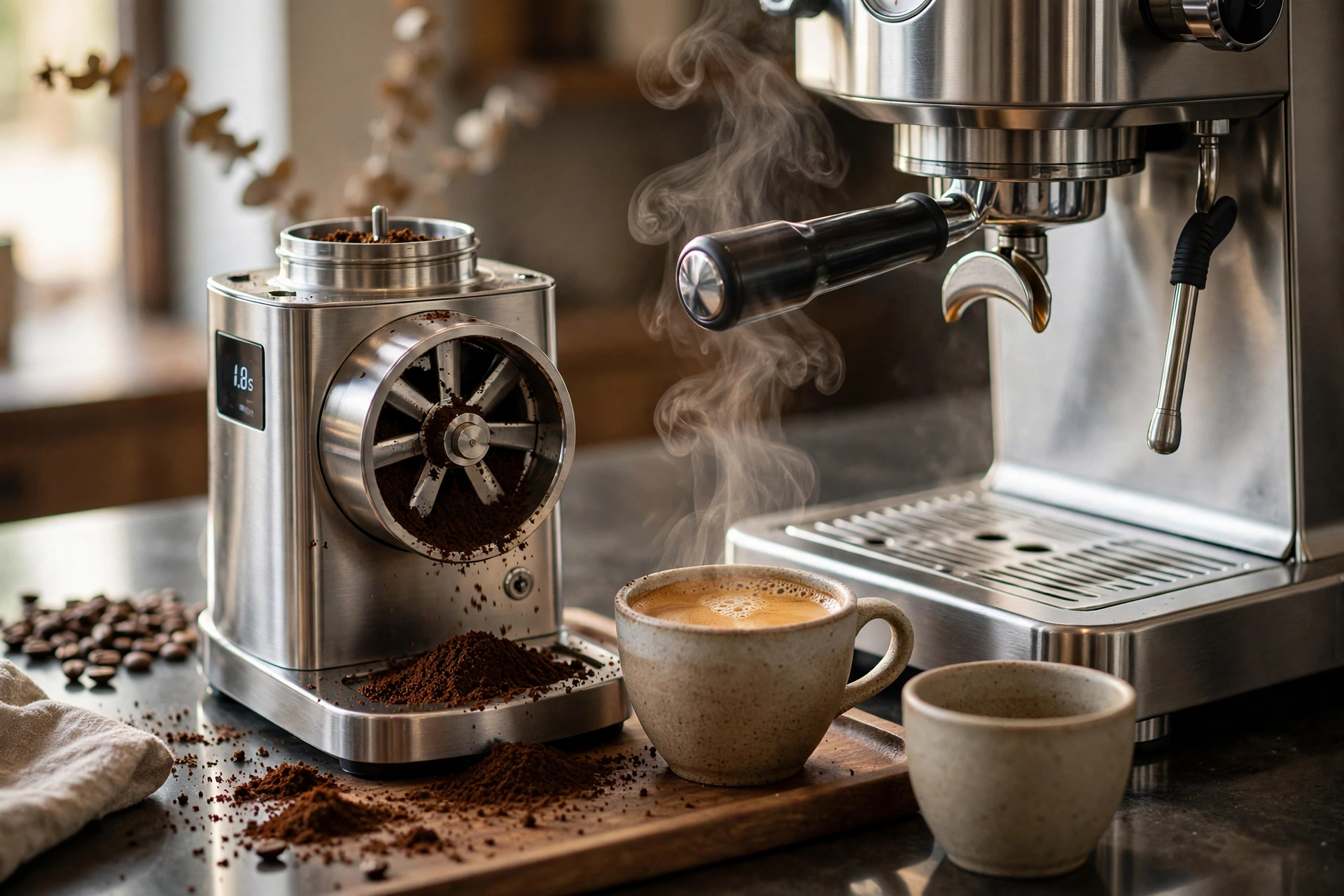
For a professional setup, you should budget between $8,000 and $25,000. This includes the commercial espresso machines themselves, a high-grade burr grinder (which can cost $1,000 to $3,000 alone), a knock box, tamping mats, and a professional water filtration system. It is a common mistake to spend $10,000 on a machine and then buy a $200 home grinder; this creates a bottleneck where the poor grind quality ruins the potential of the expensive machine.
Do commercial espresso machines require special electrical outlets?
Yes, the majority of professional machines require a 220V-240V connection. They draw a significant amount of power to maintain boiler temperatures. If you attempt to use a standard 110V outlet with an adapter, you will likely trip your circuit breaker or, worse, damage the machine's heating element. I always recommend having a licensed electrician install a dedicated line to the coffee station to ensure stability.
What is the difference between a semi-automatic and an automatic machine?
A semi-automatic machine requires the barista to manually stop the flow of water, usually by flipping a switch. An automatic machine uses a volumetric timer to stop the flow at a pre-set volume. While semi-automatics offer more control for the barista, automatics ensure consistency across different staff members. In high-volume environments, volumetric automation is essential to maintain speed and reduce waste.
How often do commercial espresso machines need professional servicing?
At a minimum, you should schedule a professional deep-clean and calibration every three to six months. This includes replacing group gaskets, screening the shower screens, and checking the water filtration levels. Neglecting this leads to "leaky" group heads and inconsistent pressure, which directly impacts the taste of your specialty coffee. A managed service like Busy Bean Coffee handles this proactively so you never have to schedule it yourself.
Can I buy a used commercial espresso machine to save money?
It is risky. A used machine may look clean on the outside, but if the previous owner didn't use a water softener, the internal boiler could be choked with lime scale. This is a "hidden" cost that can manifest as a $2,000 repair shortly after purchase. If you go this route, always insist on a service record and a pressure test from a certified technician before signing the check.
Final Thoughts on Commercial Espresso Machines
Investing in commercial espresso machines is a strategic decision that balances upfront capital, operational efficiency, and beverage quality. Whether you are targeting the high-end specialty coffee market or providing a reliable caffeine boost in a restaurant setting, the hardware you choose determines your ceiling for growth.
The most successful businesses in 2026 are moving away from the "ownership" model and toward "partnership" models. Instead of worrying about the depreciation of a $20,000 asset, they leverage all-inclusive memberships. This allows them to access the best equipment in the industry while keeping their balance sheets lean.
If you are ready to elevate your coffee program without the stress of massive upfront costs and technical failures, explore the managed solutions at Busy Bean Coffee. We provide the gear, the beans, and the expertise, so you can focus on your customers.
Recommended Readings
To deepen your understanding of these topics, we recommend reading the following articles:
- The Complete Guide to White Glove Coffee Service
- Ultimate Guide to All-Inclusive Coffee Service for Businesses
- Ultimate Guide to Automated Coffee Machines for Business
- Ultimate Guide to Specialty Coffee Equipment for Business
Free Coffee Pairing Guide & Specialty Roast Cheat Sheet
Unlock the secrets of perfect brewing ratios, water temperatures, and specialty roast profiles. Download the guide.