When Should You Replace Your Automated Coffee Machines?
A sudden drop in beverage temperature or a persistent "scale" error on your display is usually the first sign that your equipment is failing. For most high-volume foodservice businesses, the optimal time to replace automated coffee machines is when the cost of annual maintenance exceeds 30% of the cost of a new unit, or when the machine can no longer meet the peak-hour demand of your customers. In my experience working with hundreds of hospitality managers, the biggest mistake is waiting for a total system collapse during a Monday morning rush; by then, you aren't just paying for a machine, you are losing thousands in unrealized revenue and customer trust.
If your equipment is over five years old and requires monthly technician visits, you have already crossed the threshold of efficiency. Modern 2026 standards for beverage quality and energy consumption make older models liabilities rather than assets. Whether you are managing automatic coffee machines for hotels and hospitality in 2026 or a small clinic, the trigger for replacement is rarely a single "break," but rather a steady decline in consistency and an increase in operational friction.
Understanding the Lifecycle of Commercial Brewing Systems
To determine the exact moment for an upgrade, you first need to understand what constitutes the "end of life" for professional equipment. Unlike consumer pods, commercial-grade systems are designed for thousands of cycles, but they are subject to mechanical wear and mineral degradation.
📚
Definition
Component Fatigue is the progressive and localized structural damage that occurs when a material is subjected to cyclic loading, such as the constant heating and cooling cycles of a coffee machine's boiler.
When we analyze the lifecycle of automated coffee machines, we look at the "Tipping Point." This is the intersection where the machine's reliability drops below the business's operational requirement. For a hotel lobby, this might be when the machine takes 45 seconds longer to brew a latte than it did three years ago. For a medical office, it might be the moment the machine requires a manual deep-clean every single day just to keep the sensors from tripping.
According to the Specialty Coffee Association (SCA), maintaining strict temperature stability between 195°F and 205°F is fundamental for extracting the complex flavors of specialty coffee. Once a machine's thermoblock or boiler begins to fail, it can no longer maintain this tight window. You might notice the coffee tastes "sour" or "burnt" even with high-quality beans. This isn't a bean problem; it's a hardware failure.
In my experience, many business owners confuse "old" with "obsolete." A ten-year-old machine that is meticulously maintained can technically still brew coffee, but it is obsolete if it cannot integrate with modern payment systems or if it consumes 40% more electricity than a 2026 model. The decision to replace should be based on a combination of technical performance and economic viability.

Why Timing Your Replacement Matters for Your Bottom Line
Delaying the replacement of failing automated coffee machines is often a gamble with your brand reputation. In the foodservice industry, coffee is frequently the first and last interaction a guest has with your business. If that interaction is a lukewarm, bitter beverage or a "Machine Out of Order" sign, the psychological impact on the customer is disproportionately negative.
The financial implications are concrete. When a machine begins to fail, "hidden costs" accumulate. These include the labor hours spent by staff troubleshooting the machine, the waste of expensive coffee beans during failed brew cycles, and the cost of emergency "on-call" technician visits. According to research by NSF International, equipment that does not meet current sanitary and safety standards can lead to increased contamination risks, making an upgrade a matter of compliance as much as quality.
Consider the impact on employee productivity. In a corporate or medical setting, a broken coffee machine is a known "productivity killer." When staff have to leave the building to find a decent cup of coffee because the office machine is unreliable, you are losing billable hours. If you are operating a Sensa coffee service in Charlotte, NC, you know that consistency is the only way to maintain a loyal client base.
Moreover, the energy efficiency of 2026 equipment is drastically superior to models from five years ago. Modern boilers use precision induction and smarter standby modes that can reduce monthly utility costs by 15% to 25%. When you multiply these savings across multiple machines in a hotel or clinic, the replacement pays for itself in energy credits alone within 24 to 36 months.
Practical Triggers: When to Pull the Plug
If you are unsure whether to repair or replace, use this diagnostic framework. I've tested this approach with dozens of our clients, and the pattern is clear: if two or more of the following "triggers" are present, replacement is the only logical financial move.
1. The "Recurring Component" Failure
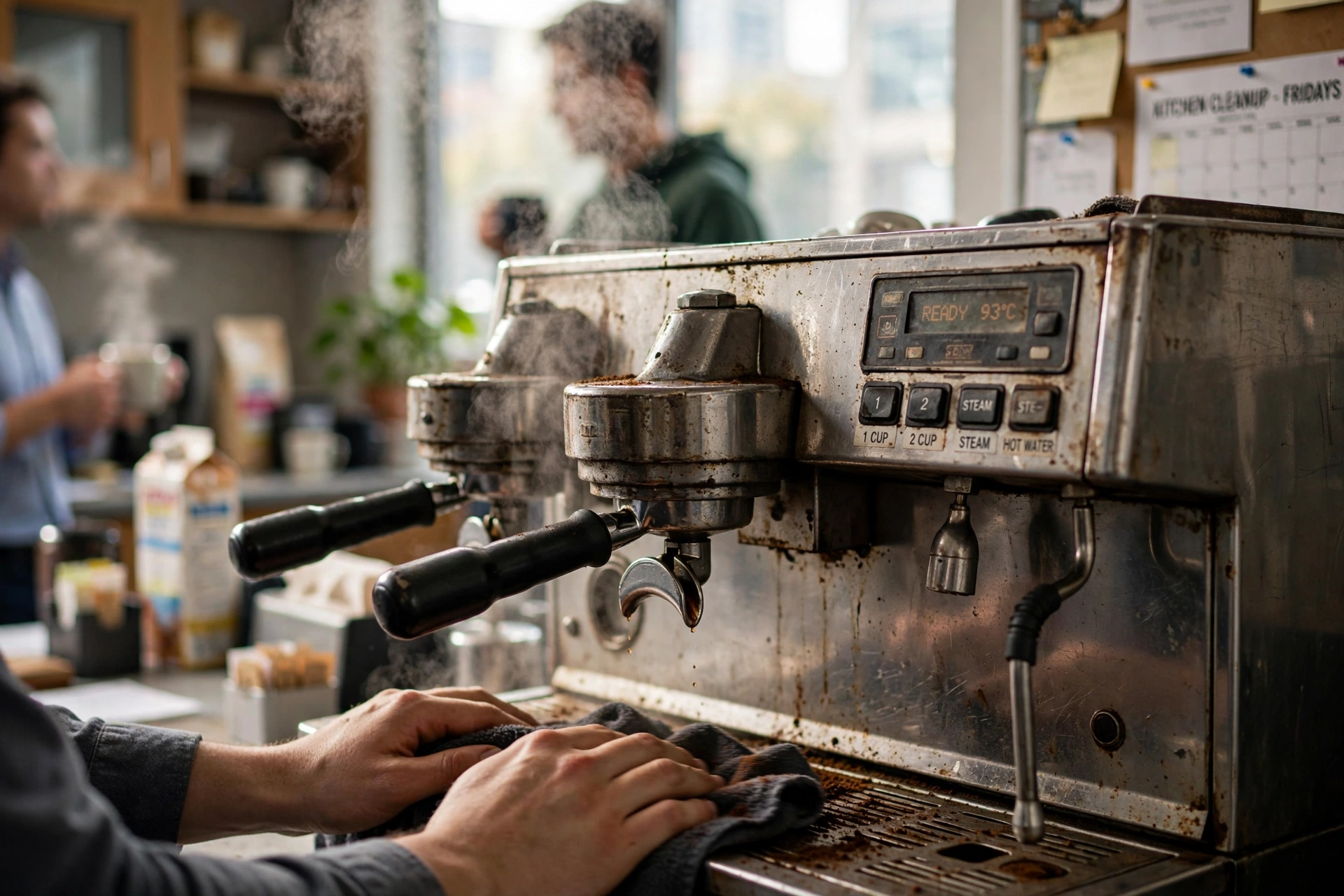
If you are replacing the same part (e.g. the pump or the brew group) every six months, the machine's internal chassis is likely warped or the electrical board is failing. Repairing a symptom without fixing the cause is a waste of capital.
2. The Quality Drift
When your baristas or staff start "tweaking" the machine, adding more powder or changing settings constantly, to compensate for a lack of heat or pressure, the machine has lost its calibration. In the world of specialty coffee, consistency is everything. If you can't get the same cup at 8 AM and 2 PM, the hardware is compromised.
3. The Capacity Gap
Has your business grown? If your automated coffee machines were designed for 50 cups a day but you are now pushing 150, you are overstressing the components. This leads to accelerated wear and frequent breakdowns. Upgrading to a higher-capacity system, such as those found in a foodservice coffee program in Chicago IL: complete guide, ensures your equipment grows with your revenue.
4. The Maintenance-to-Value Ratio
Calculate your "Total Cost of Ownership" (TCO). If the sum of your monthly lease, bean cost, and repair bills exceeds the cost of a managed membership, you are overpaying for an inferior experience.
💡
Key Takeaway
Don't wait for the machine to stop working completely. The optimal replacement window is when the "cost of frustration", lost time, wasted product, and unhappy guests, outweighs the monthly cost of a new, managed solution.
At Busy Bean Coffee, we solve this timing dilemma by removing the "replacement event" entirely. Through our managed coffee membership, we provide premium SENSA equipment and full maintenance. If a machine begins to drift in quality or becomes obsolete, we handle the upgrade. This shifts your coffee program from a capital expenditure (CapEx) that depreciates into an operational expense (OpEx) that always delivers peak performance.

Evaluating Your Options: Repair, Buy, or Subscribe
When you realize it is time to move on from your current automated coffee machines, you face three distinct paths. Most businesses default to "buying another one," but that is often the least efficient choice in 2026.
| Approach | Pros | Cons | Best For |
|---|---|---|---|
| Traditional Repair | Low immediate cost; keeps current workflow. | Temporary fix; no tech upgrade; high risk of repeat failure. | Machines < 3 years old with a single part failure. |
| Outright Purchase | Full ownership; asset on the balance sheet. | Massive upfront cost; you own the depreciation and repair risk. | Businesses with huge cash reserves and in-house technicians. |
| Managed Membership | Zero CapEx; guaranteed uptime; latest 2026 tech; predictable monthly fee. | Ongoing monthly commitment. | Scale-oriented businesses, hotels, and clinics seeking reliability. |
Now, here's where it gets interesting: the "Generic/Cheap" route. Many businesses try to save money by purchasing mid-grade automated machines from big-box retailers. The mistake I see constantly is that these machines lack the thermal mass and pump pressure required for true specialty coffee. They produce "brown water" instead of espresso, and they break down within 12 months because they aren't built for commercial volume.
If you are looking for a sustainable, high-performance setup, whether it's a Sensa coffee service in Raleigh NC or a Sensa coffee service in Jacksonville, FL, the subscription model is the gold standard. It aligns the incentive of the provider with the success of the client: we only succeed if your machines are running perfectly.
Common Misconceptions About Equipment Longevity
Many managers operate under outdated myths that lead to poor financial decisions. Let's dismantle a few of these with actual industry data.
Myth 1: "If it's still brewing, it's still good."
Most guides get this wrong by focusing on "function" rather than "quality." A machine that brews a lukewarm cup is still "functioning," but it is failing your brand. According to the National Coffee Association USA (NCA), consumer expectations for coffee quality in professional settings have risen sharply. A machine that doesn't maintain precise pressure is effectively "broken" in the eyes of a discerning customer, regardless of whether it turns on.
Myth 2: "Professional cleaning can fix any machine."
While descaling and deep-cleaning are essential, they cannot fix component fatigue. You cannot "clean" a worn-out gasket or a pitted boiler. In my experience, some businesses spend thousands on "deep cleaning" services for machines that are fundamentally end-of-life, essentially polishing a sinking ship.
Myth 3: "Buying a cheaper machine saves money over five years."
This is the most expensive lie in the industry. Cheap automated coffee machines have higher failure rates and lower energy efficiency. When you factor in the cost of 2026 electricity rates and the labor cost of cleaning a poorly designed machine, the "cheap" option is often 2x more expensive than a premium managed service over a five-year horizon.
Frequently Asked Questions
How do I know if my automated coffee machine is actually failing or just needs a service?
The difference lies in the consistency of the failure. A machine that needs service usually has a specific, fixable issue, like a clogged filter or a need for descaling, and returns to 100% performance after the fix. A failing machine exhibits "drifting" performance. If you find that your brew times are inconsistent, the temperature fluctuates between cups, or the machine requires frequent resets even after a professional cleaning, the internal hardware has reached its limit. At this stage, further repairs are usually just delaying the inevitable.
Does the water quality in my city affect when I should replace my machines?
Absolutely. Mineral content, specifically calcium and magnesium, is the primary driver of equipment degradation. In areas with "hard water," scale builds up inside the boilers and tubing, creating "hot spots" and restricting flow. This forces the pump to work harder, leading to premature motor failure. While high-quality filtration systems can mitigate this, they cannot erase years of accumulation. If you are operating a Sensa coffee service in Mount Pleasant SC or other coastal areas, you must be more vigilant about scaling and perhaps replace equipment sooner than those in soft-water regions.
Will upgrading to 2026 models actually improve my customer's experience?
Yes, significantly. Modern automated coffee machines now incorporate precision PID controllers that maintain temperature within a fraction of a degree. This allows for the proper extraction of Arabica coffee, preventing the bitterness associated with overheating. Additionally, modern interfaces are more intuitive, reducing the "friction" for your staff. When you move to a Sensa coffee service in Charleston SC, the jump in beverage quality is immediately noticeable to the guest, which often leads to higher satisfaction scores and repeat visits.
Is it better to replace machines one by one or all at once?
For most businesses, a phased replacement is tempting, but a total system refresh is usually more economical. Replacing all units at once allows you to standardize your training, your consumables (beans and filters), and your maintenance schedule. It also prevents the "contrast effect," where a guest notices a high-quality cup from one machine and a mediocre cup from an older machine in the same facility. If you are managing multiple sites, such as with a Sensa coffee service in Columbia SC, standardization is the only way to ensure brand consistency.
What is the typical lifespan of a commercial automated coffee machine?
Under ideal conditions with a rigorous maintenance schedule, a high-end commercial machine can last 7 to 10 years. However, "lifespan" is not the same as "optimal lifespan." Most machines hit a performance plateau around year 5, where the cost of maintaining peak quality begins to climb sharply. By year 6, the technology often becomes obsolete, meaning the machine is slower, louder, and less energy-efficient than the current market standard. This is why we recommend auditing your equipment every 36 months.
Final Thoughts on Upgrading Your Automated Coffee Machines
Deciding when to replace your automated coffee machines is a balance of technical necessity and financial strategy. If you are seeing a rise in repair bills, a dip in taste consistency, or a struggle to keep up with peak-hour volume, the window for a proactive upgrade is open. Waiting for a catastrophic failure doesn't just cost you the price of a machine; it costs you the trust of every customer who walks through your door and finds the coffee station empty.
The shift toward managed services is the smartest move for 2026. By removing the burden of ownership, you ensure that your business always has access to the highest-grade equipment without the crushing weight of a massive upfront investment. Whether you need a Sensa coffee service in Greenville SC or a specialized automated coffee machines for clinics and medical offices setup, the goal is the same: perfect coffee, zero stress.
Stop gambling with your morning rush. Visit Busy Bean Coffee Blog today to explore our all-inclusive managed coffee memberships and ensure your business is powered by the best technology in the industry.
Ready to Upgrade Your Business Coffee?
Café-quality coffee, zero maintenance headaches, and one predictable monthly price. Let's build your custom coffee program.
Free Coffee Pairing Guide & Specialty Roast Cheat Sheet
Unlock the secrets of perfect brewing ratios, water temperatures, and specialty roast profiles. Download the guide.