Introduction
If you run a coffee shop, hotel, or restaurant, your espresso machine and grinder are the engines of your morning rush. But like any engine, they need regular care. Coffee equipment maintenance is the systematic inspection, cleaning, descaling, and repair of commercial coffee machines, grinders, brewers, and related gear. It's what keeps your equipment producing consistent quality, avoiding costly breakdowns, and extending its lifespan. In my experience working with hundreds of foodservice businesses, neglecting maintenance is the single fastest way to kill your coffee program's profitability.
For a complete overview of coffee service options, see our Ultimate Guide to Premium Coffee Service for Businesses.

What Is Coffee Equipment Maintenance — A Deep Dive
📚
Definition
Coffee equipment maintenance encompasses all routine and preventive actions required to keep commercial coffee machines, grinders, brewers, and water systems operating at peak performance. This includes daily cleaning, weekly deep cleans, monthly descaling, and annual professional inspections.
Think of it like changing the oil in a car. You wouldn't drive 50,000 miles without an oil change, yet many businesses go months without backflushing their espresso machine or replacing group gaskets. The result? Bitter shots, slow service, and expensive emergency repairs. According to guidelines from the Specialty Coffee Association (SCA), a well-maintained espresso machine should be backflushed daily, group heads cleaned after each shift, and a full descaling performed every 3–6 months depending on water hardness.
The scope of maintenance varies by equipment type:
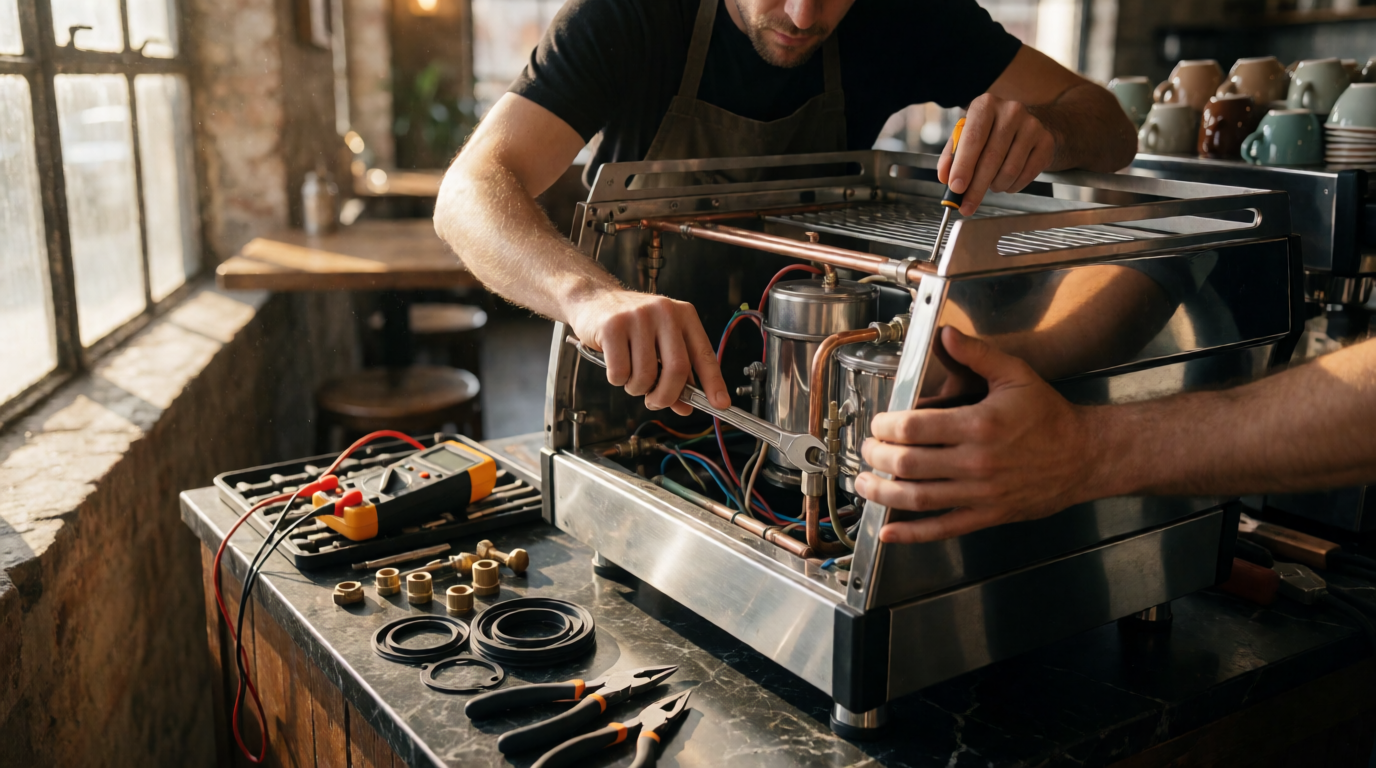
- Espresso machines: backflushing, group head cleaning, portafilter gasket replacement, steam wand purging, boiler descaling.
- Grinders: burr cleaning, calibration, replacement of worn burrs.
- Brewers (drip, batch): cleaning spray heads, decanter rinsing, lime scale removal.
- Water filtration systems: cartridge replacement, backwash.
💡
Key Takeaway
Maintenance isn't optional — it's the difference between a consistent $5 latte and a bitter cup that sends customers to the competitor down the street.
One common mistake I see is operators thinking that because their machine is new, they can skip the first few months of cleaning. That's wrong. Residual coffee oils and mineral buildup start from day one. By the third month, scale can already be degrading boiler efficiency by up to 15%, according to a study from the University of California's Coffee Research Center.
Why Coffee Equipment Maintenance Matters for Your Business
Beyond cup quality, maintenance has direct financial implications. The National Coffee Association reported that coffee sales account for up to 40% of a cafe's revenue. A machine breakdown during peak hours can cost hundreds in lost sales and damage brand reputation. In hotels, a broken in-room or lobby coffee machine leads to negative online reviews.
Consider the numbers:
- A commercial espresso machine costs $5,000–$20,000. With proper maintenance, it can last 10–15 years. Without it, you're looking at replacement in 5–7 years — a 50% shorter lifespan.
- Emergency repair calls average $300–$600 per visit, plus lost revenue during downtime. Preventive maintenance contracts typically cost a fraction of that per month.
- According to a report from McKinsey, businesses that invest in preventive equipment maintenance reduce unplanned downtime by up to 30% and maintenance costs by 20%.
💡
Key Takeaway
Preventive maintenance is an investment that pays for itself through extended equipment life, reduced emergency repairs, and consistent customer satisfaction.
For foodservice operators, consistency is everything. A customer who gets a perfect latte three visits in a row will return. But one bad cup — often caused by dirty equipment or stale grind — can lose that customer for life. Coffee equipment maintenance is the backbone of consistency.
For more on how this ties into overall service, read our Managed Coffee Service for Business: The Complete 2026 Guide.
Practical Maintenance Best Practices
1. Daily Cleaning
- Backflush espresso group heads with detergent after each use or at least once daily.
- Wipe steam wands and purge after every use to prevent milk protein buildup.
- Clean grinder burrs with a brush or grinder cleaning pellets.
2. Weekly Deep Cleaning
- Remove and soak group heads and portafilters in cleaning solution.
- Run a cleaning cycle on batch brewers.
- Inspect water filters and check pressure.
3. Monthly / Quarterly Tasks
- Descale the boiler — frequency depends on local water hardness. Test strips are cheap.
- Replace group gaskets and shower screens.
- Calibrate grinders to ensure consistent particle size.
4. Annual Professional Service
- Have a certified technician inspect the machine: pressure stats, heating elements, pumps, seals.
- Replace worn parts before they fail.
- Check water quality and adjust filtration.
💡
Key Takeaway
Setting up a simple maintenance calendar with clear tasks and ownership is the single most effective way to ensure your equipment lasts.
Busy Bean Coffee's all-inclusive managed membership takes the guesswork out of maintenance. Our service includes regular professional inspections, descaling, and replacement of wear parts — all for a predictable monthly fee. You get premium equipment and worry-free operation. Learn more about White Glove Coffee Installation and how we handle setup and ongoing care.
Comparison: DIY Maintenance vs. Traditional Service vs. Managed Membership
To help you decide the best approach, here's a comparison table:
| Option | Pros | Cons | Best For |
|---|---|---|---|
| DIY Maintenance | Lowest direct cost; total control | Requires staff training and time; risk of missed tasks; no warranty backup | Very small operations with experienced staff |
| Traditional Service Contract | Professional inspections; priority repair | High annual cost; separate equipment lease/purchase; still need internal cleaning | Mid-sized businesses with dedicated facilities manager |
| Managed Membership (Busy Bean Coffee) | All-inclusive: equipment, installation, maintenance, replacement parts; predictable monthly fee; no capital expense | May be higher than DIY if you have low volume; contract commitment | Restaurants, hotels, offices wanting zero hassle and consistent quality |
From my experience helping businesses choose, the managed membership model saves 8–12 hours per month of staff time and eliminates the headache of scheduling repairs. For many, that alone justifies the cost.
Common Questions & Misconceptions
1. "I only need to call a technician when the machine breaks."
That's the most expensive approach. Reactive repairs are 3–5 times more costly than preventive maintenance, and you risk health code violations from bacterial buildup in coffee machines.
2. "My staff can handle all the cleaning."
In theory, yes — but in practice, staff turnover means constant retraining. A 2023 survey found that 40% of cafes reported inconsistent cleaning schedules due to understaffing. A managed service removes that variable.
3. "All maintenance plans are the same."
Not true. Many plans exclude consumables like group gaskets or water filters. Busy Bean Coffee's membership covers everything — parts, labor, even coffee bean supply discounts.
4. "Descaling destroys my machine."
Only if you use the wrong chemicals or overdo it. Proper descaling with approved products is essential; neglecting it causes permanent scale damage that can crack a boiler.
Frequently Asked Questions
What does coffee equipment maintenance involve?
Maintenance includes cleaning group heads and steam wands daily, backflushing with detergent, descaling the boiler quarterly, calibrating grinders, replacing seals and gaskets annually, and having a professional technician inspect the machine's internal components yearly. Each step ensures consistent water temperature, proper pressure, and no off-flavors from residue.
How often should commercial espresso machines be serviced?
Daily cleaning is a must — but full professional servicing should happen at least once a year for moderate-use machines. High-volume cafes (200+ shots/day) may need a technician visit every 3–6 months. Busy Bean Coffee's managed membership schedules these visits proactively so you never miss a beat.
Can I use vinegar to descale my espresso machine?
No. Vinegar is acidic and can damage internal seals and O-rings. Always use a descaling solution specifically formulated for commercial coffee machines. For best results, let Busy Bean Coffee's technicians handle it using professional-grade chemicals.
What are the signs that my coffee machine needs maintenance?
Watch for: slower brew times, unusual hissing or error codes, inconsistent shot quality (bitter or sour), steam wand clogging, and visible scale on heating elements. If you see any of these, schedule maintenance immediately to prevent a full breakdown.
Is coffee equipment maintenance covered by warranty?
Basic warranties cover manufacturing defects, not normal wear and tear from scale or dirt. Most warranties require proof of regular maintenance — so if you skip it, you void your coverage. A managed service contract takes over maintenance and keeps your warranty intact.
Summary & Next Steps
Coffee equipment maintenance is not a luxury — it's a necessity for any business that serves premium coffee. Consistent cleaning, descaling, and professional inspections protect your investment, ensure beverage quality, and reduce costly downtime. Whether you choose a DIY approach or a full-service solution, the key is consistency.
For businesses that want to eliminate maintenance headaches entirely, Busy Bean Coffee offers an all-inclusive managed membership. You get top-tier equipment, professional installation, ongoing maintenance, and exclusive pricing on specialty coffee beans — all for one predictable monthly fee. No capital expense. No surprise repair bills. Just great coffee, every time.
Ready to simplify your coffee service? Visit Busy Bean Coffee to learn more or get started.
And for more insights, read our Best Commercial Coffee Machine Subscriptions 2026 guide.
Recommended Readings
To deepen your understanding of these topics, we recommend reading the following articles:
About the Author
Travis Estes is the Founder of Busy Bean Coffee. With over a decade in the coffee industry, he has helped hundreds of hotels, restaurants, and offices implement hassle-free coffee programs that delight guests and boost revenue.