The Ultimate Guide to Specialty Coffee Equipment for Businesses
In the competitive landscape of foodservice, the quality of your coffee program is no longer a footnote—it's a headline. A staggering 64% of consumers now say they are willing to pay more for a better cup of coffee, according to the National Coffee Association's 2025 trends report. Yet, for most business owners, navigating the complex world of specialty coffee equipment feels like deciphering a foreign language. This guide cuts through the jargon. I’m the founder of Busy Bean Coffee, and for over a decade, we’ve installed, maintained, and managed thousands of pieces of equipment across the country. This isn't just theory; it's the playbook we use with our clients every day to transform their beverage service from a cost center into a profit driver and a powerful brand asset.
What is Specialty Coffee Equipment?
📚Definition
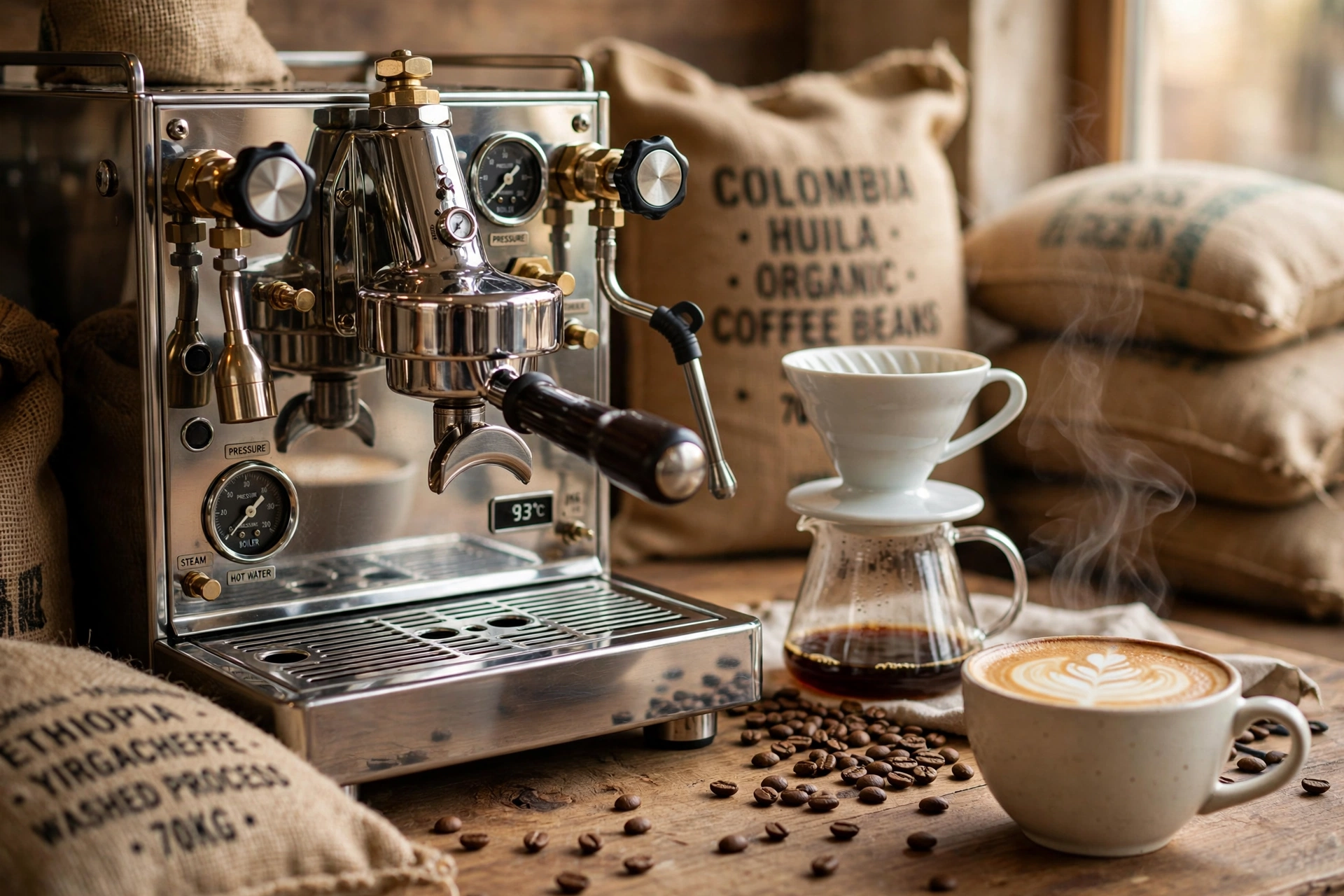
Specialty coffee equipment refers to commercial-grade machines and tools engineered to precisely control the extraction variables of high-quality, specialty-grade coffee beans. This goes beyond basic brewing to encompass grinders, espresso machines, brewers, and ancillary tools that enable consistency, quality, and scalability for business environments.
At its core, specialty coffee equipment is the bridge between a premium bean and an exceptional cup. While a standard office pot or a basic espresso machine might get the job done, specialty equipment is designed with precision in mind. It controls water temperature to within a degree, manages pressure profiles for espresso, and ensures uniform particle size from a grinder. This precision is non-negotiable because specialty coffee beans, which score 80 points or above on a 100-point scale by certified Q Graders, have delicate, complex flavor profiles. In my experience, using a standard brewer with these beans is like playing a symphony on a child's keyboard—you might recognize the tune, but you’ll miss the depth, nuance, and power.
The category includes several key systems:
- Commercial Espresso Machines: The workhorses for lattes, cappuccinos, and straight shots. They can be manual, semi-automatic, super-automatic, or fully automated.
- Precision Grinders: Perhaps the most critical piece. Burr grinders ensure consistent particle size, which is paramount for even extraction.
- Specialty Brewers: Including batch brewers with precise temperature control, pour-over stations, and cold brew towers.
- Ancillary Tools: Digital scales, precision kettles, milk frothing pitchers, and water filtration systems.
💡Key Takeaway
Specialty coffee equipment is defined by its ability to unlock the full potential of high-scoring coffee beans through precise control over every variable in the brewing process. It’s the essential tool for any business serious about coffee quality.
For a deeper dive into the beans themselves, explore our guide on specialty coffee beans.
Why Specialty Coffee Equipment Matters for Your Business
Investing in the right specialty coffee equipment is not an expense; it's a strategic investment with a measurable ROI. The difference is felt in customer satisfaction, employee morale, and your bottom line.
1. Elevates Guest Experience & Drives Revenue
In hospitality and retail, coffee is a direct touchpoint. A study by the Specialty Coffee Association in 2024 found that venues offering a certified specialty coffee program saw an average increase of 22% in beverage revenue. Guests perceive value, are more likely to return, and often pair their coffee with a higher-margin pastry or snack. For hotels, a premium in-room or lobby coffee experience directly influences guest satisfaction scores. We’ve seen this firsthand with clients like boutique hotels that use our SENSA systems; they report coffee becoming a noted amenity in positive online reviews.
2. Reduces Operational Costs & Waste
This seems counterintuitive, but precision leads to efficiency. High-end grinders and brewers are engineered for consistency, which means your staff uses the exact right amount of coffee per cup, every time. Automated machines eliminate the "barista skill gap," reducing costly mistakes and product waste. According to industry data from the Foodservice Technology Network, businesses that switch from manual, inconsistent methods to precision equipment can reduce their coffee product waste by up to 30% annually.
3. Enhances Employee Satisfaction & Productivity
A great office coffee program is a powerful, low-cost perk. Research from MIT’s Sloan School of Management indicates that access to quality coffee and dedicated break spaces correlates with a 14% increase in perceived employee well-being and collaboration. It keeps teams energized and on-site, saving the time and money lost on Starbucks runs. When we install a system in a corporate office or medical clinic, the feedback from staff is immediate and overwhelmingly positive—it’s seen as a tangible investment in their daily experience.
4. Future-Proofs Your Business
Consumer tastes are shifting rapidly. The demand for craft, traceable, and quality-driven products is the new norm. By implementing a specialty coffee equipment program now, you position your business as a leader, not a follower. It builds brand equity and caters to the growing demographic that seeks out quality experiences.
5. Creates a Competitive Differentiation
In a crowded market, your coffee can be your unique selling proposition. While your competitor serves generic, bitter brew, you can offer a single-origin pour-over or a perfectly textured latte. This is especially powerful for restaurants, bakeries, and cafes looking to stand out. It transforms coffee from a commodity into a signature item.
Discover how this applies directly to your sector in our focused guides on
hotel coffee equipment and restaurant coffee solutions.
How Specialty Coffee Equipment Works: The Science of a Perfect Cup
Understanding the mechanics demystifies the technology and helps you make informed choices. The goal of all specialty coffee equipment is to master extraction—the process of dissolving desirable flavors from coffee grounds into water.
1. The Grind: The Foundation of Flavor
It all starts with the grinder. A high-quality commercial burr grinder crushes beans between two surfaces (burrs) to create uniform particles. Consistency is critical because uneven grounds extract at different rates: fines over-extract (causing bitterness), while boulders under-extract (causing sourness). The grinder also allows for dialing in the grind size—finer for espresso (needing more pressure), coarser for French press (needing more immersion time). In our managed programs, we lock in these grind settings during installation to ensure every location gets identical quality.
2. The Brew: Precision in Action
- Espresso Machines: These force hot water (around 200°F) through finely-ground, tamped coffee at high pressure (9 bars). The machine must maintain stable temperature and pressure throughout the shot. Advanced models allow for pressure profiling, pre-infusion, and have dual boilers for simultaneous brewing and steaming.
- Precision Batch Brewers: Unlike old urns, these saturate grounds evenly with water at an optimal 199-205°F, held in a thermal carafe to prevent burning. They ensure every cup from a full batch tastes as good as the first.
- Pour-Over & Alternative Brew: This manual method highlights the barista’s skill but is supported by tools like gooseneck kettles (for controlled pouring) and digital scales (for exact coffee-to-water ratios).
3. The Water: The Unsung Hero
Water constitutes about 98% of your coffee. Specialty systems often integrate or recommend water filtration to remove impurities like chlorine and balance mineral content. Hard water scales machines; soft, mineral-free water can lead to flat extraction. Proper water treatment is a non-negotiable part of equipment longevity and taste.
4. Automation & Consistency
Modern specialty coffee equipment, especially in foodservice, leans into automation. Super-automatic espresso machines grind, tamp, brew, and even froth milk at the touch of a button. This isn't about removing craft; it's about guaranteeing a perfect, repeatable outcome during a busy lunch rush or with a non-expert staff. This is the principle behind our SENSA Pro line—it delivers barista-quality results without requiring a trained barista on payroll.
Learn more about the different automation levels in our guide to automated coffee machines.
Types of Specialty Coffee Equipment: A Comparative Breakdown
Choosing the right equipment depends on your volume, space, staff skill, and menu. Here’s a breakdown of the primary categories.
| Equipment Type | Best For | Key Features | Pros | Cons |
|---|
| Super-Automatic Espresso Machine | Offices, Hotels, Clinics, High-Volume Cafes | All-in-one: grinds, tamps, brews, froths milk automatically. | Extreme consistency, low staff training, fast service, easy cleaning. | Higher upfront cost, less "theatrical" craft, limited customization. |
| Semi-Automatic Espresso Machine | Specialty Cafes, Restaurants with trained baristas | Manual control over grind, dose, tamp, and shot time. Automated water delivery. | Maximum control and customization, authentic cafe experience. | Requires skilled staff, slower output, consistency depends on barista. |
| Precision Batch Brewer | Offices, Diners, Conference Centers, Hotels | Brews 1.5L+ with precise temperature control, thermal carafes. | Excellent for serving groups, consistent, simple operation, great for black coffee. | Not for espresso-based drinks, can waste coffee if not used fully. |
| Pour-Over Station | Third-Wave Coffee Shops, High-End Restaurants | Manual brew bar with kettles, scales, drippers, and timers. | Highlights bean origin, high perceived value, interactive for guests. | Very labor-intensive, slow, difficult to scale, requires expert staff. |
| Commercial Grinder | Essential for any setup using whole beans. | Flat or conical burrs, dose control, minimal heat transfer. | The single biggest factor in cup quality, enables freshness. | Requires separate brewer, needs calibration and cleaning. |
| Cold Brew System | Cafes, Smoothie Bars, Seasonal Menus | Large-format toddy systems or nitro-infusion taps. | Smooth, low-acidity product, high-profit margin, long shelf life. | Long brew time (12-24 hrs), requires dedicated fridge space. |
💡Key Takeaway
There is no "best" type, only the "best for your business." A high-volume corporate office thrives with a super-automatic, while a boutique cafe's brand might be built on semi-automatics and pour-overs.
For a detailed comparison tailored to your needs, see our guides on
commercial espresso machines and
office coffee solutions.
Implementation Guide: How to Build Your Specialty Coffee Program
Rolling out a new coffee program is a project. Based on hundreds of installations, here is our step-by-step framework to ensure success.
Step 1: Define Your Goals & Audience
Start with the "why." Are you aiming to increase check averages, improve employee retention, or compete with the cafe down the street? Quantify it. Then, profile your end-user: busy employees, discerning hotel guests, or on-the-go customers? Their needs dictate the equipment.
Step 2: Conduct a Space & Utility Audit
You can't install a machine that needs a 220V outlet if you only have 110V. Work with a provider (like Busy Bean) to assess:
- Space: Countertop footprint, under-counter clearance, height.
- Power: Voltage and amperage requirements.
- Water: Access to a water line and drain is needed for plumbed-in machines.
- Ventilation: Some machines require minimal clearance for heat dissipation.
Step 3: Select Your Equipment & Sourcing Model
This is the major decision point. You have two paths:
- Capital Expenditure (CapEx): Purchase equipment outright. You own it, but you're responsible for all maintenance, repairs, and eventual replacement.
- Managed Service/Membership (OpEx): This is our model at Busy Bean Coffee. You pay one predictable monthly fee that includes the specialty coffee equipment, installation, all maintenance, repairs, support, and often product. There's no large upfront cost, and the service risk is transferred to the provider.
Step 4: Professional Installation & Training
Never DIY a commercial installation. A certified technician ensures proper plumbing, electrical, and calibration. This is also the time for comprehensive staff training. A good provider will train your team on operation, daily cleaning, and basic troubleshooting. Our white-glove technicians, like Leslie Cook, are known for making staff feel confident from day one.
Step 5: Develop Your Menu & Dial In Recipes
Your equipment partner should help you create a simple, effective menu. This involves "dialing in" the equipment: setting the grind size, brew time, and water temperature for your chosen coffee. Document these recipes for consistency.
Step 6: Establish Daily & Weekly Maintenance Protocols
Longevity depends on care. Build simple routines: flushing the group head, cleaning the steam wand, backflushing the machine (for espresso), and descaling on a schedule. In a managed service, this is largely handled for you, but staff should know the daily basics.
Step 7: Launch, Promote & Gather Feedback
Announce the new program! Use signage, staff tastings, and promotional pricing. Then, actively seek feedback for the first few weeks to make minor tweaks and ensure the program is meeting its goals.
Pricing & ROI Analysis of Specialty Coffee Equipment
Let's demystify the costs. The price spectrum is wide, but so is the potential return.
CapEx (Purchase) Model:
- Entry-Level Super-Automatic: $3,000 - $7,000
- Commercial Semi-Automatic Setup (Machine + Grinder): $8,000 - $20,000+
- Precision Batch Brewer: $1,500 - $4,000
- Additional Costs: Installation ($500-$2,000), annual maintenance contracts ($500-$1,500), unexpected repairs (can be $1,000+), water filters, cleaning supplies.
OpEx (Managed Membership) Model:
- Typical Monthly Fee: Ranges from $150 to $600+ per month, depending on the machine, volume, and service level.
- What's Included: The equipment, installation, all preventive maintenance, all repairs (parts & labor), 24/7 remote support, and often a discounted product price.
- Financial Benefit: Transforms a large, unpredictable capital outlay into a predictable operating expense. It provides a clear, all-in cost for your coffee program, simplifying budgeting.
ROI Calculation Example:
Let's take a 50-person office currently spending $5 per employee per week on external coffee runs.
- Current Weekly Cost: 50 people x $5 = $250
- Current Annual Cost: $250 x 52 weeks = $13,000
- New Managed Program Cost: High-end machine, premium beans, full service. Estimated at $400/month.
- New Annual Cost: $400 x 12 months = $4,800
- Annual Savings: $13,000 - $4,800 = $8,200
- Soft ROI: Increased productivity, improved morale, and keeping employees on-site.
The ROI for a restaurant or hotel includes direct revenue from sold coffee, increased customer satisfaction, and higher perceived brand value. The managed model, in particular, offers a faster and more predictable path to positive ROI by eliminating surprise repair bills and ensuring peak equipment performance at all times. Explore the financials in detail in our article on
managed coffee service.
Real-World Examples & Case Studies
Case Study 1: The Boutique Hotel Chain
A 5-property boutique hotel group wanted to differentiate its guest experience but lacked the F&B expertise to manage a complex coffee program. Their existing equipment was unreliable, leading to guest complaints.
- Solution: We implemented our all-inclusive managed membership across all properties. This included installing our SENSA Fresh super-automatics in lobby areas and providing premium single-origin beans. Our team handled all installation, training, and ongoing maintenance.
- Result: Within 6 months, coffee-related guest complaints dropped to zero. The hotels began marketing their "artisan lobby coffee" as an amenity. The General Manager reported a noticeable increase in positive mentions of the coffee in post-stay surveys and online reviews, directly attributing it to a more premium guest experience. The predictable monthly fee also simplified their P&L management.
Case Study 2: The Multi-Location Medical Practice
A group of three busy medical clinics was spending over $800 monthly on a basic
coffee service that provided low-quality coffee and an unreliable brewer. Staff morale was low, and doctors were frustrated.
- Solution: We replaced their old brewers with our SENSA Duo machines, offering both premium drip coffee and one-touch specialty drinks like lattes. The all-inclusive fee covered the machines, the coffee, and all service.
- Result: The practice immediately cut its monthly coffee spend by 35%. More importantly, staff and patient satisfaction soared. The practice administrator noted, "It’s become a talking point. Patients comment on how nice it is, and our staff feels valued. It was an easy win for culture and our budget." The white-glove service meant clinic managers never had to deal with a machine issue again.
Case Study 3: The Fast-Casual Restaurant
A popular local restaurant had a stagnant beverage menu. Their coffee was an afterthought, sourced from a generic supplier.
- Solution: We worked with the owner to install a small, efficient espresso machine and grinder behind the counter. We trained two key staff members on basic operation and created a simple 3-drink menu: Espresso, Americano, and Latte.
- Result: Within the first quarter, coffee became 8% of total beverage sales, with a profit margin over 80%. The addition of specialty coffee also increased average ticket size, as customers often paired a latte with dessert. It positioned the restaurant as a destination for an afternoon coffee meeting, driving incremental traffic during off-peak hours.
Common Mistakes to Avoid with Specialty Coffee Equipment
After a decade in this field, I've seen the same pitfalls sink otherwise promising programs. Avoid these at all costs.
1. Prioritizing Price Over Total Cost of Ownership
Buying the cheapest machine often leads to the highest long-term cost. Inexpensive equipment breaks down frequently, is inefficient with coffee, and produces inconsistent quality that drives customers away. Always calculate the 3-5 year cost, including maintenance, repairs, and product waste.
2. Neglecting Staff Training
Even the best machine is useless if staff don't know how to use it. Skipping proper training leads to bad coffee, machine damage, and frustration. Invest in comprehensive, hands-on training during installation and provide quick-reference guides.
3. Ignoring Preventative Maintenance
Coffee machines are workhorses. Without daily cleaning and scheduled descaling, limescale and coffee oils will clog internal components, leading to terrible taste and catastrophic failure. This is the #1 cause of premature machine death.
4. Using the Wrong Coffee
Putting commodity-grade coffee into a precision machine is a waste. The equipment is designed to highlight nuance, and low-quality beans will only yield a more pronouncedly bad cup. Conversely, using ultra-fresh, lightly-roasted specialty beans in a machine not calibrated for them can also fail. Align your bean and equipment from the start.
5. Failing to Plan for Scale
If you're a growing business, consider your future volume. A machine that barely meets today's needs will be a bottleneck tomorrow. Work with a provider who can discuss your growth roadmap and recommend equipment that can scale with you, or offer flexible upgrade paths.
Frequently Asked Questions
What is the difference between commercial and specialty coffee equipment?
All specialty coffee equipment is commercial-grade (built for durability in business use), but not all commercial equipment is "specialty." Commercial equipment is a broad category that includes basic, high-volume brewers designed for reliability over precision. Specialty equipment is a subset focused on precision engineering to extract the best possible flavor from high-quality beans, offering control over temperature, pressure, and time.
How much does a full specialty coffee setup cost for a small cafe?
For a small cafe expecting moderate volume, a reliable setup typically includes a semi-automatic espresso machine, a high-quality grinder, and a water filtration system. The capital expenditure for this can range from $10,000 to $25,000 for the equipment alone, plus installation and ongoing costs. Many new cafes opt for a managed service model to avoid this large upfront outlay, converting it into a predictable monthly operating expense that includes maintenance and support.
Can my existing staff operate this equipment, or do I need a trained barista?
This depends entirely on the equipment you choose. Super-automatic and fully automated machines are designed specifically for operation by non-expert staff, producing consistent results at the touch of a button. Semi-automatic machines require a trained barista to control the grind, dose, and extraction. When we consult with clients, we always match the machine's complexity to the available staff skill set to ensure operational success.
How often does specialty coffee equipment need maintenance?
Maintenance is multi-tiered. Daily: Cleaning the group head, steam wand, and drip tray. Weekly: Backflushing the espresso machine (if applicable), cleaning the grinder burrs. Monthly/Quarterly: Replacing water filters, deep cleaning. Annually: Professional descaling and mechanical inspection by a technician. In a managed service plan, all scheduled and unscheduled maintenance is included and handled for you.
Is it better to buy or lease/use a subscription service for coffee equipment?
There's no one-size-fits-all answer, but the trend strongly favors the subscription/managed service model (like what we offer at Busy Bean Coffee) for most foodservice businesses. Buying (CapEx) makes sense if you have ample capital, in-house technical expertise, and want full asset control. Leasing/subscribing (OpEx) is superior for preserving capital, ensuring predictable costs, transferring repair risk, and guaranteeing your equipment is always under warranty and maintained to peak performance. It's the operational model of the future.
What kind of warranty comes with commercial specialty equipment?
Warranties vary widely. Typical manufacturer warranties range from 1 to 3 years on parts, often with only 90 days to 1 year on labor. Crucially, these warranties often become void if you don't use authorized technicians or specific descaling products. A comprehensive managed service membership effectively acts as an all-inclusive, bumper-to-bumper warranty for the life of your contract, covering all parts and labor regardless of the original manufacturer's terms.
How do I choose the right grinder for my espresso machine?
The grinder is arguably more important than the machine itself. Key factors are: Burr Type (flat burrs often preferred for espresso for consistency), Grind Speed (slower is cooler, preserving flavor), Dose Control (whether it grinds by time or weight), and Hopper Size. It must be matched to the volume of your espresso machine. A high-volume cafe needs a large-hopper, high-duty-cycle grinder, while an office might use a smaller, on-demand model.
Can I get specialty coffee equipment for a small office with only 10 people?
Absolutely. The market has excellent options for low-volume settings. Compact super-automatic machines are perfect for small offices. They take up minimal counter space, are easy to use, and can produce everything from an espresso to a cappuccino. The key is to choose a machine with a smaller bean hopper and water tank suited to your daily consumption to ensure coffee is always fresh. A managed service is often even more valuable for small offices, as they lack the scale to negotiate good pricing or handle repairs easily.
Final Thoughts on Specialty Coffee Equipment
Implementing a true specialty coffee equipment program is one of the most impactful upgrades a foodservice or workplace business can make. It signals a commitment to quality, enhances daily experiences for customers and employees alike, and delivers a compelling financial return. The landscape of equipment and services has evolved dramatically, moving from a complex, capital-intensive purchase to a streamlined, service-driven utility.
The biggest shift I've witnessed—and championed at Busy Bean Coffee—is the move from ownership to access. Why tie up capital and shoulder the burden of maintenance when you can access top-tier technology and white-glove support for a simple monthly fee? This model allows you to focus on your core business—running a great hotel, restaurant, or office—while experts ensure your coffee is consistently exceptional.
If you're ready to explore what a modern, hassle-free
specialty coffee equipment program can do for your business, the conversation starts with understanding your unique goals and challenges.
Visit Busy Bean Coffee to learn about our all-inclusive managed membership, or reach out to our team. Let's build a coffee program that becomes one of your greatest assets.
Recommended Readings
To deepen your understanding of these topics, we recommend reading the following articles:
Free Coffee Pairing Guide & Specialty Roast Cheat Sheet
Unlock the secrets of perfect brewing ratios, water temperatures, and specialty roast profiles. Download the guide.